Chinese Cuisine
Lian Ou Pai Gu Tang (Lotus Root Pork Rib Soup)
A silky, mineral-rich broth where slow-simmered pork ribs and starchy lotus root build something quietly extraordinary
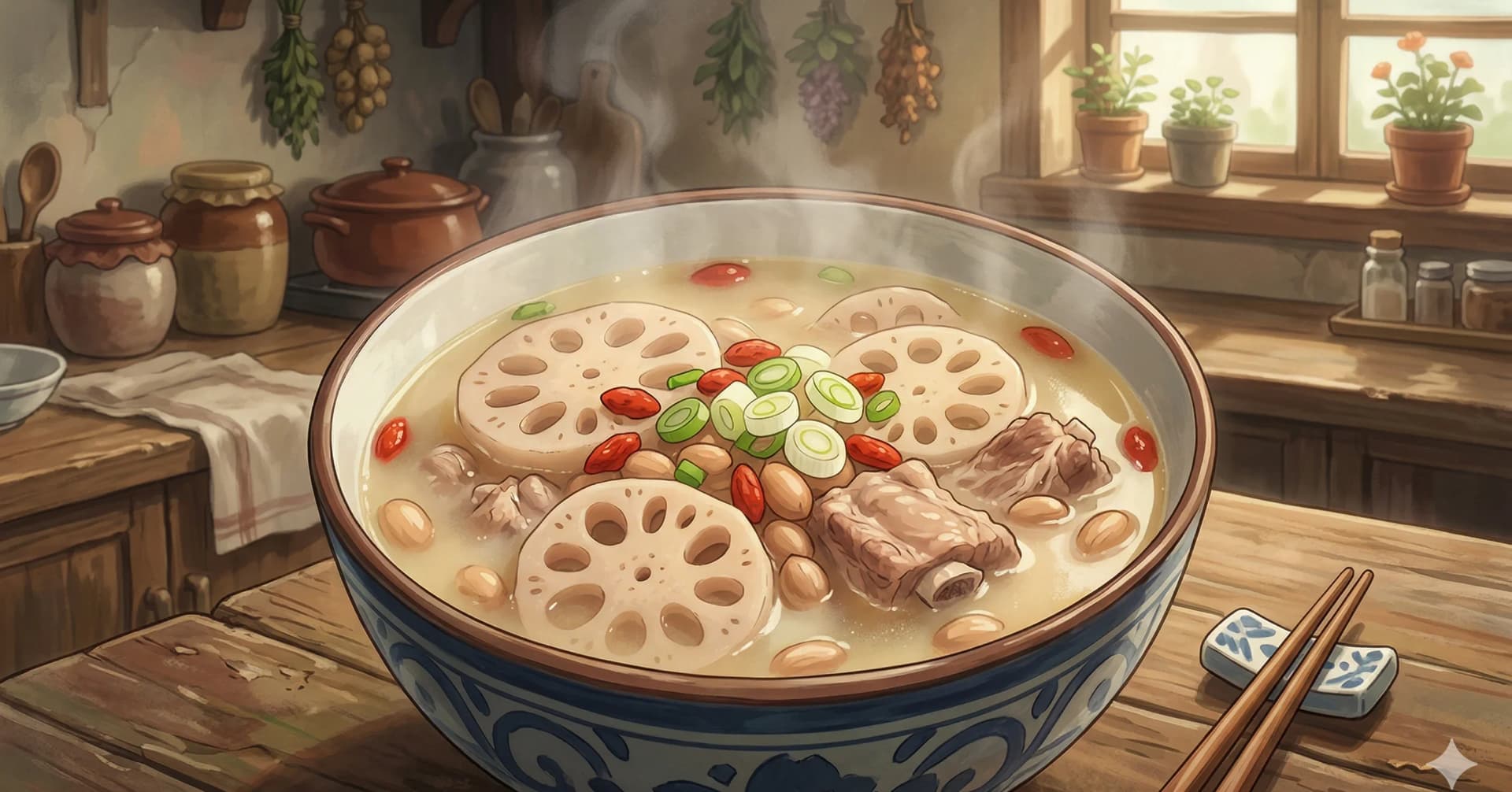
Slice a lotus root crosswise and you will see why it has fascinated people for centuries. Each round reveals a pattern of holes that looks like lace, or a honeycomb, or the cross-section of something ancient and organic. Drop those slices into a pot of slow-simmered pork rib broth and something wonderful happens. The starch leaches out slowly, thickening the liquid into something between a broth and a velvet sauce, while the root itself softens into a texture that is powdery and tender and unlike any other vegetable.
This soup is one of the great comfort dishes of central China, especially beloved in Hubei province and across the Yangtze River valley. It appears at family dinners and festival tables, but it is also the kind of thing a grandmother makes on a cold Tuesday for no occasion at all. The technique is pure simplicity. You blanch the ribs, peel the lotus root, put everything in a pot with cold water, and let it simmer for hours. The patience is the recipe.
The broth that results is clean, clear, and faintly sweet from the natural sugars in the lotus root. A few goji berries add color and a subtle tartness. Peanuts, borrowed from Cantonese and Fujian variations, contribute a gentle nuttiness and soften into creamy morsels by the time the soup is done. One thing to remember: peel and cut the lotus root just before it goes into the pot. Like potatoes, it oxidizes quickly and will turn an unappealing grey-brown if it sits exposed to air.
At a Glance
Yield
6 to 8 servings
Prep
20 minutes (plus 1 hour soaking)
Cook
3 to 4 hours
Total
4 to 5 hours
Difficulty
Easy
Ingredients
- 2 lbpork spare ribs or neck bones, cut into 2-inch pieces
- 1 lbfresh lotus root (about 2 sections)
- 4 slicesfresh ginger, about 1/8-inch thick
- 2scallions, white and green parts separated
- 1¼ ozraw peanuts (skin-on)
- 6dried shiitake mushrooms (optional)
- ¼ ozdried goji berries
- 5½ ozrehydrated dried kelp (kombu), cut into strips (optional)
- 3 qtcold water
- —Salt to taste
- —White pepper to taste
- 1scallion, thinly sliced
Method
- 1
Soak the pork. Place the pork ribs in a large bowl and cover with cold water. Let them soak for at least 1 hour, changing the water once or twice. This draws out blood and impurities and sets you up for a cleaner broth.
- 2
Blanch the ribs. Drain the soaked ribs and place them in a large pot. Cover with fresh cold water and bring to a rolling boil over high heat. Let them boil for 2 minutes. You will see a thick layer of grey foam rise to the surface. Drain the ribs, rinse each piece under cool running water to remove any clinging scum, and clean the pot. This two-step process of soaking and blanching is what gives the soup its crystal clarity.
- 3
Prepare the dried ingredients. If using shiitake mushrooms, submerge them in boiling water and let them soak for 20 minutes until softened, then drain and halve. If using dried kelp, rehydrate in cold water for at least 3 hours (overnight is fine), then rinse thoroughly until the water runs clear and cut into wide strips.
- 4
Peel and cut the lotus root. Just before adding it to the pot, peel the lotus root with a vegetable peeler and cut it into rounds about 1/2-inch thick, or into large chunks. Do not do this ahead of time. Drop the pieces into the pot promptly to prevent browning.
- 5
Build the soup. Return the blanched ribs to the clean pot. Add the lotus root, ginger slices, scallion whites, peanuts, mushrooms, kelp, and 12 cups of cold water. Bring to a boil over high heat. As soon as it boils, reduce the heat to the lowest setting so the surface barely trembles. Skim any remaining foam during the first 10 minutes.
- 6
Simmer long and slow. Cover the pot and let it simmer for 3 to 4 hours. The longer you go, the silkier the broth becomes and the more tender the lotus root. At the 2-hour mark, the lotus root will still have some bite. By 3 hours, it will be powdery-soft and the broth will have a faintly starchy body that coats the spoon.
- 7
Add the goji berries and season. In the last 10 minutes of cooking, drop in the goji berries. They need very little time to soften and will turn bitter if overcooked. Season the soup with salt and a pinch of white pepper. Remove and discard the scallion whites and ginger slices.
- 8
Serve. Ladle into deep bowls, making sure each serving gets a generous portion of lotus root, a few ribs, and some peanuts. Scatter with sliced scallion greens.
Key Ingredient Benefits
Lotus Root (Lian Ou). The rhizome of the lotus plant, widely cultivated across Asia. In Traditional Chinese Medicine, lotus root is traditionally associated with cooling the blood, supporting the spleen, and aiding digestion. It is a good source of dietary fiber, vitamin C, and potassium. The high starch content makes it behave somewhat like a potato in cooking, thickening broths and developing a floury, satisfying texture when slow-cooked.
Pork Ribs. Bone-in pork ribs contribute collagen, which breaks down into gelatin over hours of simmering. This gelatin is what gives the cooled broth its wobbly, jelly-like consistency and the hot soup its lip-coating richness. Research supports the role of collagen-derived gelatin in supporting joint and gut health, though the evidence is still developing.
Raw Peanuts. Commonly used in Cantonese and Fujian soups. Traditionally associated with nourishing the lungs and supporting digestion. They are a source of protein, healthy fats, and niacin. Skin-on peanuts are preferred in Chinese cooking for their slightly astringent quality and deeper color.
Goji Berries (Gou Qi Zi). Used in Chinese cooking and medicine for centuries. Traditionally associated with supporting kidney and liver function and improving vision. Research has explored their antioxidant content, particularly zeaxanthin and beta-carotene, though clinical evidence remains limited.
Why This Works
The long, slow simmer is everything in this recipe. Lotus root is high in starch, and as it cooks over hours, that starch gradually dissolves into the broth, giving it a body and viscosity that you cannot achieve quickly. This is the same principle that makes Congee so silky. Time and gentle heat break down the structure and release what is held inside.
Blanching the pork in a separate round of water, then starting fresh, is the same technique used in Hong Zao Ji Tang and Wu Ji Tang. It removes blood proteins, surface fat, and bone fragments before they can cloud the finished broth. Starting with cold water the second time helps extract collagen and flavor from the bones gradually, rather than shocking them with heat.
The peanuts serve two purposes. They absorb the pork flavor and soften into something almost creamy after hours of simmering, providing a subtle textural contrast to the starchy lotus root. And they contribute their own mild sweetness, reinforcing the natural sweetness of the root without any added sugar.
Goji berries go in at the end because they are delicate. They need only a few minutes to rehydrate and release their gentle tartness. Added too early, they lose their color and can turn the broth slightly bitter.
Substitutions & Variations
No lotus root? This is hard to truly replace, as the starchy quality of lotus root is the heart of the dish. In a pinch, daikon radish makes a serviceable substitute, though the texture and body of the soup will be different.
Dried kelp or mushrooms. Both are optional additions that deepen the umami of the broth. If you have both, use both. If you have neither, the soup is still excellent with just pork, lotus root, and ginger.
Light soy sauce and vinegar dipping sauce. A small dish of light soy sauce mixed with a splash of Chinkiang vinegar and a few drops of sesame oil makes a fine dip for the pork ribs, as used in the Omnivore's Cookbook variation.
Pressure cooker. Combine all ingredients (except goji berries) with 10 cups water and cook at high pressure for 45 minutes with natural release. Add goji berries after opening the lid and let them steep for 5 minutes.
Corn addition. Some Cantonese households add a few chunks of fresh corn on the cob during the last hour of simmering, which adds sweetness and color.
Serving Suggestions
This soup is a meal unto itself when served with a bowl of steamed rice. The ribs are eaten with chopsticks, the lotus root and peanuts with a spoon, and the broth is sipped throughout.
For a more complete dinner, pair it with stir-fried greens and a savory main like Soy Sauce Chicken or Gong Bao Ji Ding. The clean, understated broth plays well against bolder flavors.
In Hubei province, this soup is often part of a New Year's table, served alongside braised dishes and Lions Head Meatballs.
Storage & Reheating
The soup keeps well in the refrigerator for up to 4 days. A cap of solidified fat will form on the surface when cold, which can be lifted off before reheating for a leaner broth. Reheat gently on the stovetop over medium-low heat. Avoid bringing it to a hard boil, which can cause the lotus root to break apart and cloud the broth.
The broth freezes well for up to 3 months. The lotus root becomes slightly softer after freezing but remains perfectly edible. Store the pork ribs separately if possible, as their texture holds up better when refrigerated and eaten within a few days.
Cultural Notes
Lian ou pai gu tang (蓮藕排骨湯, "lotus root pork rib soup") is the southern Chinese family soup of pork ribs simmered for several hours with chunks of fresh lotus root, jujube dates, and ginger until the broth becomes deeply savory, the meat falls from the bone, and the lotus root softens to a tender starchy chew. The soup is one of the foundational everyday soups of Cantonese home cooking and appears at countless family dinners throughout the year, with particular prominence during winter when the soup's slow-simmered warmth provides cold-weather comfort and during postpartum recovery when its perceived nourishing qualities support a new mother's strength.
The lotus root itself is the technical signature of the dish. Fresh lotus root (lian ou), cut crosswise to reveal the distinctive lacy pattern of internal air channels, has a starchy crunch when raw that becomes soft and slightly mealy when slowly simmered. The cut surfaces release a mild sweetness into the broth, and the lotus root absorbs the pork flavor as it cooks, producing pieces that carry the soup's character through every bite. The lotus root is typically peeled, sliced into half-inch rounds, and added to the soup pot at the start so it cooks with the pork for the full simmer time of two to three hours.
The dish has the cultural place of an everyday family soup rather than a banquet item or a tonic preparation. Cantonese households often have a pot of lao huo tang (老火湯, "old-fire soup") simmering on the stove for several hours, and lian ou pai gu tang is one of the most common compositions for that pot. The soup is consumed at the start or middle of the meal in small bowls, with the diners eating both the broth and the solid contents. Modern Hong Kong cooks like Christine Ho and Maggie Zhu have published the recipe extensively in their cookbooks and online, helping the soup travel to home kitchens outside of Cantonese cultural contexts.
Nutrition Facts
Calories: 385kcal (19%)|Total Carbohydrates: 11.8g (4%)|Protein: 25.4g (51%)|Total Fat: 25.9g (33%)|Saturated Fat: 9.1g (45%)|Cholesterol: 97mg (32%)|Sodium: 166mg (7%)|Dietary Fiber: 3.4g (12%)|Total Sugars: 0.8g
You Might Also Like

Ratings & Comments
Ratings & Comments
Ratings
Share your thoughts on this recipe.
Sign in to rate and comment