Japanese Cuisine
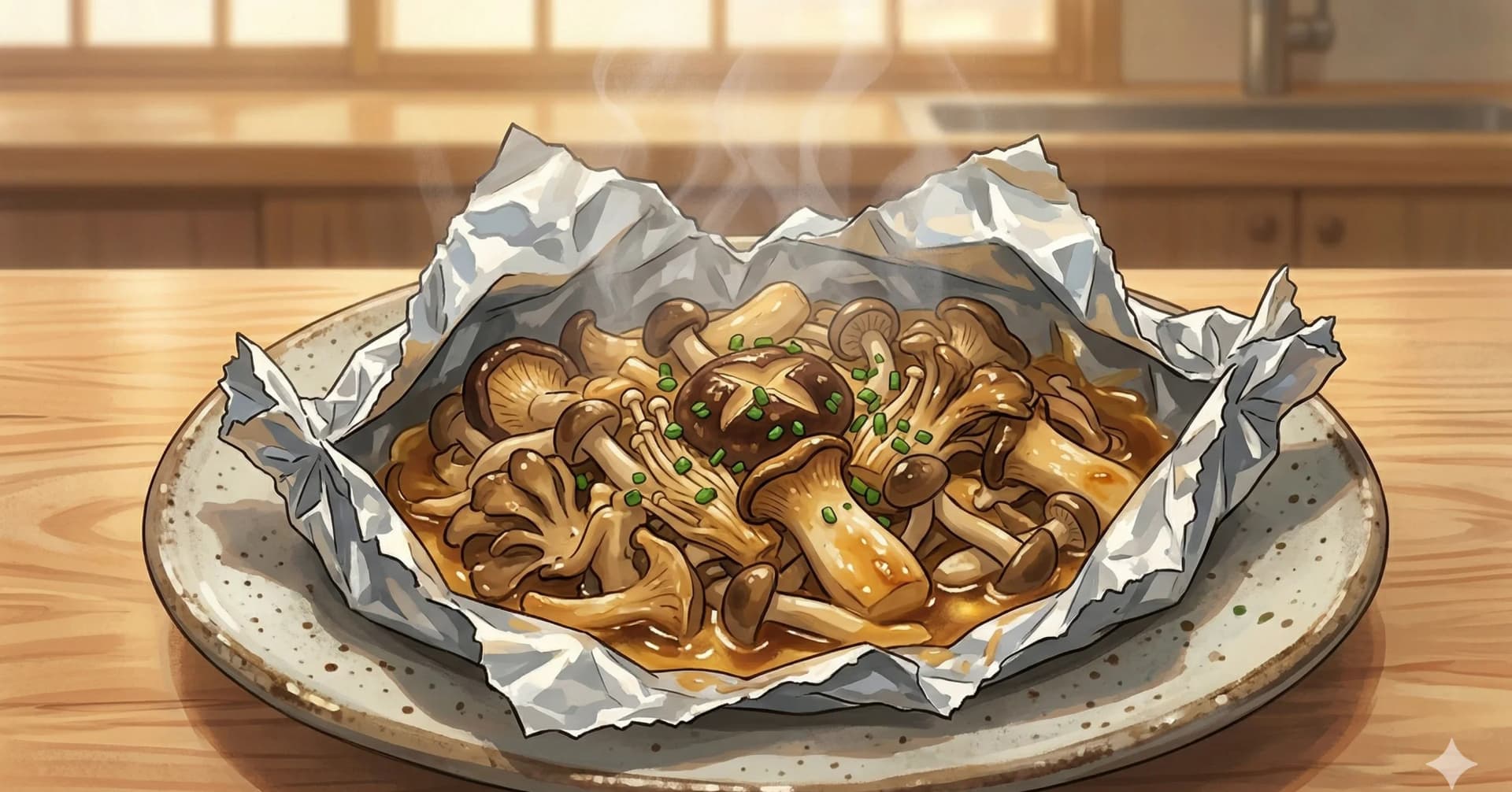
Miso Butter Mushrooms in Foil (Kinoko no Hoiru Yaki)
Five varieties of mushrooms steamed in foil packets with miso, sake, and butter, finished with a soy-butter drizzle and fresh chives
Hoiru yaki, foil-baked cooking, is one of those Japanese techniques that sounds almost too simple to be worth writing down. You put ingredients on foil, seal it, apply heat, and open it at the table. But the simplicity is the point. The sealed packet traps every drop of steam and aroma, so when you tear it open, you get this rush of fragrant air that hits you before the first bite.
The magic here is the five different mushrooms. Each one brings a different texture and flavor to the packet. Shiitake are meaty and concentrated. Shimeji have a slight crunch and a nutty, almost buttery taste. Maitake (hen of the woods) are frilly and delicate, with a woodsy depth that intensifies when steamed. Enoki are thin and silky, tangling into little nests. And king oyster, sliced thick, gives you something substantial to bite into, almost like scallops in their density.
You do not need all five. Three varieties will still give you a beautiful result. But the interplay of textures is what makes this dish worth making instead of just sauteing mushrooms in a pan.
The miso-sake mixture dissolves into the mushroom juices as they steam, creating a sauce that is savory, slightly sweet, and deeply umami without tasting heavy. The butter goes in two stages: a small piece in the foil melts into the mushrooms as they cook, and a larger finishing pat goes on top when you open the packet, so it pools and glistens over everything. A drizzle of soy sauce at the end brings it together.
Bata shoyu, butter and soy sauce, is one of Japan's most beloved flavor combinations. It dates to the Meiji era when Western dairy first arrived in Japan, and Japanese cooks discovered that butter and soy sauce together create something greater than either one alone. It has the richness of butter and the depth of fermented soy, and it makes mushrooms taste extraordinary.
At a Glance
Yield
2 servings
Prep
10 minutes
Cook
15 minutes
Total
25 minutes
Difficulty
Easy
Ingredients
- 3 ozshiitake mushrooms, stems removed, caps quartered
- 3½ ozshimeji mushrooms (bunapi or brown), base trimmed, separated into small clusters
- 3½ ozmaitake mushrooms (hen of the woods), torn into bite-sized fronds
- 3 ozenoki mushrooms, root end trimmed, separated into small bundles
- 4 ozking oyster mushrooms, sliced into 1/2-inch rounds
- 0.5medium yellow onion, thinly sliced
- 2 tbspmiso paste, any variety (white, yellow, or red)
- 2 tbspsake
- 1 tbspunsalted butter, placed inside the foil packet
- 2 tbspunsalted butter, for finishing
- 2 tspsoy sauce, for finishing
- 1 tbspfresh chives, finely chopped
Method
- 1
Tear two large sheets of aluminum foil, each about 14 inches long. Fold each sheet in half to create a double layer (this prevents tearing). Open them back up so you have a crease down the middle to help with folding later.
- 2
In a small bowl, whisk the miso paste and sake together until the miso is fully dissolved. It should be a smooth, pourable consistency.
- 3
Divide the sliced onion between the two foil sheets, spreading it in a thin layer on one half of each sheet. Place half of 1 tablespoon of butter (about 1.5 teaspoons) on top of each onion bed. Layer the mushrooms on top, dividing all five varieties evenly between the two packets. Drizzle the miso-sake mixture over the mushrooms.
- 4
Fold the foil over the mushrooms and crimp the edges tightly to seal each packet, leaving a small dome of air above the mushrooms so steam can circulate inside. The seal needs to be tight; any gaps and the steam escapes.
- 5
Place the foil packets in a large dry skillet over medium heat. Cook for 5 minutes, then reduce the heat to medium-low and cook for another 10 to 15 minutes. You will hear the packets sizzling gently inside. The mushrooms are done when the packets are puffed up with steam and the contents feel soft when you press the top of the foil with a spatula.
- 6
Transfer the packets to plates. Carefully tear open the top of each packet (the steam is very hot). Place a tablespoon of finishing butter on top of the mushrooms in each packet and drizzle with soy sauce. The butter will melt into the mushroom juices immediately. Scatter the chives over the top and serve while the butter is still pooling.
Key Ingredient Benefits
Mixed mushrooms: Using five varieties maximizes the range of bioactive compounds. Shiitake contain lentinan, a beta-glucan studied for immune-modulating properties. Maitake contain a different beta-glucan (D-fraction) that has been the subject of similar research. All mushrooms in this dish provide B vitamins, potassium, and selenium. The cooking method (steaming in a sealed packet) preserves water-soluble nutrients that would otherwise leach into cooking water.
Miso: This fermented soybean paste is rich in probiotics (beneficial bacteria from the fermentation process), though heat reduces the live cultures. It provides complete protein, B vitamins, and minerals including zinc and manganese. The fermentation also produces compounds that may support gut health, though most research is observational rather than clinical.
Butter: While butter is calorie-dense, the amounts used here are moderate. It provides fat-soluble vitamins A, D, E, and K2. The fat also improves absorption of fat-soluble nutrients from the mushrooms.
Why This Works
Foil-packet cooking creates a sealed, moist environment where mushrooms steam in their own released juices. Unlike sauteing, where liquid evaporates from the pan, every drop of mushroom liquid stays in the packet and becomes the sauce. This is why the dish tastes so intensely of mushrooms despite having no stock or broth added.
The five mushroom varieties are not just for visual appeal. Each releases liquid at a different rate and contributes a distinct texture. Enoki and maitake release moisture quickly and contribute to the sauce early. Shiitake and king oyster hold their structure longer and provide meaty bites. Shimeji land in between. The result is a more complex dish than any single mushroom could produce.
Dissolving the miso in sake before adding it to the packet ensures even distribution. Miso is thick and sticky, and placing a lump of it directly on the mushrooms would mean one area gets intensely salty while the rest is bland. Sake thins the miso into a pourable liquid that coats everything evenly and also adds its own subtle sweetness from residual sugars.
The two-stage butter technique matters. The cooking butter melts into the mushroom juices and creates a rich base. But by the time the packet opens, that butter has been absorbed. The finishing butter is what you see and taste first: glossy, golden, melting in real time. It is the visual and flavor exclamation point.
Substitutions & Variations
Mushrooms: Use any three or more varieties you can find. The combination matters more than the specific types. Cremini, oyster, chanterelle, or nameko all work beautifully. Avoid portobellos as the sole mushroom, as their dark liquid can make the sauce muddy-looking.
Miso: White (shiro) miso gives the mildest, sweetest flavor. Yellow (shinshu) is the most versatile. Red (aka) miso adds deeper, more assertive saltiness. Any will work. Reduce soy sauce slightly if using red miso.
Sake: Dry white wine or mirin (reduce miso slightly if using mirin, as it adds sweetness). In a pinch, a tablespoon of water works, though you lose the sake's subtle sweetness.
Butter: For a vegan version, use a good-quality plant butter. The flavor profile shifts, but the technique works identically.
Cooking method: These packets can also be cooked on a grill (medium heat, 12 to 15 minutes) or in a 400F (200C) oven for 15 to 18 minutes.
Serving Suggestions
Serve the foil packets unopened at the table for the full aromatic reveal. Steamed Japanese short-grain rice is the natural partner, perfect for soaking up the miso-butter sauce. This works beautifully as a side dish alongside grilled fish or Teriyaki Salmon. For a vegetarian meal, pair with a bowl of miso soup and a simple green salad dressed with rice vinegar. The packets also make an elegant first course for a Japanese-inspired dinner.
Storage & Reheating
Best fresh: This dish is best eaten immediately when the foil is first opened and the finishing butter is still melting.
Refrigerator: Store the mushrooms and their juices in an airtight container for up to 2 days.
Reheating: Gently reheat in a small saucepan over low heat with the accumulated juices. Add a small pat of fresh butter to refresh the sauce. Do not re-seal in foil and recook, as the mushrooms will become too soft.
Freezing: Not recommended. The delicate textures of enoki and maitake break down when frozen.
Cultural Notes
Hoiru yaki (ホイル焼き, foil-baked) became popular in Japanese home cooking in the mid-20th century as aluminum foil became widely available. It adapted the older technique of tsutsumi yaki (wrapping food in leaves or paper for steaming) to a modern material. The method is especially popular with mushrooms and fish, where trapping the steam concentrates flavors. Bata shoyu (バター醤油, butter-soy sauce) is a distinctly modern Japanese flavor combination that emerged during the Meiji Restoration (1868-1912), when Japan opened to Western trade and dairy products arrived for the first time. Japanese cooks quickly discovered that butter's richness paired naturally with soy sauce's depth, creating a combination that now appears across Japanese cuisine from corn on the cob to steak to pasta. The pairing is sometimes called wafu (和風, Japanese-style) Western cooking.
Nutrition Facts
Calories: 215kcal (11%)|Total Carbohydrates: 15g (5%)|Protein: 7g (14%)|Total Fat: 14g (18%)|Saturated Fat: 8.5g (43%)|Cholesterol: 35mg (12%)|Sodium: 620mg (27%)|Dietary Fiber: 3.5g (13%)|Total Sugars: 5g
You Might Also Like
Ratings & Comments
Ratings & Comments
Ratings
Share your thoughts on this recipe.
Sign in to rate and comment