Rajasthani · Indian Cuisine
Mughlai Chicken Stew (Murgh Ka Soweta)
Rajasthani chicken curry enriched with sweet corn and yoghurt
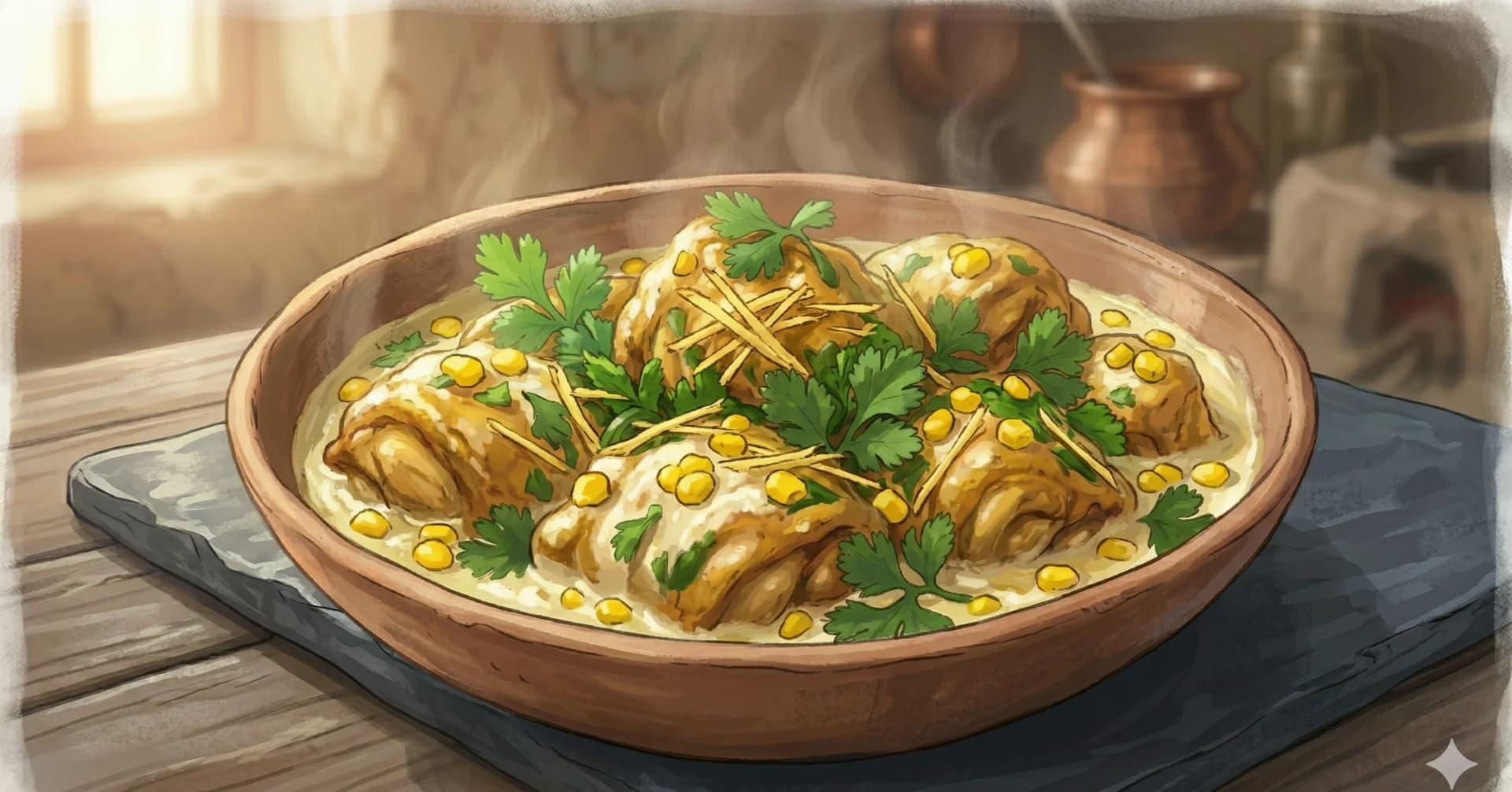
Murgh ka soweta occupies an interesting position in Rajasthani cooking. It is built on the basic chicken curry as a foundation, then taken somewhere more festive. The addition of corn (maize kernels) to a spiced chicken preparation is distinctly Rajasthani; maize has been cultivated in the arid zones of the state for centuries and appears in both bread and cooked preparations where a slight sweetness and bite are valued.
The technique here involves building the dish in two stages. The first is a standard spiced base (ginger, garlic, green chilli fried in ghee) to which the pre-made chicken curry is added. The corn goes in next, and the whole mixture is cooked down into a semi-dry, concentrated preparation. Then the yoghurt is added and cooked in, giving the dish a slight tang and a coating quality that makes it cling to the chicken and corn differently from a wet curry.
The result is more concentrated than a standard curry. Less gravy, more coat. It is the kind of dish that is served at celebrations and significant meals rather than as a weeknight staple, and its flavours have the depth that comes from building on an already-spiced base.
Ginger julienne at the finish is the traditional garnish: thin, bright slivers of raw ginger against the warm, spiced chicken that cut through the richness in every bite.
At a Glance
Yield
Serves 4–6
Prep
15 minutes
Cook
35 minutes
Total
50 minutes (plus time to make the base curry)
Difficulty
Medium
Ingredients
- 1½ lbcooked Rajasthani chicken curry (the base recipe), chicken and gravy combined
- 6 ozcorn kernels (fresh, frozen, or canned and drained)
- 1¾ tbspfresh ginger, finely chopped
- 1¼ tbspfresh garlic, finely chopped
- 1¼ tbspgreen chillies (about 2–3 small), finely chopped
- ½ cupfresh coriander leaves, roughly chopped
- 2¼ ozplain yoghurt, beaten
- 1 tspgaram masala powder
- ¼ cupghee
- ⅔ tspsalt (adjust to taste; the base curry is already seasoned)
- 2½ tspfresh ginger, cut into fine julienne (for finishing)
Method
- 1
Heat the base. If your base chicken curry has been refrigerated, bring it back to room temperature or warm it gently before beginning.
- 2
Build the aromatic base. Heat the ghee (65 g) in a wide, heavy-based kadhai or pan over medium heat. Add the chopped ginger (10 g) and fry for 30 seconds until fragrant. Add the chopped garlic (7 g) and fry for 1 minute until lightly golden. Watch carefully; garlic burns quickly. Add the chopped green chillies (2–3 small) and stir for 30 seconds.
- 3
Add the chicken curry. Add the cooked chicken curry (chicken pieces and all the gravy) to the pan. Stir well to coat everything in the aromatic ghee base. Cook over medium-high heat for 5–6 minutes, stirring regularly.
- 4
Add the corn. Add the corn kernels (175 g). Stir to combine. Continue cooking over medium heat, stirring regularly, for 8–10 minutes. The gravy will reduce and concentrate. Some of the liquid will evaporate, and the masala will begin to cling to the chicken and corn rather than pooling beneath it. Add the salt (4 g) and stir. Taste. The dish should be well-seasoned throughout.
- 5
Add the yoghurt (65 g). Reduce the heat to medium-low. Add the beaten yoghurt a tablespoon at a time, stirring constantly to prevent it from splitting. Once all the yoghurt is incorporated, stir and cook for 4–5 minutes until the yoghurt has cooked in and the gravy has thickened back down to a semi-dry consistency.
- 6
Finish. Add the garam masala powder (½ teaspoon) and stir through. Add the chopped fresh coriander (10 g). Taste and adjust seasoning.
- 7
Serve. Transfer to a serving dish. Scatter the ginger (5 g) julienne over the top immediately before serving.
Key Ingredient Benefits
Corn / maize (Zea mays) is one of the major cereal crops of the world and has been cultivated in India since its introduction by the Portuguese in the 16th century. It is a good source of B vitamins, particularly thiamine and niacin, and contains carotenoids including lutein and zeaxanthin that research suggests are associated with eye health. In this preparation the corn is cooked briefly, preserving most of its natural vitamins and texture.
Ghee in this second cooking stage is different from the ghee in the base curry. Here it is acting more as a flavour carrier and a fresh aromatic base. The aromatic compounds from the ginger, garlic, and chilli that bloom in hot ghee distribute readily through the fat and then permeate the entire dish as it continues to cook. This is the tarka principle: fresh fat carrying fresh flavour into an already-cooked preparation, used here as the opening move of the second stage.
Garam masala added at the finish contributes the volatile aromatic top notes (cardamom, clove, cinnamon) that prolonged cooking drives off. Its role here is fragrance as much as flavour, and adding it in the last few minutes before serving preserves the compounds responsible for the characteristic warm, complex top note.
Why This Works
Building on a pre-made base curry rather than starting from scratch is a legitimate and traditional technique. It concentrates and deepens the flavour of a dish that has already undergone the full masala-building process. The aromatic ghee base in this recipe adds a fresh top layer of flavour (raw ginger, garlic, chilli fried in fresh ghee) against the deeper, cooked-down flavours of the base curry, creating the layering that the dish needs.
Cooking down the gravy to a semi-dry consistency before adding yoghurt is important for the final texture. A wet gravy with yoghurt added will produce a thin, slightly split-looking sauce; a reduced, concentrated masala with yoghurt added and stirred in carefully will produce a thick, clinging coating that wraps the chicken and corn in a way that looks as good as it tastes.
Corn provides both textural contrast and flavour contrast: its natural sweetness against the spiced, slightly tangy masala creates an interplay that neither ingredient alone could generate. The fresh corn's slight pop and chew against the soft braised chicken is what makes murgh ka soweta more than just a dressed-up chicken curry.
Substitutions & Variations
Fresh vs frozen corn: Fresh corn cut from the cob is excellent here; frozen corn (thawed) works very well; canned corn (drained) is acceptable in a pinch but tends to be softer and slightly less sweet.
Without the base curry: You can build this from scratch using boneless chicken thigh pieces, following the Rajasthani chicken curry method through to the masala stage, then adding corn and continuing from step 4 of this recipe. This adds approximately 40 minutes to the preparation.
Adding paneer: 100 g of cubed, pan-fried paneer can be added alongside the corn for a version that works as a centrepiece at a vegetarian table.
Reducing the ghee: 2 tablespoons of neutral oil can replace the ghee. The dish will be lighter but less characteristically Rajasthani.
Serving Suggestions
Murgh ka soweta is a semi-dry preparation. It has a coating masala rather than a flowing gravy, which makes it well suited to serving with bread. Missi roti, tandoori roti, or paratha are the natural accompaniments. At a festive Rajasthani spread, this might be served alongside laal maans, a yellow gravy preparation, and dal: a multi-curry table where each dish brings a different texture, heat level, and colour. A cooling raita and plain rice complete the meal.
Storage & Reheating
Refrigerate for up to 2 days. The semi-dry nature of the dish means it holds its texture better than a wet curry when refrigerated. Reheat in a pan over low heat with a small splash of water, covered, stirring gently. The corn will soften slightly upon reheating but remains good. Does not freeze particularly well. The corn becomes slightly mealy.
Cultural Notes
Murgh ka soweta (मुर्ग का सोवेता) is the Hyderabadi preparation of shredded chicken cooked slowly with broken wheat (dalia), lentils, ginger-garlic, fried onions, and Hyderabadi spices until the wheat and chicken break down into a thick savory porridge that resembles the more famous haleem but uses chicken in place of the traditional lamb or beef. The dish is among the lesser-known Hyderabadi preparations and appears at Hyderabadi family kitchens and at the small Hyderabadi restaurants of the Old City and the broader Hyderabad metropolitan area.
The dish reflects the Hyderabadi technique of slow-cooking meat with grain into porridge-style preparations, a tradition that arrived in Hyderabad through the Arab and Persian influences that shaped the Nizami kitchen alongside the indigenous Telugu cooking. The most famous example of this category is haleem (the slow-cooked meat-and-wheat porridge that became central to Hyderabadi Ramadan eating and that received a Geographical Indication tag in 2010 for its Hyderabadi origin), but the soweta preparations are the smaller everyday variants of the same technique. Where haleem is cooked over hours in massive cauldrons for Ramadan iftar service to large gatherings, soweta is a home-kitchen preparation cooked in normal household quantities for a family meal.
The technique combines slow cooking with a final pounding step. Bone-in chicken pieces are simmered with broken wheat (washed and soaked), split chickpeas (chana dal), urad dal, ginger-garlic paste, sliced onions, Hyderabadi spices (cinnamon, cardamom, cloves, black pepper, Kashmiri red chili), and salt in water for one to two hours until the chicken falls off the bone and the wheat softens into a porridge consistency. The bones are removed, and the chicken is shredded with two forks (or pounded gently with a wooden masher) and returned to the pot. The mixture is cooked for another twenty to thirty minutes until the texture becomes thick and uniform, with the chicken fibers fully integrated into the wheat porridge. The dish is finished with a tempering (tadka) of ghee, fried sliced onions, fried cashews, and a generous scatter of fresh mint and cilantro. The dish is served hot with sliced lime, fried onion garnish, and fresh ginger juliennes.
Nutrition Facts
Calories: 303kcal (15%)|Total Carbohydrates: 11.8g (4%)|Protein: 18.8g (38%)|Total Fat: 20.9g (27%)|Saturated Fat: 9.9g (50%)|Cholesterol: 99mg (33%)|Sodium: 1026mg (45%)|Dietary Fiber: 0.6g (2%)|Total Sugars: 1.4g
You Might Also Like

Ratings & Comments
Ratings & Comments
Ratings
Share your thoughts on this recipe.
Sign in to rate and comment