Chinese Cuisine
Siu Yuk (Cantonese Crispy Pork Belly)
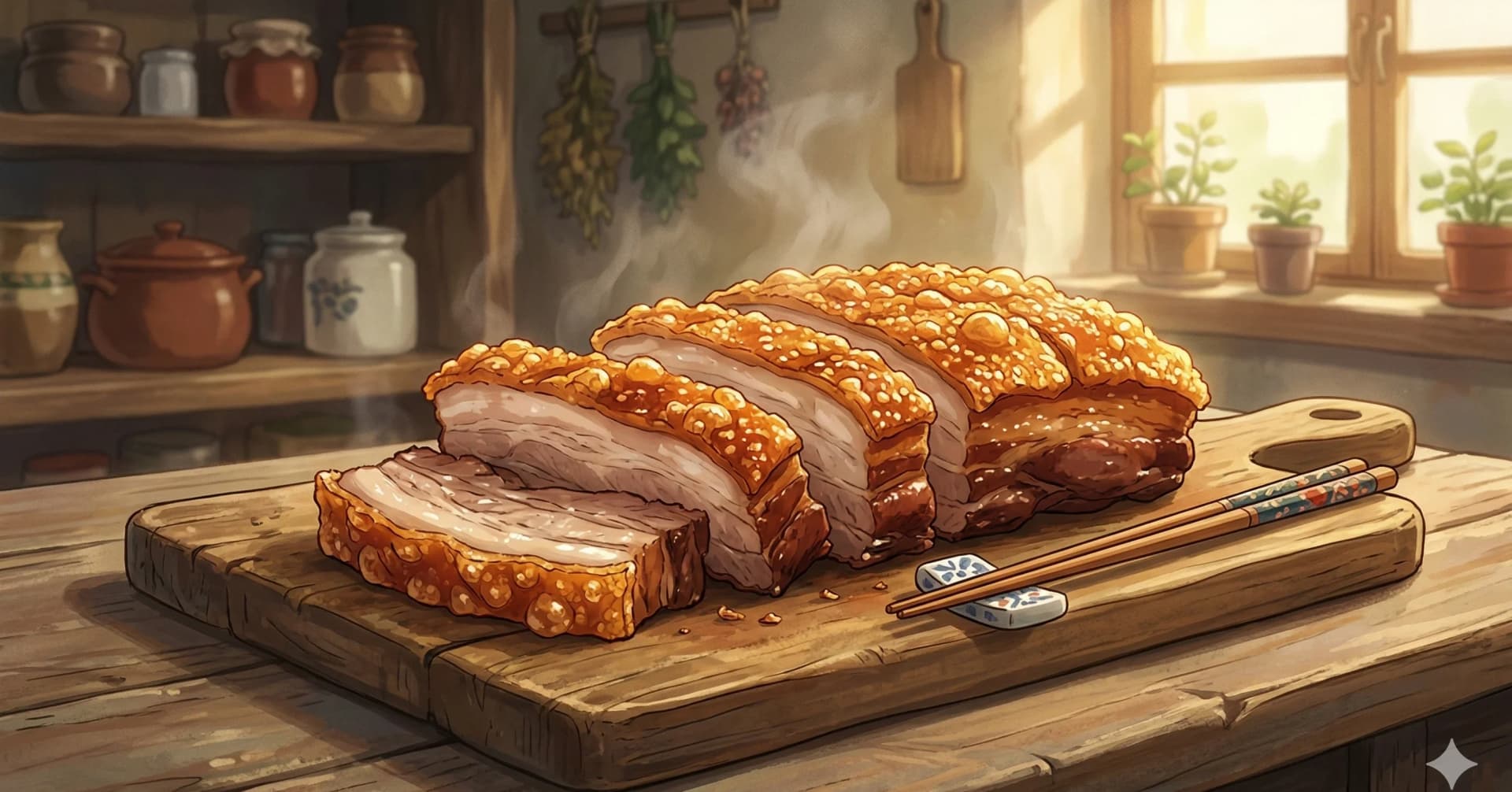
Slow-roasted pork belly with shattering crackling skin and five-spice seasoned flesh
The measure of good siu yuk is the sound it makes. When you press the flat of a cleaver against the top and push down, the skin should shatter with an audible crack, splitting into rough, glassy shards that crunch between your teeth. Beneath that crackling sits a thin layer of rendered fat, soft and almost creamy, followed by seasoned pork that is juicy and fragrant with five spice and white pepper. Getting all three layers right in one piece of meat is the challenge that defines this dish.
The technique is not complicated, but it demands patience. The skin must be dried, thoroughly and aggressively, before it can crackle. This means scoring it with a metal skewer, dozens of tiny punctures that allow moisture to escape during roasting, and then leaving the pork belly uncovered in the refrigerator overnight. By the time the belly goes into the oven, the skin should feel dry and papery, almost like parchment.
The salt crust method is a Cantonese home-cooking trick that produces remarkably even crackling. A thick layer of coarse sea salt is packed over the skin before roasting. The salt draws out remaining moisture and insulates the skin, preventing it from burning while the meat beneath cooks through. In the final minutes, the salt is removed and the exposed skin is blasted under the broiler until it puffs and blisters into golden crackling.
Siu yuk hangs in the windows of every Cantonese barbecue shop, usually in large slabs that are chopped to order. At home, you will not achieve quite the same volume of crackling, but the flavor and texture can be every bit as good. Season the meat side boldly. Dry the skin side relentlessly. Trust the broiler at the end. The sound will tell you when it is ready.
At a Glance
Yield
8 servings
Prep
30 minutes (plus overnight drying)
Cook
1 hour 45 minutes
Total
14 hours (including overnight drying)
Difficulty
Medium
Ingredients
- 3 lbslab pork belly, skin on
- 2 tspShaoxing rice wine
- 2 tspfine salt
- 1 tspsugar
- ¼ ozfive spice powder
- ¼ tspwhite pepper
- 1½ tsprice wine vinegar
- ½ cupcoarse sea salt (for the salt crust)
Method
- 1
Score the skin. Rinse the pork belly and pat it very dry. Place the belly skin-side up on a cutting board. Using a sharp metal skewer or the tip of a paring knife, poke holes across the entire surface of the skin, working systematically in rows. The holes should be close together, about 1/4 inch apart, and should penetrate through the skin layer but not deep into the fat. This step is critical. The more thoroughly you score, the better the crackling will be.
- 2
Season the meat side. Flip the pork belly skin-side down. Rub the Shaoxing wine into the exposed meat. In a small bowl, combine the fine salt, sugar, five spice powder, and white pepper. Rub this mixture thoroughly into the meat side and the sides of the belly. Do not season the skin side.
- 3
Dry the skin. Flip the belly skin-side up. Brush the rice wine vinegar evenly over the entire skin surface. Place the pork belly on a wire rack set over a rimmed baking tray, skin-side up. Refrigerate uncovered for 12 to 24 hours. The vinegar accelerates moisture evaporation and helps the skin crisp during roasting. The skin should feel dry and tight when ready.
- 4
Prepare for roasting. Remove the pork belly from the refrigerator. Preheat the oven to 375F (190C). Line a baking tray with heavy-duty aluminum foil. Create a foil border about 1 inch high around the pork belly to contain the salt. Place the pork belly skin-side up in the center.
- 5
Apply the salt crust. Pack the coarse sea salt in an even layer completely covering the skin. The salt should be about 1/4 inch thick. Press it down gently to form a compact crust.
- 6
Roast. Place the tray in the middle of the oven and roast for 1 hour 30 minutes. If the pork belly still has ribs attached, extend the time to 1 hour 45 minutes. The meat should be cooked through and tender.
- 7
Remove the salt and broil. Turn on the broiler to low (or set the oven to its highest temperature if you do not have a broiler setting). Position the oven rack at its lowest setting, as far from the heating element as possible. Carefully lift off the salt crust in one piece and discard. Unfold and remove the foil border. The skin beneath the salt will look pale and dry.
- 8
Broil until crackling. Place the pork belly under the broiler and watch it closely. Within 5 to 10 minutes, the skin will begin to puff, blister, and turn golden. It should crackle audibly. Some spots may darken faster than others. Rotate the tray if needed for even browning. Do not walk away during this step. The difference between perfect crackling and burnt skin is measured in seconds.
- 9
Rest and slice. Remove the pork belly from the oven and let it rest for 15 minutes. The crackling will continue to firm as it cools. Using a sharp, heavy knife or cleaver, cut the belly into rectangular pieces about 1/2 inch wide. Press down firmly and decisively through the crackling.
Key Ingredient Benefits
Pork belly: One of the fattiest cuts of pork, with roughly equal proportions of meat and fat. The fat layer is important structurally, providing insulation between the skin and the meat. Nutritionally, pork belly is rich in B vitamins and provides complete protein, but it is also calorie-dense. In traditional Chinese cuisine, pork belly is valued for its balance of textures and is considered nourishing in moderation.
Rice wine vinegar: The acidity (typically around 4 to 5 percent acetic acid) denatures proteins on the skin's surface, promoting dehydration and helping the skin crisp more effectively. This is a simple physical chemistry effect, not a flavor contribution. The vinegar's taste does not carry through to the finished dish.
Coarse sea salt: Used here as a cooking tool rather than a seasoning. The large crystal size creates a porous, insulating crust that draws moisture upward through capillary action while protecting the skin from direct heat. Fine table salt would pack too densely and could over-salt the skin.
Why This Works
The overnight drying is the single most important factor in achieving crackling. Pork skin is made of collagen and connective tissue that holds a great deal of moisture. If that moisture is still present when the skin hits high heat, it steams rather than crisps, resulting in tough, chewy skin instead of shattering crackling. The combination of scoring (to create escape routes for steam), vinegar (which accelerates surface dehydration), and prolonged refrigeration removes enough moisture to allow the skin to dehydrate rapidly in the oven's heat.
The salt crust serves multiple functions. It draws out residual moisture from the skin during roasting. It insulates the skin, preventing it from browning too quickly before the meat is cooked through. And it creates an even heat distribution across the surface, so the crackling develops uniformly rather than in patches.
The broiler finish transforms the dried, pale skin into actual crackling through rapid, intense heat. The dehydrated collagen puffs as residual moisture flash-converts to steam, creating the characteristic bubbled, glassy texture. This can only happen because the skin was already thoroughly dried.
Five spice powder and white pepper on the meat side provide aromatic depth without interfering with the crackling on the skin side. The skin remains unseasoned (apart from the vinegar) to ensure clean, even crisping.
Substitutions & Variations
Pork belly size: A 2 lb slab will work with the same technique. Reduce roasting time to 1 hour 15 minutes. A 4 to 5 lb slab needs 2 hours.
Five spice alternatives: If five spice powder is unavailable, use a combination of 1/4 teaspoon each of ground star anise, ground cinnamon, and ground cloves. See Five-Spice Roast Chicken for more on building custom five spice blends.
No broiler: If your oven does not have a broiler function, increase the oven temperature to its maximum (typically 500F) for the final 10 minutes after removing the salt crust.
Vinegar alternatives: White vinegar or apple cider vinegar work as substitutes. The key property is acidity, not flavor, since the vinegar evaporates during drying.
Without overnight drying: In a pinch, you can dry the skin with a hairdryer on the cool setting for 15 to 20 minutes, then refrigerate uncovered for at least 4 hours. Results will not be as consistently crispy as the overnight method, but they will be acceptable.
Serving Suggestions
Siu yuk is traditionally served chopped into rectangular pieces, either on its own with a mustard dipping sauce or as part of a Cantonese siu mei platter alongside Char Siu and Soy Sauce Chicken. Hot mustard mixed with a little soy sauce is the classic condiment.
For a rice plate, serve sliced siu yuk over steamed rice with stir-fried Chinese broccoli and a drizzle of oyster sauce. The crackling stays crunchiest when served within an hour of roasting, so time your meal accordingly.
Leftover siu yuk, while less crackling-crisp, makes an excellent addition to Claypot Rice or can be diced and stirred into fried rice.
Storage & Reheating
Refrigerator: Store in an airtight container for up to 3 days. Separate the crackling from the meat if possible to prevent the skin from absorbing moisture and softening.
Freezer: Wrap tightly and freeze for up to 1 month. The crackling will not survive freezing and thawing with its texture intact, but the meat remains delicious.
Reheating: Place pieces skin-side up on a wire rack set over a baking sheet. Warm in a 400F oven for 8 to 10 minutes, which will partially re-crisp the skin. For the best crackling restoration, finish with 1 to 2 minutes under the broiler. Watch closely. Microwave reheating should be avoided, as it will completely eliminate the crackling texture.
Cultural Notes
Siu yuk (燒肉, "roast pork") is the Cantonese roast pork belly that occupies the central position in the broader char siu family of siu mei (roast meats). Where char siu is built around marinated, lacquered shoulder strips, siu yuk is whole pork belly with the skin on, scored and salted to produce the signature airy, glass-shatteringly crisp crackling on top of layers of seasoned tender meat. The dish is one of the four classical Cantonese roast meats served at siu mei shops, alongside char siu, roast goose, and soy sauce chicken, and the crackling on a well-made siu yuk is widely treated as the test of a roast meat master's skill.
The technique is precise and unforgiving. The pork belly is scored deeply through the skin to expose the fat layer, then dry-cured overnight with salt and sometimes five-spice powder. The next day the skin is dried with paper or a fan, sometimes brushed with vinegar to break down surface proteins for better crackling, and the belly is roasted skin-up in a very hot oven (traditionally a wood-fired Cantonese roast oven) in two stages. The first stage cooks the meat through at moderate heat. The second stage cranks the heat to maximum so the skin puffs, blisters, and shatters into the small bubble structure that defines proper crackling. The roasted belly is rested briefly, then chopped through the skin and bone into bite-sized rectangles and arranged on a platter with the crackling on top.
The dish appears at every Cantonese roast meat shop across Hong Kong, Guangdong, and the global Cantonese diaspora, displayed in glass-fronted windows along with the other siu mei hung on hooks. In Hong Kong, the highest-end versions appear at Joy Hing Roasted Meat in Wan Chai and at Yat Lok in Central, where the suckling pig version (siu yu zhu, roast suckling pig) takes the technique to its most refined form. Cantonese families often buy siu yuk by the pound from neighborhood shops to bring home for family meals, and the dish is a fixture of wedding banquets, ancestor offerings, and Lunar New Year celebrations across the broader Cantonese cultural region.
Nutrition Facts
Calories: 911kcal (46%)|Total Carbohydrates: 0.7g (0%)|Protein: 16.3g (33%)|Total Fat: 92.8g (119%)|Saturated Fat: 33.8g (169%)|Cholesterol: 126mg (42%)|Sodium: 656mg (29%)|Dietary Fiber: 0g (0%)|Total Sugars: 0.6g
You Might Also Like


Ratings & Comments
Ratings & Comments
Ratings
Share your thoughts on this recipe.
Sign in to rate and comment