Parsi · Indian Cuisine
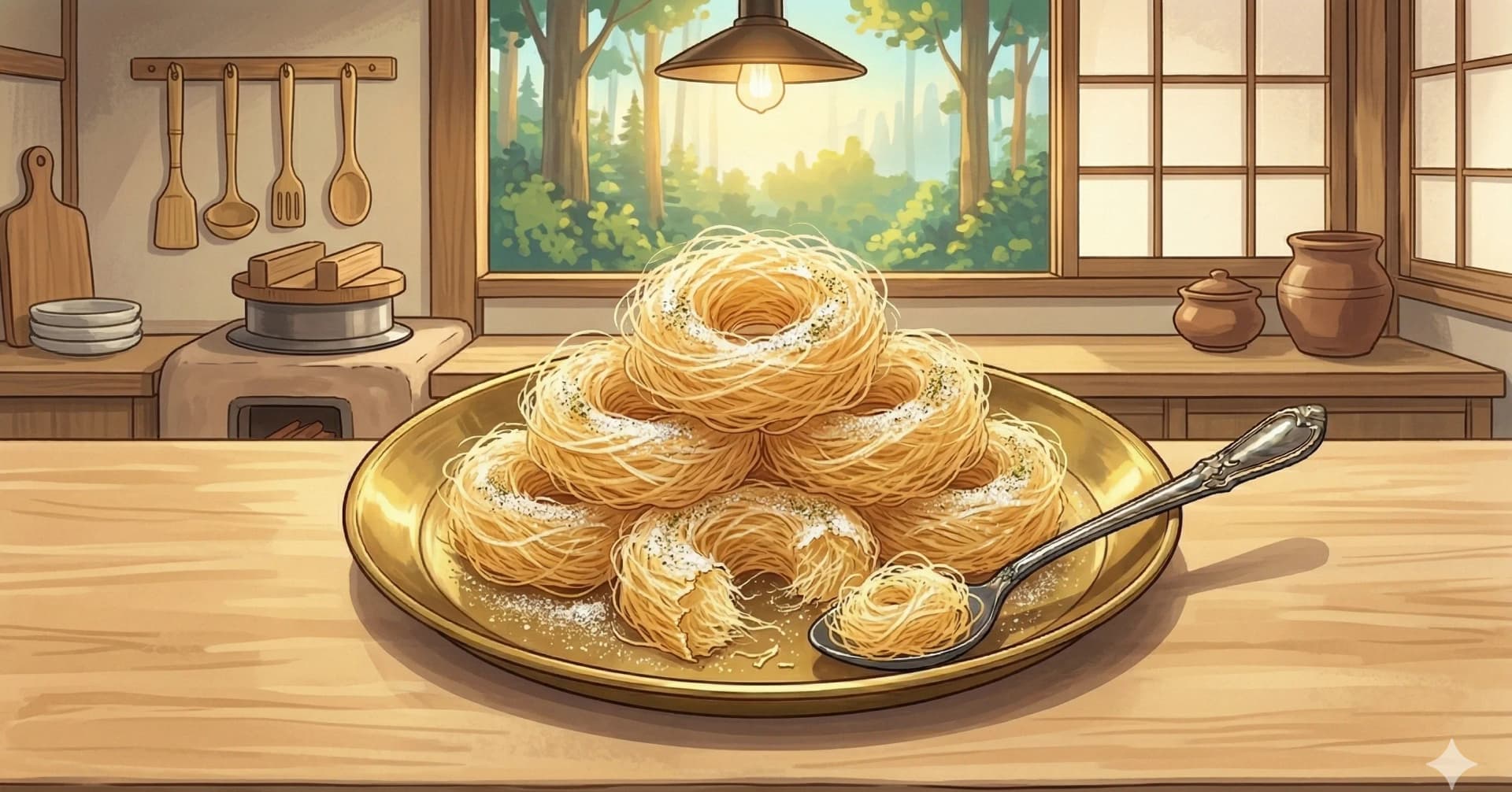
Spun Sugar Floss Sweet (Sooterfeni)
Deep-fried shredded phyllo circles soaked in saffron sugar syrup with pistachios
Sooterfeni belongs to the Persian and Central Asian tradition of thread-thin fried pastry sweets: cousins to Middle Eastern kunafe and Turkish kadayif. Shredded phyllo (or ready-made kadayif/vermicelli pastry) is twisted into small circles, flash-fried in hot ghee for exactly 30 seconds (just long enough to set without browning) then immediately dipped in saffron-scented sugar syrup. The result is a delicate, crisp-yet-syrup-soaked sweet that collapses pleasantly on the tongue.
The critical instruction in the original recipe is emphatic: do not let the pastry brown. The 30-second fry is about setting structure, not colour.
At a Glance
Yield
Makes 20–24 circles
Prep
20 minutes
Cook
30 minutes
Total
50 minutes
Difficulty
Medium
Ingredients
For Frying
- 1 lbshredded phyllo (kadayif) or fine ready-made vermicelli, loosened into strands
- —Ghee for deep-frying (enough for a deep fry)
Syrup Ingredients
To Garnish
- 1 ozpistachios, roughly chopped
- 1 ozalmonds, slivered
Method
- 1
Make the sugar (500 g) syrup. Combine sugar and water (300 ml) in a pot. Bring to a boil and simmer, without stirring, until it reaches single-string consistency. Stir in the steeped saffron and cardamom powder (1 g). Remove from heat and allow to cool until warm (not hot).
- 2
Shape the pastry. Take a small handful of shredded phyllo (400 g) strands at a time. Twist them loosely into a small round circle (about 6 cm diameter), like a small bird's nest. The texture should be loose rather than compressed. This allows the ghee to circulate during frying.
- 3
Fry. Heat the ghee in a wide deep pan to 170°C. Place a shaped circle in a perforated spoon or spider strainer. Lower into the hot ghee and fry for exactly 30 seconds. The pastry should be barely set, still pale, and just beginning to crisp. Remove immediately. It must not turn golden or brown.
- 4
Soak. Hold the fried circle above the syrup for a moment to drain any excess ghee, then dip thoroughly in the warm syrup for 1 minute, turning to coat. Remove, hold above the syrup for 30 seconds to drain, then transfer to a serving tray.
- 5
Garnish. Sprinkle each piece with chopped pistachios (30 g), slivered almonds (30 g), and a pinch of cardamom while still warm.
- 6
Cool to room temperature before serving.
Key Ingredient Benefits
Phyllo dough (or feni strands): Traditional sooterfeni uses fine fried noodle strands made fresh by skilled sweet makers. Modern home versions substitute with phyllo dough cut into thin strips, which approximates the texture. Phyllo provides about 30 g of carbohydrate per serving and minimal fat (most fat comes from the frying).
Ghee or oil for deep-frying: The cooking fat that crisps the phyllo into the characteristic shattering texture. Ghee produces the richest, most traditional result; vegetable oil works for a less expensive version.
Sugar: Standard granulated sugar, dissolved into water and boiled to a single-thread consistency (about 110°C / 230°F) for the syrup that soaks the fried phyllo.
Saffron: The signature aromatic. A generous pinch of saffron threads bloomed in warm water adds the characteristic golden color and floral aroma. Saffron is one of the world's most expensive spices but is essential to authentic sooterfeni.
Cardamom: Ground from green pods, added to the sugar syrup. Provides aromatic warmth that pairs particularly well with the saffron.
Pistachios: Slivered and used as garnish. The bright green pistachios contrast beautifully with the golden saffron syrup. High in healthy fats, vitamin E, and antioxidants.
Rose water: A few drops added to the cooled syrup. Provides the floral note characteristic of Parsi (and broader Persian-influenced) sweet making.
Almonds and other nuts (optional): Some versions include slivered almonds, pine nuts, or chopped cashews alongside or instead of pistachios. Toast briefly for additional flavor.
Lemon juice (for sugar syrup): A small amount in the sugar syrup prevents crystallization and produces the proper consistency.
Why This Works
The phyllo dough must be cut into very thin strips (about 1/4 inch wide) and gently fluffed before frying. The thin strips fry quickly and uniformly, producing the shattering crispness that defines proper sooterfeni. Thicker strips produce a chewier, less authentic result.
The oil temperature is critical: 175°C (350°F) for the first fry. Too cool and the phyllo absorbs oil instead of crisping; too hot and the strips burn before crisping properly. A thermometer is strongly recommended.
The phyllo strips should be fried in small batches and removed immediately when they turn golden brown — about 30 to 45 seconds per batch. Even 15 seconds too long produces overly dark, slightly bitter results. The strips will continue to crisp slightly after removal as residual heat works through them.
The sugar syrup must reach the single-thread consistency (110°C / 230°F) before pouring over the fried phyllo. Too thin a syrup won't coat properly and will pool at the bottom; too thick a syrup hardens into candy. Test by dipping a spoon and pressing a drop between thumb and forefinger — a single thread should form when separated.
Pouring the warm syrup over the still-warm fried phyllo allows the strips to absorb the syrup while retaining their crispness. The warm syrup penetrates the spaces between strips, coating each one, but the residual heat of the phyllo causes most of the syrup to set quickly rather than soak in completely.
Adding the saffron threads to the syrup (rather than directly to the phyllo) ensures even distribution of color and aroma. The saffron compounds are water-soluble and dissolve into the syrup, then carry through to every strip when the syrup is poured.
The rose water is added to the syrup after it has cooled slightly — too-hot syrup destroys the volatile aromatic compounds in rose water. The proper temperature is about 60°C (140°F) when the rose water is added.
Garnishing with pistachios while the syrup is still wet ensures the nuts adhere to the strips. Once the syrup sets, additional nuts won't stick properly.
Substitutions & Variations
Phyllo dough: Traditional sooterfeni uses fresh-made fine noodle strands (called feni) prepared by skilled Indian sweet makers. Phyllo is the practical home substitute. Spring roll wrappers cut into strips also work. Rice paper does not work — wrong texture.
Ghee: Vegetable oil substitutes for the frying but produces a less rich result. The traditional Parsi version uses ghee. For health-conscious modern versions, refined coconut oil can substitute.
Saffron: Cannot really be substituted authentically for the signature color and flavor. A pinch of turmeric provides color without the aroma. Skip if unavailable — the dessert remains good but loses its identity.
Cardamom: Cannot really be substituted authentically. Pre-ground cardamom works but loses aroma quickly.
Rose water: Orange blossom water is the closest substitute. Vanilla extract is not appropriate.
Pistachios: Slivered almonds, pine nuts, or cashews all work as substitutes or additions. Walnuts produce a different but acceptable result.
Sugar: Standard granulated sugar is traditional. Brown sugar or jaggery produces a darker, more caramel-flavored result. Honey is not appropriate (wrong consistency for the syrup).
Lemon juice: Cream of tartar (about 1/4 teaspoon per cup of sugar) substitutes for preventing crystallization. Both work; lemon juice is more traditional.
Spice additions: Some Parsi households add a pinch of nutmeg or mace alongside the cardamom. A few drops of kewra water (pandanus essence) can substitute for or supplement the rose water in some regional variations.
Color variations: Some modern versions use food coloring (yellow or orange) to enhance the saffron's natural color. Traditional versions rely on saffron alone.
Shape variations: Traditional sooterfeni is formed into individual nest-like circles. Modern presentations sometimes use larger sheets or smaller bite-sized pieces. The basic technique and ingredients remain the same.
Serving Suggestions
Arrange on a flat tray for celebrations. Serve at room temperature. They are most delicate and flavourful in the first few hours after making.
Storage & Reheating
Best consumed within 24 hours. Store loosely covered at room temperature. Do not refrigerate, which makes the pastry soggy.
Cultural Notes
Sooterfeni (also spelled sutarfeni or sutar feni) is a Parsi celebration dessert that exemplifies the elaborate sweet-making traditions of the community. The name derives from sutar (thin thread) and feni (a type of fried sweet), describing the dessert's signature texture of finely shredded, fried, crispy strands soaked in fragrant sugar syrup.
The dish exists within a broader Indian feni tradition — a category of layered or shredded fried sweets that includes various regional preparations. Sooterfeni is the Parsi adaptation, distinguished by its use of saffron, rose water, and pistachio garnish that reflect the community's Persian heritage.
The dessert is particularly associated with major Parsi celebrations — weddings, Navjote ceremonies, Navroz (Parsi New Year), and the anniversary of important Zoroastrian religious occasions. The visual impact of the golden-saffron strands topped with bright green pistachios makes the dessert appropriate for festive occasions where visual presentation matters as much as flavor.
The technical demands of making sooterfeni position it as a "specialty" sweet rather than a daily preparation. The traditional method requires making the fine noodle strands fresh — a skill that requires years of practice and specialized equipment (pulling and stretching the dough into hair-fine strands). Most Parsi households now buy pre-made sooterfeni from Parsi sweet shops rather than attempting the labor-intensive home preparation. The phyllo-based home version represented here is a practical adaptation that produces good results without the specialized skill.
The dish reflects the Parsi community's distinctive approach to Indian sweet making. While Hindu Indian sweets often emphasize milk-based richness (kheer, gulab jamun, rasmalai) or jaggery-based depth, Parsi sweets often emphasize crispy textures, floral aromatics (rose water, saffron), and lighter, less dense profiles. Sooterfeni — crispy, fragrant, golden, lightweight — exemplifies this Parsi sensibility.
In Mumbai's famous Parsi sweet shops (Parsi Dairy Farm, Patel Sweet Mart, Britannia & Co. sweets), sooterfeni appears as one of the signature items, particularly during festival seasons. The shops produce it in large quantities for the Parsi community and increasingly for non-Parsi customers who have discovered the cuisine through Mumbai's restaurant revival.
The dessert also appears in some related Indian Muslim sweet traditions, particularly in Hyderabadi and Lucknowi cuisines (both heavily influenced by Persian/Mughal culinary traditions). The connection between Parsi sweet making and these Mughal-influenced traditions reflects the broader pattern of Persian cultural influence on Indian dessert traditions during the medieval period.
Nutrition Facts
Calories: 350kcal (18%)|Total Carbohydrates: 67.7g (25%)|Protein: 5g (10%)|Total Fat: 7.6g (10%)|Saturated Fat: 3.3g (16%)|Cholesterol: 13mg (4%)|Sodium: 1mg (0%)|Dietary Fiber: 1.2g (4%)|Total Sugars: 42.8g
You Might Also Like
Ratings & Comments
Ratings & Comments
Ratings
Share your thoughts on this recipe.
Sign in to rate and comment