Chinese Cuisine
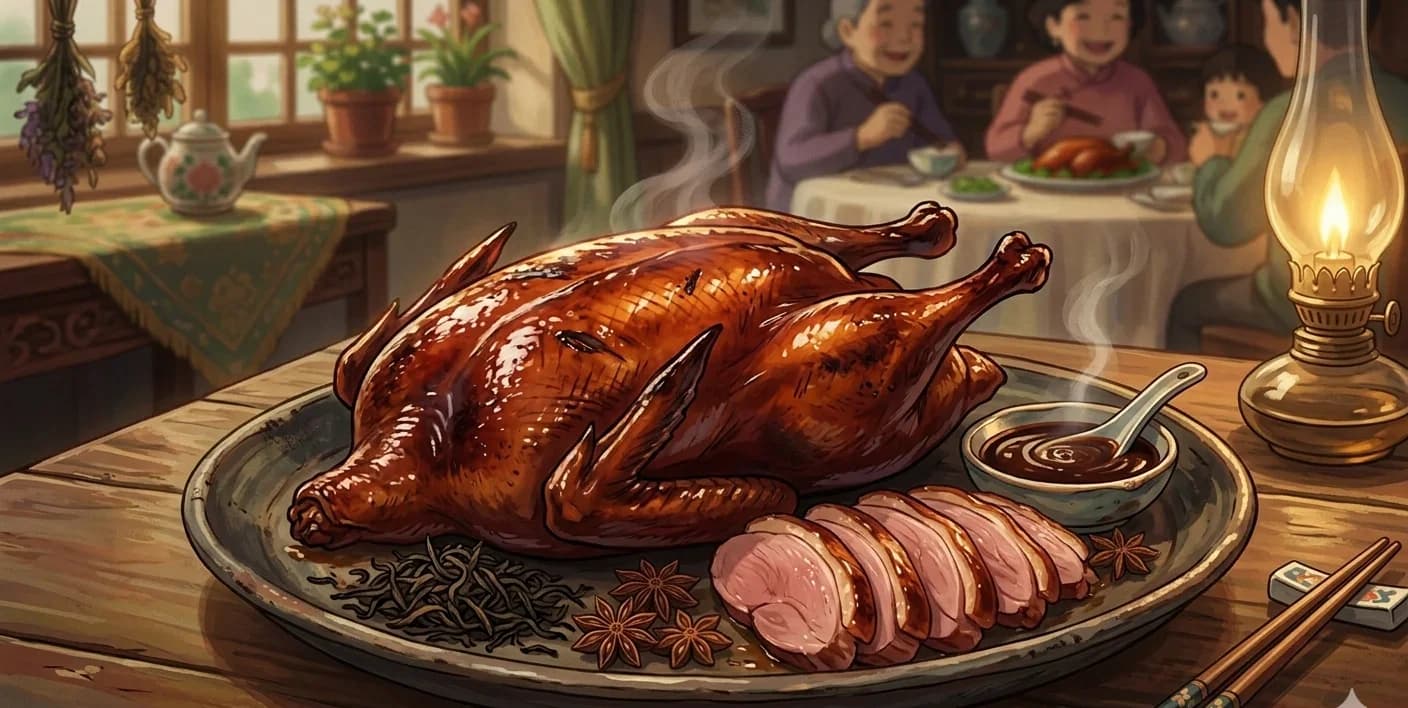
Tea-Smoked Duck
Sichuan-style duck brined with star anise and Sichuan peppercorn, then smoked over tea leaves and rice
Tea-smoked duck, or zhangcha ya in Mandarin, is one of Sichuan's most celebrated dishes and one of the most theatrical things you can cook at home. The technique involves three distinct stages: brining, steaming, and smoking. Each stage builds a different layer of flavor and texture. The brine seasons the meat and introduces the warm, numbing aromatics of Sichuan peppercorn and star anise. The steaming cooks the duck through gently, producing tender flesh that stays moist. And the smoking, done in a foil-lined wok over a mixture of black tea leaves, uncooked rice, and brown sugar, deposits a fragrant, golden haze over the surface that smells of campfire and autumn afternoons.
The smoking step is simpler than it sounds. You are not cold-smoking or maintaining a precise temperature for hours. You are generating a brief, intense plume of smoke inside a sealed wok, just long enough for the duck to absorb the tea's tannins, the rice's toasty sweetness, and the brown sugar's caramel. The process takes only 15 to 20 minutes, and the results are layered in a way that oven roasting alone cannot achieve.
The duck benefits enormously from the overnight brine. Salt, Sichuan peppercorn, star anise, ginger, and Shaoxing wine penetrate the flesh over the long rest, so every slice tastes seasoned throughout, not just on the surface. If you have eaten tea-smoked duck at a Sichuan restaurant and wondered how the flavor reaches so deep into the meat, this is the answer. There is no shortcut to time and salt.
This is a project worth planning for. The result sits proudly at the center of any table, alongside Peking Duck and Soy Sauce Chicken as one of the great Chinese whole-bird preparations.
At a Glance
Yield
4 to 6 servings
Prep
30 minutes (plus overnight brining)
Cook
1 hour 45 minutes
Total
14 hours (including brining)
Difficulty
Involved
Ingredients
Duck Ingredients
- 1 wholeduck, about 2 to 2.3 kg
- 2 tbspfine salt
- 2 tspSichuan peppercorns
- 3 wholestar anise
- ¼ ozfive spice powder
- 2 tbspShaoxing rice wine
- 4 slicesfresh ginger
- 3scallions, cut into 3-inch pieces
- —Water for the steamer
Smoking Mixture Ingredients
- 3¼ ozuncooked long-grain white rice
- 1 ozloose-leaf black tea (such as lapsang souchong or jasmine)
- ⅓ cupbrown sugar
- 2 tspSichuan peppercorns
- 3 wholestar anise
- 2 piecescassia cinnamon (about 2 inches each)
To Finish
- 1 tbspsesame oil
Method
- 1
Toast the peppercorns and salt. In a dry wok or skillet over medium-low heat, toast the Sichuan peppercorns and fine salt together until fragrant and the peppercorns begin to darken slightly, about 3 minutes. Stir frequently to prevent burning. Let cool, then grind coarsely with a mortar and pestle or the back of a heavy pan.
- 2
Brine the duck. Pat the duck thoroughly dry inside and out. Rub the toasted peppercorn-salt mixture, five spice powder, and Shaoxing wine over the entire surface and inside the cavity. Crush the star anise slightly and press them, along with the ginger slices and scallion pieces, into the cavity. Place the duck on a wire rack set over a tray, cover loosely, and refrigerate overnight, or for at least 8 hours.
- 3
Steam the duck. Remove the duck from the refrigerator 30 minutes before cooking. Set up a large steamer (a wok with a steaming rack works well, or use a large pot with a raised rack). Bring the water to a rolling boil. Place the duck breast-side up on the steaming rack. Cover tightly and steam over medium-high heat for about 45 minutes to 1 hour, until the duck is cooked through. An instant-read thermometer inserted into the thickest part of the thigh should read 165F (74C). The duck will look pale and moist at this stage. Remove and let it cool for 15 minutes. Discard the cavity aromatics.
- 4
Prepare the smoking mixture. While the duck cools, combine the rice, tea leaves, brown sugar, Sichuan peppercorns, star anise, and cassia cinnamon in a bowl. Toss to distribute evenly.
- 5
Line the wok for smoking. Line the bottom and sides of a large wok with two layers of heavy-duty aluminum foil, leaving enough overhang to fold over later. Spread the smoking mixture evenly across the foil at the bottom of the wok. Set a round wire rack or steaming rack about 2 inches above the smoking mixture.
- 6
Smoke the duck. Place the steamed duck breast-side up on the rack inside the wok. Turn the heat to high. When the smoking mixture begins to smolder and smoke appears, reduce the heat to medium. Fold the foil overhang loosely over the duck if desired, then cover the wok tightly with a lid wrapped in a damp kitchen towel to seal in the smoke. Smoke for 15 to 20 minutes. The duck skin will turn a deep golden-brown.
- 7
Ventilate and finish. Turn off the heat and let the wok sit, covered, for 5 minutes more. Then carefully remove the lid, opening it away from you, and transfer the duck to a cutting board. Brush the skin lightly with sesame oil for a subtle sheen.
- 8
Carve and serve. Let the duck rest for 10 minutes before carving. Cut into pieces through the bone with a cleaver, or carve Western-style. Arrange on a platter and serve.
Key Ingredient Benefits
Sichuan peppercorns: Not related to black pepper. They are the dried husks of the prickly ash tree (Zanthoxylum bungeanum). The numbing, tingling sensation is caused by hydroxy-alpha-sanshool, which interacts with tactile nerve receptors. In traditional Chinese medicine, Sichuan peppercorn is considered warming and is used to support digestive function. Modern research has explored its potential analgesic and anti-inflammatory properties, though clinical applications remain limited.
Black tea: Lapsang souchong, a smoked black tea from Fujian province, is particularly well-suited for this recipe because it is already smoke-dried over pinewood fires. Jasmine tea or any unflavored black tea will also work. The tannins in tea contribute to the color development on the duck skin.
Brown sugar: Produces thicker, more aromatic smoke than white sugar due to its molasses content. The caramel compounds formed during smoking contribute to the amber color of the finished duck.
Why This Works
The three-stage process, brining, steaming, then smoking, is not just tradition. Each stage accomplishes something the others cannot. The brine seasons the meat to its core and infuses it with the numbing, floral character of Sichuan peppercorn. Steaming cooks the duck gently and evenly, avoiding the uneven doneness that can plague roasted whole birds. The smoking step adds flavor and color to the exterior without adding any additional cooking time, since the duck is already fully cooked.
Black tea leaves contribute tannins and polyphenols that deposit on the surface as the smoke condenses. Rice and brown sugar provide the bulk of the visible smoke. The rice produces a neutral, toasty smoke that carries the tea and sugar flavors with it. Brown sugar caramelizes and contributes a faint sweetness to the finished skin.
Toasting the Sichuan peppercorns with salt before rubbing activates the volatile oils and makes them more fragrant and more easily absorbed by the duck during the overnight brine. This technique appears across Sichuan cooking and is one of the simplest ways to amplify peppercorn flavor.
Substitutions & Variations
Duck: Duck legs or duck breasts can be used with reduced steaming and smoking times. Steam legs for 30 minutes, breasts for 20 minutes. Smoke for 10 to 12 minutes.
Tea variety: Lapsang souchong provides the most authentic smoky flavor. Jasmine tea adds a floral note. Oolong works well for a more subtle smoke. Avoid flavored teas with added oils, which can produce acrid smoke.
Smoking fuel: Some recipes add dried orange peel or camphor wood chips to the smoking mixture for additional fragrance. A tablespoon of dried orange peel added to the rice-tea-sugar mixture is a traditional Sichuan variation.
Indoor smoking concerns: This technique produces real smoke. Open windows and run the exhaust fan. If smoking indoors is not practical, the duck can be finished on an outdoor grill. Place the smoking mixture in a foil packet with holes punched in the top, set it over one burner, and place the steamed duck on the opposite side for indirect smoking.
Steaming alternative: If you do not have a steamer large enough for a whole duck, cut the duck in half and steam the halves side by side.
Serving Suggestions
Tea-smoked duck is traditionally served at room temperature or slightly warm, carved into pieces and arranged on a platter. It pairs well with a dipping sauce of Chinkiang vinegar mixed with finely sliced ginger. Steamed bao buns or thin pancakes, as used with Peking Duck, make excellent wrappers.
For a Sichuan-themed meal, serve alongside Mapo Tofu and Dan Dan Noodles. The cool, smoky duck provides contrast to the heat and richness of the other dishes. Gong Bao Ji Ding is another strong companion that shares the Sichuan peppercorn element.
Storage & Reheating
Refrigerator: Store carved or whole duck in an airtight container for up to 4 days. The smoking creates a mild preservative effect on the surface.
Freezer: Wrap tightly and freeze for up to 2 months. Thaw overnight in the refrigerator.
Reheating: Tea-smoked duck is excellent served at room temperature, so reheating is often unnecessary. If you prefer it warm, place pieces on a baking sheet and warm in a 325F oven for 8 to 10 minutes. Avoid high heat, which can dry out the already-cooked meat. Steaming briefly for 5 minutes is another gentle option.
Cultural Notes
Zhang cha ya (樟茶鸭, "camphor tea duck") is the Sichuan smoked duck dish that finishes with a layered tea-and-camphor smoke and a final deep-fry, producing a duck with crackling skin, a pronounced smoky fragrance, and meat that pulls apart in long tender threads. The dish belongs to the tradition of refined Sichuan banquet cooking, in contrast to the spicier home and street dishes the cuisine is internationally known for, and it represents the older tradition of Sichuan smoked and cured meats that predates the chili-heavy má la style.
The preparation is multi-step and takes most of a day. The whole duck is marinated overnight in a mixture of Sichuan peppercorn, salt, ginger, and Shaoxing wine, then air-dried briefly to set the skin. The duck is then smoked over a fire of camphor wood chips (zhang), black tea leaves (cha), and sometimes brown sugar, producing the signature aromatic compounds that name the dish. After smoking, the duck is steamed for an hour or more to render the fat and tenderize the meat, then deep-fried in hot oil immediately before serving to crisp the skin to a deep mahogany. The finished duck is chopped through the bone into bite-sized pieces and served with small steamed buns or thin wheat pancakes, scallion, and hoisin or sweet bean sauce.
The dish has parallels with Peking duck in the Beijing tradition, but the smoking step gives zhang cha ya a fundamentally different flavor profile: where Peking duck emphasizes the lacquer of the skin and the clean roasted fat, tea-smoked duck carries a pronounced smoky-aromatic note throughout the meat. The dish appears at upscale Sichuan banquet restaurants in Chengdu, Chongqing, and major Chinese cities, but rarely at the smaller Sichuan stalls and noodle shops that dominate the everyday Sichuan dining landscape. Outside China, zhang cha ya appears on the menus of higher-end Sichuan restaurants and is often presented as one of the showcase items that demonstrates the kitchen's range beyond the chili-based dishes.
Nutrition Facts
Calories: 840kcal (42%)|Total Carbohydrates: 24.5g (9%)|Protein: 41.4g (83%)|Total Fat: 62.5g (80%)|Saturated Fat: 20.9g (105%)|Cholesterol: 160mg (53%)|Sodium: 2538mg (110%)|Dietary Fiber: 0.4g (1%)|Total Sugars: 10.9g
You Might Also Like
Ratings & Comments
Ratings & Comments
Ratings
Share your thoughts on this recipe.
Sign in to rate and comment