Maharashtrian · Indian Cuisine
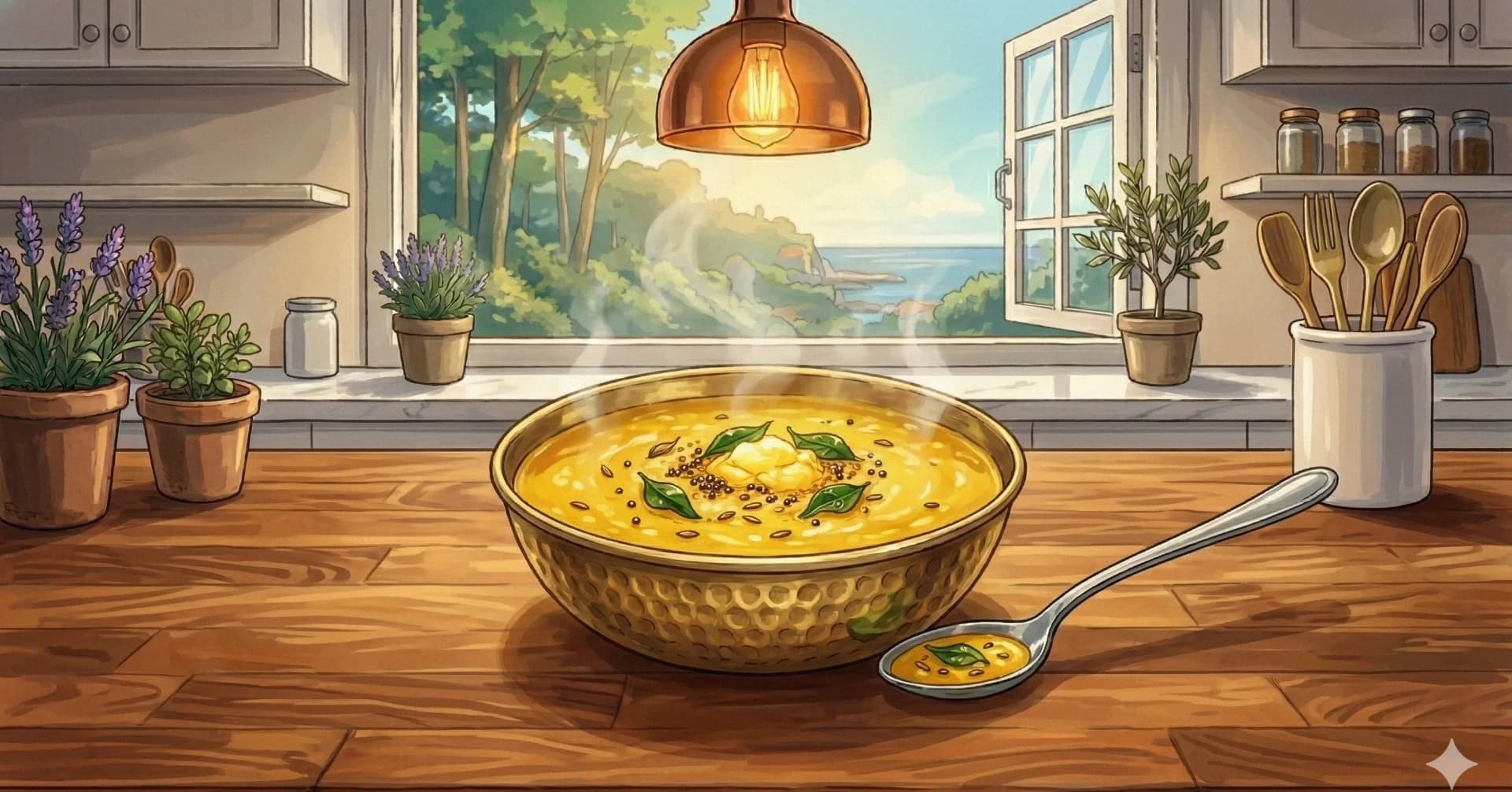
Maharashtrian Plain Dal (Varan)
The essential Maharashtrian toor dal — simply cooked with turmeric, a breath of asafoetida, and finished with jaggery and ghee
Every food culture has its threshold: the dish below which cooking cannot be simplified further without ceasing to be food. For Maharashtra, that dish is varan. It is toor dal boiled until soft, seasoned with salt, turmeric, and asafoetida, and touched with jaggery. Poured over rice. Finished with ghee. That is all.
To call varan simple is accurate but can be misleading. Simplicity here is not ease; it is precision. The ratio of water to dal, the point at which the dal is considered properly cooked, the amount of jaggery (present but not sweet-tasting), the amount of ghee (present and felt, not decorative): all of these are calibrated, and a cook who makes varan every day makes it differently, and better, than a cook who makes it once a week.
In Maharashtrian households, varan is the quiet center of the meal. It arrives alongside bhaaji, papad, and lemon, but it is the dal and rice that matter most. It is the first solid food given to children, the food made when someone is unwell, the food that appears on the most important festival days and on the most ordinary evenings in equal measure.
Comparing it to miso soup in relation to Japanese cooking is apt. Not because they are similar in flavour (they are not) but because they play the same structural role: the thing that makes a meal a meal, that grounds and sustains, that the other dishes exist around.
There is no tempering in the traditional version. No mustard seeds, no curry leaves, no tomato. Those appear in amti, varan's more dressed-up cousin. Varan is prior to all of that. It is the base.
At a Glance
Yield
4 servings
Prep
5 minutes
Cook
30 minutes
Total
35 minutes
Difficulty
Easy
Ingredients
Method
- 1
Wash the dal. Pick through the toor dal, removing any stones or damaged grains. Wash in several changes of cold water until the water runs relatively clear.
- 2
Cook the dal. Place the washed dal in a pressure cooker or heavy pot with enough water to cover by 4–5 cm (roughly 600–700 ml). If using a pressure cooker, cook for 3–4 whistles on medium heat. If cooking in an open pot, simmer covered for 35–45 minutes, adding water as needed, until the dal is completely soft and mashable.
- 3
Mash and season. Remove from heat. Mash the dal with the back of a spoon or a whisk until it reaches a smooth, slightly textured consistency. Not a puree, but no whole grains remaining. Add the turmeric, hing, and salt. Stir well.
- 4
Adjust consistency. Add water as required to reach a thin, flowing consistency. Varan should be thinner than most restaurant dals. It needs to be pourable over rice, with enough liquid to seep between the grains. Bring back to a gentle boil.
- 5
Add jaggery. Add the jaggery and stir to dissolve completely. Taste. The jaggery should not make the dal taste sweet. It should round the edges of the salt and the slight bitterness of the turmeric. Adjust as needed.
- 6
Serve. Ladle over hot plain rice. Finish with a generous spoon of pure ghee directly on top. The ghee is not optional. It is part of the dish.
Key Ingredient Benefits
Toor dal (pigeon peas): One of the most important sources of plant protein in the Indian subcontinent, with around 20–22 g of protein per 100 g dry weight. It is also high in dietary fiber, folate, and iron. The combination of toor dal with rice (as in varan-bhat) provides a complementary amino acid profile, with the rice's cysteine and methionine supplementing the dal's lysine.
Turmeric: Present here in a functional, flavor-providing amount. The compound curcumin has been extensively studied for various properties; the evidence base is large but the findings are mixed, and bioavailability in food-based amounts is considered modest. Its role in varan is flavor and color.
Asafoetida (hing): A resin obtained from Ferula species, used in tiny quantities across South Asian cooking, particularly in Brahmin and Jain cuisines that avoid onion and garlic. Its allium-like flavour compounds provide savoury depth. Use sparingly. A little too much is unmistakable.
Jaggery: Unrefined cane sugar. Retains trace minerals. Here used in such small quantity that its nutritional profile is not relevant. Its role is entirely one of flavour.
Ghee: The finish of ghee is nutritional (fat-soluble vitamins), textural (richness, mouthfeel), and cultural. In Maharashtra, eating dal-rice without ghee is considered incomplete. Use the best ghee you can find.
Why This Works
Toor dal has a high starch content and a naturally earthy, slightly astringent flavor when undercooked. Long cooking transforms this: the starch gelatinizes, the proteins fully denature, and the dal becomes smooth and giving with a mild, almost sweet, background note.
Asafoetida in small amounts acts as a flavour amplifier for the entire dish. Its sulfurous compounds hit the palate alongside the dal's earthiness and create the impression of umami depth without any added meat or fermented ingredient. It also has a long traditional association with making legumes more digestible, and some preliminary research supports the idea that it may help reduce certain compounds associated with legume flatulence.
Jaggery is not present for sweetness in any noticeable sense. In the amounts used here, it functions chemically to balance acidity and bring the seasoning into round, integrated focus. It is the finishing note.
Substitutions & Variations
- Moong dal: Produces a lighter, gentler varan. Cook for less time; the consistency is slightly more watery.
- Chana dal: Gives a nuttier, more textured result. Requires longer cooking.
- Amti: Varan with a tempering of mustard seeds, curry leaves, and sometimes tamarind becomes amti, a more complex, tangy preparation from the same dal base.
- Varan-phalahari: A version made without salt or spices for fasting days. Just dal, water, and ghee.
- Oil instead of ghee: A vegan adaptation. Use a neutral oil with a few drops of good mustard oil for a faint richness that approximates the depth of ghee.
Serving Suggestions
- Served over plain cooked rice. Varan-bhat is the complete form of this dish.
- Alongside bhaaji (a dry vegetable preparation), papad, and a wedge of lemon.
- On festival days in Maharashtra, it appears as part of the full thali alongside puran poli, amti, usal, and rice.
- For a sick-day version, make it slightly thinner, skip the jaggery, and reduce the hing. Serve warm in a cup.
Storage & Reheating
Varan keeps in the refrigerator for 2–3 days. It will thicken as it cools. To reheat, add water and stir over medium heat until it comes back to the correct flowing consistency. Adjust salt. Add fresh ghee on serving. Reheated ghee loses some of its freshness. Varan freezes adequately for up to 1 month; thaw overnight and reheat with additional water.
Cultural Notes
Varan (वरण) is the simplest of the Maharashtrian dal preparations, made from toor dal (split pigeon pea) cooked until soft, then seasoned with just turmeric, ghee, salt, and a small amount of jaggery to bring out the dal's natural sweetness. The dish is the everyday Maharashtrian dal that anchors weekday meals across the state and represents the Maharashtrian household cooking philosophy of restraint and ingredient respect. Where the broader Indian dal tradition uses heavy tempering of mustard seeds, cumin, garlic, and dried chilies, Varan keeps the seasoning minimal so the natural flavor of the dal comes through unmasked.
The dish belongs to the broader Maharashtrian amti-varan-bhat tradition that defines the everyday Maharashtrian meal. Bhat is plain steamed rice. Amti is the spicier dal preparation with goda masala, tamarind, and a heavy tempering. Varan is the simpler unspiced dal, often served alongside amti at the same meal to provide a milder counterpoint, or served alone for children, the elderly, and convalescents who need gentler food. The combination of varan with plain rice and a small spoonful of ghee is one of the most basic comfort meals in Maharashtrian home cooking.
The technique relies on the quality of the dal and the cooking time. Toor dal is washed thoroughly (the dal often comes with a coating of oil from the milling process that needs to be rinsed away), then cooked in a pressure cooker with water, turmeric, and a pinch of asafoetida until completely soft (twelve to fifteen minutes at full pressure). The cooked dal is whisked smooth with a wooden whisk or hand blender, then thinned with additional water to a soup-like consistency. Salt and a small amount of jaggery are stirred in and the dal simmers for another five minutes to incorporate the seasoning. The dish is finished with a generous drizzle of ghee just before serving (the ghee is sometimes melted with a few cumin seeds and a pinch of asafoetida for a tempering, though the strict traditional version uses plain melted ghee). The pairing with plain rice and the spicier amti is the standard Maharashtrian midday meal, with the diner mixing rice with both dals and adding ghee, lemon, and a side pickle to taste.
Nutrition Facts
Calories: 203kcal (10%)|Total Carbohydrates: 34g (12%)|Protein: 11g (22%)|Total Fat: 3g (4%)|Saturated Fat: 2g (10%)|Cholesterol: 5mg (2%)|Sodium: 580mg (25%)|Dietary Fiber: 5g (18%)|Total Sugars: 3g
You Might Also Like
Ratings & Comments
Ratings & Comments
Ratings
Share your thoughts on this recipe.
Sign in to rate and comment