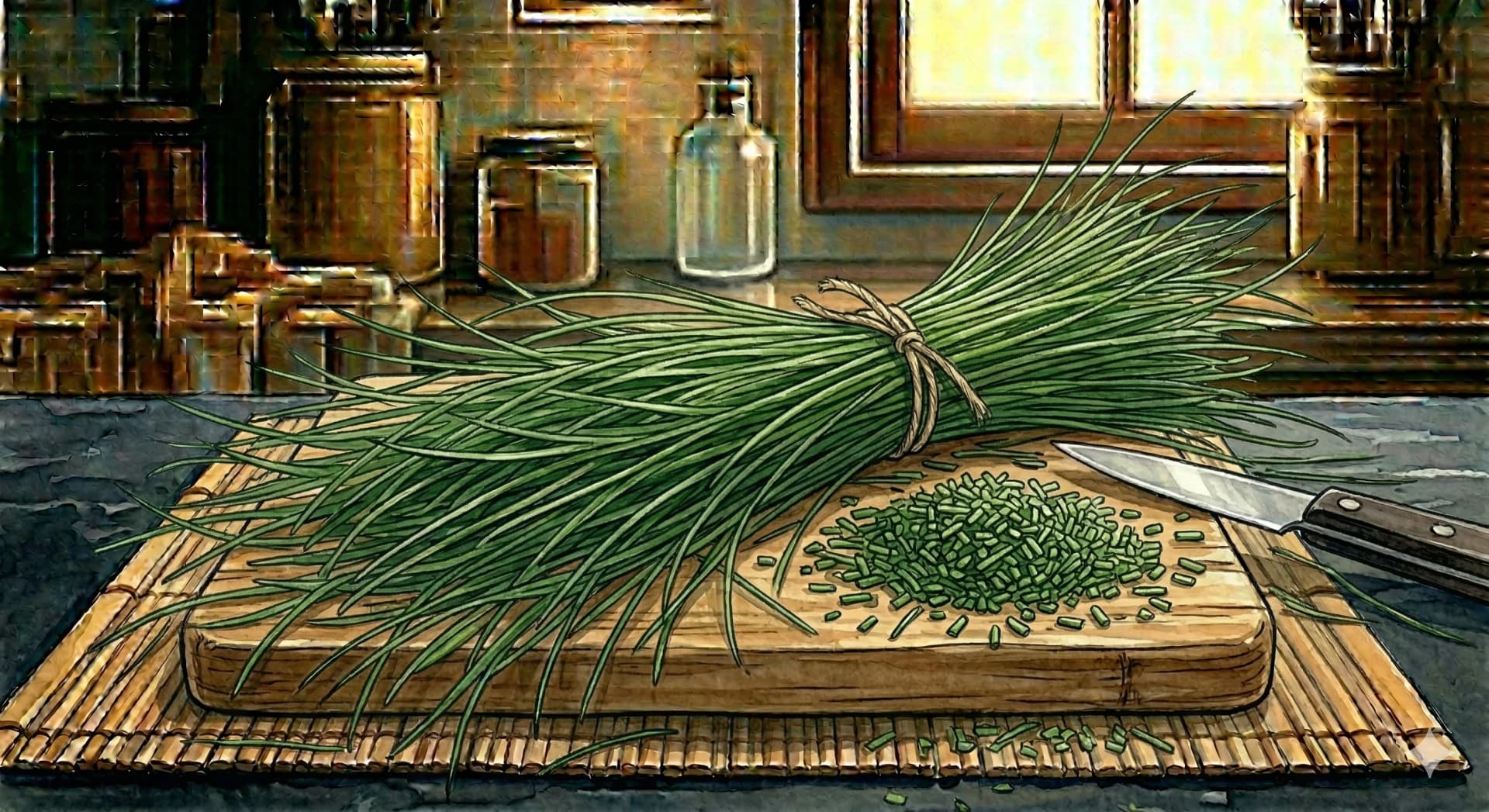
Garlic Chives
Also known as: Jiu Cai, Chinese Chives, Allium tuberosum, Oriental Chives
Garlic chives are a distinct species from Western chives — flat-leaved rather than hollow, with a pronounced garlic flavor alongside their onion-like green freshness. They are a fundamental ingredient in Chinese cooking, used in dumpling fillings, stir-fries, and as a featured vegetable in their own right.
Their assertive, garlic-forward aroma fills a kitchen when they hit a hot wok. Blanched briefly or barely cooked, they retain their vivid green color and a satisfying bite.
Key facts at a glance:
- Flat-leaved — distinct from Western hollow chives, with pronounced garlic flavor
- Dumpling essential — classic filling ingredient in northern Chinese cooking
- Quick-cooking — retain color and bite when barely cooked
- Three forms — green leaves, yellow (blanched in darkness), and flower stalks
Flavor Profile
Origin
China, East Asia, Southeast Asia
Traditional Medicine Perspectives
Traditional Chinese Medicine
Garlic chives (Jiu Cai) are classified as warm and acrid in TCM, associated with the Kidney, Liver, and Stomach meridians. They are used to warm and invigorate Kidney Yang, stop bleeding (particularly in the lower burner), regulate Qi and Blood, and detoxify. They are prescribed for deficiency cold conditions, seminal emission, and as a warming tonic for men's reproductive health. Jiu Cai is one of TCM's vegetables most strongly associated with Yang tonification.
Modern Scientific Research
Garlic chives contain organosulfur compounds similar to garlic, with associated antimicrobial and antioxidant properties. They are rich in vitamin K, vitamin C, folate, and beta-carotene.
Research on similar alliums supports anti-inflammatory and cardiovascular-protective effects.
The distinctive flat-leaf structure has a higher surface area than round chives, contributing to more pronounced flavor and potentially higher polyphenol exposure when eaten.
Cultural History
Garlic chives have been cultivated in China for over two thousand years and are deeply woven into Chinese food culture. The classic combination of garlic chives and egg is one of the most fundamental dumpling fillings in northern Chinese cooking.
In Cantonese cuisine, stir-fried garlic chives with bean sprouts and pork is an everyday home dish. Yellow chives (huang jiu cai) — blanched in darkness to prevent chlorophyll development — are a delicacy in Shanghainese cooking, milder and more tender than the green.
The flower stalks, when they bolt in spring, are themselves a seasonal delicacy.
Culinary Uses
Use in dumpling fillings — combine with pork, egg, or shrimp for classic northern Chinese dumplings. Stir-fry with bean sprouts, scrambled eggs, or pork for simple, fast dishes.
Use as a garnish over noodles and soups. Add to spring rolls and pancakes.
The flower stalks are delicious stir-fried whole with a little oyster sauce.
Preparation Methods
Cut into 1–2 inch sections for stir-fries and fillings. Do not overcook — a minute or two in a hot wok is sufficient to soften while retaining color and bite.
For dumpling fillings, salt cut chives and let sit for 10 minutes, then squeeze out excess water before mixing.
Traditional Dishes
- Jiu cai shui jiao (garlic chive dumplings)
- Stir-fried garlic chives with eggs
- Garlic chive and bean sprout stir-fry
- Cantonese rice noodle rolls (chee cheong fun)
- Korean jeon pancakes
Comments
Share your thoughts on this ingredient.
Sign in to comment0 Comments