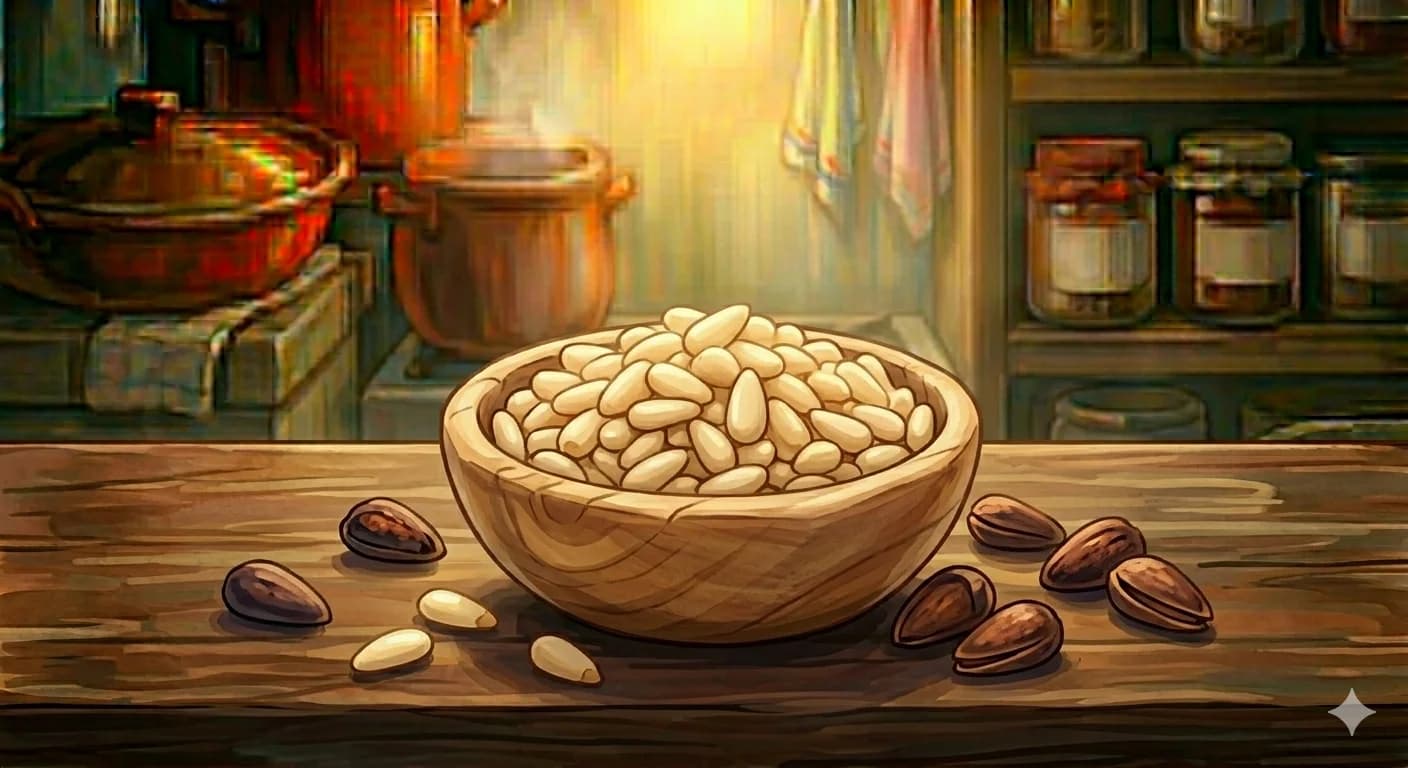
Pine Nuts
Also known as: Song Zi, Jat, Pignoli, 잣, Pine Kernels
Pine nuts — the small, ivory-colored seeds extracted from pine cones — are one of the most delicate and luxurious nuts in the world, prized across Korean, Chinese, Italian, and Middle Eastern cuisines for their buttery richness and gentle sweetness.
Their flavor is creamy, slightly resinous, and almost floral, with a soft texture that dissolves on the tongue. This subtlety makes them ideal as a finishing garnish, a base for creamy sauces, or a textural addition to porridges and desserts.
In Korean cuisine, pine nuts (jat, 잣) hold particular prestige — they are a symbol of longevity and vitality, appearing in royal court dishes, ceremonial foods, and medicinal porridges. The Korean pine nut, from the Korean pine (Pinus koraiensis), is considered among the finest in the world.
Key facts at a glance:
- Seeds of various pine species — not true nuts, extracted from pine cones
- Buttery, delicate, resinous flavor — dissolves on the tongue
- Labor-intensive harvest — contributes to their premium price
- Korean jat — among the most prized varieties worldwide
- Used across multiple cuisines — Korean, Chinese, Italian, Middle Eastern, Native American
Flavor Profile
Origin
Korea, Northern China, Siberia, Mediterranean, Southwestern United States
Traditional Medicine Perspectives
Traditional Chinese Medicine
Pine nut (Song Zi Ren) is classified as sweet and warm, entering the Liver, Lung, and Large Intestine meridians. It is used to moisten the intestines and promote bowel movement, moisten the Lungs to relieve cough, and nourish yin and fluids. It is commonly prescribed for dry constipation in elderly or debilitated patients and for dry cough.
Modern Scientific Research
Pine nuts are rich in pinolenic acid, a polyunsaturated fatty acid unique to pine seeds that has been studied for its potential effects on appetite regulation. Small human studies suggest pinolenic acid may promote the release of cholecystokinin (CCK) and glucagon-like peptide 1 (GLP-1), satiety hormones.
Pine nuts provide significant amounts of magnesium, zinc, iron, and vitamin E. They are also a source of arginine, an amino acid involved in nitric oxide production.
A curious phenomenon called "pine mouth" — a persistent metallic or bitter taste lasting days to weeks — has been reported after consuming certain Chinese pine nut species (primarily Pinus armandii). The mechanism is not fully understood but appears species-specific and is not considered harmful.
Cultural History
Pine nuts have been gathered and eaten across the Northern Hemisphere for thousands of years. In China, they appear in texts from the Han dynasty as both food and medicine, associated with immortality practices and hermit sages who supposedly lived on pine nuts and spring water.
In Korea, pine nuts have been a royal and aristocratic ingredient since the Joseon dynasty. Jatjuk (pine nut porridge) was served to royalty and convalescents, and pine nuts still appear in the most refined Korean preparations — floated on tea, ground into porridge, or used as a garnish on court cuisine dishes.
The labor required to harvest pine nuts — climbing trees, collecting cones, drying them open, and extracting the small seeds — has always made them expensive. This scarcity reinforced their association with luxury and special occasions.
Culinary Uses
Toast lightly in a dry pan until just golden — pine nuts burn quickly due to their high oil content, so watch them constantly. Use toasted pine nuts as a finishing garnish on stir-fries, salads, and grain dishes.
Grind raw or lightly toasted pine nuts with water and a pinch of salt for jatjuk (Korean pine nut porridge), a silky, ivory-colored porridge that is one of the most elegant and restorative dishes in Korean cuisine.
Toast pine nuts in a dry pan over medium-low heat, shaking frequently — they go from golden to burnt in seconds.
Float a few raw pine nuts on traditional Korean teas for an aromatic garnish. In Chinese cooking, use in stir-fries with corn and diced vegetables, or as a filling in pastries. Beyond Asian cuisines, pine nuts are essential in Italian pesto and Middle Eastern rice pilafs.
Preparation Methods
Store pine nuts in the refrigerator or freezer — their high oil content means they go rancid quickly at room temperature. Smell before using; rancid pine nuts have an unpleasant paint-like odor.
For porridge, soak in water for 2–3 hours, then blend with fresh water and strain for the smoothest texture. For garnishing, use raw or toast lightly.
Traditional Dishes
- Jatjuk (pine nut porridge)
- Songpyeon
- Yakbap
- Italian pesto
- Stir-fried corn with pine nuts
- Middle Eastern rice pilaf
Comments
Share your thoughts on this ingredient.
Sign in to comment0 Comments