Korean Cuisine
Hobakjuk (Pumpkin Porridge)
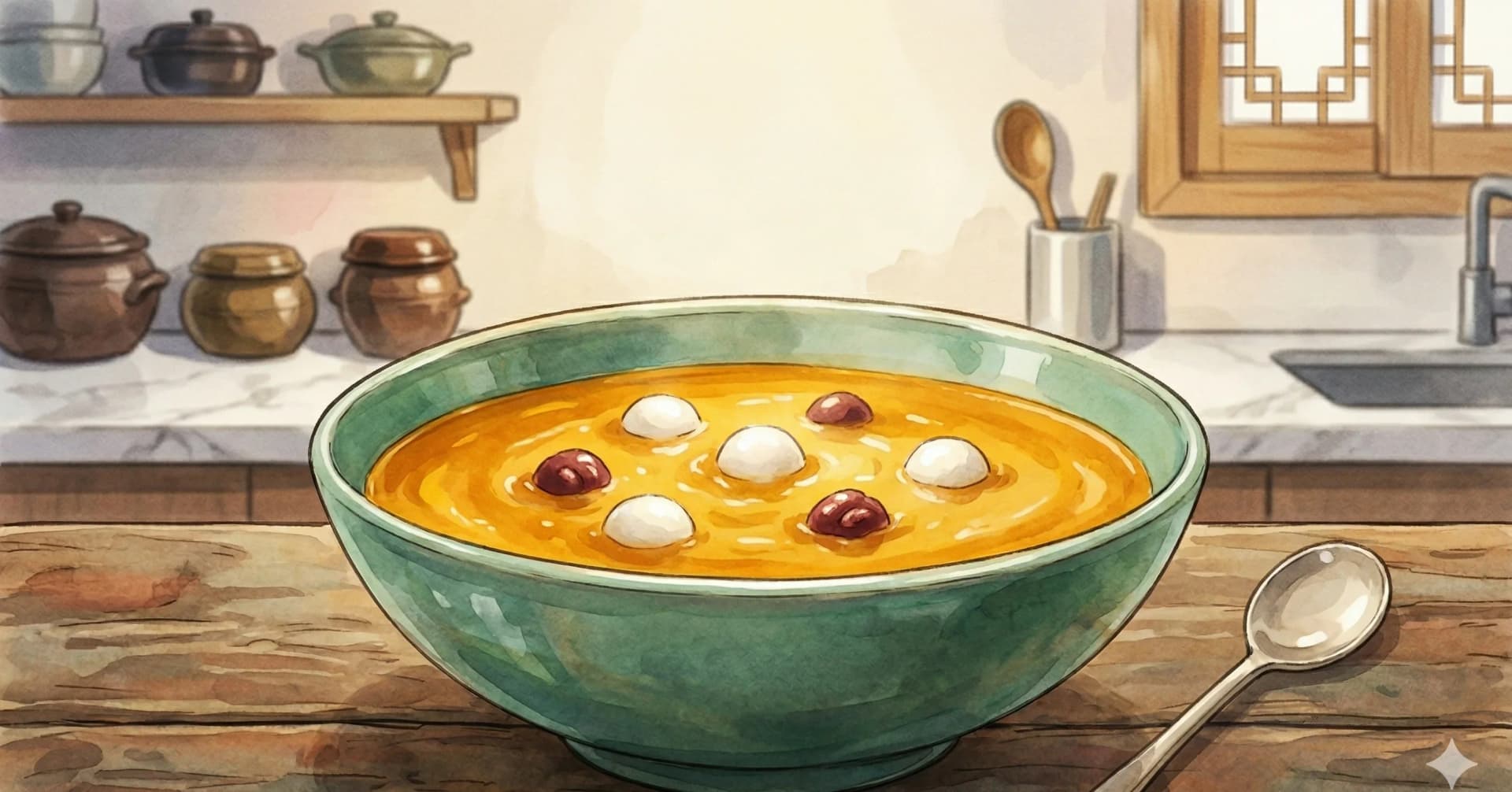
A naturally sweet porridge of kabocha squash thickened with glutinous rice and topped with chewy rice cake balls
Hobakjuk is the Korean porridge that feels like autumn in a bowl. Made from kabocha squash (danhobak in Korean), a dense, sweet winter squash with dark green skin and brilliant orange flesh, the porridge has a natural sweetness that needs very little added sugar. The color alone is warming: a deep, vivid orange that seems to glow from the center of the bowl.
Korean grandmothers have been making hobakjuk for centuries, and the process is almost meditative. The squash is steamed or boiled until it collapses into softness, then pureed with ground glutinous rice and water. The mixture simmers slowly, the glutinous rice thickening it into a porridge that is silky smooth with a gentle, velvety body. Some cooks like their hobakjuk perfectly smooth; others prefer to leave small pieces of squash for texture. Both approaches are traditional.
The finishing touches lift the porridge from simple to special. Chewy little rice cake balls, called saeal-sim, are made by kneading sweet rice flour with hot water into a dough, rolling it into small balls, and boiling them until they float. They add a delightful chewiness that contrasts with the smooth porridge. A scattering of boiled red beans adds earthy sweetness and a pop of color. Pine nuts bring a subtle nuttiness.
Hobakjuk can serve as a comforting breakfast, a light meal when the appetite is fragile, or a sweet course to close a larger Korean meal. In Korean culture, it is traditionally served to those recovering from illness and to the elderly, as it is gentle on digestion and rich in nutrients from the squash.
At a Glance
Yield
8 servings
Prep
10 minutes
Cook
50 minutes
Total
1 hour
Difficulty
Easy
Ingredients
Porridge Ingredients
- 2 lbkabocha squash (danhobak) or small pumpkin (about 1–1½ small pumpkins)
- 3¼ ozglutinous rice (sweet rice), soaked in water for at least 1 hour
- 1½ qtwater, divided
- ½ tspsalt
- 12to 24 g brown sugar (optional, to taste)
Rice Cake Ingredients
- 2¼ ozsweet rice flour (chapssal garu)
- 1⅞ tspsugar
- ¼ tspsalt
- ¼ cupboiling water
To Serve
- 1½ ozcooked red beans (pat)
- ¼ ozpine nuts
- —Pumpkin seeds or sliced jujubes
Method
- 1
Cook the squash. Cut the kabocha squash in half or quarters and remove the seeds. Place cut-side up in a large pot. Add water to reach about one-third up the sides of the squash (roughly 6 cups). Cover and boil over medium-high heat until fork-tender, about 25 to 30 minutes. Remove the squash and let it cool slightly. Discard the cooking water or reserve some for adjusting porridge consistency.
- 2
Scoop and puree the flesh. Scoop the flesh from the skin, or peel it away. Puree the cooked squash in a blender or food processor until smooth. If you prefer some texture, mash with a potato masher instead, leaving small pieces.
- 3
Grind the rice. Drain the soaked glutinous rice. Blend with 1 cup of water in a blender until very fine and smooth, like a thin paste.
- 4
Cook the porridge. Pour the ground rice mixture into a large pot along with the pureed squash and 3 cups of water. Set over medium heat and stir frequently, mashing any remaining squash chunks, until the rice turns translucent and the porridge thickens, about 15 to 20 minutes. Cover, reduce the heat to low, and simmer for another 20 minutes, stirring occasionally to prevent sticking.
- 5
Season. Add the salt and sugar (if using). Stir in the cooked red beans if using. Cook for 3 to 4 more minutes. Adjust the consistency by adding more water if the porridge is too thick.
- 6
Make the rice cake balls (optional). While the porridge simmers, mix the sweet rice flour, sugar, and salt in a small bowl. Add the boiling water and stir. When cool enough to handle, knead into a smooth dough. Roll into a cylinder and cut into 3/4-inch pieces. Roll each piece into a small ball. Bring a pot of water to a boil, add the balls, and cook until they float to the surface. Transfer to cold water briefly, then drain.
- 7
Serve. Ladle the hot porridge into bowls. Add the rice cake balls and garnish with pine nuts, pumpkin seeds, or sliced jujubes. Serve warm.
Key Ingredient Benefits
Kabocha squash (danhobak): One of the most nutrient-dense winter squashes. Its deep orange color indicates a high concentration of beta-carotene, a carotenoid that the body converts to vitamin A. One cup of cooked kabocha provides roughly 450% of the daily value for vitamin A. It also contains vitamin C, potassium, manganese, and dietary fiber. In Korean traditional medicine, kabocha is considered a warming food that supports digestion and reduces swelling.
Glutinous rice (chapssal): Despite the name, glutinous rice contains no gluten. The term refers to its sticky, waxy texture when cooked. It is easier to digest than regular rice and has been used in Korean and Chinese traditional medicine as a gentle food for recovering patients. See also jeonbokjuk for another porridge using similar rice techniques.
Red beans (pat): Adzuki beans are rich in protein, fiber, folate, and iron. In Korean and East Asian food culture, red beans are traditionally associated with warding off misfortune. They are also used in sweet preparations like patbingsu and patjuk (red bean porridge).
Why This Works
Glutinous rice, ground to a fine paste and cooked with the squash puree, provides the thickening power that gives hobakjuk its characteristic velvety body. Regular rice would not produce the same smooth, slightly sticky texture. The glutinous rice starches, high in amylopectin, gelatinize easily and create a cohesive, creamy porridge.
Boiling the squash in its skin preserves the flavor and prevents waterlogging. The skin acts as a barrier, keeping the flesh contained while it steams from within. The resulting flesh is concentrated in flavor and easy to puree.
The rice cake balls are boiled separately to avoid muddying the porridge with the flour from the raw dough. Adding them at the end keeps them chewy and distinct.
Substitutions & Variations
Squash: Butternut squash or sugar pumpkin can replace kabocha. The flavor will be slightly different, less sweet and nutty, but the porridge will still be excellent.
Without rice cake balls: The porridge stands on its own without the saeal-sim. They add texture but are not essential.
Savory version: Omit the sugar and increase the salt. Add a splash of soup soy sauce for a more savory take. Some Korean homes serve hobakjuk as a light, warming dinner rather than a sweet dish.
Red bean porridge (patjuk): For a completely different but related dish, make the porridge primarily from red beans with rice cake balls. This is a traditional winter solstice dish.
Serving Suggestions
Hobakjuk is typically served on its own as a light meal, breakfast, or gentle comfort food. It pairs well with simpler banchan like oi muchim or baek-kimchi if served as part of a larger meal. In Korean tradition, hobakjuk is given to the elderly, to those recovering from surgery or illness, and to new mothers, alongside dishes like baeksuk and samgyetang.
Storage & Reheating
Refrigerator: Store in a sealed container for up to 3 days. The porridge will thicken considerably as it cools.
Reheating: Warm gently over medium-low heat, adding water to thin it back to the desired consistency. Stir frequently. Store the rice cake balls separately if possible, as they harden when cold. Re-boil them briefly before adding back to the porridge.
Freezer: The porridge (without rice cake balls) can be frozen for up to 1 month. Thaw in the refrigerator overnight.
Cultural Notes
Hobakjuk (호박죽) means "pumpkin porridge," and it belongs to the much broader Korean juk (죽) tradition of cooked-down grain and starch porridges. Juk in Korean culture is far more than thin breakfast food. It is a category of dishes designed specifically to be gentle on a tired or recovering body, considered essential nutrition for the very young, the very old, the sick, the postpartum, and the convalescent. Specialized juk restaurants exist across Korea, and chains like Bonjuk operate hundreds of locations nationwide.
Hobakjuk specifically uses danhobak (단호박), kabocha squash, a winter squash that is exceptionally sweet and dense and stores well through the cold months. The dish is most associated with autumn and early winter, when squash is at peak quality, and it shows up prominently on the menus of Korean Buddhist temple cuisine (sachal eumsik, 사찰음식), where the absence of meat, alliums, and dairy makes naturally sweet, deeply nourishing dishes like hobakjuk especially valued.
Two cultural roles set hobakjuk apart from other juk. The first is postpartum recovery (sanhujori, 산후조리), the structured three-week-plus recovery period that Korean tradition prescribes for new mothers. Hobakjuk is believed to reduce postpartum swelling and aid recovery, and it appears in nearly every Korean postpartum care plan alongside miyeok guk.
The second is Chuseok. Adding small chewy rice cake balls (saealsim, 새알심) on top of the porridge is a Chuseok tradition. The grain symbolizes prosperity for the coming year, and the dish shows up on many Korean tables during the autumn harvest festival.
Nutrition Facts
Calories: 186kcal (9%)|Total Carbohydrates: 42.5g (15%)|Protein: 2.8g (6%)|Total Fat: 0.9g (1%)|Saturated Fat: 0.1g (1%)|Cholesterol: 0mg (0%)|Sodium: 224mg (10%)|Dietary Fiber: 2.3g (8%)|Total Sugars: 15.6g
You Might Also Like
 Medium
Korean Cuisine
Bibimbap (Mixed Rice Bowl)
1 hour 10 minutes
 Medium
Korean Cuisine
Baek Kimchi (White Kimchi)
3 hours (plus 1 to 3 days fermentation)
 Easy
EasyKorean Cuisine
Bibim Naengmyeon (Spicy Mixed Cold Noodles)
30 minutes
 Easy
EasyVietnamese Cuisine
Cháo Gà (Vietnamese Chicken Rice Porridge)
1 hour 30 minutes
Ratings & Comments
Ratings & Comments
Ratings
Share your thoughts on this recipe.
Sign in to rate and comment