Korean Cuisine
Baeksuk (White Chicken Soup)
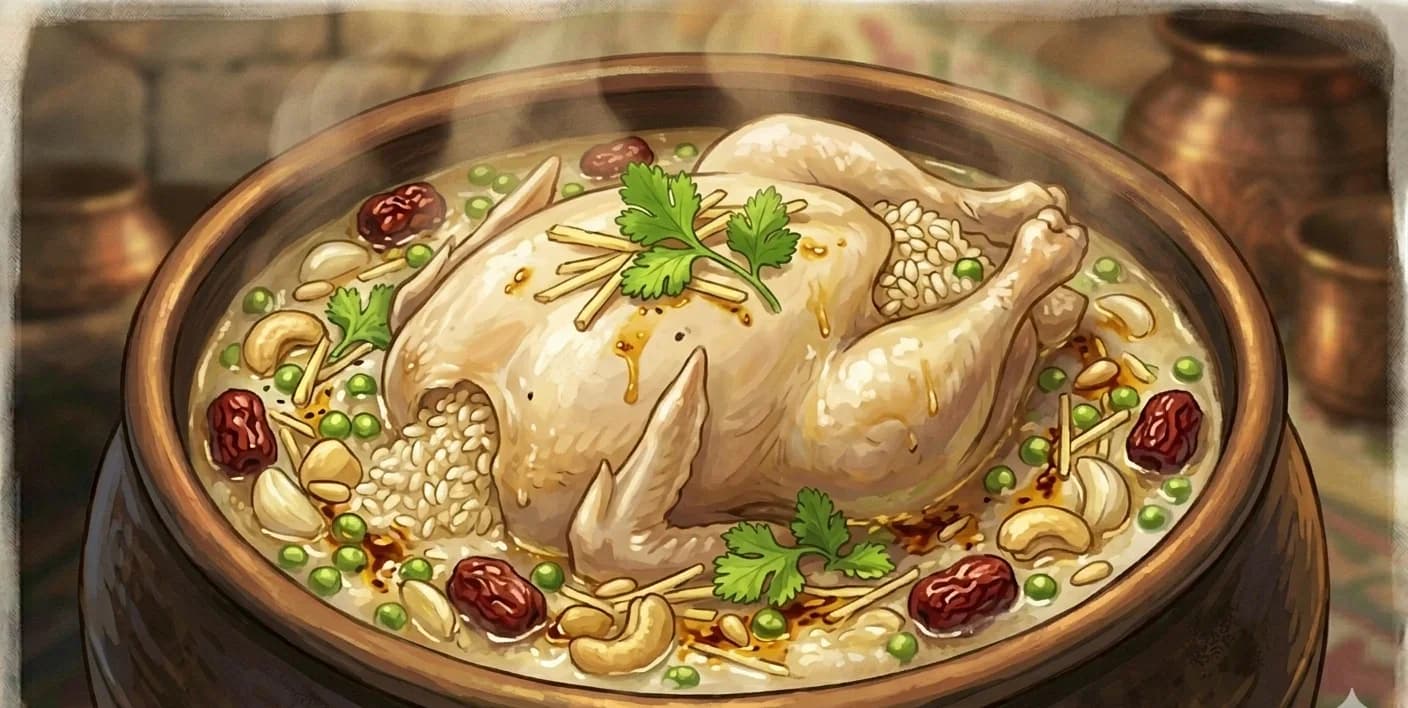
A whole chicken simmered gently with garlic, jujubes, and glutinous rice until the meat is silky and tender
Baeksuk means "white cook" or "plain boil," and the name captures the spirit of this dish perfectly. There is no chili paste, no fermented bean sauce, no complex marinade. Just a whole chicken, a generous handful of garlic, a few jujubes (dried Korean dates), and glutinous rice stuffed inside the cavity. The bird goes into cold water and simmers slowly until the meat slides from the bone and the broth turns milky and rich from the collagen released by the bones and skin.
This is the gentlest dish in the Korean repertoire. Where samgyetang adds ginseng for its tonic properties, baeksuk strips away even that, trusting the chicken itself and a few aromatics to do all the work. Korean families have long prepared baeksuk for those who need nourishment without complication: new mothers recovering from childbirth, elderly relatives with weakened digestion, anyone feeling run down. The plain broth is easy on the stomach, and the garlic-infused chicken provides sustenance without demanding too much of the body.
Eating baeksuk is a quiet experience. Each person pulls apart their portion of chicken at the table, dipping pieces into a small dish of salt mixed with ground black pepper. The broth, ladled into bowls, is sipped alongside. Some people add chopped scallions or a squeeze of lemon. The glutinous rice inside the chicken absorbs the juices during cooking and turns into a soft, porridge-like stuffing that you scoop out with a spoon.
There is no better cold-weather comfort food. On a still winter evening, with steam rising from the pot and the kitchen fragrant with garlic and simmered chicken, baeksuk feels like a meal designed to make everything a little better.
At a Glance
Yield
4 servings
Prep
15 minutes (plus 1 hour soaking rice)
Cook
1 hour 10 minutes
Total
2 hours 25 minutes
Difficulty
Easy
Ingredients
- 1 wholechicken (about 1.4–1.6 kg), cleaned
- 3¼ ozglutinous rice (sweet rice), rinsed and soaked in cold water for 1 hour
- 16garlic cloves, peeled and left whole
- 4to 6 dried jujubes (Korean dates), rinsed
- 2to 3 slices fresh ginger (optional)
- 2½ qtcold water
- 2to 3 green onions, chopped
- —Kosher salt
- —Ground black pepper
- —Toasted sesame seeds (optional)
- 2 tspkosher salt
- 1/2 tspground black pepper
Method
- 1
Prepare the chicken. Remove the giblets and any excess fat from the cavity. Rinse the chicken under cold running water and pat dry. Trim the wing tips and tail if desired.
- 2
Stuff the chicken. Drain the soaked glutinous rice. Stuff the chicken cavity with the rice, about half the garlic cloves, and 2 jujubes. Do not overstuff. Close the cavity loosely by crossing the drumsticks or tying them with kitchen twine.
- 3
Start the simmer. Place the stuffed chicken in a large heavy pot. Add the remaining garlic cloves, remaining jujubes, and ginger slices. Pour in 10 cups of cold water. The water should cover the chicken by at least an inch.
- 4
Bring to a boil. Set the pot over medium-high heat and bring to a boil. Skim off any foam or impurities that rise to the surface during the first few minutes. This step keeps the broth clear and clean-tasting.
- 5
Simmer gently. Reduce the heat to medium-low. Cover the pot and let the chicken simmer for about 1 hour, until the meat is very tender and pulls away from the bone easily. Ladle broth over the top of the chicken occasionally if it is not fully submerged.
- 6
Check for doneness. The thigh should feel loose when wiggled, and the juices should run clear when the thickest part of the thigh is pierced with a knife. The rice inside the cavity should be soft and porridge-like.
- 7
Prepare the dipping salt. Mix the kosher salt and black pepper together in a small dish.
- 8
Serve. Carefully transfer the chicken to a large bowl or serving platter. Ladle the broth into individual bowls. Scatter chopped green onions over the broth. Each person pulls chicken apart at the table, dipping pieces into the salt mixture. Scoop the glutinous rice stuffing out with a spoon. Sip the broth between bites.
Key Ingredient Benefits
Whole chicken: Cooking a whole bird with bones and skin yields a broth rich in collagen, which converts to gelatin during the long simmer. Gelatin has been studied for its potential to support gut lining integrity and joint mobility. The chicken provides complete protein, niacin, vitamin B6, and selenium.
Jujubes (Korean dates, daechu): Small, wrinkled, reddish-brown fruits used throughout East Asian cooking and traditional medicine. They contain flavonoids, saponins, and polysaccharides. In Korean and Chinese traditional medicine, jujubes are classified as calming and nourishing, believed to support digestion and restful sleep. Modern research has explored their antioxidant and anxiolytic properties in animal studies, though human clinical data remains limited. See also daechu-cha for a jujube tea preparation.
Garlic: Contains allicin when crushed or cut, a compound with well-documented antimicrobial properties in laboratory settings. Long simmering transforms the sharp, pungent flavor into something mellow and sweet.
Glutinous rice: Despite the name, glutinous rice is gluten-free. The term refers to its sticky, waxy texture when cooked, due to its high amylopectin content.
Why This Works
Starting the chicken in cold water and bringing it to a simmer slowly is essential for a clear, richly flavored broth. When meat is dropped into boiling water, the proteins on the surface seize up immediately and seal in the juices, which is fine for a quick cook but prevents flavor from transferring to the broth. A slow start allows collagen, gelatin, and chicken flavor to dissolve gradually into the liquid.
The glutinous rice inside the cavity serves two purposes. It absorbs the concentrated juices that pool inside the bird during cooking, becoming a deeply flavored porridge. It also helps regulate the cooking of the chicken from the inside out, ensuring even doneness.
Whole garlic cloves, simmered for an hour, lose their sharp bite and become soft, sweet, and spreadable. They can be eaten on their own or mashed into the broth.
Substitutions & Variations
Chicken size: A smaller chicken (Cornish hen, about 1 1/2 lb) makes an elegant individual serving, similar to samgyetang. Reduce cooking time to about 45 minutes.
Ginseng: Adding 1 or 2 fresh or dried ginseng roots to the pot transforms baeksuk into samgyetang. The ginseng adds a slightly bitter, earthy note and is prized for its tonic properties.
Chestnuts and ginkgo nuts: Some versions include peeled chestnuts and ginkgo nuts inside the cavity alongside the rice. These add sweetness and texture.
Pressure cooker: Baeksuk can be made in a pressure cooker in about 30 minutes. The broth will be slightly less clear but the chicken will be equally tender.
Serving Suggestions
Baeksuk is traditionally served with just the dipping salt, but you can offer a sesame dipping sauce (salt, sesame seeds, black pepper, and sesame oil mixed together) or a sweet soy-vinegar sauce as alternatives. Kkakdugi is the classic kimchi accompaniment, adding spicy crunch to the mild soup. Oi muchim also pairs well. A bowl of steamed rice on the side is optional, since the glutinous rice stuffing serves a similar role.
Storage & Reheating
Refrigerator: Store the chicken and broth together in a sealed container for up to 3 days. The broth may gel when cold, which is a sign of high gelatin content.
Freezer: The broth freezes well for up to 2 months. The cooked chicken can be frozen separately for up to 1 month.
Reheating: Warm the broth gently in a pot over medium heat until hot. Add the chicken pieces and heat through. The broth will return to liquid form as it warms. Do not boil vigorously, as this can make the meat tough.
Cultural Notes
Baeksuk (백숙) means literally "white cook" or "plain boil," and the name carries the dish's whole philosophy. Most celebratory Korean chicken dishes lean hard on pungent gochugaru, fermented soybean pastes, or sticky marinades. Baeksuk goes the opposite direction. A whole chicken, water, garlic, jujubes, and time. The closest analogue in another cuisine is the French poule-au-pot, and that comparison is not a coincidence. Both dishes treat restraint as the point.
Baeksuk sits at the heart of Korea's boyangsik (보양식) tradition: foods cooked specifically to restore vitality. Boyangsik are eaten most often during sambok (삼복), the three hottest days of summer, on the theory that "fighting heat with heat" (이열치열, iyeolchiyeol) rebalances the body. The more famous summer boyangsik is samgyetang, where the chicken is stuffed with glutinous rice and ginseng. Plain baeksuk is the year-round version: gentler, more economical, equally restorative.
In rural Korean households, baeksuk was historically the dish you cooked for a sick family member, for a mother recovering from childbirth (alongside miyeok guk), or for a tired farmer at the end of harvest. Modern baeksuk jib (백숙 집), the specialty restaurants serving the dish, still cluster in mountain regions where the broth is often built up further with regional medicinal herbs and tree bark. The leftover broth, thickened with rice the next morning, becomes dak-juk.
Nutrition Facts
Calories: 480kcal (24%)|Total Carbohydrates: 22.5g (8%)|Protein: 39.5g (79%)|Total Fat: 25.2g (32%)|Saturated Fat: 7.1g (36%)|Cholesterol: 152mg (51%)|Sodium: 590mg (26%)|Dietary Fiber: 0.7g (3%)|Total Sugars: 0.3g
You Might Also Like
Ratings & Comments
Ratings & Comments
Ratings
Share your thoughts on this recipe.
Sign in to rate and comment