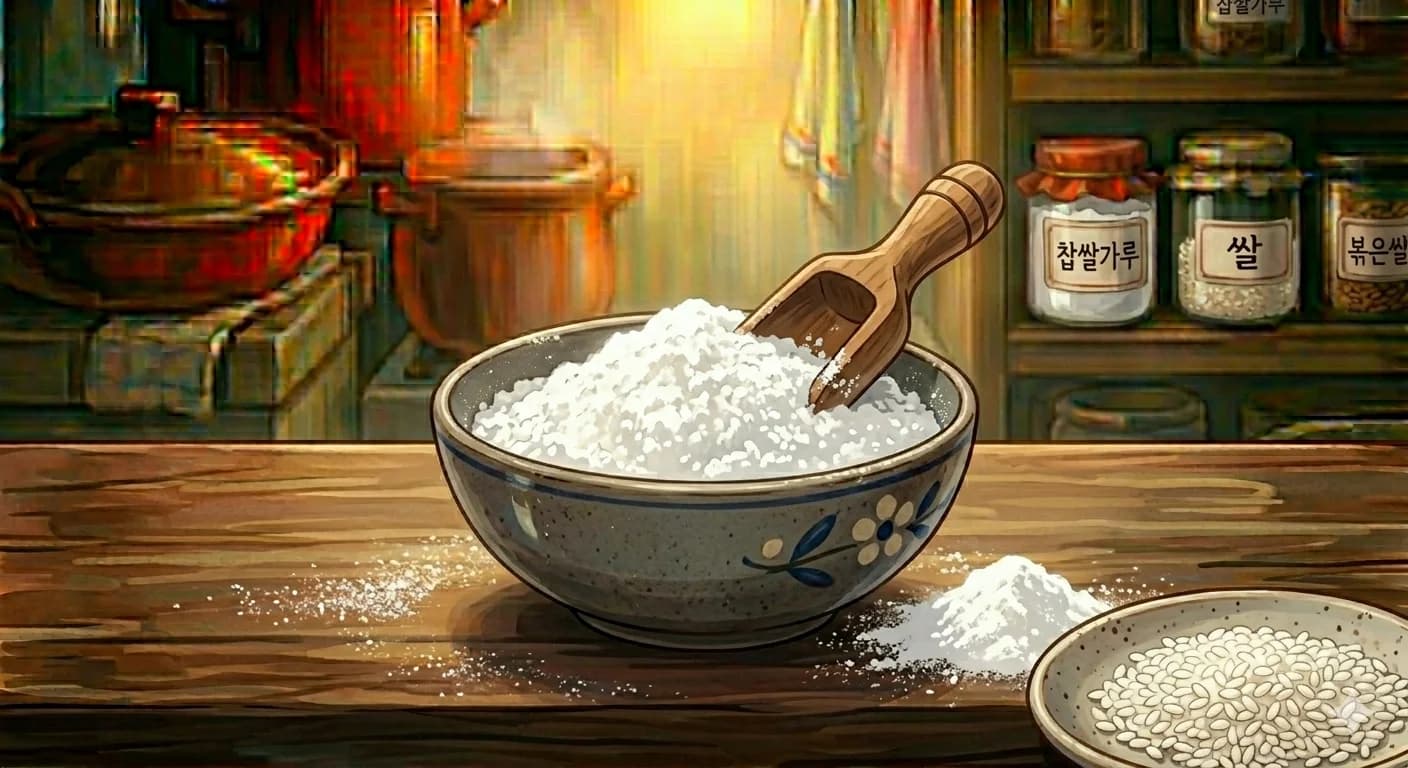
Rice Flour
Also known as: Chawal Ka Atta, Bột Gạo, Jōshinko, Shingadana Peeth, Rice Powder, Galapindi
Rice flour is one of the oldest and most versatile grain flours in the world — finely ground from raw rice into a silky white powder that transforms into everything from lacy Vietnamese crêpes to pillowy South Indian steamed cakes.
Unlike wheat flour, rice flour contains no gluten. This absence is not a limitation — it is the very quality that gives rice flour batters their distinctive clean snap, their delicate crispness when fried, and their tender, slightly chewy texture when steamed. A dosa would not shatter the way it does with wheat. A banh cuon would not drape like silk.
Rice flour comes in two main forms: regular rice flour (from long-grain or medium-grain rice) and glutinous rice flour (from sticky rice, despite the confusing name — still gluten-free). They behave very differently. Regular rice flour gives you crisp, clean textures. Glutinous rice flour gives you stretch and chew. Knowing which one a recipe calls for is essential.
Key facts at a glance:
- Finely ground from raw rice — available in regular and glutinous varieties
- Naturally gluten-free — the basis of countless traditional dishes across Asia
- Used in 18 recipes on the site — from dosa batters to turnip cakes
- Texture chameleon — crispy when fried, tender when steamed, chewy when boiled
- Thousands of years of use — foundational to South Indian, Vietnamese, Chinese, and Japanese cooking
Flavor Profile
Origin
Southern China, Southeast Asia, South India, Vietnam, Japan, Korea
Traditional Medicine Perspectives
Ayurveda
Rice flour is considered light, cooling, and easily digestible in Ayurvedic tradition. It is classified as having a sweet taste (madhura rasa) and a cooling energy (shita virya). It is considered balancing for Pitta dosha and is recommended during convalescence and for those with sensitive digestion. Fermented rice flour preparations, like those in dosa and idli batters, are regarded as more digestible than unfermented forms.
Traditional Chinese Medicine
In TCM, rice (and its flour) is associated with the Spleen and Stomach meridians. It is considered sweet in flavor and neutral in temperature. It is used to tonify qi and support the middle burner. Rice congee and rice-based preparations are among the most commonly recommended foods for restoring digestive strength after illness.
Modern Scientific Research
Rice flour is a significant source of resistant starch, particularly when cooked and cooled — a process that increases the retrograded starch content. Resistant starch functions as a prebiotic, feeding beneficial gut bacteria and producing short-chain fatty acids like butyrate.
Research published in the Journal of Food Science and Technology has shown that the fermentation process used in traditional dosa and idli batters significantly increases the bioavailability of B vitamins, iron, and zinc, while also improving protein digestibility. The lactic acid bacteria present during fermentation partially break down phytic acid, which otherwise binds minerals.
Rice flour is naturally free of gluten proteins (gliadin and glutenin), making it safe for individuals with celiac disease. It is one of the most widely used base flours in gluten-free baking research.
Cultural History
Rice flour's history mirrors the history of rice cultivation itself — stretching back at least eight thousand years in the river valleys of southern China and Southeast Asia. Wherever rice was the staple grain, people eventually ground it into flour, opening up an entire universe of textures beyond the steamed grain itself.
In South India, rice flour became the foundation of the dosa-idli tradition, one of the most sophisticated fermented batter systems in world cooking. The practice of soaking rice, grinding it with urad dal, and fermenting the batter overnight predates written records in the region. Tamil Nadu, Kerala, Karnataka — each developed their own variations, but rice flour remained the constant.
In Vietnam and southern China, rice flour took a different path — into fresh rice noodles, steamed rice rolls, and translucent wrappers. The banh cuon of Hanoi, the cheung fun of Guangdong, the kway teow of the Straits — all are expressions of the same idea: rice flour, water, and steam producing something impossibly delicate. In Japan, rice flour (jōshinko) became essential to wagashi, the refined art of traditional confections.
Culinary Uses
In South Indian cooking, rice flour is the backbone of the breakfast tradition. Soak raw rice for several hours, grind it with a portion of urad dal, ferment overnight, and you have the batter for dosa and idli — crispy lacy crêpes and soft steamed cakes that are eaten daily by hundreds of millions of people. The ratio of rice to dal, the grind, and the fermentation time all affect the final texture.
In Vietnamese cuisine, rice flour produces some of the most delicate preparations in all of Asian cooking. Banh cuon — steamed rice crêpes filled with pork and mushrooms — require a batter so thin it steams into translucent sheets in seconds. Banh xeo uses rice flour with turmeric and coconut milk to create sizzling, crispy crêpes with an audible crunch.
In Chinese dim sum and Cantonese cooking, rice flour is essential for turnip cake (lo bak go), rice noodle rolls (cheung fun), and fresh rice noodles. The texture of a properly made fresh rice noodle — silky, slightly chewy, with a clean bite — cannot be achieved with any other flour.
Rice flour also excels as a coating for frying. A light dusting produces an exceptionally crisp, shattering crust that stays crispy longer than wheat flour coatings. Many Korean and Japanese fried preparations use rice flour for exactly this reason.
Preparation Methods
For fermented batters (dosa, idli), soak raw rice for 4–6 hours, then grind to a smooth paste with water using a wet grinder or high-powered blender. The grind must be very fine for dosa (pour-and-spread consistency) and slightly coarser for idli (which benefits from tiny air pockets). Combine with ground urad dal, salt, and ferment 8–12 hours in a warm place.
For steamed preparations (banh cuon, cheung fun), whisk rice flour with water and a small amount of tapioca starch for elasticity. The batter should be very thin — almost like milk. Steam on greased cloth or non-stick surfaces for just 1–2 minutes until the sheet is set and translucent.
For frying coatings and batters, rice flour can be used dry as a dredge or mixed into a batter. It produces a lighter, crispier result than wheat flour. For the crispiest results, combine rice flour with a small amount of cornstarch and ice-cold water. Store rice flour in an airtight container in a cool, dry place — it absorbs moisture readily, which can affect batter consistency.
Traditional Dishes
Recipes Using Rice Flour
- Steamed Rice Rolls (Bánh Cuốn)
- Bengali Crepe Rolls (Patishapta)
- Turmeric Leaf Rice Cakes (Patoli)
- Crispy Stuffed Crepe (Bánh Xèo)
- Khao Niao Mamuang (Thai Mango Sticky Rice)
- Yangnyeom Chicken (Korean Fried Chicken)
- Spiced Lentil Fritters (Mysore Bonda)
- Kerala Fried Fish (Meen Porichattu)
- Pajeon (Korean Scallion Pancake)
Comments
Share your thoughts on this ingredient.
Sign in to comment0 Comments