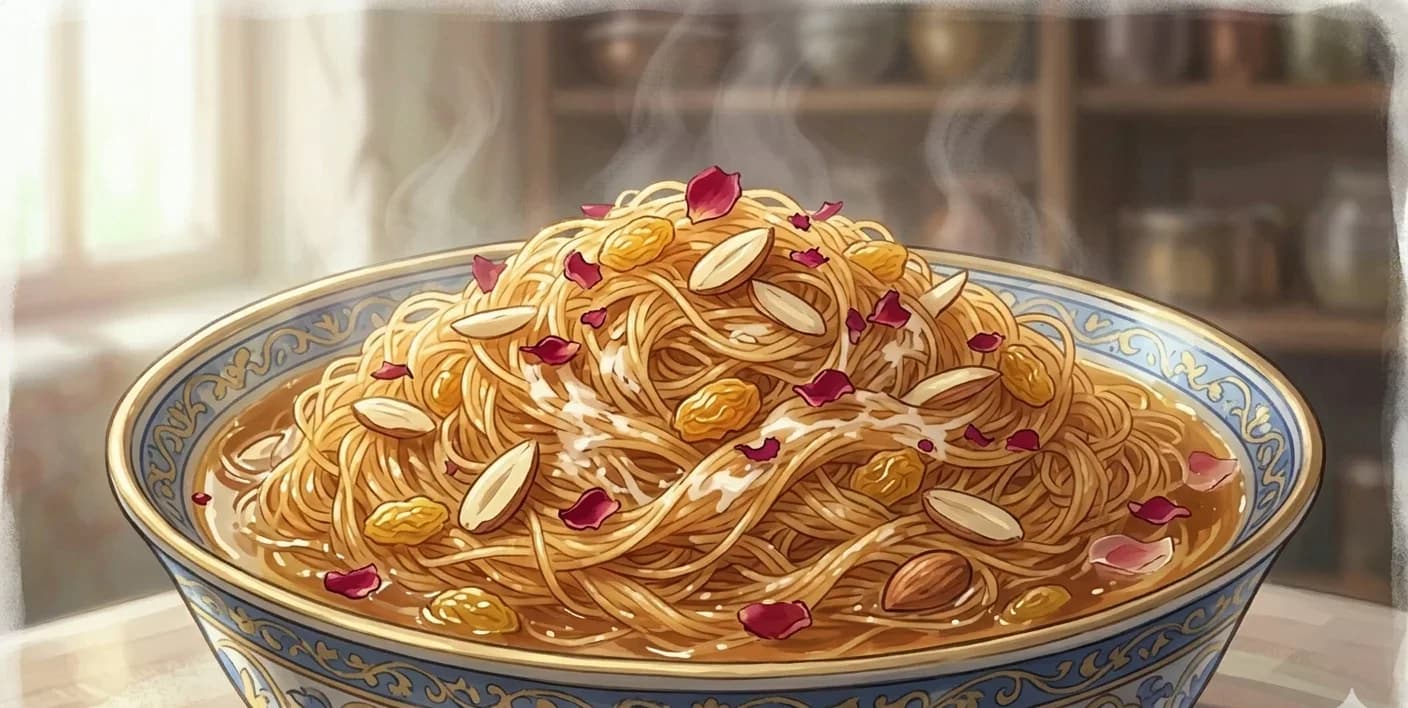
Kerala · Indian Cuisine
Malabar Rice Flatbread (Pathiri)
Thin, soft rice flour flatbreads from Kerala's Moplah Muslim community — cooked on a hot pan, served with curries
Pathiri is the bread of the Moplah table. The Moplah are Kerala's Muslim community of Malabar, descendants of Arab traders who arrived along the spice coast and married into local life over centuries, producing a distinct cultural and culinary tradition. The Moplah kitchen is one of the most interesting in India: Keralite in its spices and coconut, Arabic in some of its sweet preparations and festival foods, and entirely its own in dishes like pathiri.
Pathiri is made from rice flour, and its preparation begins with a step that might surprise those familiar with other flatbreads: the flour is cooked before it is rolled. Boiling water, seasoned with salt and a drop of oil, is brought to a vigorous simmer, then the flame is dropped to its lowest possible point and the rice flour is added all at once, stirred rapidly. The flour absorbs the water immediately and transforms into a soft, cohesive, pliable dough. This process gelatinizes the starch and makes the dough workable without any gluten to bind it.
The dough is shaped into small balls, rolled thin (as thin as a chapatti, possibly thinner) and cooked on a dry, hot pan. Pathiri does not color the way wheat flatbreads do. It stays white, with faint ghost-marks where it touched the pan, soft and yielding rather than crisp. Oil is applied on both sides as it cooks, keeping the surface supple.
These are the breads for biriyani, for curries, for any richly spiced Moplah dish. They are mild themselves, barely flavored, built to carry rather than compete.
At a Glance
Yield
10–12 pathiri
Prep
15 minutes
Cook
20 minutes
Total
35 minutes
Difficulty
Easy
Ingredients
- 7 ozrice flour (fine ground)
- 2 tspoil, plus more for cooking
- 1 cupwater
- 1⅔ tspsalt
Method
- 1
Boil the water. Bring the 250 ml water to a full, rolling boil in a small, heavy saucepan. Add the oil and salt. Stir to dissolve the salt.
- 2
Add the flour. Reduce the flame to its absolute minimum. Add all the rice flour at once to the boiling water, stirring immediately and continuously with a wooden spoon. Work quickly. The flour will absorb the water and clump together almost instantly. Stir vigorously, pressing and folding, for 1–2 minutes.
- 3
Watch for the color change. As the flour cooks in the hot water, it will change from bright white to a slightly translucent, off-white, almost glossy. This color change indicates the starch has gelatinized and the dough is cooked through. At this point, remove from heat.
- 4
Make the dough. While still very warm (but cool enough to handle), knead the dough briefly on a lightly oiled surface for 1–2 minutes until smooth and uniform. The dough should be soft, pliable, and non-sticky. If it feels dry or cracks, add a teaspoon of warm water and knead further.
- 5
Divide and roll. Divide the dough into 10–12 equal balls, roughly the size of a large marble. On a lightly oiled surface or between two sheets of oiled plastic, roll each ball into a thin disc, about 15 cm in diameter. The dough is delicate. Roll gently, using even pressure.
- 6
Cook on a hot pan. Heat a tawa or flat pan until very hot. Place a pathiri on the dry pan. Cook for 45–60 seconds until the bottom shows faint, dry patches and the bread firms up enough to flip. Turn and cook the second side for the same time. The pathiri should remain white, not golden. If it is browning, the pan is too hot.
- 7
Apply oil and serve. Apply a small amount of oil to both sides of the cooked pathiri with a brush or clean cloth. Stack them covered with a cloth to keep soft. Serve while still warm.
Key Ingredient Benefits
Rice flour: Naturally gluten-free, making pathiri one of the few Indian flatbreads suitable for those with celiac disease or gluten intolerance. Fine-ground rice flour produces a smoother pathiri; coarse-ground will give a slightly grainier texture.
Oil in the dough water: A small amount of oil in the cooking water pre-coats the starch granules, contributing to a smoother, more cohesive dough and slightly more tender finished bread.
Minimal ingredients: Pathiri's restrained ingredient list (four items) is what makes it the ideal accompaniment to richly spiced Kerala curries. A bread with its own strong flavor competes with the curry; pathiri simply carries it.
Why This Works
Cooking the rice flour in boiling water (the "choux pastry" principle applied to a gluten-free bread) is what makes a rollable dough possible from a flour that contains no gluten. When starch granules in the rice flour encounter boiling water, they gelatinize: they swell, absorb water, and form a network of swollen granules that holds together cohesively even without gluten protein. This gelatinized starch dough behaves similarly to a wheat dough in that it can be shaped and rolled, but it has zero elasticity, which means it does not spring back when rolled thin, making it easier in some ways.
The color change from opaque white to slightly translucent is the visual indicator of complete starch gelatinization. Under-cooked rice flour dough will be gritty and taste raw; properly cooked dough will be smooth and neutral.
A dry pan (not oiled) is important during cooking, because oiling the pan creates steam between the pathiri and the surface, which softens the bread before it has time to set. The oil is applied after cooking to keep the surface supple as the bread rests.
Substitutions & Variations
- Coconut milk pathiri: Replace 50–100 ml of the water with coconut milk for a slightly richer, faintly sweet pathiri. Common in some household versions.
- Thicker pathiri: Roll slightly thicker (0.5 cm) for a bread that holds up better to very wet curries. Cook time increases by 30 seconds per side.
- Steamed pathiri: Some households steam pathiri in a steamer for 3–4 minutes rather than pan-cooking them. The result is softer and slightly moister.
- Stuffed pathiri: Fold a small amount of grated coconut with a pinch of salt and sugar into the center of the rolled disc, seal the edges, and cook as usual. This sweet-filled version is served with tea in some Moplah households.
Serving Suggestions
- The traditional pairing is with any Kerala curry: chicken, beef, egg, or fish.
- With Moplah biriyani for the full festival table.
- With coconut milk stew (ishtu). The mildness of each complements the other.
- As a light breakfast with fried egg and a green chutney.
Storage & Reheating
Pathiri is best eaten immediately or within a few hours of cooking. Stack cooked pathiri with a sheet of oiled paper between each and cover with a damp cloth to prevent drying. To reheat, sprinkle with a few drops of water and warm briefly in a covered pan over very low heat, or cover with a damp cloth and heat in a microwave for 20 seconds. Do not freeze.
Cultural Notes
Pathiri (പത്തിരി) is the Malabar Muslim (Mappila) flatbread of rice flour cooked with hot water into a soft dough, rolled into thin round disks, and griddled briefly until cooked through and lightly puffed. The bread is white, soft, paper-thin, and very different from the wheat-based flatbreads of north India and the rice-and-lentil-based dosa-idli family of south India. The dish belongs to the Mappila Muslim cuisine of the Kerala Malabar coast (the northern Kerala region around Calicut, Kannur, and Malappuram) and appears at Mappila family meals, wedding feasts, and the Mappila restaurants that have spread from the Malabar coast to Bangalore, Chennai, Mumbai, and the Mappila diaspora communities in the Gulf and the United Kingdom.
The Mappila culinary identity is the cultural anchor. The Mappila Muslim community of the Malabar coast traces its origins to Arab traders who arrived on the Malabar coast from the seventh century onward, married into the local Hindu and Christian communities, and gradually established a distinct Muslim community with its own dialect of Malayalam, its own architecture, and its own cuisine that blends Arab, Persian, Tamil, and Malayalam influences. The Mappila cuisine is one of the most distinct regional Muslim cuisines in India, marked by the rice-flour preparations (pathiri, ari pathiri, thari kanji), the seafood-rich curries (Malabar fish biryani, prawn curries), and the elaborate sweet course that includes Portuguese-influenced sweets like muttamala. The pathiri is the everyday Mappila flatbread, the equivalent of the chapati in north India or the dosa in south India.
The technique requires the rice flour to be hydrated with hot water rather than cold. Fine rice flour (preferably from the Malabar parboiled rice variety) is mixed with salt in a heavy bowl. Boiling water is added in a steady stream while stirring with a wooden spoon, until the mixture comes together as a soft slightly sticky dough. The hot dough is covered with a damp cloth and rested for ten minutes (the hot water hydrates the rice flour in a way cold water cannot, and the rest lets the gluten-free dough come together). The dough is divided into small balls (about the size of a walnut) and rolled out between two sheets of plastic or on a lightly floured surface into thin round disks (about five inches across). Each disk is cooked on a hot griddle (tava) for about thirty seconds per side, with no browning desired (the pathiri should stay white). The hot pathiri is stacked and covered with a cloth to stay soft until serving. The dish is paired with Malabar fish curry, kerala-beef-masala, chicken curry, or vegetable stew.
Nutrition Facts
Calories: 429kcal (21%)|Total Carbohydrates: 76.5g (28%)|Protein: 7.2g (14%)|Total Fat: 10.3g (13%)|Saturated Fat: 1.7g (9%)|Cholesterol: 0mg (0%)|Sodium: 5008mg (218%)|Dietary Fiber: 4.6g (16%)|Total Sugars: 0.7g
You Might Also Like
Ratings & Comments
Ratings & Comments
Ratings
Share your thoughts on this recipe.
Sign in to rate and comment