Wasabi
Also known as: Japanese horseradish, Eutrema japonicum, Wasabia japonica, わさび, 山葵, Hon-wasabi
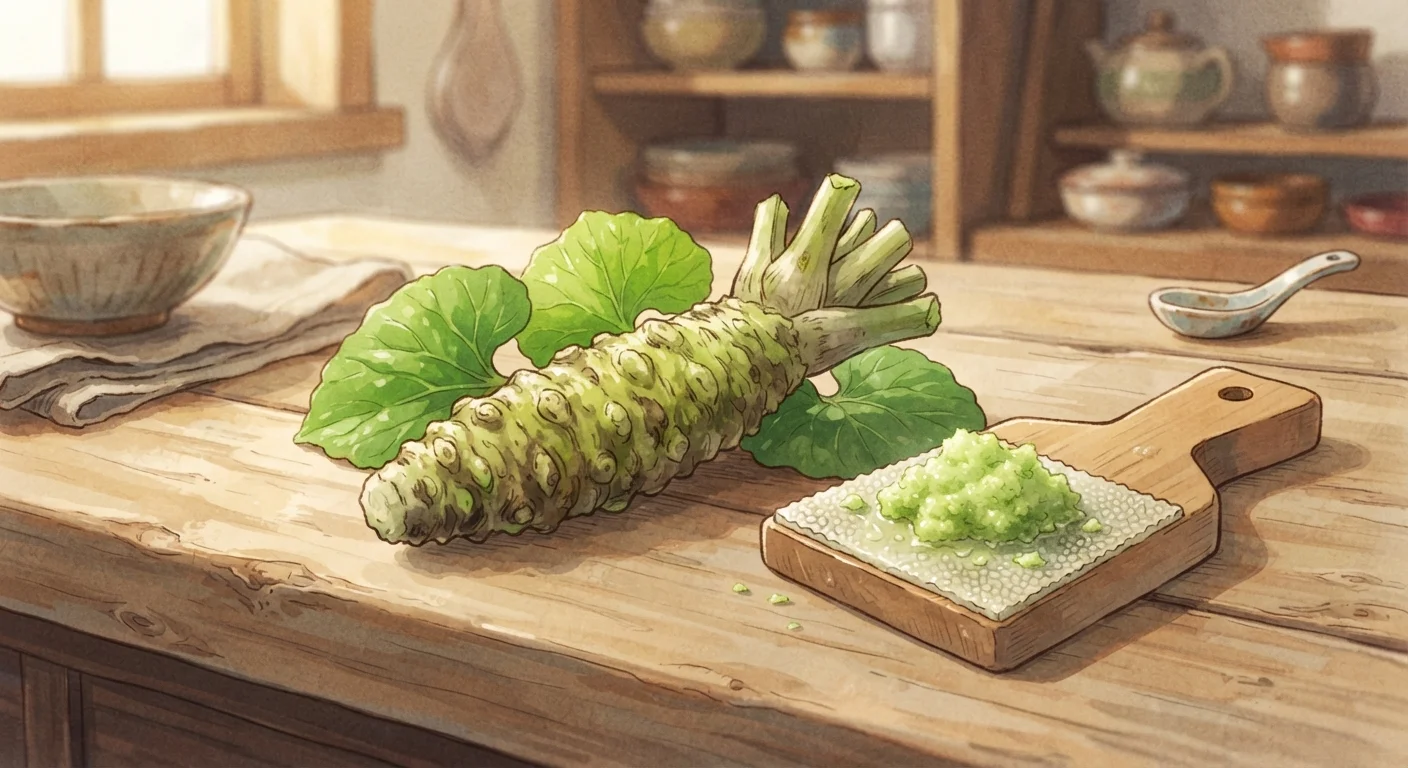
Wasabi (わさび) is the grated stem of a Japanese plant in the cabbage and mustard family. Freshly grated, it is pale green, fine and moist, with a clean, sharp heat that rushes up the nose and fades in seconds, followed by a surprising sweetness.
Like shichimi togarashi, it is added at the table, not cooked into the dish. Most of what is sold as wasabi outside Japan is something else: horseradish and mustard, colored green. It shares the nose-clearing heat but none of real wasabi's sweetness or green, fresh flavor.
Key facts at a glance:
- The stem (rhizome) of Eutrema japonicum, grated fresh
- Heat goes up the nose, not onto the tongue, and fades fast
- Real wasabi is rare and expensive outside Japan
- Most tube and powder "wasabi" is mainly horseradish and mustard
- Grated at the last minute for sushi, sashimi and zaru soba
Flavor Profile
Origin
Japan
Traditional Medicine Perspectives
Japanese food tradition
Wasabi has long been served with raw fish in Japan, and Japanese food tradition holds that it helps keep raw fish safe to eat. Laboratory studies have found antimicrobial activity in wasabi isothiocyanates, though the small amount eaten with a piece of sushi is no substitute for fresh fish and careful handling.
Modern Scientific Research
Wasabi's heat comes from isothiocyanates, the same family of compounds that gives mustard seeds their bite, and they only form when the plant's cells are broken. Grating mixes an enzyme, myrosinase, with sulfur compounds in the stem, and the pungent molecules appear. They are volatile, which is why the heat climbs into your nose and why grated wasabi loses its flavor quickly.
One of these compounds, 6-MSITC, has been studied for brain health. In a 2023 trial published in Nutrients, 72 healthy adults aged 60 and over took either a capsule with 0.8 mg of 6-MSITC or a placebo every night for 12 weeks.
The wasabi group did better on tests of working memory and episodic memory, but showed no change in attention, processing speed or reasoning.
It was one small study, using a concentrated extract rather than wasabi itself, and the capsules were supplied by a wasabi company. It's a reason for more research, not a reason to eat wasabi by the spoonful.
Cultural History
Wasabi grows wild along cold mountain streams in Japan, Sakhalin and the Korean Peninsula. According to Wikipedia's entry on wasabi, the oldest record of it as a food dates to the 8th century.
It is a difficult crop. The plant dislikes direct sun, wants cool, clean running water and takes a long time to reach a usable size. The traditional terraced wasabi fields of the Izu Peninsula in Shizuoka are recognized as a Globally Important Agricultural Heritage System, and Azumino in Nagano is home to one of the largest wasabi farms in the world.
Outside Japan, real wasabi is rare enough that many sushi restaurants serve a horseradish blend instead.
The leaves are eaten too. In Shizuoka, they are pickled in sake lees to make wasabizuke, a local specialty.
Culinary Uses
Real wasabi is grated to order and eaten within minutes, while it is at its most fragrant.
- With sashimi and sushi, where a little is dabbed onto the fish rather than stirred into the soy sauce
- In the dashi and soy dipping sauce for zaru soba, with scallions
- With grilled steak and soy sauce, a common pairing in Japan
- Stirred into mayonnaise, dressings or mashed potatoes
Wasabi flavors the fish. Dissolving a lump of it in your soy sauce mostly just makes the soy sauce hot.
Tube and powdered wasabi are fine for dressings and sauces, where the heat matters more than subtlety. Check the label: products that list wasabi first taste noticeably greener and sweeter.
There is even a wasabi Kit Kat, made with Tamaruya wasabi from Shizuoka, though Japanese buyers rank it near the bottom.
Preparation Methods
To grate fresh wasabi, trim the top and rub the stem in a slow circular motion on a fine grater. Japanese cooks traditionally used sharkskin graters; metal oroshigane graters are common today. A very fine rasp works too.
Grate only what you need and let it sit for a minute so the flavor develops, then use it right away, before it fades.
Wrap an unused stem in a damp paper towel, put it in a container in the fridge and rinse it every couple of days. Kept cold and damp, it lasts a few weeks. For powdered wasabi, mix with an equal amount of water, cover and wait a few minutes before serving.
Comments
Share your thoughts on this ingredient.
Sign in to comment0 Comments