Vietnamese Cuisine
Cha Ca La Vong (Hanoi Turmeric Fish with Dill)
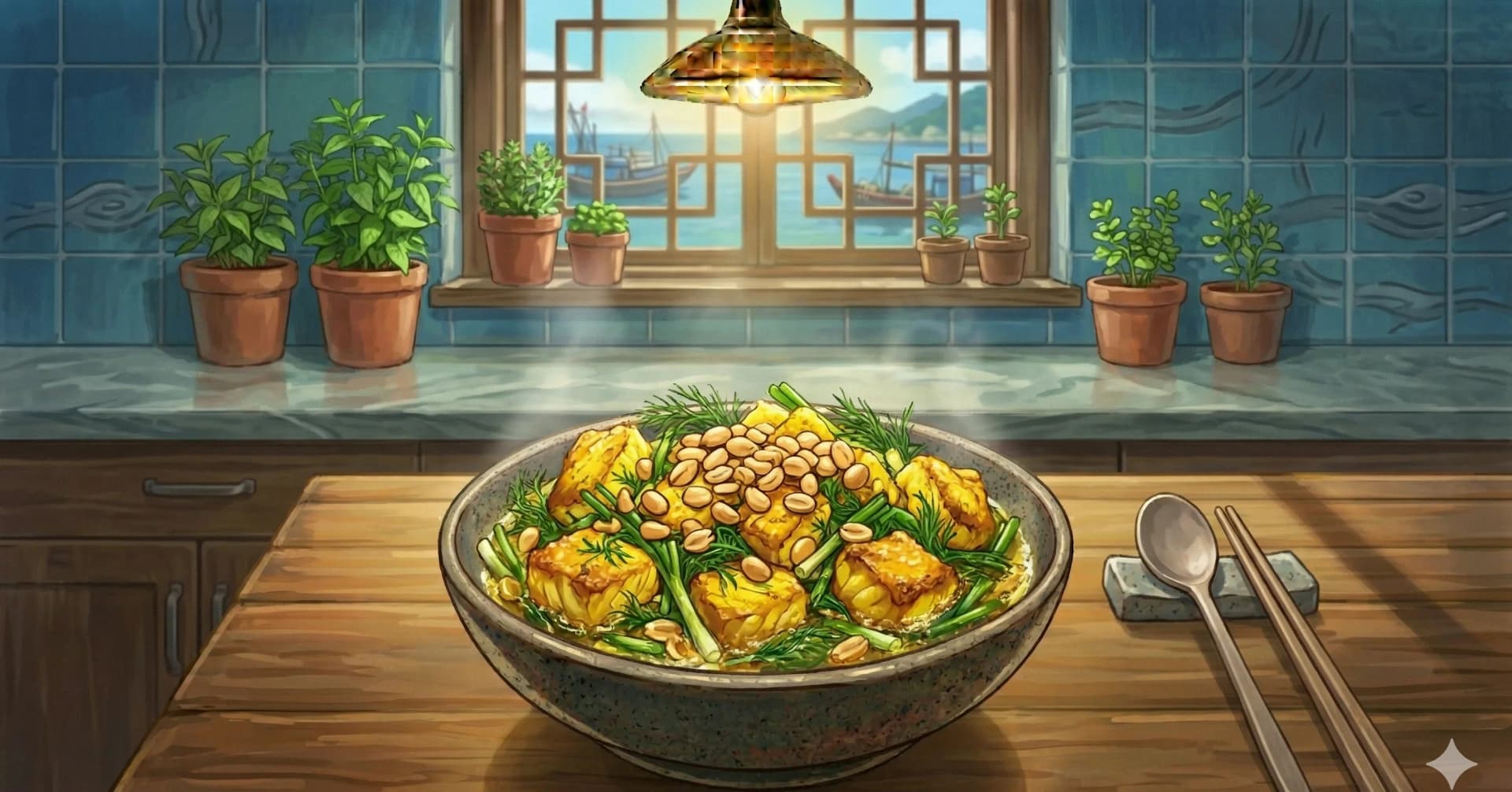
Golden turmeric-marinated fish seared with clouds of fresh dill and green onions, served over rice noodles with roasted peanuts and fermented shrimp dipping sauce
Cha ca la vong is named after a street in the Old Quarter of Hanoi, where a single restaurant made this dish famous enough to rename the road after it. The original establishment, Cha Ca La Vong, has served turmeric-stained fish on sizzling skillets since the late nineteenth century, and the dish now appears in nearly every Vietnam guidebook and food program. It is one of those rare preparations where a city and a recipe have become inseparable.
The dish is built on a simple idea: chunks of mild white fish are marinated in turmeric, galangal, garlic, shallots, and fish sauce, then fried until golden and transferred to a hot skillet with a generous pile of fresh dill and green onions. The aromatics wilt in the residual heat and the oil takes on the fragrance of everything it touches. At the table, you pull together your own bowl from the communal components: noodles, fish, herbs, a scattering of roasted peanuts, and a spoonful of mam tom, the pungent fermented shrimp sauce that ties the whole plate together.
What makes cha ca la vong worth cooking at home is the experience of eating it. The dish is deconstructive by design, meant to be assembled and reassembled bite by bite. You can wrap everything in moistened rice paper, or simply pile it all into a bowl and drizzle the sauce on top. Either way, each bite offers a slightly different ratio of crisp fish, soft noodle, bright herb, and salty-funky sauce. It shares the same do-it-yourself spirit as bun cha and goi cuon, where the pleasure is as much in the building as in the eating. The turmeric stains everything it touches a warm gold, and if your cutting board looks like a sunset afterward, you have done it right.
At a Glance
Yield
4 servings
Prep
20 minutes (plus 30 minutes marinating)
Cook
20 minutes
Total
1 hour 10 minutes
Difficulty
Easy
Ingredients
Fish Ingredients
- 1½ lbwhite fish fillets (catfish, swai, tilapia, or halibut), cut into 4 cm pieces
- 1/2 tspfine sea salt
- 1 tspfish sauce
- 1 tspgranulated sugar
- 1 tspturmeric powder
- 1 tspfinely grated galangal or fresh ginger
- 2 clovesgarlic, finely grated
- 2 tbspfinely minced shallots
- ½ cupcornstarch, for coating
- —Neutral oil for deep frying (about 500 ml)
- 1large bunch fresh dill (about 40 g), cut into 5 cm lengths
- 4green onions, cut into 5 cm segments
- 1small yellow onion, peeled and cut into thin wedges
- 1 tbspneutral oil
Dipping Sauce Ingredients
- 1 tbspfermented shrimp paste (mam tom)
- 2 tbspwarm water
- 1 tspgranulated sugar
- 2 tbspfresh lime juice (about 1 lime)
- 1 clovegarlic, finely minced
- 1to 2 bird's eye chilies, thinly sliced (optional)
To Serve
- 1 lbdried rice vermicelli noodles (bun), cooked according to package directions
- 2 ozroasted salted peanuts
- —Rice paper rounds (banh trang), if desired
- —Sesame rice crackers (banh trang me), if available
- —Lime wedges
- —Fresh herbs: cilantro, mint, Thai basil (optional)
Method
- 1
Place the fish pieces in a mixing bowl. Add the salt, fish sauce, sugar, turmeric powder, grated galangal, garlic, and shallots. Toss gently until each piece is evenly coated in the golden marinade. Cover and refrigerate for at least 30 minutes or up to 2 hours. The turmeric will stain the fish a deep yellow and the aromatics will begin to perfume the flesh.
- 2
Remove the fish from the refrigerator about 10 minutes before frying. Spread the cornstarch on a plate. Working in batches, press each piece of fish lightly into the cornstarch, turning to coat all sides, and shake off any excess. The coating should be thin and even, not clumpy.
- 3
Pour enough oil into a deep skillet or wok to reach a depth of about 2.5 cm. Heat over medium-high until the oil reaches approximately 180C (350F). Test readiness by dropping a small pinch of cornstarch into the oil; it should sizzle immediately and float to the surface. Fry the fish in batches, being careful not to crowd the pan. Cook for about 5 minutes, turning once halfway through, until the pieces are golden brown on all sides and the crust feels firm when tapped with tongs. Transfer to a plate lined with paper towels or a wire rack set over a tray. The residual heat will finish cooking the centers while the coating stays crisp.
- 4
While the fish drains, prepare the mam tom dipping sauce. In a small bowl, combine the fermented shrimp paste with the warm water and stir until dissolved. The mixture will look pale purple. Add the sugar and lime juice and stir until the sugar dissolves. Mix in the garlic and sliced chilies if using. Taste and adjust: it should be salty, tangy, and slightly sweet, with the shrimp paste providing a deep funky undertone rather than an overwhelming punch.
- 5
Heat a cast-iron skillet or heavy pan over medium heat with 1 tablespoon of oil. Add the yellow onion wedges and cook, stirring occasionally, until they soften and develop light golden edges, about 2 minutes. Add the green onion segments and toss for 30 seconds until they brighten. Add the dill and cook for about 1 minute, just until the fronds begin to wilt and release their herbal fragrance. The dill should still have some structure and not turn to mush.
- 6
Arrange the fried fish pieces over the bed of aromatics in the skillet. Scatter the roasted peanuts on top. Bring the skillet directly to the table while it is still hot.
- 7
Cook the rice vermicelli according to package directions, usually by soaking in boiling water for 3 to 5 minutes until tender but still slightly chewy at the center. Drain, rinse under cold water to stop cooking and remove excess starch. Shake dry and portion onto a serving platter or individual plates.
- 8
Set out the noodles, dipping sauce, rice paper, sesame crackers, lime wedges, and fresh herbs on the table. Each person assembles their own bowl: lay down some noodles, add pieces of fish with dill and onion, drizzle with a spoonful of mam tom sauce, and finish with peanuts and a squeeze of lime. Alternatively, wrap everything in a piece of moistened rice paper for a handheld bundle.
Key Ingredient Benefits
Turmeric: The bright yellow spice provides curcumin, which has been extensively studied for anti-inflammatory and antioxidant properties. In culinary quantities, absorption is limited, but pairing turmeric with fat (as in the oil-based marinade and frying here) modestly improves bioavailability. Turmeric has a long history in Vietnamese, Indian, and Southeast Asian traditional medicine, where it is used in topical applications and consumed in teas and curries for general wellness support.
Galangal: A rhizome in the ginger family with a sharper, more citrusy bite than common ginger. It contains galangin and alpinin, compounds with preliminary antioxidant activity observed in cell studies. In Vietnamese and Thai cooking, galangal appears in soups, marinades, and curry pastes. It is considered warming in traditional Vietnamese herbal practice.
Fermented shrimp paste (mam tom): Produced by salting and fermenting small shrimp for weeks to months. The result is a concentrated paste rich in free glutamic acid, providing deep umami. It is high in sodium and should be used in measured amounts. The fermentation process also generates B vitamins, including B12, though amounts vary by brand and production method.
Dill: Widely used in northern Vietnamese cooking, particularly in fish dishes. The herb contains carvone, limonene, and other volatile oils traditionally associated with digestive comfort. Dill is a source of manganese and small amounts of vitamin A and vitamin C. Its distinctive anise-like fragrance is heat-sensitive, which is why it is added at the very end of cooking.
White fish: Catfish, tilapia, and swai are lean protein sources with modest omega-3 fatty acid content. Halibut and cod offer slightly higher omega-3 levels. All provide complete protein, B12, selenium, and phosphorus. Firm-fleshed varieties hold their shape better when cubed and fried.
Why This Works
The cornstarch coating on the fish serves two purposes. It creates a thin, shatteringly crisp shell that contrasts with the soft flesh inside, and it protects the delicate fish pieces from falling apart during frying. The coating is light enough that it does not mask the turmeric marinade underneath, and the residual yellow color bleeds through, keeping the golden appearance intact.
Deep frying the fish before adding it to the aromatic skillet means you get both textures in one dish: the exterior stays crisp from the fryer while the dill and onion contribute a softer, more fragrant layer. If you were to pan-sear the fish directly with the herbs, as some versions do, the fish would absorb more oil and lose its crunch. The two-stage cooking keeps each element distinct.
Galangal in the marinade provides a sharper, more peppery note than ginger alone. It cuts through the earthiness of the turmeric and keeps the marinade from tasting flat. Even a small amount makes a measurable difference in the aromatic complexity of the finished fish, much the same way it functions in Thai preparations like turmeric fried fish.
The mam tom dipping sauce works because the fermentation process has already broken down the shrimp proteins into free amino acids, creating a concentrated source of umami. Diluting it with water and lime juice tames the intensity while preserving the depth. The sauce fills the same role as the nuoc cham in bun cha, but with a heavier, more complex flavor that stands up to the richly seasoned fish.
Fresh dill is the defining herb of this dish, and its late addition to the skillet is deliberate. Dill loses its flavor rapidly under sustained heat, so the brief wilting preserves most of its anise-like aroma while softening the texture just enough to meld with the onions and fish.
Substitutions & Variations
Fish: Catfish and swai are the closest to the traditional freshwater fish used in Hanoi. Tilapia and halibut work well for a milder flavor. Monkfish offers an especially firm, almost lobster-like texture that holds up beautifully to frying and tossing. Avoid very delicate fish like sole or flounder, which will break apart. For a comparison of how turmeric pairs with different fish preparations, see turmeric fried fish and pla nueng manao, which takes a gentler steaming approach.
Galangal: If unavailable, substitute with an equal amount of fresh ginger plus a small pinch of white pepper. The flavor will be slightly different but still aromatic and warm.
Fermented shrimp paste (mam tom): If you find mam tom too pungent, replace the dipping sauce entirely with nuoc cham (a mixture of fish sauce, lime juice, sugar, water, garlic, and chili). The dish will be milder but still satisfying. Mam ruoc, a similar fermented paste made from a different type of small shrimp, can be used interchangeably with mam tom, though it tends to be darker in color.
Broiling method (Andrea Nguyen's approach): Instead of deep frying, arrange the marinated fish on a foil-lined rack set inside a baking sheet. Broil about 10 cm from the heat source for 8 minutes, turn carefully, and broil for 5 to 8 minutes more until tinged brown on both sides. This produces a lighter result with less oil. After broiling, top the fish with the dill and green onions and pour 60 ml of hot oil over them to wilt the herbs.
Pan-searing method: For a lighter preparation, skip the cornstarch coating and sear the marinated fish in 2 tablespoons of oil over medium-high heat, about 3 minutes per side, until cooked through. Then proceed with the aromatic skillet step. The fish will be softer without the crisp shell but absorbs the herbs more directly.
Sour cream in the marinade: Some recipes, following Andrea Nguyen's adaptation, add 2 tablespoons of sour cream or plain yogurt to the marinade. This substitutes for the traditional Vietnamese me (fermented rice mash), adding a subtle tang and helping the marinade cling to the fish. It is not essential but worth trying for a slightly richer coating.
Cornstarch: Rice flour can be used in place of cornstarch for the coating. It produces a slightly grainier crust that stays crisp a bit longer.
Serving Suggestions
Cha ca la vong is traditionally a complete meal on its own, with the noodles, fish, and herbs providing everything you need. At Hanoi restaurants, it is the only dish served, and nothing else is expected on the table.
For a larger Vietnamese spread at home, start with goi cuon, the fresh spring rolls that share the same herb-and-noodle foundation and offer a cool, clean opening. The light, uncooked wrapper contrasts nicely with the fried fish that follows.
If you are building a Hanoi-inspired dinner, pho bo or a light broth soup would work well as a first course, though traditionally these dishes would not appear at the same meal.
Cold bia hoi (Vietnamese draft lager) or a light pilsner is the classic drink pairing. The carbonation and mild bitterness cut through the richness of the fried fish and the intensity of the mam tom sauce. A glass of cold tra da (iced tea) works equally well for a non-alcoholic option.
For dessert, fresh tropical fruit is the most natural finish. Sliced mango, rambutan, or longan keeps the meal light after the richly seasoned fish.
Storage & Reheating
Fried fish: Store in a sealed container in the refrigerator for up to 2 days. Reheat in a skillet over medium-high heat with a small amount of oil, turning once, until the exterior crisps again and the interior is warmed through, about 2 to 3 minutes per side. Microwaving will warm the fish but softens the cornstarch crust. An oven at 200C (400F) for 5 to 7 minutes on a wire rack also restores some crispness.
Dipping sauce: Keeps refrigerated for up to 5 days. The garlic flavor will intensify over time. Stir well before serving and add a fresh squeeze of lime to brighten it after storage.
Noodles: Cooked rice vermicelli does not store well. It hardens and clumps in the refrigerator. Cook fresh noodles for each serving. They take only a few minutes, so this is not burdensome. To soften leftover noodles, sprinkle with water and microwave for 60 to 90 seconds.
Aromatics: The wilted dill and onions are best eaten immediately and do not reheat well. Prepare fresh herbs for leftovers.
Marinated fish (uncooked): Can be refrigerated for up to 24 hours before frying. Can also be frozen on a parchment-lined tray in a single layer, then transferred to a zip-top bag for up to 1 month. Thaw in the refrigerator overnight before coating and frying.
Cultural Notes
Chả cá Lã Vọng is one of the most precisely located dishes in Vietnamese cooking. It is named after Chả Cá Street in Hanoi's Old Quarter, and the street itself was originally named after the dish rather than the other way around. The original Chả Cá Lã Vọng restaurant, founded in 1871 by the Doãn family, is considered one of the oldest continuously operating restaurants in Vietnam. The address is 14 Chả Cá Street. The restaurant has served basically nothing but this one dish, prepared the same way by the same family lineage, for more than 150 years.
The Doãn family origin story ties the dish to the late-19th-century Vietnamese resistance against French colonial rule. According to family tradition, the restaurant was originally a meeting place for nationalist intellectuals and revolutionaries who needed cover for their political organizing. A small wooden statue of Lã Vọng, a legendary Chinese fishing-philosopher figure, sat on display in the dining room and worked as a symbolic identifier for those in the know. After Vietnamese independence in 1954, the Doãn family added the Lã Vọng name formally to both the dish and the restaurant.
Chả Cá Street today has several restaurants serving variants of the same dish (Chả Cá Anh Vũ, Chả Cá Thanh Long), each claiming some lineage or culinary connection back to the original. The original Chả Cá Lã Vọng is the most prestigious and the most expensive, drawing both international tourists and Hanoi locals on special occasions. The preparation has stayed almost unchanged for over a century: turmeric-marinated fish gets seared tableside in a hot pan with clouds of dill and scallion, then served over rice noodles with peanuts, herbs, and mắm tôm (fermented shrimp paste).
The BBC named chả cá Lã Vọng one of the "100 things to eat before you die" in 2010, which brought a noticeable bump in international recognition. The restaurant did not need it. People had been showing up for over a century already.
Nutrition Facts
Calories: 430kcal (22%)|Total Carbohydrates: 48g (17%)|Protein: 30g (60%)|Total Fat: 18g (23%)|Saturated Fat: 3.5g (18%)|Cholesterol: 94mg (31%)|Sodium: 580mg (25%)|Dietary Fiber: 1g (4%)|Total Sugars: 2g
You Might Also Like
Ratings & Comments
Ratings & Comments
Ratings
Share your thoughts on this recipe.
Sign in to rate and comment