Cross-Cultural · India
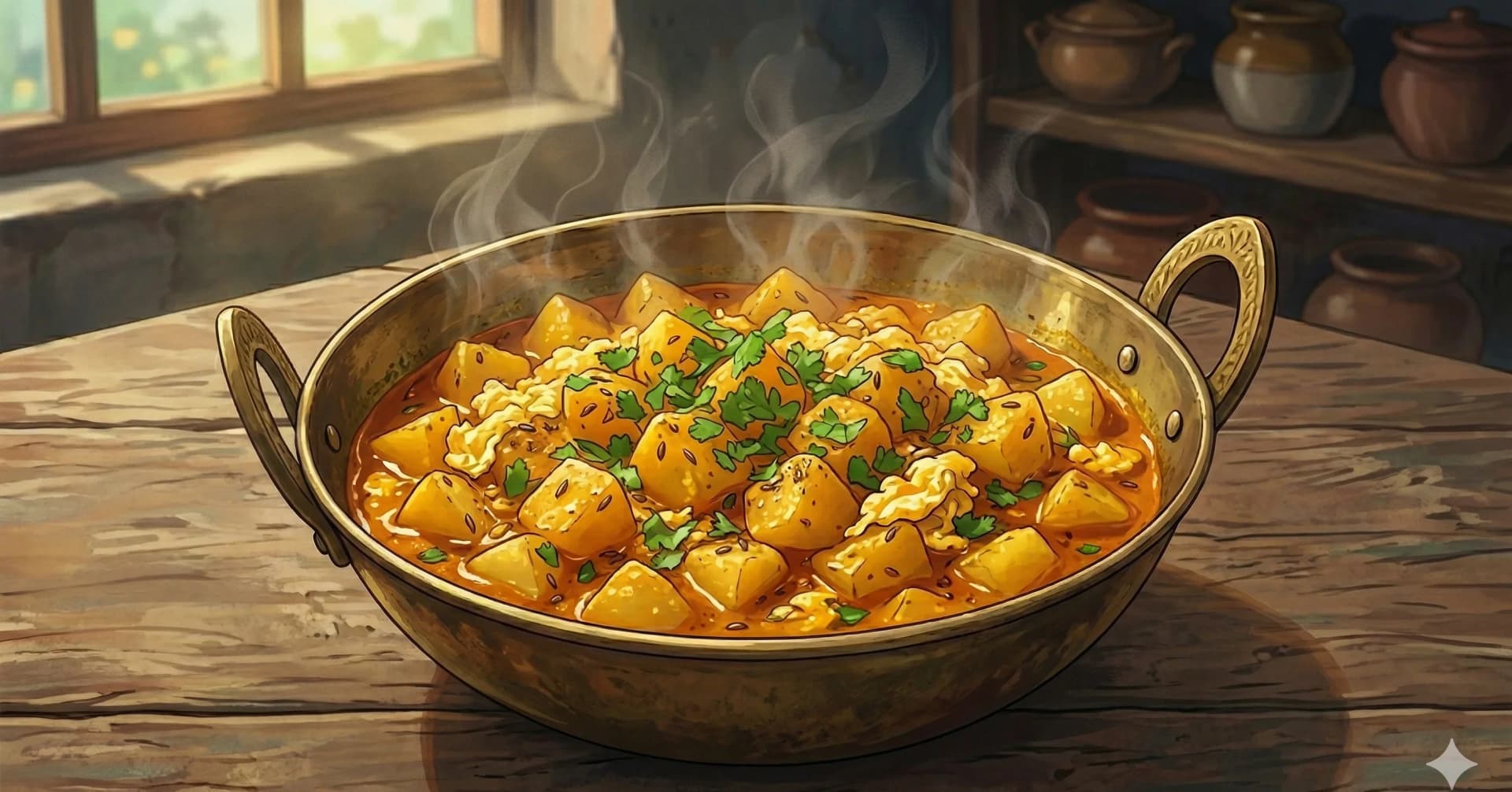
Mughlai Braised Potatoes (Ghurma Aloo)
Cumin-scented potatoes simmered with tomatoes, turmeric, and cayenne, a 30-minute one-pot curry of Iranian origin adapted through North Indian kitchens
Ghurmas are thick-sauced stews of Iranian origin, spiked with dry herbs and thickened with vegetables. This one traveled through North Indian boarding school kitchens and became a weeknight staple, the kind of dish that feeds a table with almost nothing in the pantry. Potatoes, an onion, a tomato, cumin seeds, turmeric, and cayenne. That is the entire ingredient list.
The technique is straightforward: bloom cumin seeds in hot oil until they sizzle and turn reddish-brown, which takes about five seconds. Potatoes and onion stir-fry until the edges brown. Water goes in, the lid goes on, and the potatoes simmer until almost falling apart. The tomato and cilantro go in last and cook for just two minutes. This is not a fancy dish. It is a dish that a cook of Iranian ancestry made for boarding school students who were hungry and needed something good.
At a Glance
Yield
6 servings
Prep
10 minutes
Cook
25 minutes
Total
35 minutes
Difficulty
Easy
Ingredients
- 1.5 lbsrusset or Yukon Gold potatoes (680 g), peeled, cut into 1/2-inch cubes
- 2 tbspcanola or vegetable oil
- 1 tbspcumin seeds
- 1small red onion, cut into 1/2-inch cubes
- 1 tspground turmeric
- 2 tspcoarse salt
- 1 tspcayenne pepper
- 1 cupwater
- 1medium tomato, cut into 1-inch cubes
- 2 tbspfresh cilantro, finely chopped
Method
- 1
Bloom cumin seeds in hot oil for 5-10 seconds until reddish-brown and fragrant.
- 2
Add potatoes, onion, turmeric, and tomato. Stir-fry 4-6 minutes until lightly browned.
- 3
Add salt, cayenne, 1 cup water. Cover, simmer 18-20 minutes until potatoes are fall-apart tender.
- 4
Stir in cilantro. Cover, simmer 2 minutes. Serve.
Key Ingredient Benefits
Potatoes: The structural foundation of the curry. Russet or Yukon Gold potatoes work best — both are high enough in starch to partially break down during the simmer, naturally thickening the sauce. Potatoes contribute about 110 calories per medium potato, complex carbohydrates, vitamin C, potassium, and small amounts of B6. Indian cooking treats potatoes as one of the most versatile vegetables, suitable for everything from dry preparations like aloo gobi to brothy curries like this one.
Cumin seeds: The aromatic backbone of the dish. Whole cumin seeds are bloomed in hot oil at the very start, releasing their volatile oils into the cooking fat — a technique called tadka or tarka. Cumin contains cuminaldehyde and other terpenes that contribute the characteristic warm, earthy aroma. The brief bloom is non-negotiable; cumin added at the end of cooking has a fraction of the impact.
Onion: Provides sweetness and body. The onion is added with the potatoes and lightly browned before the spices go in. As it cooks, the onion's sugars caramelize and the moisture evaporates, concentrating flavor.
Turmeric: Contributes color and an earthy, slightly bitter depth. The active compound curcumin has been extensively studied for anti-inflammatory effects, though absorption is poor without fat and black pepper to enhance bioavailability. Both are present in this dish (ghee/oil and the cayenne).
Cayenne: Provides heat. Amount is adjustable; the traditional version is moderately spicy but not aggressively so. Cayenne contains capsaicin (the heat compound) along with vitamin A and small amounts of other nutrients.
Tomato: Added at the very end. Provides freshness, acidity, and color. The tomato is barely cooked — just warmed through — to preserve its bright flavor and act as a counterpoint to the deeply-cooked potato.
Cilantro (coriander leaves): Final fresh herb garnish, added off-heat to preserve the bright, citrusy notes. About 10% of people have a genetic variation that makes cilantro taste soapy; substitute parsley or omit if needed.
Why This Works
Blooming cumin seeds in hot oil is the technique that separates this from a generic potato curry. The seeds are added to hot oil and watched carefully — they should sizzle immediately and turn a shade darker within 5 to 10 seconds. The aromatic compounds in cumin are oil-soluble, and the brief high-heat exposure pulls them into the cooking fat, which then flavors everything that follows. Burnt cumin (more than 15 seconds at high heat) becomes acrid and bitter — pull from heat the moment it turns reddish-brown.
The potatoes go in raw, not pre-boiled. This is essential. Adding raw potatoes to the seasoned oil and letting them brown slightly at the edges develops Maillard-derived flavor compounds that pre-boiled potatoes lack. The potatoes then absorb the spiced cooking liquid as they simmer, becoming flavored throughout rather than just sauce-coated.
Simmering covered with limited water (just 1 cup for a full batch) produces the right consistency. The water creates steam to cook the potatoes through, but the small quantity means the final result is thick rather than soupy. As the potatoes cook, their starch releases into the liquid, naturally thickening the sauce. No additional thickener is needed.
Adding tomato only at the very end (just 1 to 2 minutes before serving) preserves its bright, fresh acidity. Long-cooked tomato becomes muted and stewy; briefly-warmed tomato retains its character and provides the dish's necessary acidic counterpoint to the rich cumin-and-spice base. The same principle drives the late tomato addition in many other Indian preparations.
The dish should be slightly dry rather than soupy. As it cooks, the moisture reduces and the potatoes break down slightly at the edges, creating a thick sauce that clings to the potato chunks. If too dry, add a tablespoon of water; if too wet, simmer uncovered for a few minutes.
Substitutions & Variations
Potatoes: Yukon Gold or russet work best. Red potatoes produce a slightly firmer result. Sweet potatoes work and produce a sweeter, milder curry — adjust the heat down. New potatoes can be used whole.
Cumin seeds: Whole are essential for this dish — ground cumin produces a flatter, less aromatic result. If only ground is available, use 1 teaspoon ground cumin added after the oil is hot but before the potatoes go in.
Onion: Yellow or red both work. Shallots produce a sweeter, more refined result. Without onion (some traditional versions skip it), the dish remains good but slightly less complex.
Turmeric: Cannot be substituted without losing the color and earthy depth. Curry powder is too complex and not appropriate.
Cayenne: Adjust to taste. Kashmiri chili powder (less spicy, more color) is a popular variation. Aleppo pepper substitutes well. For non-spicy version, omit entirely and add a pinch of paprika for color.
Tomato: Fresh ripe tomato is best. Canned diced tomato works but adjust the acidity (canned tomatoes are usually more acidic than fresh). Skip in winter when fresh tomatoes are poor; the dish remains good.
Cilantro: Flat-leaf parsley substitutes acceptably. Mint can work as a non-traditional addition. Skip if needed.
Oil: Neutral vegetable oil is standard. Ghee produces a richer result. Mustard oil is traditional in eastern Indian versions and adds a sharp, pungent character. Olive oil is not appropriate (the flavor clashes).
Spice additions: Some versions add a pinch of garam masala at the end, a pinch of fennel seeds with the cumin, or a small piece of dried red chili. The minimalist version (just cumin, turmeric, cayenne) is the most authentic to the boarding-school origin of this dish.
Protein additions: Some versions add chickpeas (in which case it becomes aloo chana) or green peas (aloo matar) for additional substance. Both work without changing the essential character.
Serving Suggestions
Ghurma aloo is a side dish in most Indian meal contexts, served alongside dal, rice, and a flatbread. It works particularly well with chapati or roti — the soft bread is ideal for scooping up the saucy potatoes.
For a complete vegetarian Indian meal, pair with dal makhani, jeera rice, and a raita (yogurt sauce). The dal provides protein, the rice provides carbs, the potato curry provides vegetable, and the raita provides cooling contrast.
For a casual weeknight meal, serve over rice with just a squeeze of fresh lemon and a dollop of yogurt. The dish is substantial enough to anchor a simple meal.
In boarding school and dhaba tradition (the dish's origins), ghurma aloo appears as part of a thali — a metal platter with several small dishes. The potatoes are one element among many, providing the warm, spicy backbone of the meal.
For brunch or breakfast (some North Indian regions serve this in the morning), pair with puri or aloo paratha — the combination of potato curry and fried bread is a classic Punjabi/North Indian breakfast.
Pair with masala chai, lassi, or cold beer. The dish's moderate spice level suits all three.
Garnish with extra fresh cilantro, a squeeze of fresh lemon, and a few thin slices of fresh red chili for diners who want additional heat.
Storage & Reheating
Refrigerator: Stores excellently for up to 5 days in an airtight container. The flavor genuinely improves overnight as the spices continue to permeate the potatoes. Many North Indian families consider day-old ghurma aloo better than fresh.
Reheating: Stovetop with a splash of water for 5 to 7 minutes is the best method. The potatoes will absorb water and continue to break down slightly, which is desirable. Microwave works in a pinch — heat in 1-minute intervals, stirring between.
Make-ahead: Designed to be made ahead. The entire dish can be prepared up to 3 days in advance and refrigerated. Particularly useful for meal prep — a single batch lasts 5 days as a side dish.
Freezing: Acceptable for up to 2 months. Potato texture suffers slightly on thawing — some cells break down further, producing a slightly softer result. Still tasty but textually different.
Make-ahead tip for entertaining: Cook to about 80% done, then finish reheating just before serving. The final 5 minutes of cooking absorbs more liquid and slightly thickens the sauce, producing a fresh-tasting result.
Pre-prep: The potatoes can be cut hours in advance and held in a bowl of water (drain and pat dry before cooking). The onion can be diced a day ahead. The spice mixture can be measured days in advance into a small container.
Leftover use: Chop coarsely and use as a filling for paratha or samosa. Mash and use as a topping for dosa or as a sandwich filling.
Cultural Notes
Ghurma aloo represents a specific style of Indian cooking that emerged from the cross-cultural exchange between Iranian/Persian cooking traditions and North Indian regional kitchens. The word ghurma (also spelled ghorma, gorma, or qhorma) derives from Persian and refers to a category of dishes characterized by thick, rich, slow-cooked sauces. The same root produces qormeh sabzi in Iran, korma in Mughal-influenced North India, and gorma across Central Asia.
The dish's specific style — minimal ingredients, fast cooking, vegetarian, no dairy — reflects a particular subset of this tradition. While Mughal-era korma is rich, dairy-based, and often slow-cooked, this version emerged in more austere contexts: boarding schools, dhaba road-side cafes, and modest home kitchens where cooks needed to feed many people on limited ingredients. The dish's anonymous quality — no famous chef invention, no royal kitchen origin — is part of its character.
The dish appears across North Indian regional kitchens, particularly in Punjabi, Rajasthani, and Uttar Pradeshi cooking. Each region has slight variations: Punjabi versions tend to use more ghee and richer spices; Rajasthani versions may add a pinch of asafoetida; eastern versions sometimes use mustard oil instead of vegetable oil. The recipe represented here is the basic North Indian boarding-school version, the most widely-recognized variation.
The cultural significance of potato in modern Indian cooking is worth noting. The potato is a New World vegetable, introduced to India by Portuguese traders in the 17th century. Within 200 years, the potato had become one of the most important vegetables in Indian cuisine, particularly in North Indian cooking. Dishes like ghurma aloo, aloo gobi, dum aloo, and aloo paratha all date from this period of culinary integration.
The dish's role as a "boarding school staple" reflects a particular Indian institutional cooking tradition. Many of India's elite boarding schools (Mayo College, Doon School, Welham, La Martiniere) developed cooking traditions in their kitchens — often led by cooks from particular regional backgrounds — that produced specific dishes for their student populations. These dishes are often Anglicized or simplified versions of regional preparations, designed to feed large numbers of students efficiently. Ghurma aloo is one such dish — simple, economical, vegetarian, and easily scaled.
The dish's modern persistence reflects its appeal as a weeknight meal. In an era of complex Indian cooking with long ingredient lists and slow techniques, ghurma aloo's 30-minute one-pot simplicity makes it appealing for busy households. The dish has been adopted into modern Indian home cooking far beyond its boarding school origins and now appears in many North Indian household repertoires.
Nutrition Facts
Calories: 140kcal (7%)|Total Carbohydrates: 25g (9%)|Protein: 3g (6%)|Total Fat: 3g (4%)|Saturated Fat: 0.4g (2%)|Cholesterol: 0mg (0%)|Sodium: 662mg (29%)|Dietary Fiber: 4g (14%)|Total Sugars: 2.8g
You Might Also Like
Ratings & Comments
Ratings & Comments
Ratings
Share your thoughts on this recipe.
Sign in to rate and comment