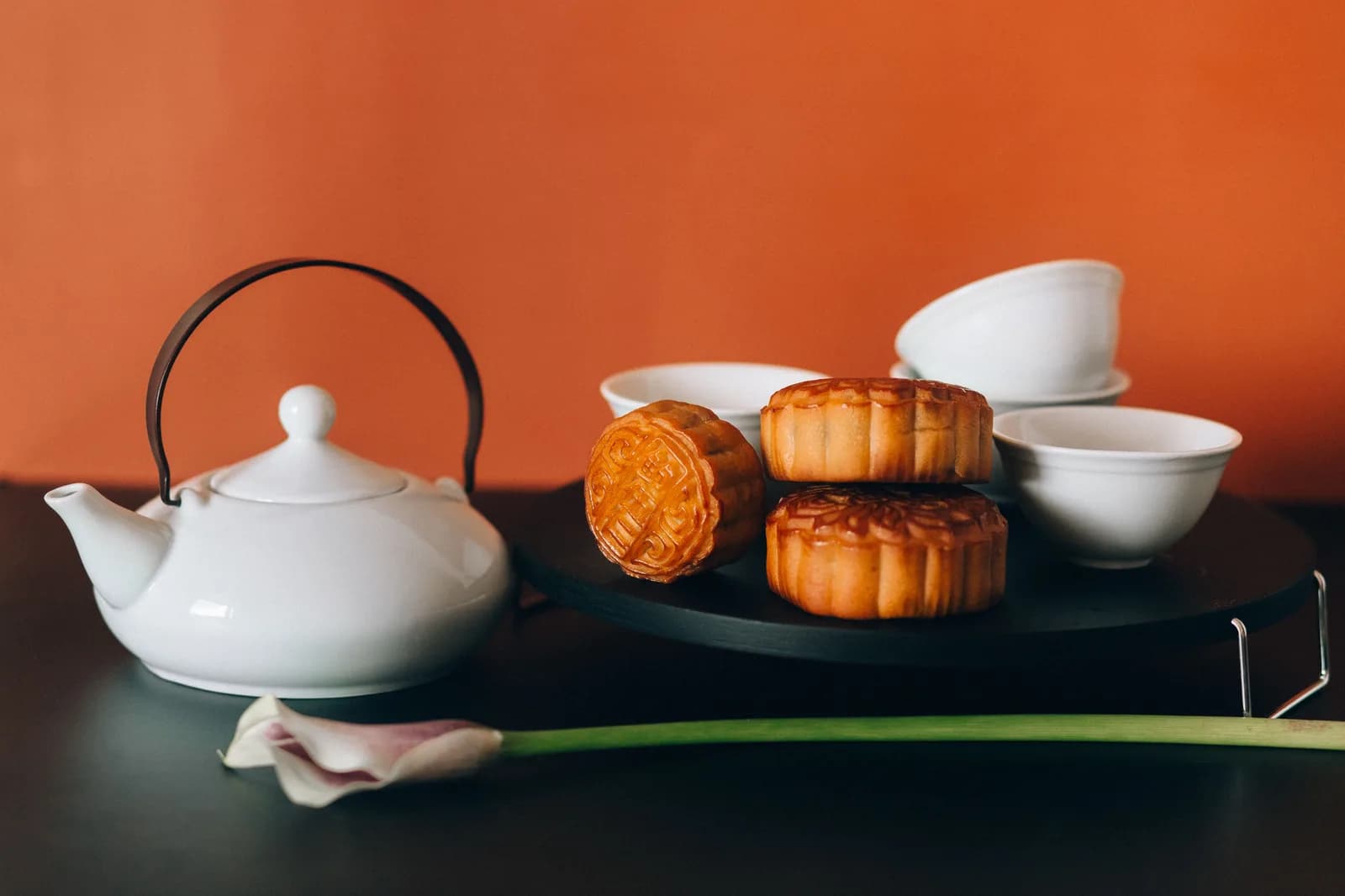
Chuseok and Mid-Autumn: The Moon Festivals, Eaten
On the fifteenth day of the eighth lunar month the moon is at its fullest and closest, the harvest is in, and roughly a quarter of the world's population sits down to eat about it. China calls it Zhongqiu, Korea calls it Chuseok, Vietnam calls it Tet Trung Thu, and Japan keeps a quieter version called Tsukimi.
The same astronomical event, four festivals, and four completely different dinners. What they share is the shape of the occasion: a harvest thanksgiving built around a round moon, and food that is round because of it.
China: the mooncake, which is a lot of work about not much
Mooncakes are dense, heavy, about the size of a hockey puck, and filled with lotus seed paste or red bean, often around a salted duck egg yolk that stands in for the moon. They are pressed in carved wooden moulds so the top carries a character or a pattern.
They are also a genuine acquired taste. A traditional Cantonese mooncake is extremely rich and cut into eighths, and nobody eats a whole one. The custom that matters more than the eating is the giving: boxes of them circulate between families, colleagues and business contacts for weeks beforehand, in packaging that frequently costs more than the contents.
Beyond the cakes, the meal is a family reunion dinner, second only to Lunar New Year in importance. Round foods dominate for the obvious symbolic reason. Hairy crab is in season and shows up on tables across the Yangtze delta, along with pomelo, taro and osmanthus wine.
Korea: Chuseok is about ancestors, not the moon
Chuseok is the largest holiday in Korea, and the whole country moves. People travel to their ancestral hometowns, traffic jams last for many hours, and the central ritual is charye, a memorial table set for the family's ancestors with food arranged by strict positional rules.
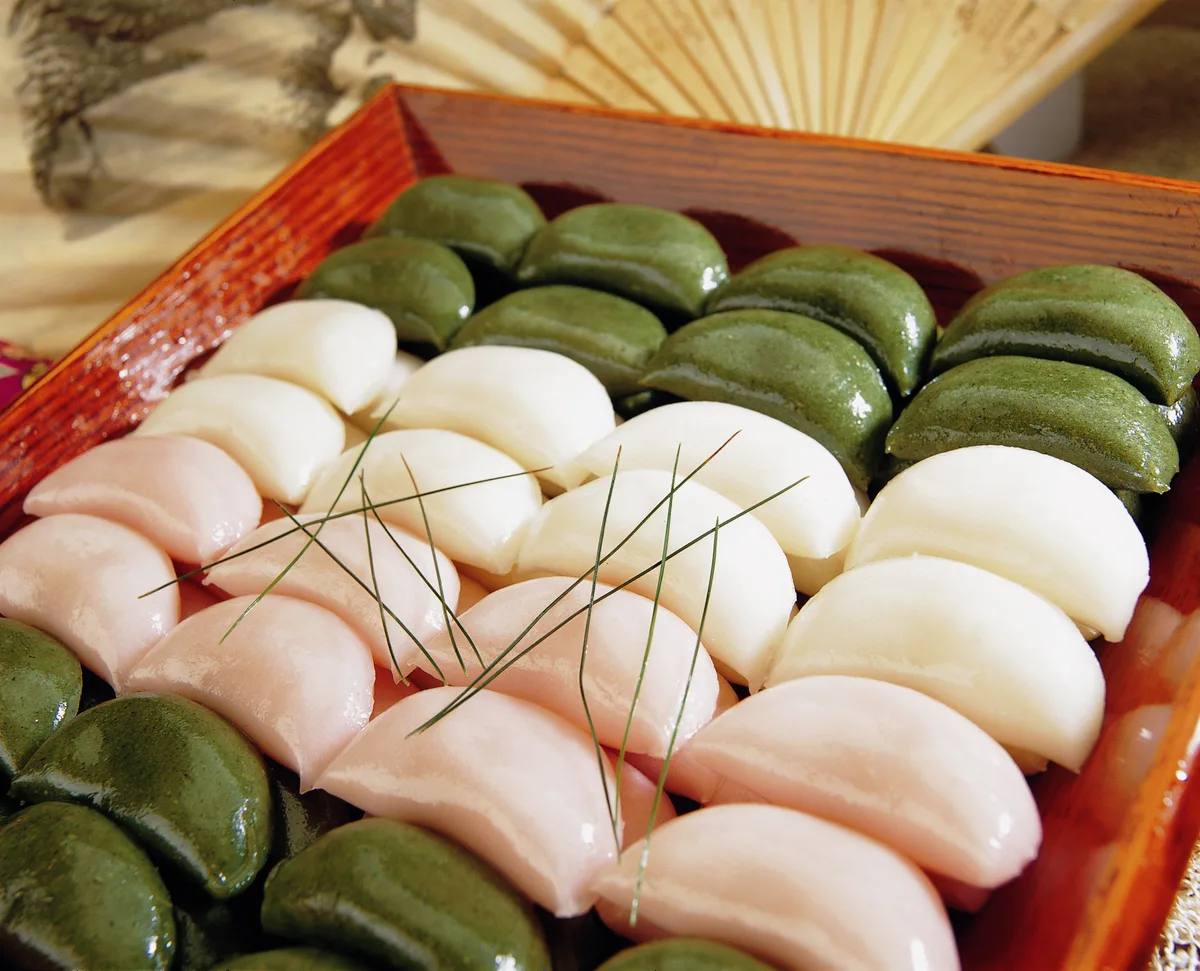
The signature food is songpyeon, half moon rice cakes stuffed with sesame and honey or sweetened bean, steamed over a layer of pine needles that scents them. The shape is the point of an old saying: that a person who makes beautiful songpyeon will have a beautiful child.
The rest of the table is a feast of familiar dishes made in unfamiliar quantity. Japchae, sweet potato noodles with vegetables. Galbi jjim, braised short ribs, which is the celebration dish in Korea more than any other. And jeon, the whole family of pan fried things in egg batter, which appears at every Korean ritual meal: pajeon, hobak jeon with courgette, daegu jeon with white fish.
Making jeon for Chuseok is also, notoriously, hours of standing at a pan, which is why it comes up in every Korean conversation about how the holiday's labour is distributed.
Vietnam: the children's festival
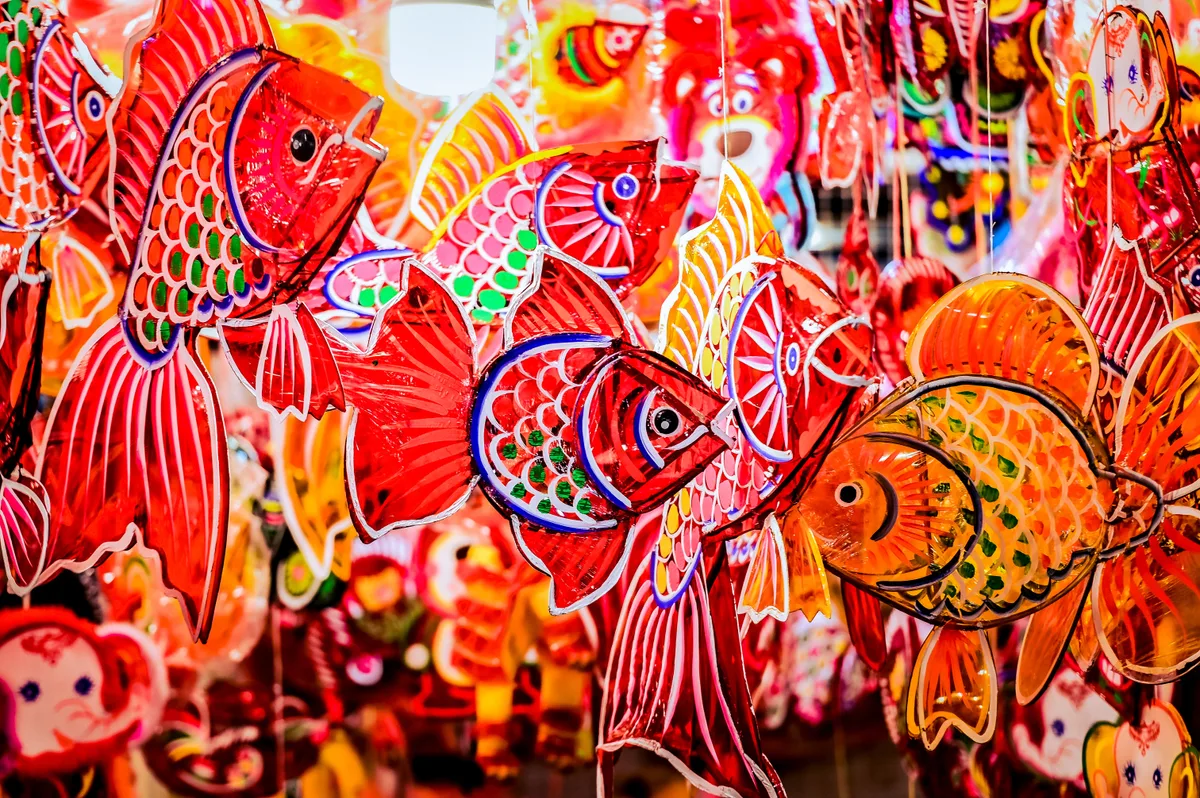
Tet Trung Thu in Vietnam has drifted furthest from the harvest origin and become a festival for children. Lantern processions, lion dances, and star shaped lanterns carried through the streets after dark.
Vietnamese mooncakes come in two forms: banh nuong, baked and similar to the Chinese version, and banh deo, a soft white unbaked cake made from glutinous rice flour and sugar syrup, which has no Chinese equivalent and is the more distinctive of the two.
The origin of the child focus is usually explained as timing. The festival falls just after the harvest, in the window when parents had time for their children again after the busiest weeks of the agricultural year.
Japan: Tsukimi, the restrained one
Japan kept the moon viewing and dropped almost everything else. Tsukimi means moon viewing, and the traditional observance is decorating with pampas grass and offering tsukimi dango, plain white rice dumplings stacked in a pyramid.
There is no feast and no gift economy. The Japanese version is closer to a seasonal aesthetic than a holiday, which is consistent with how a lot of Chinese festivals were received and then pared back in Japan.
The one modern survival is the naming convention: in Japan a raw egg on top of anything is a tsukimi version of that dish, because the yolk looks like the moon. Tsukimi soba, tsukimi udon, and a tsukimi burger that appears at fast food chains every autumn.
Frequently asked questions
Why are mooncakes so expensive?
The packaging and the gift economy, mostly. Mooncakes function as a business and social gift in China, which pushes the market towards elaborate boxes, and premium fillings such as double yolk or abalone add to it. A plain one from a local bakery costs very little.
What is the difference between Chuseok and Mid-Autumn Festival?
The date is the same. The content is not. Mid-Autumn in China centres on family reunion, the moon and mooncakes. Chuseok in Korea centres on ancestral rites and a memorial table, with songpyeon rather than mooncake, and the moon itself is much less prominent.
Do people still perform the ancestral rites?
Fewer households do the full charye than a generation ago, and the practice has shortened considerably in urban Korea. The travel, the food and the family gathering have survived better than the ritual itself.
What to cook
For a Chuseok table, galbi jjim is the centrepiece and worth the long braise, and japchae is the dish that will be gone first. Make pajeon to understand the jeon family, since the technique transfers to every other version. And for the Korean shelf these all draw on, we listed the ingredients to buy first.
Comments
Share your thoughts on this post.
Sign in to comment0 Comments