Korean Cuisine
Hobak Jeon (Pan-Fried Zucchini)
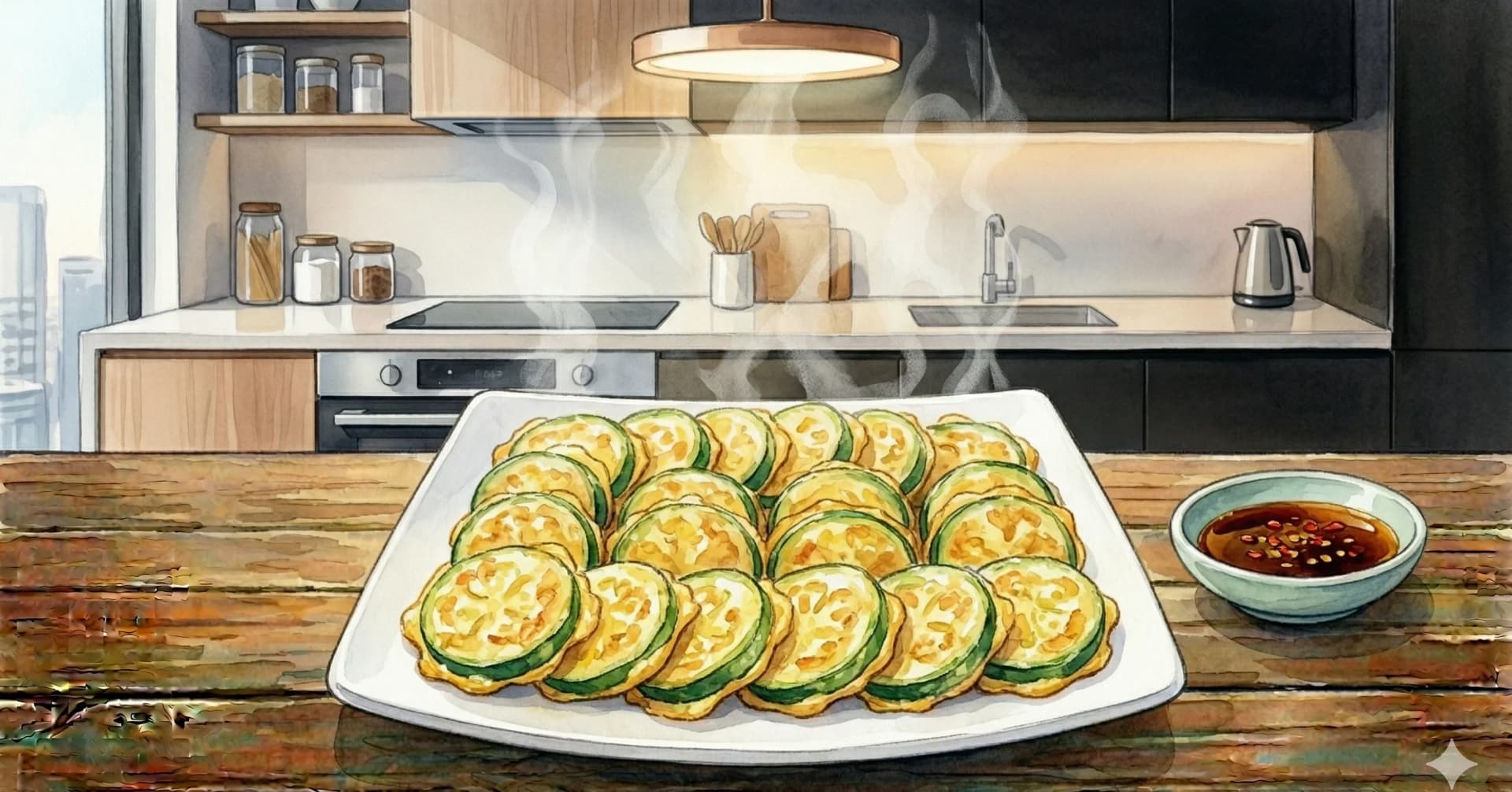
Thin zucchini rounds dipped in egg and pan-fried to a gentle golden finish
There is a quiet elegance to hobak jeon that belies its simplicity. Each round of zucchini wears a thin coat of golden egg, just enough to give it a soft, slightly custardy exterior while the vegetable inside turns tender and sweet from the heat of the pan. It is one of the most basic preparations in the Korean banchan repertoire, and one of the most beloved.
Jeon, the broad category of Korean pan-fried foods, encompasses everything from elaborate seafood pancakes to these humble vegetable rounds. Hobak jeon sits at the simple end of the spectrum, requiring only zucchini, flour, egg, and a pan. Yet this simplicity is what makes it so essential. It appears at holiday feasts (especially during Chuseok and Seollal), on daily dinner tables as banchan, and alongside rice and soup as part of an everyday Korean meal.
What hobak jeon delivers is a gentle, homey comfort. The flavor is mild, almost delicate, with the natural sweetness of zucchini amplified by the brief time in hot oil. The egg coating provides a soft, savory wrapper that turns golden where it touches the pan. There is nothing assertive here, no chili, no fermented paste, just the pure taste of the vegetable enhanced by the simplest of techniques.
The practical insight is to salt the zucchini slices before cooking. A brief rest with salt draws out excess moisture, which would otherwise create steam under the egg coating and prevent it from crisping. Salted and patted dry, the slices fry evenly and the egg adheres without bubbling or separating.
At a Glance
Yield
4 servings (as banchan)
Prep
10 minutes
Cook
15 minutes
Total
25 minutes
Difficulty
Easy
Ingredients
Zucchini Ingredients
- 2medium zucchini (about 400 g total)
- ½ tspfine salt
- 3¾ tbspall-purpose flour
- 2eggs, beaten
- —Vegetable oil for pan-frying
Dipping Sauce Ingredients
- 1 tbspsoy sauce
- 1 tsprice vinegar
- —Pinch of gochugaru (optional)
Method
- 1
Cut the zucchini into rounds about 5 to 7 mm thick. Uniformity matters so they cook at the same rate. Too thin and they will be limp; too thick and the center will not soften by the time the egg browns.
- 2
Spread the zucchini rounds on a plate or cutting board and sprinkle both sides with the salt. Let them rest for 5 to 7 minutes. Small beads of moisture will appear on the surface.
- 3
Pat each slice dry with paper towels, pressing gently to absorb the released moisture. This step ensures the flour and egg adhere properly and the rounds fry rather than steam.
- 4
Set up a dredging station. Place the flour in one shallow dish and the beaten eggs in another. Work near the stove so the coated pieces go into the pan quickly.
- 5
Heat a large nonstick skillet over medium heat with enough vegetable oil to lightly coat the bottom, about 15 ml. The oil should shimmer but not smoke.
- 6
Dredge each zucchini round lightly in flour, shaking off the excess. The flour coating should be barely visible, just a thin dusting that gives the egg something to grip.
- 7
Dip each floured round into the beaten egg, coating both sides. Let the excess drip off for a moment.
- 8
Place the egg-coated rounds in the hot skillet, leaving a little space between each one. They should sizzle gently on contact. Do not crowd the pan, as overcrowding drops the temperature and causes steaming.
- 9
Cook for about 2 minutes on the first side until the egg sets and turns golden. The edges will show a visible ring of golden-brown egg, and the zucchini will begin to look translucent.
- 10
Flip each round carefully with chopsticks or a small spatula. Cook for another 1 to 2 minutes until the second side is equally golden.
- 11
Transfer the finished rounds to a plate lined with paper towels to absorb excess oil. Continue with the remaining zucchini in batches, adding small amounts of oil between batches as needed.
- 12
Make the dipping sauce by stirring together the soy sauce, rice vinegar, and gochugaru if using.
- 13
Arrange the hobak jeon on a serving plate, overlapping slightly. Serve warm or at room temperature with the dipping sauce alongside.
Key Ingredient Benefits
Zucchini (hobak): Korean cuisine uses a variety of zucchini called aehobak, which is slightly shorter and rounder than Western varieties, with a tender skin and sweet flesh. Any green zucchini or summer squash works well. Zucchini provides vitamin C, manganese, and potassium, with very low calorie density.
Eggs: Provide complete protein, choline (important for brain function), and vitamin D. The thin egg coating in this preparation adds minimal calories while providing a significant protein boost.
Why This Works
Salting the zucchini before cooking removes excess moisture, which would otherwise create steam between the vegetable and the egg coating, causing the egg to bubble and separate. Dry surfaces produce better adhesion and more even browning.
The flour layer between the zucchini and the egg acts as an intermediary, giving the wet egg something to grip. Without the flour, the egg tends to slide off the slippery surface of the vegetable.
Medium heat is essential. Too high, and the egg browns before the zucchini inside softens. Too low, and the egg absorbs oil without crisping. At medium heat, the egg sets into a thin, golden layer while the zucchini cooks through gently, becoming tender and sweet.
The thin egg coating is intentional. This is not a battered fritter. The goal is to enhance the zucchini, not mask it. The egg should function almost like a second skin, adding color and a soft texture without hiding the vegetable underneath.
Substitutions & Variations
Other vegetables: This same technique works beautifully with eggplant rounds, sweet potato slices, mushroom caps, perilla leaves, and green pepper halves. A mixed jeon platter (modeum jeon) featuring several vegetables is traditional for Korean holidays.
Stuffed variation: Cut the zucchini into thicker 1.5 cm rounds, hollow out a small well in the center, and fill with seasoned ground beef or tofu before flouring, dipping in egg, and pan-frying.
Without egg: For an egg-free version, a thin batter of flour and water can substitute, though the texture will be slightly different.
Cheese hobak jeon: A modern variation that places a small piece of mozzarella between two zucchini rounds before coating in egg and frying.
Serving Suggestions
Hobak jeon is a banchan side dish, served alongside rice, soup, and other small dishes. It pairs naturally with any Korean meal and is especially common alongside doenjang-jjigae, kimchi-jjigae, or grilled meats. During Korean holidays (Chuseok, Seollal), hobak jeon is part of the jeon platter alongside kimchijeon, pajeon, and various other pan-fried items.
Storage & Reheating
Leftover hobak jeon: Store in an airtight container in the refrigerator for up to 2 days. They are actually quite good eaten cold the next day.
Reheating: Warm in a dry skillet over medium heat for 1 to 2 minutes per side to restore some crispness. An oven at 180°C for 5 minutes also works. Microwaving softens the egg coating.
Not ideal for freezing: The zucchini releases water when thawed, making the texture soggy.
Cultural Notes
Hobak jeon (호박전) is one of the most popular vegetables in the broad Korean jeon (전) tradition. Jeon is a sweeping category of pan-fried, lightly battered foods that covers everything from scallion pancakes (pajeon) and kimchi pancakes (kimchijeon) to fish fillets, mushrooms, lotus root, and even slices of beef. The technique is a foundational Korean cooking method and was historically central to formal court cuisine and to ancestral memorial rituals (jesa, 제사).
The connection to jesa still matters. Korean ancestral rites, performed at Chuseok, Lunar New Year, and family death anniversaries, traditionally require an array of carefully prepared offering foods laid out on a tiered ceremonial table. Several rows of that table are dedicated to jeon of various kinds, and hobak jeon, the round golden gently-colored zucchini slices, is among the standard inclusions. The frying gets done the evening before, often by the family's women working communally, and the leftovers feed the family for days after the rite is over.
In modern everyday Korean cooking, hobak jeon has moved past its ritual roots and become a standard banchan and anju (drinking food) preparation. The gentle, slightly sweet flavor of aehobak (애호박, Korean summer squash) and the soft eggy coating make it one of the few jeon dishes children reliably enjoy.
Hobak jeon is also a fixture of the rainy-day Korean cooking tradition. When the monsoon rains arrive (jangma, 장마), Korean households across the country fry jeon and pour glasses of makgeolli (rice wine) in a national rainy-day ritual that has its own name, bijeon (비전), a pun on "rain" plus "jeon."
Nutrition Facts
Calories: 82kcal (4%)|Total Carbohydrates: 9.2g (3%)|Protein: 5.4g (11%)|Total Fat: 2.8g (4%)|Saturated Fat: 0.9g (5%)|Cholesterol: 93mg (31%)|Sodium: 540mg (23%)|Dietary Fiber: 1.2g (4%)|Total Sugars: 2.6g
You Might Also Like
Ratings & Comments
Ratings & Comments
Ratings
Share your thoughts on this recipe.
Sign in to rate and comment