Coconut Oil
Also known as: Nariyal Tel, Velichenna, Thengai Ennai, Pol Thel, Copra Oil, Virgin Coconut Oil, Minyak Kelapa
Coconut oil is the everyday cooking fat of the Malabar coast and of most places where coconut palms crowd the shoreline: Kerala, the Konkan coast through Goa and coastal Karnataka, Sri Lanka, the Philippines and the Pacific islands. In a Kerala kitchen, velichenna goes into the pan for nearly everything, from the mustard seeds that start a thoran to the raw spoonful stirred into avial just before it reaches the table.
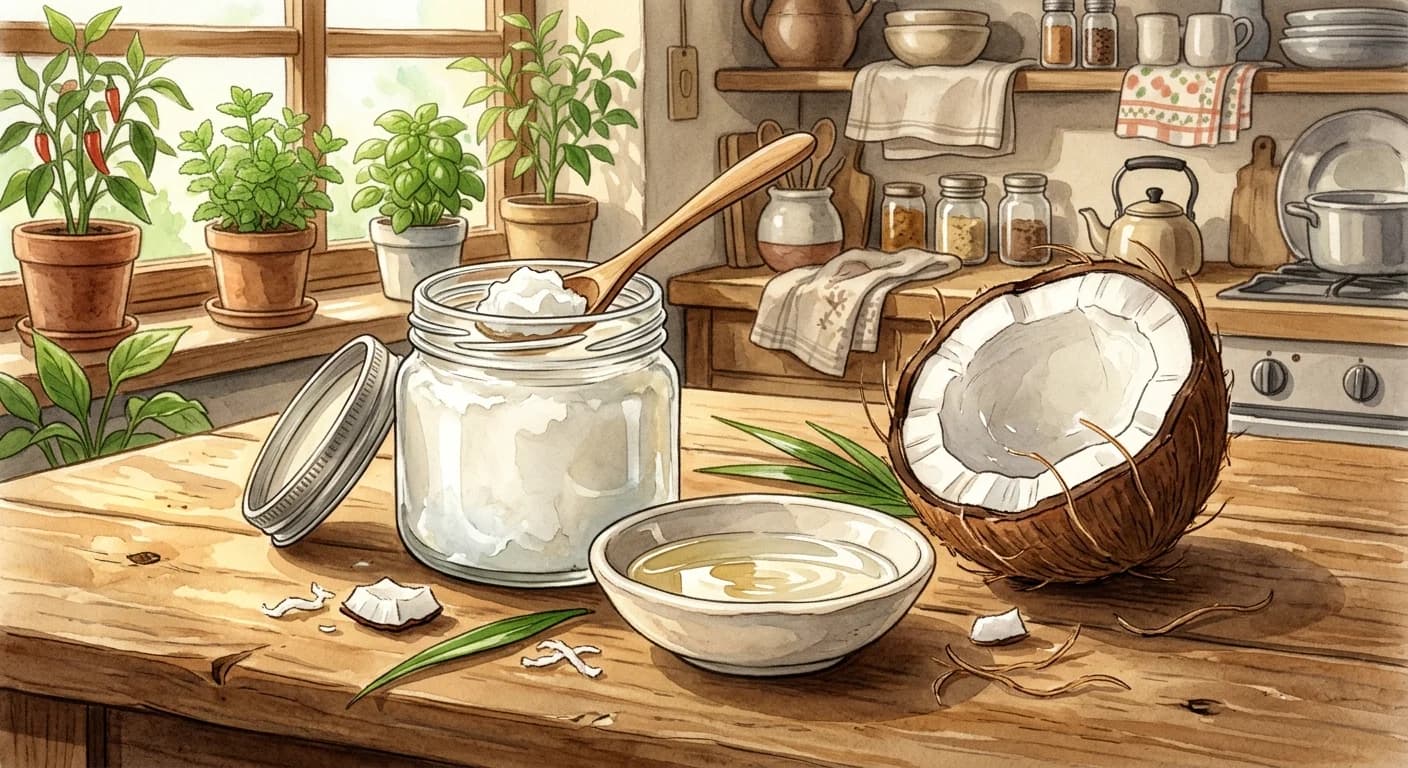
Two quite different products share the name. Virgin coconut oil is pressed from fresh coconut meat and tastes plainly of coconut, sweet and a little nutty. Refined coconut oil is made from dried copra, then bleached and deodorized until it tastes of nothing. Kerala's traditional oil sits between them: pressed from sun-dried copra and filtered but not refined, it keeps a toasty, almost roasted coconut smell.
Key facts at a glance:
- Solid below about 24°C (76°F). A jar turns white and firm in a cool kitchen and melts back to clear oil in a warm pan or a warm hand.
- Virgin and refined do different jobs. Virgin oil smokes around 177°C (350°F) and carries coconut flavor; refined oil holds to about 204°C (400°F) and is neutral.
- About 82 percent saturated fat, more than butter or lard. That is why it keeps for months without going rancid.
- Kerala's finishing oil. A raw spoonful with crushed curry leaves goes over avial, thoran and fish curry at the very end.
- Cooling in Ayurveda, the oil of choice for hot weather and for pitta.
Flavor Profile
Origin
Kerala, Coastal Karnataka, Goa, Tamil Nadu, Sri Lanka, Southeast Asia, Philippines, Pacific Islands
Traditional Medicine Perspectives
Ayurveda
Coconut oil (narikela taila) is classified as sweet (madhura), heavy (guru) and cooling (sheeta), which makes it pacifying for pitta and vata and something to use more sparingly for kapha. It is the classic oil for abhyanga (self-massage with oil) in hot weather or for people who run hot, and it is rubbed into the scalp before bathing to cool the head. Kerala Ayurveda uses it as the base for many medicated hair and skin oils, in which herbs are cooked slowly into the oil until it takes on their color and smell. Oil pulling (gandusha and kavala, holding or swishing oil in the mouth) appears in the classical texts mostly with sesame oil; coconut oil became the popular choice in modern practice.
Southeast Asia and the Pacific
Filipino hilot, the traditional massage practice, uses lana, home-made coconut oil, often warmed with herbs. In Polynesia, monoi, coconut oil steeped with tiare flowers, is used to protect skin and hair from sun and salt water.
Siddha and Kerala household practice
In the Siddha tradition of Tamil Nadu, coconut oil (thengai ennai) is a common base for oils applied to the skin and scalp. Across Kerala, oiling the hair before a bath, massaging babies with warm coconut oil and rubbing it into cracked heels and dry skin are daily household habits rather than prescriptions. Urukku velichenna, the gentle oil made by boiling down coconut milk, is the version traditionally kept for infants.
Modern Scientific Research
Coconut oil is about 82 percent saturated fat, a higher share than butter or lard, and close to half of its fatty acids are lauric acid. That saturation is what makes it solid at room temperature and slow to go rancid. It is also the center of the health argument.
The cholesterol evidence points one way. In its 2017 presidential advisory on dietary fats, the American Heart Association noted that coconut oil raised LDL cholesterol in all seven controlled trials it reviewed, and advised against using it. A 2020 meta-analysis of 16 trials in Circulation found that coconut oil raised LDL by about 10 mg/dL compared with non-tropical vegetable oils. It also raised HDL by about 4 mg/dL, and it showed no significant effect on body weight, blood sugar or markers of inflammation.
Much of coconut oil's wellness reputation borrows from research on medium-chain triglycerides (MCTs). Those studies mostly used purified MCT oil made of caprylic and capric acids (C8 and C10), which are only a small share of coconut oil. Lauric acid (C12) is technically medium-chain, but the body absorbs most of it the way it absorbs long-chain fats, so results from MCT oil don't carry over to a spoonful of coconut oil.
Virgin and refined oil have the same fat profile. Virgin oil keeps more of the coconut's polyphenols, which refining strips out.
Oil pulling, swishing a spoonful of oil around the mouth for several minutes, has been tested in a handful of small, short trials measuring plaque and gum inflammation. Some report modest improvements, but few compare it fairly against ordinary brushing and flossing. It is an add-on to dental care at most, not a replacement.
The fair reading: coconut oil is a stable, flavorful cooking fat, and eaten in quantity it raises LDL more than unsaturated oils do. Cook with it where its flavor matters, and don't take it by the spoonful as a supplement.
Cultural History
The coconut palm has grown around the Indian Ocean and the western Pacific for thousands of years, and pressing oil from copra, the dried kernel, is one of the oldest industries on those coasts. In Kerala it was traditionally done in a chakku, a heavy wooden or stone mill turned by a bullock. The state's name is often linked, in popular telling, to kera, the Malayalam word for the coconut palm, though historians usually trace it to the Chera dynasty instead.
Copra and its oil were trade goods long before they were wellness products. Arab and later European merchants bought them along the Malabar coast, and in the nineteenth century copra became a major export from Ceylon and the Pacific islands, shipped to Europe to be pressed for soap and margarine.
Home production never went away. Kerala households made urukku velichenna by slowly boiling down fresh coconut milk until the oil separated, a mild, fragrant oil kept for babies and for the hair. Filipino cooks made lana the same way. In Malaysia and Indonesia, minyak kelapa cooked out of santan was the household frying oil until palm oil took over in the second half of the twentieth century.
In Sri Lanka, pol thel is as basic as rice. In Goa and coastal Karnataka, Konkani, Goan Catholic and Mangalorean kitchens built their fish curries on it. Across Polynesia, coconut oil steeped with flowers, like Tahitian monoi made with tiare blossoms, was for skin and hair rather than the pan.
Outside these regions its reputation has swung hard. In the late 1980s American campaigns against "tropical oils" painted it as artery-clogging; in the 2010s it came back as a health food. Neither swing had much to do with how coastal cooks had always used it.
Culinary Uses
In Kerala coconut oil is the default fat. Mustard seeds, dried red chilies and curry leaves crackled in hot coconut oil start a thoran and finish a fish curry. Avial gets a spoonful of raw oil and a handful of crushed curry leaves stirred in off the heat, and that last addition is what makes it smell like Kerala. Fish for meen porichattu is shallow fried in it, and Kerala beef masala is braised first, then fried hard in a generous pour of coconut oil with crushed shallots, pepper and fennel. Banana chips (upperi) are fried in coconut oil too, which gives them their unmistakable smell.
The mild coconut-milk stews, fish moilee and lamb ishtu, start with whole spices and onions softened gently in coconut oil, so the oil's sweetness carries through the sauce.
On the Konkan coast, Goan fish curry and the fish and chicken curries of Mangalore traditionally use coconut oil. In Tamil Nadu it shares the work with sesame oil, with coconut favored toward the coast and the Kerala border. In Sri Lanka, pol thel fries the spices for curries and the batter for kokis, the crisp new-year rosettes.
In Southeast Asia the oil often comes straight out of the coconut cream. Thai cooks "crack" coconut cream by simmering it until the fat separates, then fry curry paste in that oil. Indonesian and Malaysian cooks do the same thing at a slower pace for rendang, cooking coconut milk down until the meat fries in the oil it releases.
Refined coconut oil has no coconut flavor, so it suits baking, dairy-free pastry and higher-heat frying, where you want the fat but not the taste. Solid at cool room temperature, it can stand in for butter or shortening in flaky doughs.
Preparation Methods
Choose the oil for the job. Virgin coconut oil smokes around 177°C (350°F), so keep it for tempering, gentle sautéing, finishing and baking, where its flavor is the point. For deep frying or a hard sear, refined coconut oil, good to about 204°C (400°F), is the safer choice.
Tempering (tadka) in coconut oil. Heat the oil until it shimmers and a single mustard seed dropped in sizzles at once. Add the mustard seeds and half-cover the pan. When the popping slows, add dried red chilies and curry leaves, which will spit, then pour everything over the dish or keep cooking in the same pan. The oil should smell toasty and the curry leaves should turn glossy and crisp, not black.
Finishing raw. For avial, thoran and many Kerala curries, a spoonful of unheated oil and a few torn curry leaves go in at the very end, off the heat. Put the lid on for a minute so the aroma stays in the pot.
Working with solid oil. Below about 24°C (76°F) coconut oil sets white and firm. Scoop it with a dry spoon, or stand the jar in warm water for a few minutes to melt it. For baking, use it in the state the recipe asks for: solid for flaky doughs, melted for cakes and muffins. Cold eggs or milk can make melted coconut oil seize into little lumps, so bring them to room temperature first.
Storage. All that saturated fat makes coconut oil one of the most stable oils in the pantry, and a sealed jar keeps for a year or more in a cool, dark cupboard. Use a clean, dry spoon, since water and crumbs are what spoil it. When it does turn, it smells sour or soapy.
Comments
Share your thoughts on this ingredient.
Sign in to comment0 Comments