Indian Cuisine
Jaggery Rice Fritters (Ariselu)
Andhra Deep-Fried Rice and Jaggery Rounds Crusted with Sesame
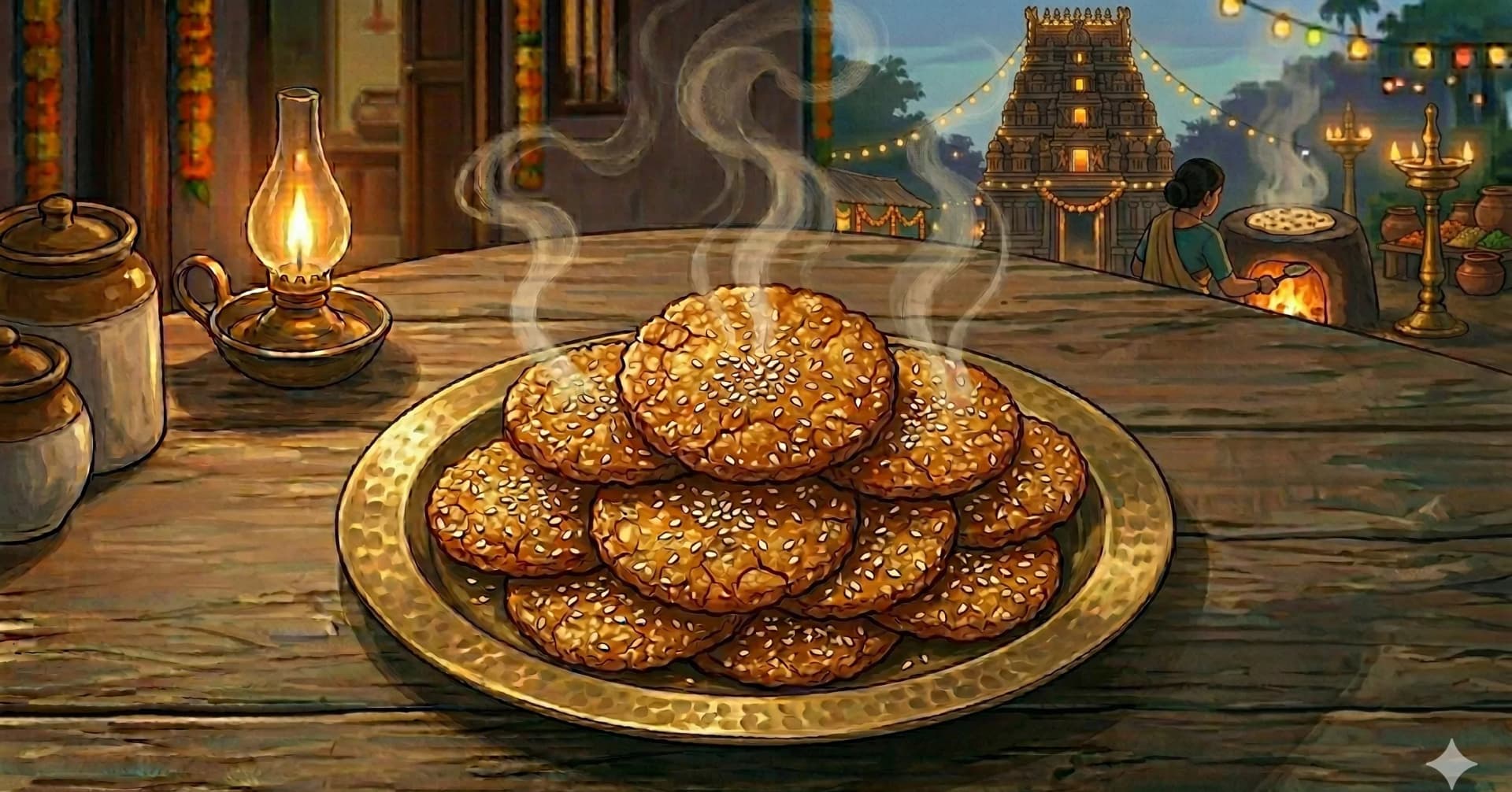
Sankranti in Andhra Pradesh and Telangana arrives with a specific set of demands: new rice from the harvest, sesame from the fields, jaggery from the cane, and the patience to make ariselu. This dense, deeply browned disc, its surface studded with sesame seeds that have toasted dark against the hot oil, is the festival sweet of the Telugu-speaking world, made in every household in January without exception.
The method begins six hours earlier, when the rice goes into cold water to soak. The soaking is not incidental. It changes the rice's starch in ways that matter. After six hours, drained rice ground into a fine powder behaves differently from un-soaked rice flour: it holds together more readily, produces a smoother dough when mixed with hot jaggery syrup, and fries to a denser, more cohesive interior that is characteristically ariselu's.
The jaggery syrup is the next critical step. Jaggery is dissolved in a small amount of water and cooked slowly until thick. The test is consistency, not colour. Take a drop of syrup and press it between your thumb and forefinger: when you pull apart, it should form a clean, firm single thread. At this point, the ground rice powder goes in, added gradually, stirring constantly to prevent lumps. The resulting dough is stiff, warm, and pliable enough to press into rounds on a plastic sheet dusted with sesame seeds.
Frying on low heat is essential. The interior of each ariselu is dense, and high heat would colour the sesame-crusted exterior dark brown before the interior had time to cook through. The finished pieces are a deep mahogany brown, the sesame nearly black, the jaggery richly caramelised. Serve hot, while the interior is still warm and yielding.
At a Glance
Yield
20–25 pieces
Prep
20 minutes (plus 6 hours soaking)
Cook
45 minutes
Total
7 hours (mostly passive soaking)
Difficulty
Medium
Ingredients
- 2¼ lbrice, soaked 6 hours and ground to fine powder
- 1¾ lbjaggery
- ⅞ cupwater
- ⅓ cupsesame seeds (white or black)
- —Oil, for deep frying
Method
- 1
Soak and grind the rice. Six hours before cooking, wash the rice thoroughly and cover with cold water. Leave to soak. After 6 hours, drain well and spread on a clean cloth until the surface moisture is gone. Grind to a fine powder, using a dry grinder or taking to a mill. No grains should remain. Set aside.
- 2
Make the jaggery syrup. Break the jaggery into pieces. Place in a wide pan with the water. Heat over medium-low flame, stirring until the jaggery dissolves completely. Once dissolved, strain through a fine sieve if the jaggery contains debris. Return to the pan and cook over low heat until the syrup thickens. Test by placing a drop in cold water or pressing a drop between your fingers. Pull apart: it should form a clean, soft thread. This is single-thread consistency, approximately 108–112°C.
- 3
Add the rice powder. With the jaggery syrup still over low heat, gradually add the ground rice flour, stirring constantly and vigorously to prevent lumps. Work steadily: add a portion, stir until fully incorporated, then add more. Continue until all the rice powder is in and you have a stiff, warm dough that holds together when pressed. Remove from heat.
- 4
Shape the ariselu. While the dough is still warm and pliable, divide into golf ball-sized portions. Lay a clean plastic sheet on your work surface and sprinkle sesame seeds liberally over it. Place a dough ball on the sesame seeds and press out with damp fingers or the back of a spoon into a thin round disc, approximately 7–8 cm in diameter and 4–5 mm thick. The sesame seeds will stick to the underside. Sprinkle more over the top and press gently so they adhere.
- 5
Fry. Heat oil in a deep pan over low-medium heat. The oil should be hot enough to sizzle when a small piece of dough is dropped in, but not smoking. Lower the ariselu carefully into the oil, sesame-side down. Fry over low heat for 3–4 minutes until the underside is deep brown. Turn carefully and fry the other side for 3–4 more minutes until deeply coloured. The sesame seeds will be very dark, almost black at the edges. Remove with a slotted spoon.
- 6
Serve hot.
Key Ingredient Benefits
Soaked and dried rice flour behaves differently from commercial rice flour. The extended soak modifies the starch structure, producing a flour that binds more readily with the hot jaggery syrup and gives you a dough that holds together without being dense. This soaking-and-grinding process is traditional across South Indian sweet-making (see also: anarsas, patishapta) and consistently outperforms shop-bought rice flour for these preparations.
Jaggery gives ariselu their dark colour, caramelised sweetness, and depth. Telugu jaggery, often made from cane grown in the Krishna and Godavari delta regions, has a slightly smoky, earthy character. It contains iron, potassium, and magnesium in small amounts that refined sugar lacks, and its flavour complexity comes from the residual molasses left in the unrefined product.
Sesame seeds form the crust and give ariselu their visual character. Sesame is one of the highest plant sources of calcium and contains lignans (sesamin and sesamolin) that have shown antioxidant activity in research. The deep toasting during frying develops their characteristic nutty, slightly bitter edge.
Why This Works
The six-hour soaking of rice modifies its starch structure in two important ways. First, the starch granules absorb water and swell partially, making them easier to grind to a fine powder without the heat generated by dry grinding. Second, slight enzyme activity during the soak partially breaks down some of the starch chains, producing a flour that binds more readily with the hot jaggery syrup and produces a more cohesive dough.
Cooking the jaggery syrup to single-thread consistency (rather than a lighter syrup) ensures the dough will hold together when pressed into rounds. Too dilute a syrup produces a sticky, unworkable dough that spreads in the oil; single-thread provides the right balance of pliability when warm and structural integrity when fried.
Pressing the ariselu thin (4–5 mm) and frying on low heat ensures the interior cooks through before the sesame-crusted exterior becomes too dark. Sesame seeds, being high in oil, fry faster than the surrounding dough. Low heat extends the cooking time and lets the interior catch up.
Substitutions & Variations
- Black sesame: Using black sesame seeds produces a visually dramatic ariselu with a slightly more bitter, more earthy crust.
- With poppy seeds: Some versions replace part of the sesame with poppy seeds for a softer, more floral crust.
- Coconut addition: A small amount of grated fresh coconut worked into the dough produces a slightly softer, more moist interior.
- Thinner ariselu: Press the rounds even thinner (2–3 mm) for a more crisp, cracker-like result.
Serving Suggestions
Ariselu are festival food, served warm immediately after frying, two or three per person, as a Sankranti sweet. In Andhra and Telangana homes, they are stacked in large platters at the centre of the celebration and eaten throughout the day as guests arrive. No accompaniment is traditional. The combination of dense rice-jaggery interior and dark toasted sesame crust is entirely self-sufficient. Serve while still warm enough that the interior remains slightly yielding.
Storage & Reheating
Ariselu keep well at room temperature in an airtight container for up to 5–7 days. The jaggery acts as a preservative and the dry interior resists spoilage. They firm up as they cool. After storage they're good cold or at room temperature. The interior actually gets denser and the flavour deepens a little over the first two days. Brief warming in a low oven (150°C, 5 minutes) is possible but not traditional; these are generally eaten at room temperature.
Cultural Notes
Ariselu (అరిసెలు, also called adhirasam in Tamil) is the Andhra-Telugu rice-and-jaggery sweet made from a dough of soaked-and-ground rice combined with melted jaggery, shaped into small flat disks, and deep-fried in ghee until the surface develops a golden crackle pattern and the interior stays soft and chewy. The dish is the central sweet of the Andhra and Telangana harvest festival of Sankranti (held in mid-January, marking the sun's northward turn) and one of the dishes most strongly associated with Andhra-Telugu festival cooking.
The Sankranti festival is the cultural anchor. Sankranti (also called Pongal in Tamil Nadu, Lohri in Punjab, Magh Bihu in Assam) is the pan-Indian winter solstice harvest festival that celebrates the new crop of rice and sugarcane. In Andhra and Telangana the festival is held over three or four days with elaborate household preparations, kite-flying competitions, cow worship rituals, and an extensive sweets tradition centered on rice-and-jaggery preparations: ariselu, boorelu (jaggery-stuffed lentil dumplings), sakinalu (savory rice flour rings), and poornam boorelu (sweet stuffed dumplings). The village of Atreyapuram in the East Godavari district of Andhra Pradesh received a Geographical Indication tag in 2024 for its Atreyapuram pootharekulu and traditional ariselu, formal recognition of the regional craft tradition.
The technique demands precise heat control to avoid burning the jaggery. Raw rice is soaked overnight, drained, spread on a cloth to dry partially, and pounded or ground into a coarse flour with a slightly moist texture (not bone-dry like commercial rice flour). Jaggery is melted slowly in a small amount of water until it dissolves into a thick syrup, then cooked to the soft-ball stage (the syrup forms a soft ball when dropped into cold water). The hot jaggery syrup is poured over the rice flour and mixed quickly with a wooden spoon to form a soft warm dough. The dough is rested briefly, then small portions are flattened between palms (or on a piece of greased paper) into thin disks about two inches across. Ghee is heated in a deep kadai to about 160°C (slightly cooler than for other fried sweets, since the jaggery in the dough can burn quickly), and the disks are slid in one at a time and fried for two to three minutes per side until both surfaces develop a golden cracked pattern. The disks are removed, pressed lightly between two flat surfaces to expel excess ghee, and cooled completely before storage. The dish keeps for two to three weeks in an airtight tin.
Nutrition Facts
Calories: 1415kcal (71%)|Total Carbohydrates: 309g (112%)|Protein: 17g (34%)|Total Fat: 12g (15%)|Saturated Fat: 2g (10%)|Cholesterol: 0mg (0%)|Sodium: 56mg (2%)|Dietary Fiber: 3.8g (14%)|Total Sugars: 97.5g
You Might Also Like

Ratings & Comments
Ratings & Comments
Ratings
Share your thoughts on this recipe.
Sign in to rate and comment