Indian Cuisine
Basic Green Paste
The foundational North Indian green chutney paste of coriander, mint, ginger, and green chilli
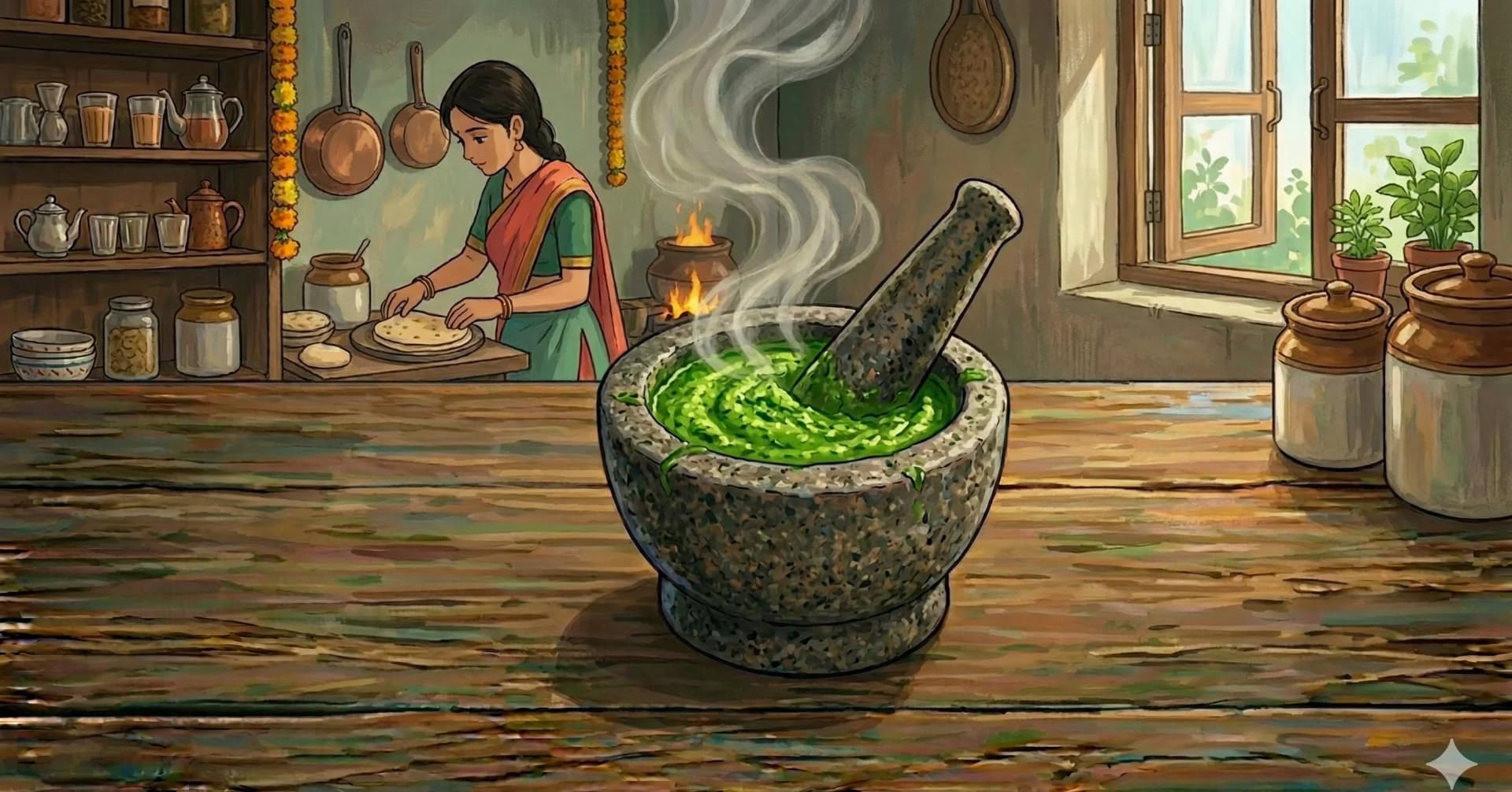
Before almost anything else in North Indian cooking, before the chaat is assembled, before the tandoori marinade is made, before the street vendor hands over a plate of samosa, there is this paste. Coriander, mint, ginger, green chilli, blended with the minimum water required to make the blender work. It is the baseline from which a dozen different chutneys, marinades, and flavouring pastes in the subcontinent begin.
In its simplest form it is a chutney: spooned beside pakoras, smeared inside a roll, stirred into yogurt to make a raita. Used concentrated and not thinned, it serves as a marinade base for tandoori and tikka preparations, providing the green colour and herbaceous aromatics that characterise that entire family of dishes. Mixed with yogurt, it becomes a mint raita. Mixed with tamarind water, it becomes the green layer in a chaat.
The proportions here (roughly equal parts coriander and mint, with substantial ginger and green chilli) produce a paste that is bright, sharp, and hot. Adjust the chilli quantity to your tolerance and the balance of coriander to mint to your preference. Make it in a larger quantity than you need. It keeps in the refrigerator for a week and in the freezer for three months, and you will find yourself reaching for it constantly.
At a Glance
Yield
Makes about 200 g of paste
Prep
10 minutes
Cook
None
Total
10 minutes
Difficulty
Easy
Ingredients
Method
- 1
Wash the herbs thoroughly. Fresh coriander (300 g) and mint (200 g) often carry grit. Wash in several changes of cold water and shake or spin dry.
- 2
Blend. Place the coriander, mint, ginger (90 g), and green chillies (100 g) in a blender. Add 1–2 tablespoons of water, just enough to get the blender moving. Blend, stopping to scrape down the sides, until a smooth, fine paste forms. Add water a tablespoon at a time only if needed; a drier paste has a more concentrated flavour and longer shelf life.
- 3
Taste and adjust. Taste for heat (add more chilli if wanted), sharpness (add a small piece more ginger), and herb balance. The paste should be bright, very green, and boldly seasoned.
- 4
Store immediately in a sealed glass jar in the refrigerator.
Key Ingredient Benefits
Fresh coriander (all parts, including stems) contains linalool and other volatile compounds responsible for its citrus-forward aroma. In this paste, its primary role is aromatic and structural. It's the dominant green.
Fresh mint (Mentha species) provides a cooling, almost sweet counterpoint to the coriander's assertiveness. Spearmint is milder than peppermint; either works, though spearmint or garden mint (the common Indian variety) is traditional.
Green chilli delivers a different heat from dried red chilli: fresher, more immediate, less deep. The capsaicin content varies widely by chilli type; adjust accordingly.
Why This Works
Using the minimum amount of water when blending preserves the volatile aromatic compounds in the herbs. Adding large amounts of water physically dilutes the essential oils responsible for the paste's brightness and pungency. The paste should be as concentrated as the blender allows.
The ginger-to-herb ratio here is high by the standards of a finished chutney. This is intentional, since the paste is designed to serve as a base for other preparations where it will be diluted or combined with other ingredients. If using it directly as a table chutney, reduce the ginger by half.
Substitutions & Variations
Cilantro: The defining herb — cannot really be substituted. About 10% of people have a genetic variation that makes cilantro taste soapy; for them, use a mix of parsley and mint to approximate.
Mint: Fresh spearmint is traditional. Peppermint is too aggressive. Use 1:3 ratio of mint to cilantro for the standard balance. Increase mint for a more pronounced cooling note.
Green chilies: Thai bird chilies, Indian green chilies, serranos, or jalapeños all work. Adjust quantity to taste — the paste should be moderately spicy but not aggressive. Remove seeds for less heat.
Ginger: Fresh ginger is essential. Skip if ginger is unavailable; the paste loses some warmth but remains good.
Garlic: Optional in traditional versions (many Jain and Brahmin households omit garlic). Include for non-Jain/non-Brahmin households.
Lemon or lime juice: Lime juice is more authentic for Indian chutneys; lemon works. Acid is essential to prevent the paste from oxidizing and turning brown.
Salt: Standard table salt. Some versions use kala namak (black salt) for additional complexity — produces a slightly sulfurous, more pronounced flavor.
Water: Just enough to allow the food processor to blend smoothly. Too much water dilutes the paste.
Optional additions: Some traditional versions include a few peanuts or roasted chana dal for body and protein. Cumin powder (a pinch) adds depth. A small piece of raw mango (when in season) adds sourness.
Serving Suggestions
Basic green paste (commonly called green chutney or hari chutney) is one of the most ubiquitous condiments in North Indian cooking. It appears with virtually every snack, appetizer, and street food. Common applications:
Chaat (street food): The essential green chutney for bhel puri, pani puri, sev puri, dahi puri, and other chaat preparations. Drizzled over the snacks at assembly.
Samosa and pakora: The traditional dipping accompaniment for samosa and various pakoras. Often served alongside tamarind chutney for the classic sweet-spicy pairing.
Sandwich spread: The defining green sandwich (hari sandwich) of Bombay tiffin culture. Spread on white bread with cucumber, tomato, and boiled potato — a classic vegetarian sandwich.
Kathi rolls and frankies: Spread inside kathi rolls, frankies, paratha wraps for the bright herbaceous note that defines these street foods.
Tandoori dipping: Served alongside tandoori chicken, seekh kebab, and other tandoor preparations as a cooling contrast.
Restaurant garnish: Drizzled over biryanis, layered into wraps, or used as a finishing touch on appetizer platters.
Sauce for grilled fish: Modern Indo-Western fusion application. The bright green paste works beautifully with grilled fish or as a base for fish marinades.
Pairing notes: Best served fresh — the bright green color and intense aromatic character begin to fade after a few hours. Make in small batches and use within a day for the best results.
Storage & Reheating
Store in a sealed glass jar in the refrigerator for up to 1 week. The colour will darken slightly over time (this is oxidation and does not affect flavour). Freeze in ice-cube trays, then transfer to a freezer bag, for up to 3 months.
Cultural Notes
Green chutney (hari chutney, pudina-dhania chutney) is one of the foundational condiments of North Indian and broader South Asian cuisine. The preparation appears in some form across virtually every Indian regional tradition — Punjabi, Gujarati, Bengali, Maharashtrian, and beyond — though with slight variations in herb ratios and additional ingredients.
The condiment exists as part of a broader Indian chutney tradition that includes tamarind chutney (sweet-sour, brown), coconut chutney (white, South Indian), tomato chutney (red, often spicy), and dozens of regional variations. Chutneys serve as the small contrasting elements that complete Indian meals — typically eaten in small quantities alongside larger dishes rather than as standalone foods.
The dominance of cilantro and mint reflects the Persian and Mughal influence on North Indian cooking. Both herbs were prized in the Mughal courts and integrated into the cuisine through royal kitchens. The combination of cilantro + mint + green chili + ginger is essentially universal across North India, with regional variations in the additional ingredients (peanuts, yogurt, coconut, mango, etc.).
The condiment's role in street food culture is particularly significant. Bombay (Mumbai) street food vendors developed many of the classic chaat preparations (bhel puri, pani puri, sev puri) and made green chutney one of their three essential condiments (alongside tamarind chutney and yogurt). The Indian chaatwallah (street snack vendor) typically prepares fresh green chutney daily and uses it generously on every order.
The condiment's persistence reflects its versatility and the universal Indian appreciation for fresh, bright, herbaceous flavors. Unlike heavier curry preparations that require long cooking, green chutney is fast (5 minutes in a blender), uses everyday pantry herbs, and provides the necessary acid-spice-freshness balance to almost any meal.
In modern Indian-American and Indian-British cooking, green chutney has become one of the most recognizable Indian preparations and appears at virtually every Indian restaurant. The condiment has also influenced broader culinary trends — Indian-inspired green chutneys now appear on menus far beyond Indian restaurants as a bright, herbaceous sauce option.
Nutrition Facts
Calories: 7kcal (0%)|Total Carbohydrates: 1g (0%)|Protein: 0g (0%)|Total Fat: 0g (0%)|Saturated Fat: 0g (0%)|Cholesterol: 0mg (0%)|Sodium: 5mg (0%)|Dietary Fiber: 0.6g (2%)|Total Sugars: 0.2g
You Might Also Like
Ratings & Comments
Ratings & Comments
Ratings
Share your thoughts on this recipe.
Sign in to rate and comment