Cross-Cultural · China
Beef and Broccoli (西兰花牛肉)
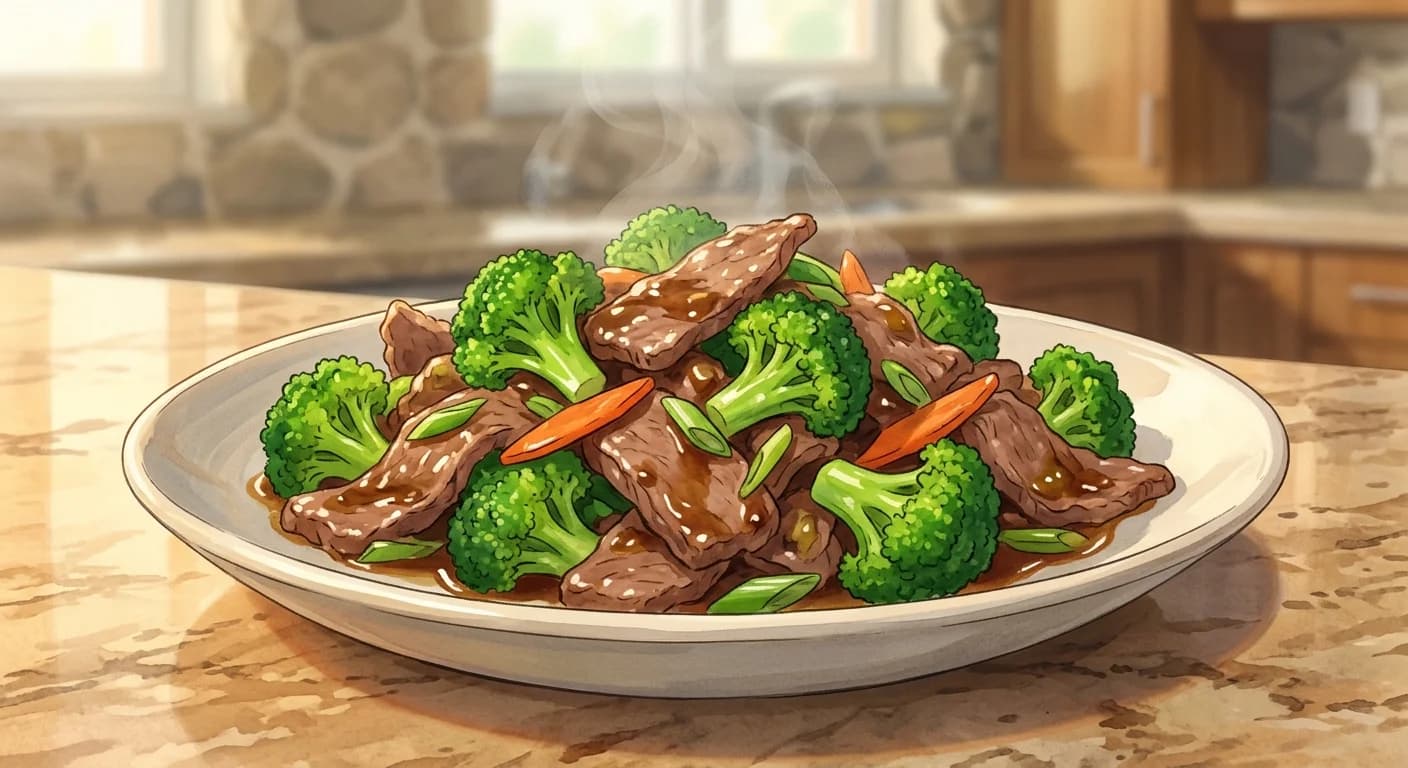
Tender flank steak and bright green broccoli in a glossy garlic and oyster sauce, the Chinese takeout classic made at home
Good beef and broccoli gets three things right. The beef is soft enough to break with chopsticks, the broccoli is still bright green with a little snap, and there is just enough dark, glossy sauce to soak into the rice underneath. Plenty of takeout versions miss at least one of them.
The dish is a Chinese-American adaptation. Cantonese cooks stir-fry beef with gai lan, Chinese broccoli, and in the United States regular broccoli took its place. It has been on Chinese-American menus for about a hundred years.
The habit that matters most is cooking the beef, the broccoli and the sauce separately and bringing them together only at the end. The broccoli goes into the wok already blanched, so it doesn't steam the beef. The beef comes out while it's still a little pink and finishes in the sauce. After the 30-minute marinade, the cooking takes about 10 minutes, so have everything chopped and lined up before the wok goes on.
Inspired by Made With Lau and The Woks of Life.
At a Glance
Yield
4 servings
Prep
45 minutes
Cook
10 minutes
Total
55 minutes
Difficulty
Easy
Ingredients
Beef Ingredients
- 1 lbflank steak, sliced 1/4 inch thick against the grain
- 1/2 tspbaking soda
- 3 tbspwater
- 1 tbspoyster sauce
- 1 tbsplight soy sauce
- 1 tbspShaoxing wine
- 1 tspsugar
- 1/4 tspground white pepper
- 1 tbspcornstarch
- 1 tbspvegetable oil, mixed in last
Sauce Ingredients
- ½ cuplow-sodium chicken stock
- 1 tbspoyster sauce
- 1 tbsplight soy sauce
- 1 tspdark soy sauce
- 1 tspsugar
- 1/8 tspground white pepper
- 1 tbspcornstarch
Stir-Fry Ingredients
- 1 lbbroccoli, cut into bite-size florets (about 5 cups)
- 1½ ozcarrot (about ½–1 carrot), 1/2 small carrot, thinly sliced on the diagonal
- 3 clovesgarlic, minced
- 1 tspfresh ginger, minced
- 2scallions, cut into 1 1/2-inch pieces on the diagonal
- 3 tbspvegetable oil, divided
- 1 tbspShaoxing wine
- 1 tspsesame oil
- 1 pinchsalt, plus a splash of oil, for the blanching water
Method
- 1
Slice the beef. Look for the long lines running down the flank steak; that is the grain. Cut the steak with the grain into strips about 2 inches wide, then turn each strip and slice it across the grain into 1/4-inch slices. If the meat is soft and hard to slice, put it in the freezer for 15 minutes first.
- 2
Rinse the slices in a bowl of cold water, drain, and press out as much water as you can. This washes off blood, which keeps the sauce tasting clean.
- 3
Stir the baking soda into the 3 tablespoons of water, pour it over the beef, and massage it in with your hand until the meat has absorbed the liquid. Add the oyster sauce, light soy sauce, Shaoxing wine, sugar, white pepper and cornstarch, and mix until every slice is coated. Stir in the 1 tablespoon of oil last. Leave the beef to marinate for 30 minutes at room temperature, or up to 2 hours in the fridge.
- 4
While the beef marinates, make the sauce. Stir the chicken stock, oyster sauce, light and dark soy sauces, sugar, white pepper and cornstarch together in a small bowl until no lumps of cornstarch remain. Prep the broccoli, carrot, garlic, ginger and scallions, and set everything next to the stove. Once the wok is hot, there is no time to chop.
- 5
Bring a large pot of water to a boil with the pinch of salt and a splash of oil. Add the broccoli and cook for 1 minute, until it turns bright green and a knife meets a little resistance in the thickest stem. Drain well and shake the colander a few times. Water left on the florets will thin the sauce.
- 6
Heat a wok or 12-inch skillet over high heat until it just begins to smoke. Add 2 tablespoons of the oil and swirl it around. Spread the beef out in one layer and leave it alone for 30 to 60 seconds, until the underside is browned. Flip the slices and cook for 30 to 60 seconds more. Take the beef out while a little pink still shows; it finishes cooking in the sauce. If you are using a skillet, sear the beef in two batches so it browns instead of steaming.
- 7
Lower the heat to medium and add the remaining 1 tablespoon of oil. Add the garlic and ginger and stir for 15 to 20 seconds, until fragrant but not browned. Add the scallions and carrot and stir for 30 seconds.
- 8
Turn the heat back up to high, add the broccoli and toss for 30 seconds. Pour the 1 tablespoon of Shaoxing wine around the edge of the wok, where it will sizzle and steam off.
- 9
Stir the sauce again, because the cornstarch settles, and pour it in. Stir as it comes to a boil and turns glossy and thick, about 30 seconds. Return the beef and any juices on the plate and toss for 30 to 60 seconds, until the sauce coats everything and the beef is just cooked through. If the sauce gets too thick, add a splash of water; if it looks thin, let it bubble a little longer.
- 10
Turn off the heat, drizzle in the sesame oil and toss once more. Serve right away with steamed rice.
Key Ingredient Benefits
Broccoli: Broccoli contains glucosinolates, which an enzyme in the plant called myrosinase turns into isothiocyanates such as sulforaphane. Those compounds are widely studied for their effects on health. Heat inactivates the enzyme, but according to the Linus Pauling Institute, light cooking, such as steaming for less than 5 minutes, preserves some of it, and gut bacteria can do part of the conversion when it's gone. The blanch here lasts only a minute, though it is boiling rather than the light steaming the institute describes. Broccoli is also a good source of vitamin C and fiber.
Flank steak: A lean cut that is a good source of protein and of heme iron, the form of iron the body absorbs more easily than the iron in plants.
Ginger and scallions: Cantonese cooks pair them with beef and seafood to freshen strong flavors. Traditional Chinese medicine classifies fresh ginger as warming.
Oyster sauce: The main savory flavor in the sauce, with a little sweetness. It is made from oyster extract, so it is a shellfish allergen; mushroom-based vegetarian oyster sauce works as a swap.
Sodium: Between the soy sauces, the oyster sauce and the baking soda, this is a salty dish, roughly 970 mg of sodium per serving. Low-sodium soy sauce brings that down without changing the method.
Why This Works
Baking soda raises the pH on the surface of the meat. At a higher pH, the muscle proteins have a harder time bonding tightly as they heat, so they squeeze out less water and the slices stay tender. Half a teaspoon is plenty for a pound of flank steak. Much more and the beef turns spongy and picks up a soapy taste.
The cornstarch in the marinade forms a thin coating that browns fast and protects the meat from the wok's heat. The oil stirred in last keeps the slices from clumping together and sticking to the pan.
Cooking in stages keeps the wok hot. A pound of raw broccoli would cool the pan and release water, and the beef would come out gray and stewed. Blanched and drained, the broccoli only needs to heat through, and the beef can come out early and finish in the sauce without overcooking.
The sauce thickens only once the cornstarch boils, which is why it goes into a hot wok and bubbles before the beef comes back. Dark soy sauce is there mostly for color, giving the deep brown you know from takeout, and oyster sauce brings the savory depth.
Substitutions & Variations
Gai lan (Chinese broccoli): For the Cantonese original, use 1 pound of gai lan in place of the broccoli. Cut the stems into 2-inch pieces on the diagonal and keep the leaves separate. Blanch the stems for 1 minute and the leaves for 15 seconds. It is leafier and pleasantly bitter.
Beef cut: Sirloin, flat iron and skirt steak all work. Flank is the usual choice because its long grain is easy to see and slice across. Chuck is too tough for a quick stir-fry.
No baking soda: Leave it out. The beef will be a little chewier but still good if it's sliced thin. Another option is to pound the slices lightly with a meat mallet.
Shaoxing wine: Dry sherry is the closest swap. To skip alcohol, use chicken stock in the marinade and leave the wine out of the stir-fry.
Gluten-free: Use tamari in place of the light soy sauce, a gluten-free oyster sauce, and a gluten-free dark soy sauce, or 1 extra teaspoon of tamari for the dark soy sauce. Shaoxing wine is brewed with wheat, so use dry sherry in both the marinade and the stir-fry.
Chicken and broccoli: Use 1 pound of boneless chicken thighs, sliced thin. Cut the baking soda to 1/4 teaspoon and cook the chicken until no pink remains.
Extra sauce: For more sauce on the rice, double the sauce ingredients. The cooking time stays the same.
Serving Suggestions
Serve it over steamed jasmine rice, which is what the sauce is made for. For a takeout-style spread at home, add egg drop soup or hot and sour soup and something crunchy, such as spring rolls. A plate of plain stir-fried greens, like garlic bok choy, rounds it out if you want more vegetables.
Storage & Reheating
Fridge: Keep leftovers in an airtight container for up to 3 days. The broccoli softens and darkens a little but tastes fine.
Reheating: Warm it in a hot wok or skillet with a splash of water for 2 to 3 minutes, tossing until heated through. In the microwave, cover it and heat for 1 to 2 minutes, stirring halfway.
Freezing: It freezes for up to 2 months, but the broccoli turns soft. If you plan to freeze it, freeze the beef and sauce on their own and blanch fresh broccoli when you reheat.
Cultural Notes
Beef with gai lan (芥蘭牛肉) is a Cantonese stir-fry of thin-sliced beef and Chinese broccoli, which has thin stems, large dark leaves and a slightly bitter bite. In the United States, Chinese cooks replaced the gai lan with broccoli, which Italian immigrants had made popular there. According to Wikipedia's history of the dish, beef and broccoli was an established item at Chinese-American restaurants by the 1920s and everywhere by the 1950s. Today it is one of the most popular Chinese-American dishes.
The Chinese name used here, 西兰花牛肉 (xī lán huā niú ròu), simply means broccoli beef. If you can find gai lan at an Asian grocery, the swap in Substitutions takes you back to the original.
Nutrition Facts
Calories: 360kcal (18%)|Total Carbohydrates: 16g (6%)|Protein: 28g (56%)|Total Fat: 19g (24%)|Saturated Fat: 4.5g (23%)|Cholesterol: 75mg (25%)|Sodium: 970mg (42%)|Dietary Fiber: 3g (11%)|Total Sugars: 5g
You Might Also Like
 Easy
Cross-Cultural · China
Chop Suey (雜碎)
35 minutes
 Easy
Traditional Chinese Medicine · China
Bok Choy in Ginger Sauce (姜汁白菜)
6 minutes
 Easy
Japanese Cuisine
Yakisoba Sauce (Homemade Japanese Stir-Fried Noodle Sauce)
5 minutes
 Easy
Chinese Cuisine
Braised Chicken with Lily Buds and Mushrooms (Jin Zhen Yun Er Ji)
80 minutes
Ratings & Comments
Ratings & Comments
Ratings
Share your thoughts on this recipe.
Sign in to rate and comment