Punjabi · Indian Cuisine
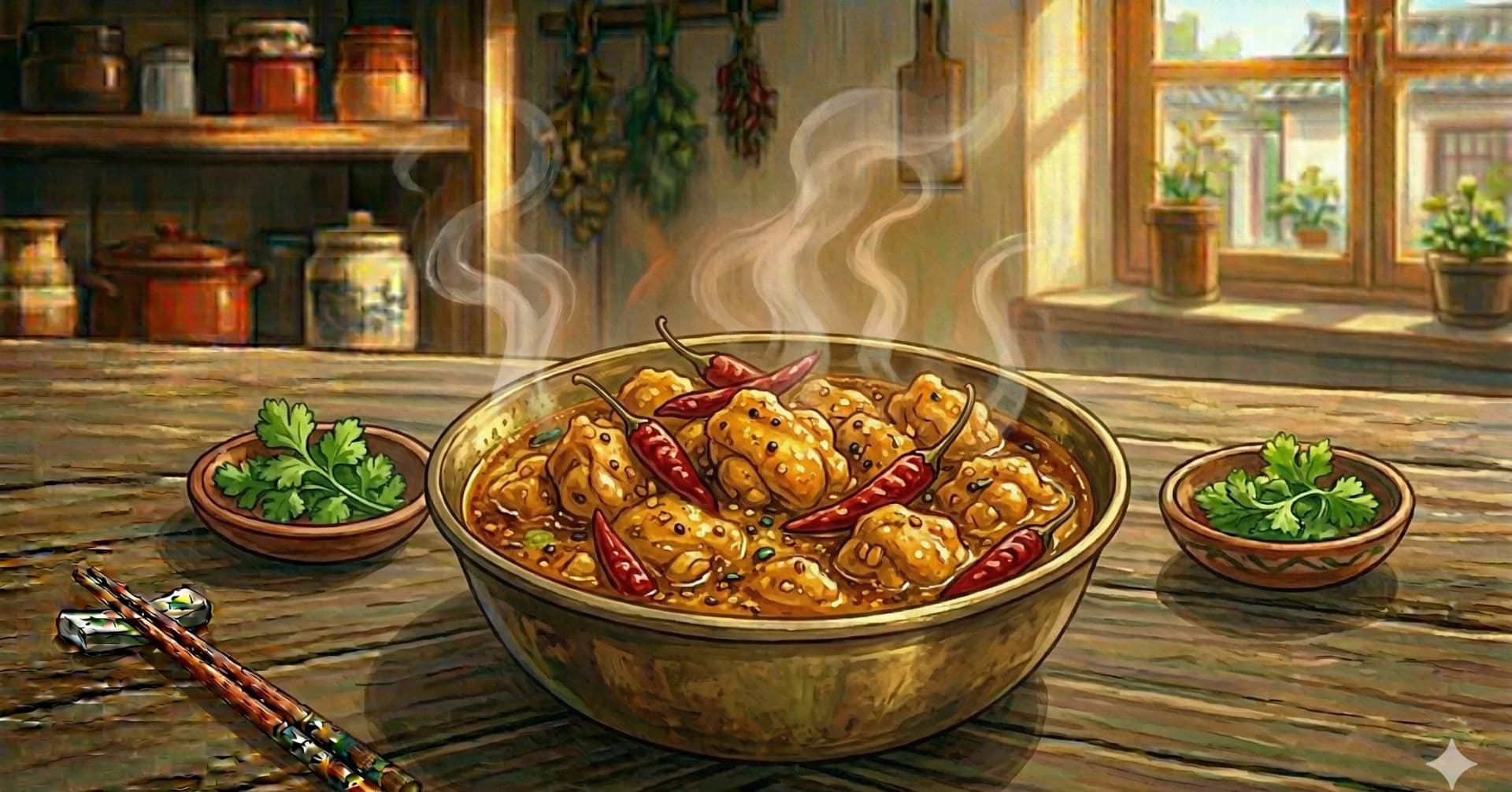
Punjabi Chicken Curry
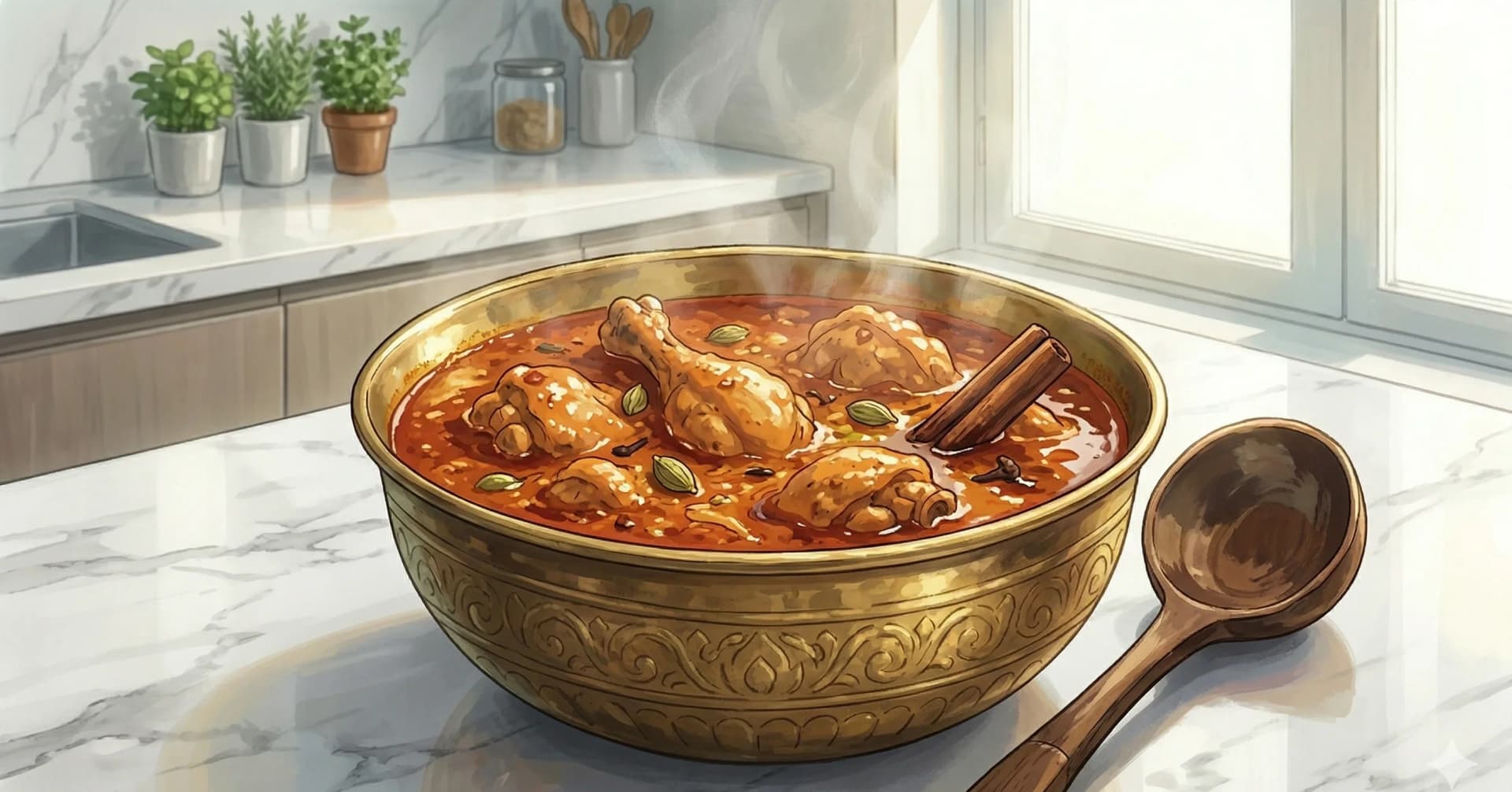
Bone-in chicken in a dark, spiced tomato and onion gravy
There is a version of chicken curry in every regional Indian kitchen, but the Punjabi style has a particular intensity: a thick, rust-coloured gravy built on fried onions and fresh tomato, the chicken seared separately so it develops a crust before it meets the masala, the whole thing finished with beaten yoghurt for body and tang. The oil rising to the surface is not a defect; it is the signal that the masala has cooked long enough.
This is the technique behind almost every North Indian restaurant curry, reduced to its home-kitchen essentials. The masala (onion fried to deep golden, ginger-garlic paste, Kashmiri chilli for its deep colour and moderate heat, tomato cooked until mashed and the fat breaks free) is the foundation. Separately searing the chicken before adding it to the masala serves two purposes: it develops colour and a slightly firmer texture on the surface of the pieces, and it keeps the chicken from releasing large amounts of water into the gravy that would require long evaporation to recover.
Kashmiri red chilli powder is the right choice here. Its colour is extraordinary, a deep, vivid brick red that other chilli powders cannot replicate, and its heat is measured rather than fierce, allowing the quantity needed for colour without overwhelming the dish.
The ginger julienne and coriander scattered at the end are not just garnish. They arrive fresh against the cooked spice base, pulling the finished dish back toward brightness just before it reaches the table.
At a Glance
Yield
Serves 4–6
Prep
20 minutes
Cook
45 minutes
Total
1 hour 5 minutes
Difficulty
Medium
Ingredients
- 1½ lbchicken, curry cut (bone-in pieces)
- ¼ ozgreen cardamom pods (about 4 pods)
- ¼ ozbay leaves (about 2 leaves)
- 3½ ozonion (about ½–1 onion), finely sliced
- 2¾ tspginger paste
- 1⅓ tspgarlic paste
- 2½ tspKashmiri red chilli powder
- 1⅛ tspturmeric powder
- 1¼ tbspcoriander powder
- 3½ oztomatoes (about ½–1 tomato), puréed or finely chopped
- ⅔ tspsalt
- 1¼ tbspfresh ginger, cut into fine julienne
- 2½ tspgreen chillies (about 2), slit lengthways
- ¾ cupfresh coriander, roughly chopped
- 2½ ozplain yoghurt, beaten
- ⅔ tspgaram masala powder
- 2 tsplemon juice
- ⅓ cupneutral oil, divided
Method
- 1
Sear the chicken (700 g). Heat 2 tablespoons of the oil in a wide heavy-based pan over high heat. Season the chicken pieces with a pinch of turmeric (½ teaspoon), a pinch of Kashmiri chilli, and a small pinch of salt (¾ teaspoon). Add to the hot oil and sear without moving for 3–4 minutes until the surface is golden and slightly crisp on the underside. Turn and sear the other side for 2–3 minutes. Remove the chicken to a plate; it should be coloured outside but still raw at the centre. Set aside.
- 2
Build the masala base. In the same pan (wipe if needed) heat the remaining oil over medium heat. Add the cardamom pods (4 pods) and bay leaves (2 leaves). Within 30 seconds they will release their fragrance into the oil. Add the sliced onions and cook, stirring regularly, for 12–15 minutes until they are deep golden throughout; not pale, not burnt, but genuinely dark and sweet-smelling. Take your time here. This is the flavour foundation.
- 3
Add the pastes and spices. Add the ginger (7 g) paste (14 g) and garlic paste (7 g) to the onions. Stir and cook for 2 minutes until the raw smell is gone and the mixture is fragrant. Add the Kashmiri chilli powder (1 teaspoon), the remaining turmeric, the coriander (15 g) powder (2 teaspoons), and the salt. Stir continuously for 1 minute.
- 4
Add tomato. Add the tomato purée (or finely chopped tomatoes (100 g)) and stir well. Cook over medium heat, stirring frequently, for 8–10 minutes until the tomatoes have completely broken down and the oil begins to separate and pool at the edges and surface. This is the moment the masala is ready. The mixture should look slightly glossy and the colour will have deepened.
- 5
Add the chicken and yoghurt (70 g). Add the seared chicken pieces to the masala and stir to coat. Add the beaten yoghurt a little at a time, stirring constantly to prevent it from splitting. Once all the yoghurt is incorporated, bring to a boil, then reduce the heat to a steady simmer. Cover and cook for 20–25 minutes until the chicken is cooked through and tender; the meat should pull easily from the bone.
- 6
Check and reduce. Remove the lid. If the gravy is thinner than you like, increase the heat and cook uncovered for 5 minutes, stirring, until it reaches your preferred consistency. Taste and adjust salt. The oil should be visible on the surface; this is correct.
- 7
Finish. Add the garam masala (½ teaspoon) and stir through. Add the lemon juice (10 ml). Scatter the ginger julienne, slit green chillies (2), and fresh coriander over the top. Serve immediately.
Key Ingredient Benefits
Kashmiri red chilli (Capsicum annuum var.) is prized for its deep colour and relatively mild heat; it contains less capsaicin than many other dried chilli varieties. The compounds responsible for its vibrant colour are carotenoids, which research suggests may act as antioxidants in the body. In Indian restaurant cooking, Kashmiri chilli has largely replaced food colouring as the preferred way to achieve the characteristic deep red colour of tandoori and curry dishes.
Yoghurt in the curry provides both texture and a gentle lactic acid tang that balances the richness of the onion-tomato masala. In Ayurvedic tradition, yoghurt is considered a warming food that supports digestion when used in cooked preparations. Adding it to the pan in small amounts and stirring continuously is important: if poured in all at once into a very hot pan, the protein in the yoghurt can coagulate too rapidly, creating curdled flecks rather than a smooth emulsified sauce.
Fresh ginger julienne at the finish provides a distinct contribution from ginger paste in the base: the paste cooks down and integrates deeply into the masala, while the raw julienne retains its volatile aromatic compounds. A bright, slightly citrusy warmth that cuts through the braised richness of the finished curry.
Why This Works
Searing the chicken separately before adding it to the masala solves two problems simultaneously. First, it creates Maillard browning on the chicken skin and surface, flavour that simply cannot develop when raw chicken is added directly to a wet masala. Second, pre-seared chicken releases less water into the gravy during the braising stage, which means the masala stays thicker and more concentrated rather than diluting and requiring prolonged evaporation.
The three-stage aromatics in this recipe (whole spices bloomed in oil first, then fried onion base, then ginger-garlic paste) is the fundamental North Indian curry architecture. Each layer cooks at a different temperature and for a different duration because each ingredient responds differently to heat. Whole spices need hot oil to release their volatile oils. Onions need medium heat and time to develop sweetness through caramelisation. Ginger-garlic paste needs less time but high enough heat to lose its raw, slightly acrid edge.
Substitutions & Variations
Boneless chicken: Use boneless thigh pieces, reducing cooking time after adding yoghurt to 12–15 minutes. The gravy will be slightly less rich without the collagen from bones.
Lamb instead of chicken: Replace with lamb shoulder pieces on the bone, increasing the covered braise to 50–60 minutes until the meat is completely tender.
Tomato paste shortcut: 2 tablespoons of tomato paste dissolved in 100 ml water can replace fresh tomatoes; cooks faster and produces a very consistent colour, though slightly less fresh in taste.
Spice level: For a milder curry, reduce Kashmiri chilli to ½ teaspoon. For more heat, add ½ teaspoon of regular hot chilli powder alongside the Kashmiri.
Serving Suggestions
This curry is at home with chapati, paratha, or rice; it has enough gravy to work well with all three. A simple raita (yoghurt with cucumber and cumin) alongside provides a cooling counterpoint. At a larger table, this is the centrepiece: serve with dal makhni, a dry sabzi like aloo gobhi, and pickles. Left overnight, the flavours deepen considerably, making this an excellent dish to prepare a day ahead and reheat to order.
Storage & Reheating
Refrigerate for up to 3 days, or freeze for up to 1 month. To reheat, warm over low-medium heat with a splash of water, covered, until heated through. The curry actually improves after a day in the refrigerator as the spices continue to integrate into the sauce.
Cultural Notes
Punjabi chicken curry (पंजाबी चिकन करी) is the everyday home-cooked chicken curry of Punjab, built on the standard Punjabi flavor foundation: deeply browned onions, ginger-garlic paste, tomato puree, kashmiri red chili powder, coriander, cumin, garam masala, and a finish of fresh cilantro and a small drizzle of cream. The dish is the most basic and most universally cooked of all Punjabi non-vegetarian preparations and the version of "Indian chicken curry" that most Punjabi households produce on weeknights when the more elaborate murgh-makhni or restaurant-style preparations are not warranted.
The dish has no formal recipe codification and varies from household to household, but the common elements are consistent. Bone-in chicken pieces (usually a whole chicken cut into eight or ten pieces, since bone-in produces deeper flavor than boneless) are marinated briefly in yogurt, turmeric, and salt. The cooking base is built from a heavy hand of sliced onions browned slowly in ghee or oil until they pass through translucent, then golden, then a deep amber-brown that produces the dark Punjabi gravy color (the long onion browning is the most time-consuming step and the one that distinguishes a well-made Punjabi curry from a quick generic Indian curry). Ginger-garlic paste, tomato puree, and the dry spices follow, then the marinated chicken is added and stirred over moderate heat until the spices coat each piece.
The simmer finishes the dish. Water or stock is added to bring the gravy to the desired consistency, the pot covers, and the curry cooks at low heat for forty-five minutes to an hour until the chicken is tender and the gravy has thickened to a glossy coating consistency. The dish is finished with garam masala, a final pinch of kasuri methi (dried fenugreek leaves crushed between the palms), chopped fresh cilantro, and sometimes a small swirl of cream or yogurt for richness. The pairing with roti, naan, jeera-pulao, or plain rice is the standard Punjabi family dinner format. The dish has spread through the global Punjabi diaspora and is the version of "chicken curry" that most home cooks of Punjabi heritage produce as the default chicken preparation, distinct from but related to the restaurant-style butter chicken and tikka masala preparations.
Nutrition Facts
Calories: 304kcal (15%)|Total Carbohydrates: 2.7g (1%)|Protein: 26.4g (53%)|Total Fat: 19.6g (25%)|Saturated Fat: 4.7g (24%)|Cholesterol: 105mg (35%)|Sodium: 763mg (33%)|Dietary Fiber: 0.5g (2%)|Total Sugars: 1.7g
You Might Also Like
Ratings & Comments
Ratings & Comments
Ratings
Share your thoughts on this recipe.
Sign in to rate and comment