Punjabi · Indian Cuisine
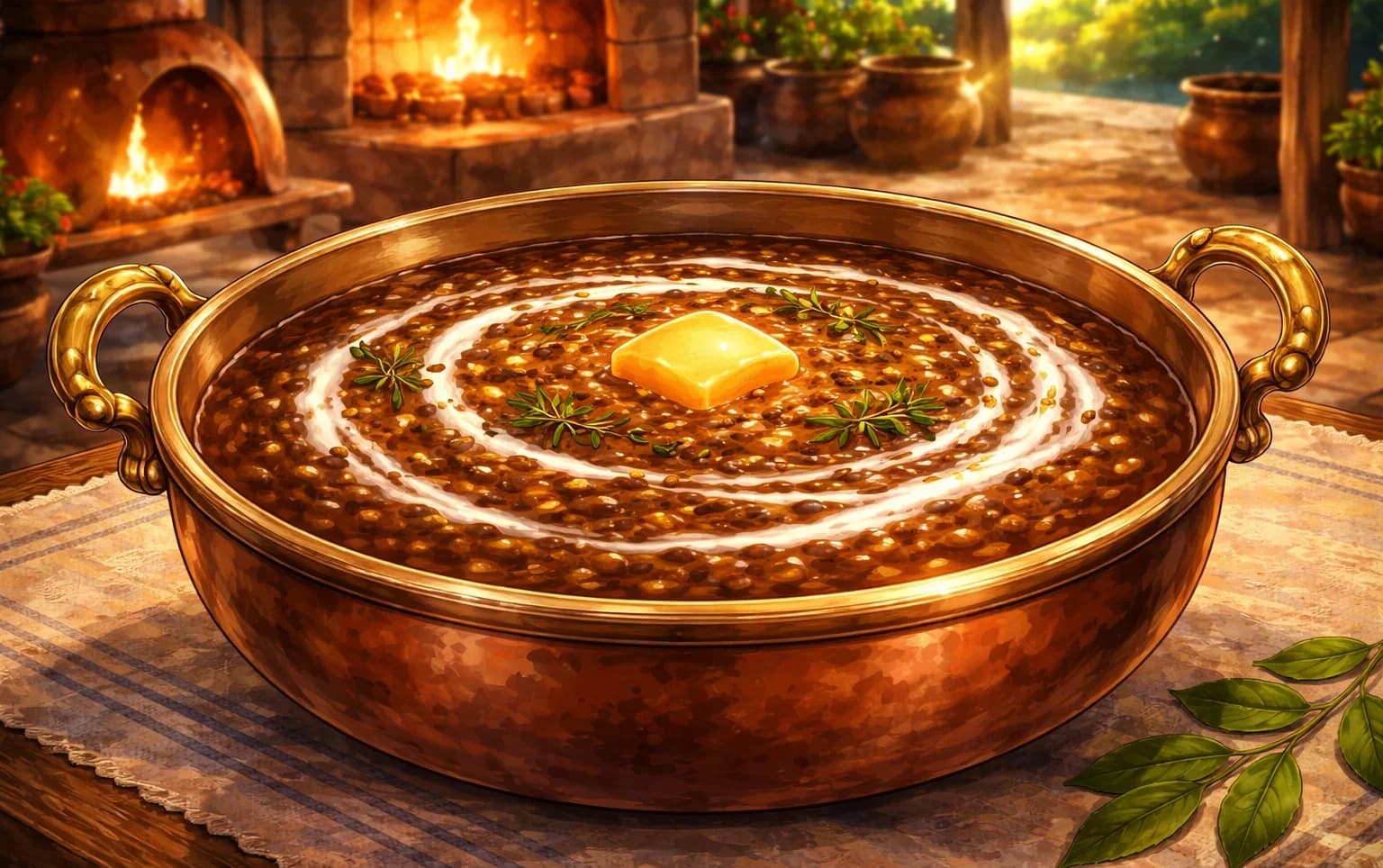
Dal Makhni
Slow-Cooked Punjabi Black Lentil Dal with Butter and Cream
Dal makhni does not announce itself. It arrives quietly in a black iron pot, dark and almost still, with a small swirl of cream on top that has already begun to melt into the surface. Then you stir it, and it moves thickly, slowly, with a glossiness that tells you something took a long time. This is a dish that refuses to be hurried.
It is originally a dish of the Punjabi dhabas, the roadside eating houses that lined the old highways north of Delhi, where whole black urad dal would go into a pot before midnight and cook over slow coals until the truckers arrived before dawn. Restaurant versions of dal makhni, most famously associated with Moti Mahal in Delhi, are cooked for twelve to twenty-four hours over a low flame, the dal and masala slowly losing their individual identities and becoming something unified and much greater than either alone. This long cooking is not excess. It is the recipe.
The transformation that happens during a slow simmer is worth understanding. The urad dal is dense and starchy. As it cooks, the starch gradually leaves the lentils and thickens the surrounding liquid. The butter begins to emulsify into the dal. The tomatoes lose all their acidity and become sweet. The kasuri methi's slight bitterness rounds out the richness. Given enough time and enough attentive stirring, the pot arrives at something that feels complete: thick, glossy, deeply savoury, with a richness that cream alone cannot explain.
At home, an hour of simmering after combining the dal and masala produces a very good result. Two hours produces something noticeably better. If you have the afternoon, let it go. The dal rewards patience in direct proportion to how much time you give it.
At a Glance
Yield
4 servings
Prep
15 minutes (plus overnight soaking)
Cook
2 hours minimum
Total
2 hours 15 minutes (plus soaking)
Difficulty
Easy
Ingredients
- ¾ lbwhole black urad dal (whole black lentils, not split), soaked overnight in cold water
- 1¾ ozdried kidney beans (rajma), soaked overnight in cold water
- 1 tspsalt
- 1¼ qtwater
- ½ cupunsalted butter
- 1¾ ozonion (about half a medium onion), finely diced
- 1¼ tbspginger garlic paste (equal parts fresh ginger and garlic, blended smooth)
- 7 oztomato purée (or 3 medium tomatoes (about 1½–2 tomatoes), blended smooth)
- 1¾ tbspKashmiri red chilli powder
- 2¾ tspcoriander powder
- 1⅔ tspgaram masala
- 1 tspsalt
- ⅓ cupdouble cream
- ¼ ozkasuri methi (dried fenugreek leaves), lightly crushed between palms
- 1 tbspcold butter, to finish
- —Salt to adjust
Method
- 1
Soak the dal and beans. The night before, place the black urad dal and kidney beans in a large bowl with enough cold water to cover by several centimetres. They will swell significantly. Soak for a minimum of 8 hours, ideally 12. Drain and rinse well.
- 2
Pressure cook until very soft. Combine the drained dal and kidney beans in a pressure cooker. Add 1.2 litres of water and 1 tsp salt. Pressure cook for 8–10 whistles (approximately 25–30 minutes under full pressure). Allow pressure to release naturally. The dal should be very soft; when you press a lentil between your fingers it should crush without resistance. The kidney beans should be completely tender with no chalkiness. If they are not soft enough, pressure cook for 3–4 more whistles. Alternatively, cook in a regular pot with 1.5 litres of water at a steady simmer, covered, for 2–3 hours until very tender. Top up water as needed. Set the cooked dal aside, retaining all its cooking liquid.
- 3
Make the tadka. In a wide, heavy-bottomed pan or kadai, melt the butter over medium heat. Add the diced onion (half a medium onion) and cook, stirring occasionally, for 10–12 minutes until deep golden. Take it further than you might instinctively, to the edge of caramelisation. This depth of colour goes directly into the flavour of the dal. Add the ginger garlic paste and stir for 2 minutes until the raw smell cooks off. Add the tomato purée, Kashmiri chilli powder, coriander powder, and salt. Stir well. Cook over medium heat, stirring regularly, for 15–20 minutes until the tomatoes have reduced, darkened, and the butter is visibly separating and pooling at the edges of the pan. The masala should look thick and glossy, not wet. Add the garam masala, stir through, and cook for 1 minute more.
- 4
Combine and begin the slow simmer. Add the cooked dal (with all its liquid) to the tadka pan. Stir everything together thoroughly. The mixture will look loose; this is correct. It will thicken significantly during the slow cook. Bring to a gentle simmer. Reduce heat to the lowest possible setting. The surface should barely bubble. Cook uncovered (or partially covered, leaving a gap for steam to escape) for a minimum of 1 hour, stirring every 10–15 minutes to prevent the dal from catching on the bottom. As it cooks, the dal will thicken progressively. Add a small splash of hot water if it becomes too stiff to stir; the consistency should move like thick porridge, not set like a solid. At the 1-hour mark, taste. The dal should have begun to integrate with the masala, the flavours deepening. Continue for a second hour if time allows. Two hours is visibly and tastably better than one.
- 5
Add cream and kasuri methi. In the last 15 minutes of cooking, stir in the double cream and the crushed kasuri methi. The cream will lighten the colour slightly and further enrich the texture. The kasuri methi will bloom in the heat and give the dal its aromatic depth. Simmer the final 15 minutes uncovered, stirring frequently. The dal is ready when it is thick enough to coat the back of a spoon heavily and falls from the spoon in slow, thick ribbons.
- 6
Finish and serve. Taste and adjust salt. Remove from heat. Stir in the cold butter, which will melt into the surface and give a final glossy richness. Serve in a warm bowl or pot. If you like, swirl a small amount of fresh cream on the surface. Serve immediately with naan, tandoori roti, or steamed rice.
Key Ingredient Benefits
Whole black urad dal (sometimes labelled sabut urad or whole black lentils) is the foundation of this recipe. It should not be confused with split white urad dal (dhuli urad), which is a different product with different properties. The whole lentil retains its black husk, which contains much of the fibre content and contributes the characteristic earthiness of the dish. Research suggests urad dal is a good source of plant protein, iron, and B vitamins.
Kidney beans (rajma) contribute body and a slightly different texture to the finished dal. Research suggests kidney beans are a good source of plant protein, complex carbohydrates, and folate. They must be fully cooked; undercooked kidney beans contain lectins that can cause digestive discomfort.
Kasuri methi (dried fenugreek leaves) is the aromatic that defines this dish in its final stage. It is available at any Indian grocery store. Traditionally used as a digestive spice in Indian cooking, research suggests fenugreek may support healthy blood glucose levels. The slight bitterness of the kasuri methi balances the richness of the cream and butter.
Butter and cream are used generously. Dal makhni is a rich dish by design; it is a celebration dal, not an everyday dal. The butter emulsifies into the slow-cooking dal in a way that cream alone cannot replicate, contributing body and a savoury depth. If cooking for dietary reasons, see substitutions.
Kashmiri red chilli powder gives the dal its characteristic warm brick-red colour without high heat. It is significantly milder than regular chilli powder. Do not substitute in equal quantities with cayenne or regular chilli powder.
Why This Works
Overnight soaking is not optional for whole urad dal and kidney beans. Unlike split lentils, these require full rehydration before cooking. Unsoaked whole dal will take significantly longer to become tender, and kidney beans must be fully cooked (not al dente) to be safe to eat.
Cooking until very soft in the pressure cooker is essential before the slow simmer begins. The slow simmer's purpose is flavour integration and texture development, not structural cooking. If the dal is not already completely tender before the masala combines with it, the slow cook will not fix this.
The caramelised onion tadka is the foundation of the dal's flavour. The 10–12 minutes of cooking until deep golden creates Maillard compounds in the onion that provide a savoury complexity the masala cannot achieve without them. Under-cooked onions produce a sharp, raw flavour that persists in the finished dal.
The slow simmer (minimum one hour, ideally two) is where the dish transforms. The starch released from the urad dal gradually thickens the cooking liquid. The butter emulsifies into the dal. The masala and lentils lose their separateness and become a single thing. This cannot be accelerated by increasing the heat; it requires time.
Kasuri methi late in cooking preserves its aromatic volatile compounds. Added too early, the characteristic fenugreek scent cooks off entirely. Added in the last 15 minutes, it provides the aromatic signature that makes a good dal makhni instantly recognisable.
Substitutions & Variations
Reducing richness: Butter can be reduced to 60g and cream to 50ml for a lighter result. The dal will still be very good; earthier and less luxurious. A knob of butter at the very end, even if the recipe is otherwise reduced, does more for the final texture than butter cooked in at the beginning.
Vegan version: Replace butter with neutral oil or vegan butter, and cream with full-fat coconut cream or cashew cream (50g soaked cashews blended with 100ml water until smooth). The result is different but satisfying; slightly sweeter from the coconut.
Without a pressure cooker: Cook the soaked dal in a large pot with plenty of water at a rolling simmer for 2–3 hours until very tender. Top up water as needed. This works well; it simply takes longer.
Extended cooking (restaurant method): If you have the time, after combining dal and masala, transfer to an oven at 100°C / 210°F and cook for 4–6 hours, stirring every hour. Add water as needed to maintain a thick but fluid consistency. This produces a dal that is genuinely different in character; deeper, more unified, with a complexity that shorter cooking cannot reach.
Dhungar smoke technique: For restaurant-style smokiness, place a small steel katori in the centre of the finished dal, place a piece of lit charcoal in it, pour half a teaspoon of ghee over it, and immediately cover the pot for 2 minutes. Remove the katori before serving.
Serving Suggestions
Dal makhni is served across the full range of Punjabi eating occasions, from casual family dinners to wedding feasts.
- Tandoori roti or butter naan: the classic and best accompaniment
- Steamed basmati rice: rice and dal makhni is a deeply satisfying combination
- Murgh makhni (butter chicken) alongside: the classic pairing in Punjab and Delhi
- Sliced raw onion, green chilli, and lime wedges: as is traditional at a Punjabi table
- A small additional knob of butter melted over the individual serving is appropriate and traditional
Storage & Reheating
Refrigerator: Store in an airtight container for up to 4 days. Dal makhni is one of the dishes that genuinely improves over 24–48 hours in the refrigerator as the flavours continue to integrate.
Freezer: Freezes very well for up to 3 months. The texture is well-suited to freezing; the thick consistency holds up better than thinner dals. Freeze in portion-sized containers.
Reheating: Dal makhni will thicken significantly when cold; it may solidify. Reheat in a pan over low heat, adding water gradually and stirring continuously until it reaches the desired consistency. Do not rush with high heat; it will catch and burn on the bottom. Add a small knob of butter and a splash of cream when reheating to restore the finish.
Cultural Notes
Dal makhani (दाल मखनी, "buttery dal") is the slow-cooked black urad dal and red kidney bean dish that anchors the Delhi Punjabi restaurant tradition and shares its origin story with murgh-makhni: both dishes were created at Moti Mahal restaurant in Daryaganj, Old Delhi, in the late 1940s by Kundan Lal Gujral and his partners. The dish has a specific technical character that distinguishes it from the broader Indian dal family: whole black urad (sabut urad, the small black-skinned lentils with white interior) are cooked very slowly with kidney beans, butter, and cream for at least six hours and sometimes overnight, producing a dish that is darker, richer, and far more luxurious than everyday yellow dal.
The traditional preparation has three stages. The dal and kidney beans are soaked overnight to soften, then drained and pressure-cooked or simmered for two to three hours until the urad has just begun to break down. The cooked lentils go into a heavy pot with a tempering of ginger-garlic paste, tomato purée, kashmiri chili powder, and ground spices, then are simmered at the lowest possible heat for another three to six hours with a generous addition of butter and cream, stirred periodically. The long slow cook is what gives the dal its characteristic smooth, almost velvety texture and the deep iron-toned color from the urad skins breaking down into the gravy. The dish is finished with a final swirl of cream and a small pat of butter just before serving.
The cultural place of dal makhani in modern Indian cuisine is enormous. The dish appears at virtually every Punjabi restaurant in India and the global South Asian diaspora, at wedding banquets across northern India, and as one of the most ordered items at Indian restaurants worldwide. The traditional pairing is with naan or roti and a rice preparation, often with butter chicken alongside as the "classic Moti Mahal set." Madhur Jaffrey's Indian Cooking and Camellia Panjabi's 50 Great Curries of India both document the dish's restaurant origin and its technical demands, with both authors noting that the home version typically falls short of the restaurant version because home cooks cannot easily commit the six to twelve hours of slow simmering that the restaurant kitchens dedicate to the dish.
Nutrition Facts
Calories: 542kcal (27%)|Total Carbohydrates: 60g (22%)|Protein: 24g (48%)|Total Fat: 25g (32%)|Saturated Fat: 14.8g (74%)|Cholesterol: 71mg (24%)|Sodium: 1319mg (57%)|Dietary Fiber: 19.3g (69%)|Total Sugars: 3.1g
You Might Also Like
Ratings & Comments
Ratings & Comments
Ratings
Share your thoughts on this recipe.
Sign in to rate and comment