Chinese Cuisine
Gan Bian Si Ji Dou (Dry-Fried Green Beans)
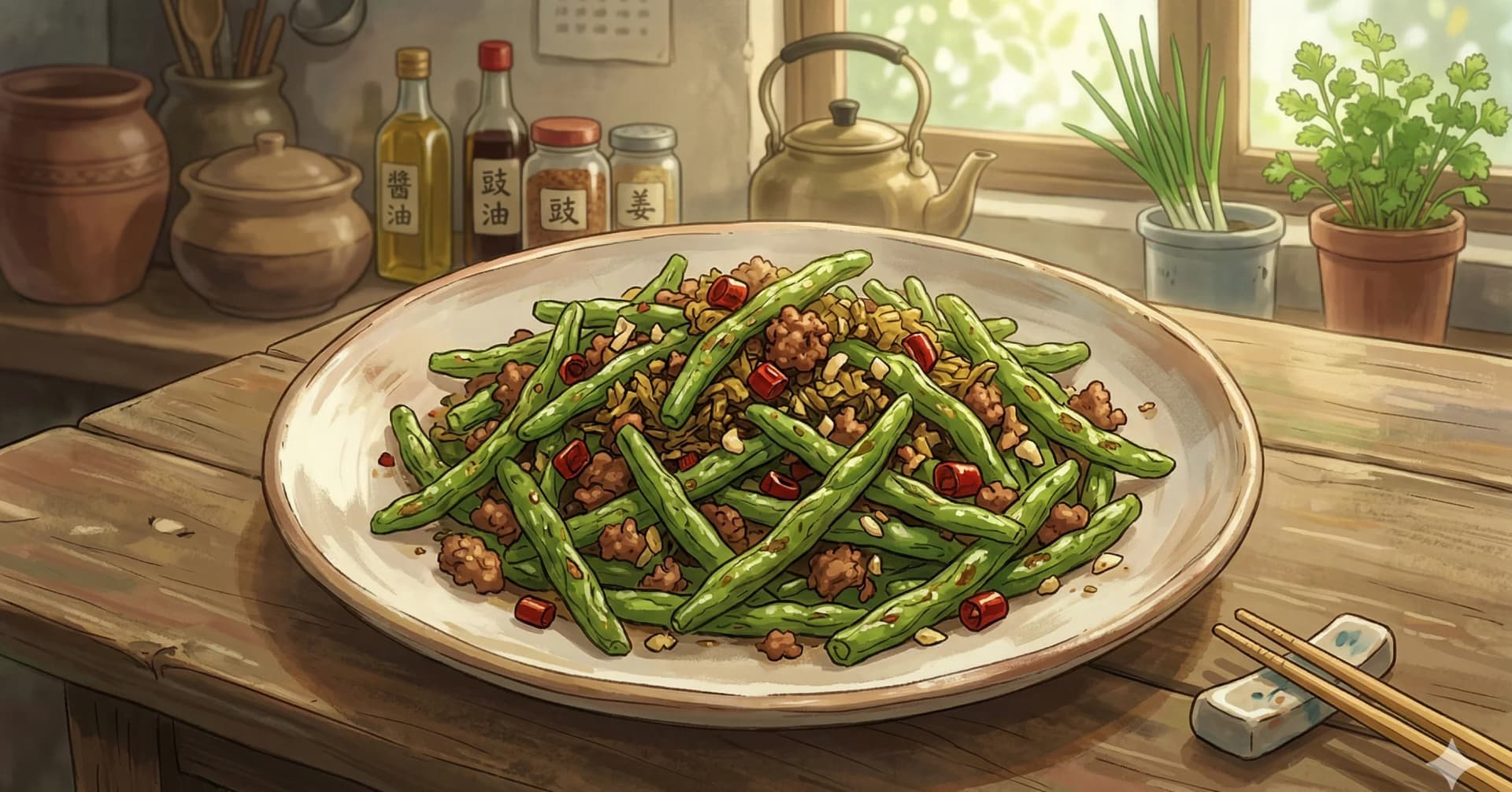
Sichuan dry-fried green beans blistered in a wok with pork, preserved vegetables, and chili
The first sign that these beans are ready is the sound: the rapid popping and hissing gives way to a quieter sizzle, and the beans themselves have collapsed from their bright, taut freshness into something wrinkled, blistered, and deeply golden at the edges. That transformation is the whole point. Dry-frying, or gan bian, is a technique that drives out moisture through sustained high heat, concentrating flavor and creating a texture that is simultaneously tender and slightly chewy, with charred spots that taste almost smoky.
This dish is a staple across Sichuan and has become one of the most popular Chinese vegetable preparations worldwide, though many restaurant versions rely on deep-frying for speed. The home version, done in a wok with a modest amount of oil and patience, produces a cleaner result with more nuanced flavor. The beans are cooked first, then joined by a small amount of seasoned ground pork (or omitted entirely for a vegetarian take) and ya cai, Sichuan's mustard green preserve that adds a salty, earthy depth you cannot replicate with anything else.
The practical key is heat management. The beans need enough heat to blister without burning, which means a wok over a strong flame and constant movement. If your stove runs cooler, work in smaller batches. Crowding the wok steams the beans instead of frying them, and you will end up with limp, pale results that miss the point entirely.
At a Glance
Yield
4 servings
Prep
10 minutes
Cook
15 minutes
Total
25 minutes
Difficulty
Easy
Ingredients
- 1 lbgreen beans (Chinese long beans or standard green beans), trimmed and cut into 8 cm lengths
- 2 tbspvegetable oil
- 3½ ozground pork
- ¾ ozya cai (Sichuan preserved mustard greens), rinsed and minced
- 4dried red chilies, snipped into pieces, seeds shaken out
- 1⅔ tspSichuan peppercorns
- 3 clovesgarlic, minced
- 1¾ tbspfresh ginger, minced
- 2 tsplight soy sauce
- 1 tspShaoxing wine
- ½ tspsugar
- 1 tspsesame oil
Method
- 1
Wash the green beans and dry them thoroughly. Any residual water will cause dangerous splattering in the hot oil and will steam rather than fry the beans. Use a clean kitchen towel or salad spinner.
- 2
Heat a wok over high heat until a wisp of smoke rises from the surface. Add the vegetable oil and swirl to coat the sides.
- 3
Add half the green beans in a single layer. Let them sit undisturbed for about 30 seconds, then toss. Continue cooking, tossing every 20 to 30 seconds, for 3 to 4 minutes. The beans should develop blistered, wrinkled skins with brown spots and feel tender when pressed between your fingers.
- 4
Transfer the first batch to a plate and repeat with the remaining beans, adding a small splash of oil if the wok looks dry.
- 5
With all the beans set aside, reduce the heat to medium. Add the ground pork to the wok, breaking it into small pieces with your spatula. Cook for 2 to 3 minutes, stirring frequently, until the pork is no longer pink and has begun to crisp at the edges.
- 6
Push the pork to one side. Add the dried chilies and Sichuan peppercorns to the open space. Let them toast in the residual oil for about 20 seconds, until the chilies darken slightly and the peppercorns become fragrant. Be careful not to let them burn.
- 7
Add the garlic and ginger, stirring everything together. Cook for 15 seconds, just until the raw smell disappears and a sharp, aromatic warmth fills the air.
- 8
Add the ya cai and stir-fry for another 20 seconds. The preserved vegetable will release a salty, earthy fragrance that deepens the dish considerably.
- 9
Return all the blistered green beans to the wok. Toss vigorously to combine with the pork and aromatics.
- 10
Splash the Shaoxing wine along the edge of the wok. It will evaporate almost instantly, leaving behind its fragrance. Add the light soy sauce and sugar, tossing to distribute evenly.
- 11
Stir-fry everything together for another 30 to 45 seconds, allowing the flavors to meld. The beans should be well coated with small bits of pork, ya cai, and chili clinging to their surfaces.
- 12
Remove the wok from the heat. Drizzle with sesame oil and give one final toss.
- 13
Transfer to a serving plate. The beans should look wrinkled and slightly oily, flecked with bits of pork and red chili. Serve immediately.
Key Ingredient Benefits
Green beans are a good source of fiber, vitamin C, and vitamin K. The high-heat cooking in this preparation does reduce some heat-sensitive vitamins, but the short cooking time helps preserve more nutrients than prolonged boiling would.
Ya cai (preserved mustard greens) is a fermented condiment and, like many preserved vegetables, is high in sodium. Research suggests that fermented vegetable products may contain beneficial lactic acid bacteria, though the quantities consumed as a condiment are modest.
Sichuan peppercorns contain hydroxy-alpha sanshool, the compound responsible for the numbing sensation. They have been traditionally used in Chinese medicine for digestive support, and some modern studies suggest mild analgesic properties.
Why This Works
Dry-frying removes moisture from the beans through sustained contact with high heat, which accomplishes two things. First, it concentrates the beans' natural sugars and vegetal flavors, making them taste more intensely of themselves. Second, it creates a wrinkled surface with more area to catch and hold the sauce and aromatics.
The pork serves as a seasoning rather than a main protein. A small amount, cooked until crisp, adds savory depth and textural contrast without turning this into a meat dish. Ya cai plays a similar role: its fermented saltiness means you need very little added soy sauce, and it provides a layer of umami that is more complex than salt alone.
Sichuan peppercorns contribute their signature numbing tingle (ma), which, paired with the heat of the dried chilies (la), creates the ma la flavor profile that defines much of Sichuan cooking. Toasting them briefly in oil activates their aromatic compounds without making them overpoweringly numbing.
Substitutions & Variations
- Ya cai: If unavailable, use finely minced Tianjin preserved vegetable (dong cai) or, in a pinch, a small amount of chopped capers for a similar salty-fermented note.
- Ground pork: Ground chicken or turkey works, though the flavor will be lighter. For a vegetarian version, omit the meat entirely and add a tablespoon of chopped fermented black beans for additional savory depth.
- Long beans vs. green beans: Chinese long beans (dou jiao) are traditional and hold up beautifully to the heat. Standard green beans work well too, just cut them a bit shorter.
- Heat level: Reduce or omit the dried chilies for a milder version. The Sichuan peppercorns alone provide plenty of flavor interest.
Serving Suggestions
Serve as part of a multi-dish Chinese meal alongside steamed rice, a braised meat, and a lighter soup. These beans also work beautifully as a standalone side dish for grilled or roasted meats. They are excellent at room temperature, which makes them a practical choice for a buffet or potluck table.
Storage & Reheating
Store in an airtight container in the refrigerator for up to 3 days. The beans will soften slightly but remain flavorful. Reheat in a hot wok or skillet over high heat for 1 to 2 minutes, tossing frequently. A splash of water can help steam them back to life. These beans do not freeze well, as the texture becomes mushy upon thawing.
Cultural Notes
Gan bian si ji dou (干煸四季豆, "dry-fried four-season beans") is the Sichuan green bean dish built on the technique known as gan bian, one of the foundational Sichuan cooking methods alongside stir-frying, deep-frying, and braising. Gan bian literally means "dry stir-frying" and refers to cooking ingredients in a small amount of oil over high heat for an extended time, until the surface moisture evaporates and the exterior shrivels and chars while the interior cooks through. The technique produces a wrinkled, slightly leathery surface texture and a concentrated, smoky flavor that no quick stir-fry can replicate.
The traditional preparation uses thin Chinese long beans (chang dou, yard-long beans) rather than standard Western green beans, since the long beans hold up to extended cooking without turning to mush. The beans are cooked in oil (traditionally deep-fried briefly first to set the exterior, then dry-fried in the same wok with less oil to develop the wrinkled surface) until the skin blisters and the surface goes leathery. The aromatics added in the second stage are a mix of ya cai (Sichuan preserved mustard greens, the same fermented condiment that crowns dan dan noodles), ground pork, garlic, ginger, dried chilies, and a small amount of Shaoxing wine. The final dish is dry to the eye, with no sauce pooling at the bottom, the beans coated in a sticky-dry mixture of pork and aromatics.
The cultural place of gan bian si ji dou in Sichuan cuisine is as a vegetable course in the standard multi-dish family meal. The dish provides a textural contrast to the wetter dishes like mapo tofu or shui zhu yu that typically share the table, and the pickled mustard greens supply a slightly funky, fermented note that adds depth without adding heat. The version most commonly served in American Chinese restaurants is often closer to a wet stir-fry with green beans, soy sauce, and ground pork, which is a meaningful departure from the traditional dry-fried form. The authentic version requires patience: the beans take eight to ten minutes of active cooking, not the two-minute flash typical of Cantonese vegetable stir-fries.
Nutrition Facts
Calories: 155kcal (8%)|Total Carbohydrates: 9.9g (4%)|Protein: 6.8g (14%)|Total Fat: 10.5g (13%)|Saturated Fat: 2.4g (12%)|Cholesterol: 20mg (7%)|Sodium: 214mg (9%)|Dietary Fiber: 3.2g (11%)|Total Sugars: 4.4g
You Might Also Like
 Medium
Chinese Cuisine
Niu Rou Yang Cong Jiaozi (Beef and Onion Dumplings)
60 minutes
 Medium
Chinese Cuisine
Bai Qie Ji (White Cut Chicken)
4 hours 30 minutes
 Easy
EasyCross-Cultural · China
Chicken and Broccoli in White Sauce (白汁鸡花椰)
45 minutes
 Medium
Chinese Cuisine
Char Siu (Chinese BBQ Pork)
9 hours (including marinating)
Ratings & Comments
Ratings & Comments
Ratings
Share your thoughts on this recipe.
Sign in to rate and comment