Dum · Indian Cuisine
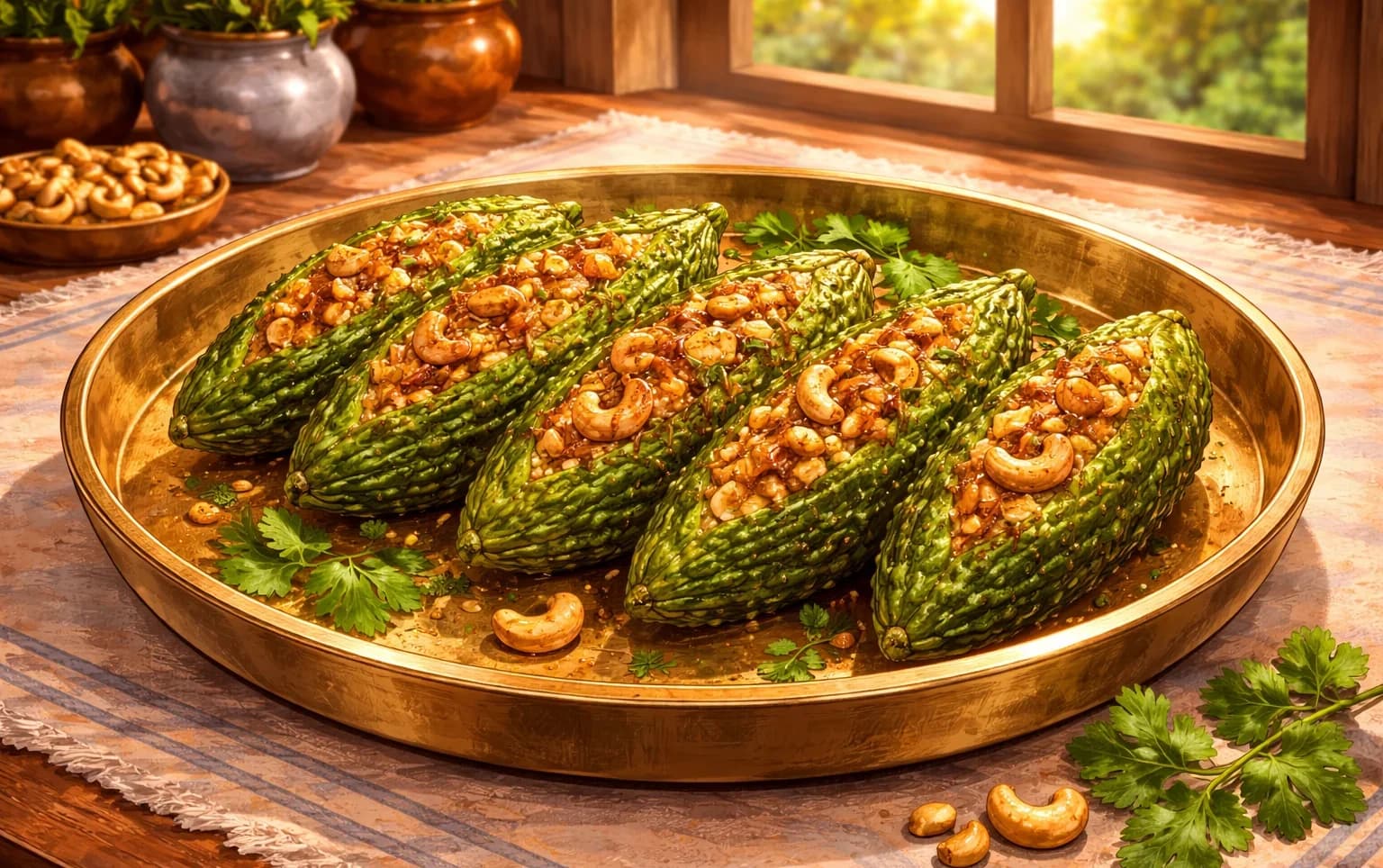
Slow-Cooked Bitter Melon (Dum Ke Kareley)
Bitter gourd stuffed with a spiced nut and seed filling, slow-cooked in a sealed pot
Karela — bitter gourd — is one of those vegetables that demands to be understood rather than merely tolerated. Its bitterness is not a flaw to be cooked away entirely; it is the point. In this dum preparation, the gourd is hollowed, salted, and stuffed with a filling of grated onion, aniseed, chironji (a small Indian nut), and cashews, then slow-cooked in ghee until the exterior is mellow and the interior has absorbed the fat and spice in the sealed heat of the dum method.
Salting the gourds draws out much of the surface bitterness before cooking, softening the edge without eliminating the character that makes this dish interesting. What remains is a vegetable that is savoury, slightly sweet from the cooked onion, nutty from the chironji and cashews, and fragrant with aniseed — a complexity that would not exist without the bitterness as its backbone.
The dum technique is used here not for tenderness of meat but to concentrate flavour: the sealed environment prevents moisture from escaping, forces the steam through the filling and walls of the gourd, and allows the stuffing to cook the vegetable from the inside while the ghee works from the outside. The result is a dish that eats very differently from any other preparation of karela.
Served with chapattis and a simple dal, this is the kind of food that makes a virtue of constraint. A handful of pantry ingredients and a patient hand producing something genuinely memorable.
At a Glance
Yield
Serves 4
Prep
25 minutes + 10 minutes soaking
Cook
35 minutes
Total
1 hour 10 minutes
Difficulty
Medium
Ingredients
- 2¼ lbkarela (bitter gourds) (about 12½ bitter melons), about 8–10 medium gourds
- 3 tspsalt, for soaking
- 2⅛ cupwater, for soaking
- ½ lbonions (about 1½–2 onions), finely grated
- 3¼ tbspgarlic, juice extracted (grate or pound and press through a cloth)
- ⅓ cupcoriander powder
- ¾ tspturmeric powder
- 3¼ tbspaniseed (saunf), roasted and ground
- ⅔ tspkalonji (nigella seeds)
- ¾ ozchironji (charoli nuts)
- 1¾ ozcashewnuts, roughly ground
- ¾ tspdried mango powder (amchur, about ½ teaspoon)
- 1⅔ tspfine salt
- ½ cupghee, for cooking
Method
- 1
Prepare the gourds. Wash the bitter gourds and scrape the ridged skin lightly with a peeler or knife. Slice off and reserve the tops (stem ends). Using a small spoon or the handle of a teaspoon, gently hollow out the inner flesh and seeds, leaving the walls intact. Dissolve 3 teaspoons salt in 500 ml water, add the hollowed gourds and their tops, and soak for 10 minutes. Drain and rinse well.
- 2
Make the stuffing. Grate the onions (250 g) finely. Extract the garlic (20 g) juice by pounding or grating the garlic and pressing it through a piece of muslin or fine cloth. Roast the aniseed (20 g) in a dry pan over medium heat until fragrant, then grind. Combine grated onion, garlic juice, coriander powder (6 teaspoons), turmeric (½ teaspoon), ground aniseed, kalonji (2 g), chironji (20 g), ground cashews, mango powder (2 g), and salt (3 teaspoons). Mix well.
- 3
Heat the ghee (100 g). In a kadhai, heat a little of the ghee. Add a splash of garlic juice if any remains. Add sautéed onion from the stuffing mixture (reserving the bulk for filling) and fry briefly. Remove and add to the stuffing mixture.
- 4
Stuff and seal. Fill each hollowed gourd with the spice mixture, pressing it gently but firmly. Replace the tops and secure with kitchen twine so the filling cannot escape during cooking.
- 5
Cook dum-style. Heat the remaining ghee in a heavy, deep kadhai or pot with a tight-fitting lid. Add the stuffed gourds in a single layer. Cook over medium heat, turning occasionally, for about 8–10 minutes until the exterior begins to brown. Reduce heat to very low, cover tightly, and cook for a further 20–25 minutes until the gourds are completely tender when pierced. Drain off any excess oil.
- 6
Serve hot with chapattis or paratha.
Key Ingredient Benefits
Bitter gourd (karela) is one of the most studied vegetables in traditional medicine across South and Southeast Asia. In Ayurvedic tradition it is considered beneficial for blood sugar regulation and digestive health. Modern research has found compounds in bitter gourd that may have hypoglycaemic activity, though this should not be understood as a substitute for medical treatment. Culinarily, its bitterness signals the presence of specific phytochemicals, including charantin and momordicin.
Chironji (charoli, Buchanania lanzan) are small seeds from a tree native to South Asia, used in both sweet and savoury cooking. They have a mild, almond-like flavour and add texture and richness. They are relatively high in fat, mostly monounsaturated.
Why This Works
Salt-soaking draws out bitter compounds from the gourd's skin and flesh through osmosis. The brief soak is enough to reduce the sharpest bitterness without affecting the structural integrity of the gourd. It remains firm enough to stuff and hold together during cooking.
Aniseed (saunf) in the stuffing is the aromatic key. Its slightly sweet, fennel-like character bridges the bitterness of the karela and the richness of the ghee, creating a balance that neither ingredient achieves alone. Roasting it before grinding deepens and concentrates its oils.
The sealed dum environment means the gourds cook simultaneously from outside (ghee) and inside (stuffing and steam). This dual approach produces a texture — soft but not collapsing, the filling merged with the walls — that braising or frying alone cannot achieve.
Substitutions & Variations
No chironji: Replace with an equal weight of melon seeds (magaz) or broken cashewnuts. The flavour will be slightly sweeter.
No aniseed: Fennel seeds are a close substitute. Roast and grind them in the same way. The flavour will be similar but slightly more assertive.
Less bitter version: Increase the soaking time to 30 minutes and add ½ teaspoon sugar to the stuffing mixture to further offset the bitterness.
Serving Suggestions
Dum ke kareley belongs alongside simple flatbreads — chapatti or phulka — and a plain dal that does not compete with the assertive flavours of the gourd. A spoonful of thick yogurt on the side provides cooling relief. In the North Indian tradition, this is often a side dish rather than a main, paired with a dal-chawal or a simple sabzi spread.
Storage & Reheating
Keeps refrigerated for up to 2 days. Reheat in a covered pan over low heat, adding a splash of water if needed. The flavour deepens overnight. Not suitable for freezing.
Cultural Notes
Dum ke kareley (दम के करेले, "bitter gourd cooked dum") is the Awadhi vegetarian preparation of bitter gourd (karela, the gourd of Momordica charantia) stuffed with a sweet-tangy filling of caramelized onion, tamarind, jaggery, ginger, fennel, and ground spices, then slow-cooked in a sealed pot until the gourd skin softens and the filling melds with the gourd's natural bitterness into a complex sweet-bitter-tangy flavor profile. The dish belongs to the Awadhi vegetarian repertoire and represents the regional Indian approach of balancing the bitter gourd's pronounced kadwa (bitter) note with contrasting sweet, sour, and savory elements rather than masking the bitterness.
The cultural attitude toward bitter gourd shapes the dish's character. In Ayurvedic tradition bitter gourd is classified as a tikta rasa (bitter taste) food considered to support liver function and blood-sugar regulation, and the vegetable is eaten across India as a tonic preparation in summer when its bitterness is thought to be cooling. The Awadhi treatment respects the gourd's bitterness rather than trying to eliminate it, building a stuffed preparation in which the sweet jaggery and sour tamarind in the filling balance and round the bitterness so the eater experiences all four notes at once. This contrasts with the simpler South Indian karela preparations that often emphasize crisp frying over slow stuffing.
The technique requires a salt-rest step to manage the bitterness. Small to medium bitter gourds are scraped lightly to remove the bumpy outer ridges, slit lengthwise on one side, and the seeds and central pith are scooped out. The hollowed gourds are rubbed with salt inside and out and rested for an hour, which draws out some of the bitterness in the released liquid. The gourds are rinsed and patted dry. A filling is prepared from caramelized onion (cooked slowly until deep golden), tamarind paste, jaggery, ground fennel, ground cumin, ginger paste, and salt. The filling is stuffed into the hollowed gourds, which are tied with kitchen twine to hold their shape. The stuffed gourds are sautéed briefly in mustard oil in a heavy handi, then a small amount of water is added, the pot is sealed with a tight lid (or dough closure for the formal version), and cooked over low heat for forty-five minutes until the gourd skin softens and the filling melds with the gourd's bitterness.
Nutrition Facts
Calories: 306kcal (15%)|Total Carbohydrates: 21.4g (8%)|Protein: 6.7g (13%)|Total Fat: 23.5g (30%)|Saturated Fat: 10.6g (53%)|Cholesterol: 38mg (13%)|Sodium: 111mg (5%)|Dietary Fiber: 8.7g (31%)|Total Sugars: 6.2g
You Might Also Like



Ratings & Comments
Ratings & Comments
Ratings
Share your thoughts on this recipe.
Sign in to rate and comment