Cross-Cultural · Korea
Braised Black Cod (Eundaegu-jorim / 은대구조림)
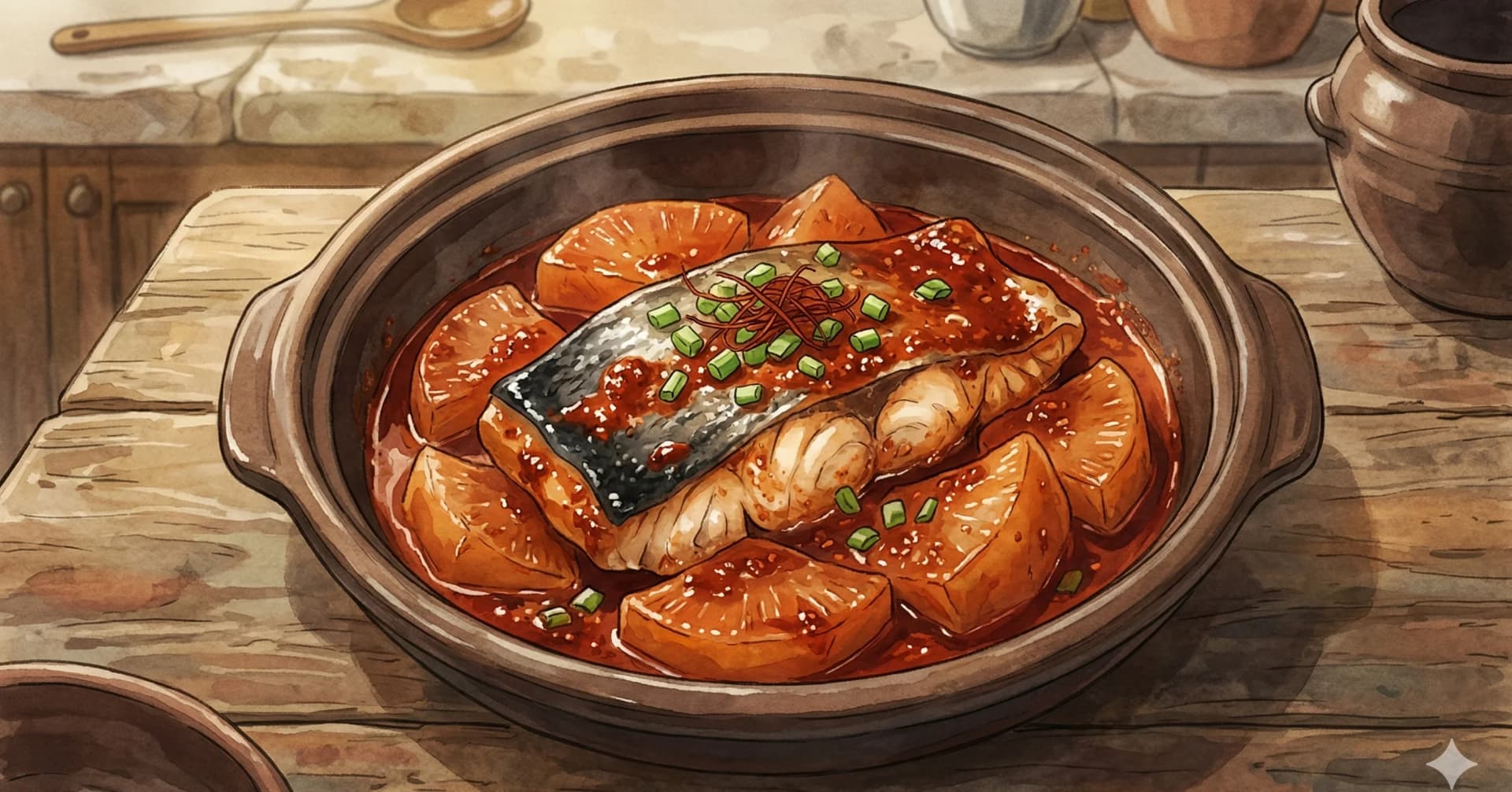
Black cod braised Korean-style with radish, gochugaru, and soy sauce in a spicy-savory sauce
Eundaegu-jorim is the Korean way of braising black cod, and it could not be more different from the Japanese nitsuke version. Where nitsuke is subtle and sweet, the Korean approach is bold and spicy. The fish sits on a bed of radish that has been pre-simmered in water, and a sauce of soy sauce, gochugaru, garlic, and sugar is poured over the top. Everything braises together under a lid until the radish is translucent, the fish is flaky and infused with the spicy sauce, and the braising liquid has reduced into a thick, savory coating.
Black cod works beautifully here because its rich, fatty flesh can stand up to the aggressive seasoning without drying out or being overwhelmed. The fat in the fish enriches the braising liquid, and the radish absorbs that enriched liquid and becomes one of the best parts of the dish. The sliced onion, large scallion, and green and red chilies go in toward the end, adding freshness and color.
This is a dish that appears at Korean celebrations, including Lunar New Year and Chuseok, where it is believed to bring good fortune. It is also popular at Korean restaurants as a main course, served with steamed rice and banchan. The braising liquid is worth spooning over your rice.
At a Glance
Yield
4 servings
Prep
15 minutes
Cook
30 minutes
Total
45 minutes
Difficulty
Medium
Ingredients
Fish Ingredients
- 2 lbsblack cod (sablefish) (900 g), cut into steaks or fillets
- 1medium Korean radish or daikon, sliced into 3/4-inch rounds
- 1/2medium onion, sliced
- 2-3stalks large scallion (daepa), cut into pieces
- 2green chili peppers, sliced
- 2 cupswater
Method
- 1
Mix soy sauce, garlic, gochugaru, and sugar into a seasoning sauce.
- 2
Arrange radish rounds on the bottom of a large pot. Add 2 cups water, cover, cook 15 minutes over medium-high.
- 3
Add sliced onion, scallion, and chili peppers over the radish.
- 4
Place fish on top, pour seasoning sauce over. Cover, reduce to medium, cook 10 minutes.
- 5
Gently shift the radish so it does not stick. Spoon broth over fish and vegetables. Simmer 5-10 more minutes until fish flakes easily.
- 6
Serve with braising liquid ladled over. Eat with rice.
Key Ingredient Benefits
Black cod (sablefish): Despite the name, black cod is not actually a cod but a deep-water fish (Anoplopoma fimbria) found in the cold northern Pacific. Its flesh has the highest fat content of any white fish on the market, with omega-3 content rivaling salmon. The fat is what makes it ideal for braising; it stays tender and rich even after extended cooking, where leaner white fish would dry out and flake apart.
Korean radish (mu): Sweeter, denser, and starchier than daikon, with a higher water content that releases a subtle vegetable broth as it simmers. The radish absorbs the spicy braising sauce and becomes the textural counterpoint to the rich fish — many Koreans consider the radish the better part of the dish.
Gochugaru: Provides both color and a fruity, building heat that does not overpower the delicate fish. The coarse Korean grind also gives the sauce a textural quality you cannot replicate with fine chili powders.
Soy sauce and garlic: The savory backbone. Korean braising sauces typically use a balance of soy sauce for salinity, gochugaru for heat, garlic for pungency, and a touch of sugar to round the edges. The sugar is essential, even when the dish is not meant to taste sweet, because it tames the harsh edges of soy sauce and chili.
Why This Works
Pre-simmering the radish before adding the fish is the technique that separates a good jorim from a great one. Radish needs longer cooking than fish to become tender and absorb sauce, and starting it first means you can pull the fish off the heat the moment it is just cooked through, rather than overcooking the fish to accommodate the radish.
Black cod's high fat content is what allows this dish to take heat and bold flavor without losing the fish itself. Leaner white fish like cod or halibut would absorb so much chili sauce that the fish would taste only of sauce. Black cod's richness pushes back, creating a balance where you taste both the fish and the braise.
The sauce ingredients are layered in a specific order. Soy sauce, gochugaru, garlic, and sugar go into the simmering water early so they meld and mellow. The fresh aromatics — scallion, green chili, more garlic — go in late so they retain their brightness. This layering is the difference between a one-note spicy braise and one with depth.
The fish goes in last and cooks gently. Korean jorim dishes are not boiled aggressively; the liquid should be at a low simmer, just barely moving. This protects the fish texture while still letting the sauce reduce and concentrate around it.
Substitutions & Variations
Black cod: This dish is traditionally made with black cod (eundaegu), but Pacific cod, halibut, mackerel, or even monkfish work well. Mackerel (godeungeo) is the most common substitute in Korean home kitchens and produces a similarly rich, oily braise. Reduce cooking time by 5 minutes for thinner fillets.
Korean radish (mu): Daikon is a one-to-one swap and the most common substitute outside Korea. The flavor is slightly sharper and less sweet, but the texture is nearly identical. Watermelon radish or large red radishes will work but produce a more peppery result.
Gochugaru: A blend of sweet paprika and cayenne (3 to 1 ratio) approximates the color and heat in an emergency, but the flavor will be flatter. There is no good substitute for the smoky-fruity quality of Korean chili.
Daepa (large scallion): Regular scallions or even leek whites work. Use 4 to 5 regular scallions for every 2 daepa stalks.
Soy sauce: Use Korean soy sauce (jin ganjang) if available. Japanese-style soy sauce works fine; just avoid sweet or low-sodium varieties, which throw off the balance of the braise.
Serving Suggestions
Eundaegu-jorim is built for steamed short-grain rice. The braising sauce is concentrated enough that even a spoonful drizzled over rice tastes complete, and the soft, sauce-soaked radish becomes its own banchan alongside the fish.
Round out the meal with at least one cooling banchan. Sigeumchi namul (seasoned spinach) and kongnamul muchim (seasoned soybean sprouts) are both classic pairings that balance the heat and richness of the fish. A bowl of clear miyeok-guk (seaweed soup) or a side of kimchi completes a traditional Korean home meal.
For an alternative protein-forward Korean fish dish, see galchi-jorim (braised hairtail) or godeungeo-jorim (braised mackerel), both built on the same braising technique.
Storage & Reheating
Refrigerator: Store in an airtight container for up to 3 days. Like most Korean braised dishes, this improves overnight as the radish and fish absorb more of the sauce.
Reheating: Reheat gently in a covered pan over medium-low heat with a splash of water to loosen the sauce. The radish will hold up beautifully; the fish needs careful handling to avoid breaking apart. If reheating in the microwave, cover loosely and use medium power.
Make-ahead: The radish can be pre-simmered in the seasoned broth several hours in advance, then cooled and refrigerated. Bring back to a simmer and add the fresh fish at serving time. This actually deepens the radish's flavor.
Freezing: Not recommended. The radish texture suffers significantly on thawing, and the fish breaks down.
Cultural Notes
Jorim (조림) is a Korean cooking method, not a single dish. The word means "to reduce" or "to braise in a small amount of seasoned liquid until the sauce coats the main ingredient." It is one of the foundational techniques of Korean home cooking, alongside guk (soups), jjigae (stews), bokkeum (stir-fries), and namul (seasoned vegetables). Almost any protein or vegetable can be braised this way: fish, beef, tofu, lotus root, eggs, potatoes.
Eundaegu (은대구) literally translates as "silver cod," referring to the fish's pale, silvery skin. The dish is a winter staple in Korea's coastal regions, where black cod is plentiful and the rich, fatty fish suits cold-weather appetites. In Busan and other southern port cities, you will find eundaegu-jorim on the menu of nearly every traditional banchan-style restaurant.
Spicy braised fish in this style sits at the intersection of two Korean food principles: that bold seasoning makes humble ingredients special, and that the sauce-laden vegetables underneath the protein are often the best part of the dish. Many Koreans grow up fighting their siblings for the radish, not the fish.
Nutrition Facts
Calories: 385kcal (19%)|Total Carbohydrates: 13.2g (5%)|Protein: 24.1g (48%)|Total Fat: 27.4g (35%)|Saturated Fat: 5.8g (29%)|Cholesterol: 83mg (28%)|Sodium: 848mg (37%)|Dietary Fiber: 3.7g (13%)|Total Sugars: 8.4g
You Might Also Like
Ratings & Comments
Ratings & Comments
Ratings
Share your thoughts on this recipe.
Sign in to rate and comment