Malaysian Cuisine
Ikan Bakar (Malaysian Grilled Fish in Banana Leaves)
Whole snapper grilled in banana leaves with a fiery, aromatic sambal paste
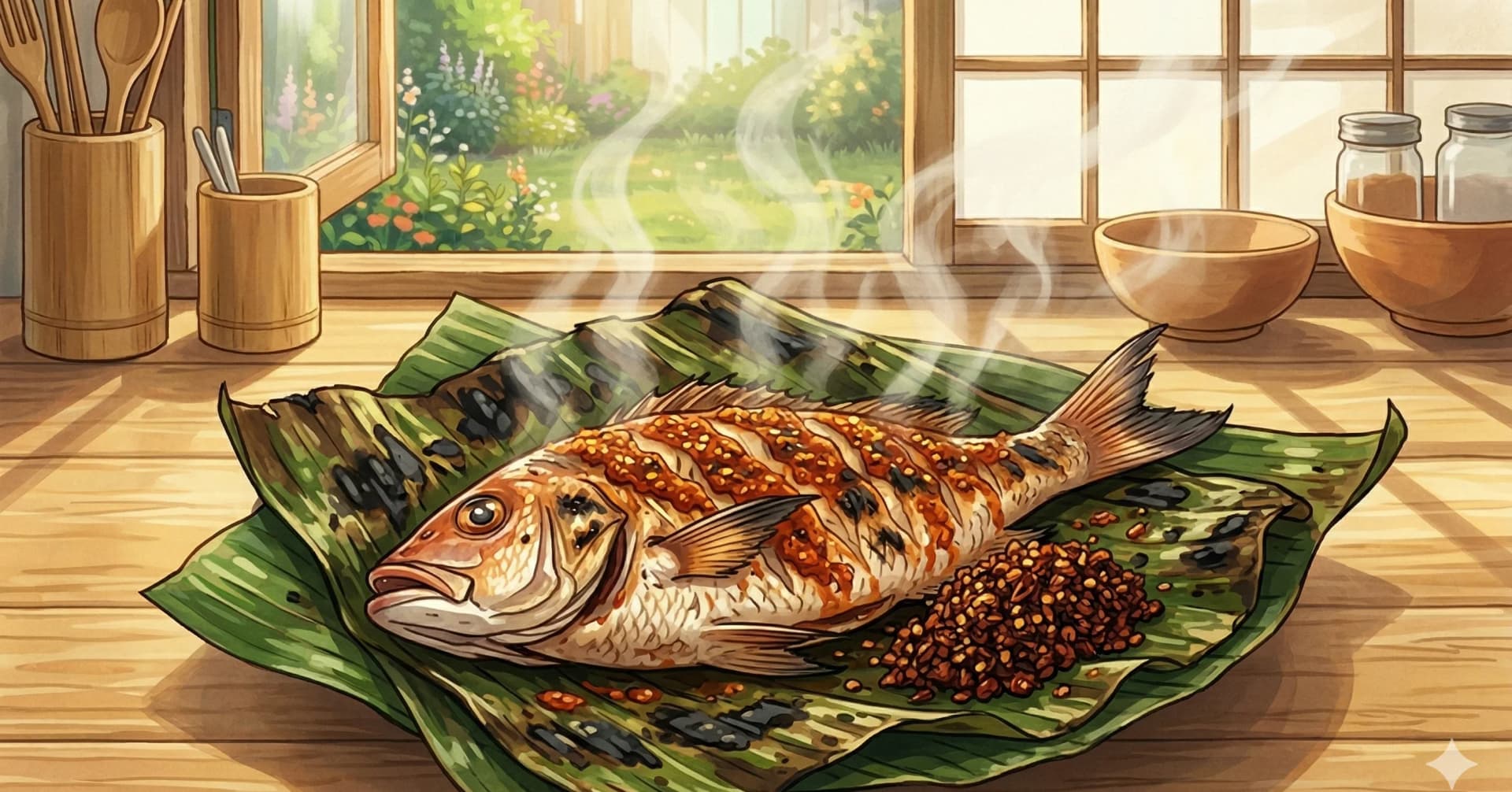
Along the coasts of Peninsular Malaysia, from Penang down to Johor, the scent of charring banana leaves drifting from roadside stalls is as familiar as the salt air itself. Ikan bakar, which translates simply to "burnt fish" or "grilled fish," is one of the defining street foods of the region. A whole fish, scored and slathered with a cooked sambal paste, gets wrapped in banana leaves and placed over coals until the leaves blacken and the flesh inside turns impossibly tender and fragrant. The banana leaves do more than prevent sticking. As they heat, they release chlorophyll compounds and volatile aromatics that perfume the fish with a green, earthy sweetness you cannot replicate with aluminum foil alone.
The sambal is the heart of the dish. Fresh red chilies, shallots, lemongrass, and belacan (fermented shrimp paste) are pounded or blended into a coarse paste, then cooked in oil until the rawness fades and the flavors concentrate. This step, called tumis in Malay, is essential. Raw sambal tastes sharp and one-dimensional. Cooked sambal has depth, a slight sweetness from the caramelized shallots, and a rounded heat that lingers without burning. A touch of turmeric tints the fish golden underneath the red sambal, and a squeeze of lime at the end lifts everything.
This recipe draws primarily from a Penang-style approach using whole snapper, though flat fish fillets and stingray wings are equally traditional. If you have tried Turmeric Fried Fish or the gentler steamed preparation in Pla Nueng Manao, ikan bakar sits at the other end of the spectrum: bold, smoky, and unapologetically spicy. It is street food meant to be eaten with your hands, the banana leaf serving as both cooking vessel and plate.
At a Glance
Yield
4 servings
Prep
20 minutes
Cook
20 minutes
Total
40 minutes
Difficulty
Easy
Ingredients
Spice Paste Ingredients
- 1¾ cupfresh red chilies, seeded and roughly chopped
- 4 ozshallots, roughly chopped
- 2 stalkslemongrass, white part only, thinly sliced
- ½ oztoasted belacan (Malaysian shrimp paste)
- ¼ cupneutral oil (such as vegetable or peanut)
- 2 tspfish sauce
- 2⅓ tspsugar
- ⅛ tspsalt, or to taste
- ⅓ tspturmeric powder
- —Juice of half a lime (about 15 ml)
Fish Ingredients
- 1 wholered or white snapper (about 500 g), cleaned and scaled
- 3to 4 sheets banana leaf, rinsed and patted dry
- 1 tbspneutral oil, for greasing
Dipping Sauce Ingredients
- 1small ball tamarind pulp (about 15 g), soaked in 120 ml warm water
- 3fresh red chilies, seeded
- 2bird's eye chilies, seeded (optional, for extra heat)
- ¼ oztoasted belacan
- 2shallots, thinly sliced
- ¾ tspsugar
- —Salt to taste
Method
- 1
Toast the belacan. If your belacan is not already toasted, wrap it in a small piece of foil and place it in a dry pan over low heat for 3 to 4 minutes, flipping once. The paste should darken slightly and smell intensely savory, almost nutty. Set aside.
- 2
Blend the sambal paste. Place the fresh red chilies, shallots, lemongrass, and toasted belacan in a food processor. Pulse until you have a coarse but relatively uniform paste. A few visible flecks of chili and shallot are fine. Scrape down the sides as needed. If the mixture is too dry to blend, add a tablespoon of the oil to help it along.
- 3
Cook the sambal. Heat the remaining oil in a wok or wide pan over medium heat. When the oil shimmers, add the blended paste. Stir-fry steadily for 6 to 8 minutes. The paste will darken from bright red to a deeper brick color, and you will see the oil begin to separate and pool around the edges of the paste. This is the sign that the sambal is properly cooked. The raw, sharp smell will have mellowed into something fragrant and rounded. Stir in the salt, sugar, fish sauce, turmeric powder, and lime juice. Taste and adjust. Remove from heat and let cool slightly.
- 4
Prepare the fish. Score the snapper with 3 to 4 diagonal cuts on each side, about 1 cm deep. These slashes allow the sambal to penetrate and help the fish cook evenly.
- 5
Soften the banana leaves. Pass each banana leaf briefly over an open flame or hold it a few inches above a hot burner for about 5 seconds per section. The leaf will change from matte to glossy and become pliable rather than brittle. Trim away any tough midrib sections.
- 6
Assemble for grilling. Lay 2 sheets of banana leaf on your work surface, slightly overlapping. Brush the surface with a thin layer of oil. Spread about 45 ml (3 tablespoons) of the cooked sambal in a fish-shaped layer on the leaves. Place the scored snapper on top. Rub a thin layer of turmeric over the fish if desired, then spread another 45 ml of sambal over the top and into the score marks. Fold the banana leaves over the fish to form a neat parcel, or leave the top open if using a covered grill or a pan with a lid.
- 7
Grill the fish. For a charcoal or gas grill, place the parcel over indirect heat at about 150C (300F), cover, and cook for 8 to 10 minutes. Flip carefully, add more sambal to the exposed side if desired, and grill for another 8 to 10 minutes. For the last minute or two, move the parcel over direct heat until the banana leaves char and you smell their sweet, smoky fragrance. For a stovetop method, set the banana leaf parcel in an oiled grill pan or heavy skillet over medium heat, cover with a lid, and cook for 8 minutes per side. The fish is done when the flesh at the thickest point is opaque and flakes easily when pressed with a fork. An instant-read thermometer should read 63C (145F).
- 8
Make the dipping sauce (optional). While the fish grills, squeeze the soaked tamarind pulp through your fingers to release the juice into the water, then strain out the seeds and fibers. In a mortar, pound the red chilies, bird's eye chilies, and belacan to a rough paste. Stir in the tamarind water, sliced shallots, sugar, and salt. The sauce should taste tart, salty, and spicy in roughly equal measure.
- 9
Serve immediately. Transfer the fish on its banana leaf to a platter. Spoon any remaining sambal alongside. Serve the dipping sauce in a small bowl with lime wedges on the side.
Key Ingredient Benefits
Red snapper: A firm, lean white fish with a mild, slightly sweet flavor that holds up well to grilling without falling apart. It provides about 26 g of protein per 100 g serving, along with selenium, phosphorus, and vitamin B12. Red and white snapper are interchangeable here. The choice is largely visual.
Belacan (fermented shrimp paste): Made from tiny krill fermented with salt, belacan is the umami backbone of Malaysian cooking. It is intensely pungent raw but mellows dramatically when toasted and cooked. Traditionally, it was valued as a concentrated source of protein and calcium in fishing communities. A small amount delivers significant depth of flavor.
Lemongrass: The woody stalks contain citral, the same aromatic compound found in lemon zest, but paired with a grassy, floral quality unique to this plant. Only the tender white and pale green inner portions carry the aroma. Thinly slicing before blending releases the essential oils more effectively.
Fresh red chilies: Malaysian sambal typically uses long red chilies (cili merah), which offer moderate heat and a fruity, slightly sweet flavor when cooked. They provide vitamin C and carotenoids alongside capsaicin.
Banana leaves: Beyond their aromatic contribution, banana leaves contain polyphenols that have been studied for antioxidant activity. In traditional practice, they are valued for keeping food moist and imparting a gentle, herbaceous quality that no synthetic wrapping can replicate. They also make cleanup considerably easier.
Why This Works
Cooking the sambal before applying it to the fish is the most important step. Raw sambal contains harsh sulfur compounds from the shallots and volatile capsaicinoids from the chilies that mellow considerably with heat. The tumis process caramelizes the natural sugars in the shallots and chilies, builds Maillard compounds in the belacan, and drives off excess moisture so the paste clings to the fish rather than sliding off. This is why every Malay cook insists on frying the paste until the oil separates: it is the visual confirmation that these flavor transformations are complete.
Banana leaves create a micro-steaming environment around the fish while allowing exterior charring. The wax coating on the leaf surface melts and contributes a subtle, slightly sweet fragrance. This dual action of steaming and smoking keeps the fish moist while developing complex surface flavors that neither foil wrapping nor open grilling alone can achieve.
Scoring the fish serves a structural purpose. Whole fish cooks unevenly because the head end is thicker than the tail. Cuts through the flesh create more surface area for heat to penetrate and for the sambal to season the meat from within, resulting in more uniform doneness.
Substitutions & Variations
Fish: Stingray wings are the classic choice at Malaysian hawker stalls because their flat shape grills evenly and the gelatinous flesh absorbs sambal beautifully. Flat white fish fillets such as sole, basa, or tilapia work well for a boneless option. Salmon fillets produce a richer result. If using fillets, reduce cooking time by about a third and watch carefully, as they dry out faster than whole fish.
Banana leaves: If banana leaves are unavailable, aluminum foil is the standard substitute. The fish will still cook well, but you will lose the distinctive charred-leaf aroma. Parchment paper works for oven preparations but is not suitable for open flame grilling.
Belacan: If you cannot find Malaysian belacan, Thai shrimp paste (kapi) is the closest substitute. Use slightly less, as kapi tends to be saltier. For a shrimp paste-free version, increase the fish sauce to 20 ml and add a pinch of MSG for umami depth. The flavor profile will shift, but the dish will still be satisfying.
Heat level: Seed all the chilies for a milder sambal, or leave the seeds in some of them for more intensity. Adding 2 to 3 bird's eye chilies to the sambal paste brings it closer to the heat level you would encounter at a roadside stall.
Indonesian style: Ikan bakar across the strait in Indonesia often includes kecap manis (sweet soy sauce) in the marinade, creating a darker, sweeter glaze. Add 15 ml of kecap manis to the cooked sambal for this variation. For a different take on Indonesian fish preparations, see Pepes Ikan, where fish is steamed in banana leaf parcels with a turmeric and chili base.
Oven method: Preheat the oven to 200C (400F). Place the banana leaf parcel on a baking sheet and roast for 15 to 18 minutes, until the fish flakes easily.
Serving Suggestions
Ikan bakar is most at home alongside Nasi Lemak, where the rich coconut rice tempers the heat of the sambal and the cucumber slices on the plate offer a cool, refreshing contrast. At Malaysian night markets, it is common to see ikan bakar served alongside Satay as part of a larger spread, with both dishes sharing the same charcoal grill.
Plain steamed jasmine rice is the simplest and most traditional accompaniment. A plate of sliced cucumbers, raw onion rings, and a few sprigs of fresh herbs (cilantro, Thai basil, or Vietnamese mint) rounds out the meal without competing for attention.
For a cross-regional comparison, try serving ikan bakar alongside Cha Ca La Vong, where turmeric-marinated fish meets dill and scallions in a very different but equally compelling grilled fish tradition from Hanoi.
Storage & Reheating
Refrigerator: Store leftover grilled fish and sambal separately in sealed containers for up to 2 days. The sambal keeps well on its own for up to 5 days refrigerated.
Freezer: The cooked sambal paste freezes well for up to 2 months. Freeze it in ice cube trays or small portions for easy portioning. The grilled fish itself does not freeze particularly well, as the texture of whole fish deteriorates after thawing.
Reheating: Wrap the fish loosely in fresh banana leaf or foil and warm in a 175C (350F) oven for 8 to 10 minutes. Alternatively, place it in a covered skillet over low heat for 5 minutes. Avoid the microwave if possible, as it tends to make the sambal oily and the fish rubbery. If reheating the sambal separately, warm it gently in a small pan with a splash of oil to refresh the aromatics.
Cultural Notes
Ikan bakar translates simply as "grilled fish" in Malay, but the dish is much more specific than the literal name suggests. It refers to the Malay practice of marinating fish in a thick chili-and-aromatics paste (sambal), wrapping the fish in banana leaves, and grilling over charcoal until the leaves char and the fish inside steams in its own juices and sambal. The technique runs parallel to the Sundanese Indonesian pepes ikan tradition but uses open-flame grilling rather than steaming, which produces a smokier, more deeply charred result.
The dish belongs especially to the coastal Malay communities of Peninsular Malaysia's west coast: Penang, Melaka, Klang, Port Dickson, Johor Bahru. Night-market stalls in those cities specialize entirely in grilling fresh-caught whole fish to order. The Pantai Cenang night market on Langkawi Island, the Medan Ikan Bakar stalls along the Klang River, and the Muar Tanjung Emas waterfront in Johor are among the most famous regional centers. The dish runs in dozens of variations, with different sambals (sambal bawang, sambal cili padi, sambal tumis, sambal hijau) and different fish species favored in each coastal region.
The eating ritual is distinctive and deliberately communal. The fish arrives at the table still wrapped in its blackened banana leaf, opens tableside to release a billow of fragrant steam, and gets shared family-style with rice, ulam (raw vegetables and herbs), and additional sambal. The standard accompaniments (air asam, a tamarind dipping sauce; budu, a fermented anchovy sauce from the east coast; and kicap manis, sweet soy sauce) let each diner tune the dish to taste. In Malaysian food culture, ikan bakar holds the position of one of the most beloved casual restaurant orders. It is affordable, dramatic, immediately recognizable, and almost always better at a small roadside stall than at a high-end restaurant.
Nutrition Facts
Calories: 275kcal (14%)|Total Carbohydrates: 21.6g (8%)|Protein: 29.7g (59%)|Total Fat: 7.7g (10%)|Saturated Fat: 1.2g (6%)|Cholesterol: 51mg (17%)|Sodium: 810mg (35%)|Dietary Fiber: 1.1g (4%)|Total Sugars: 11.6g
You Might Also Like

Ratings & Comments
Ratings & Comments
Ratings
Share your thoughts on this recipe.
Sign in to rate and comment