Kerala · Indian Cuisine
Lamb Ishtu
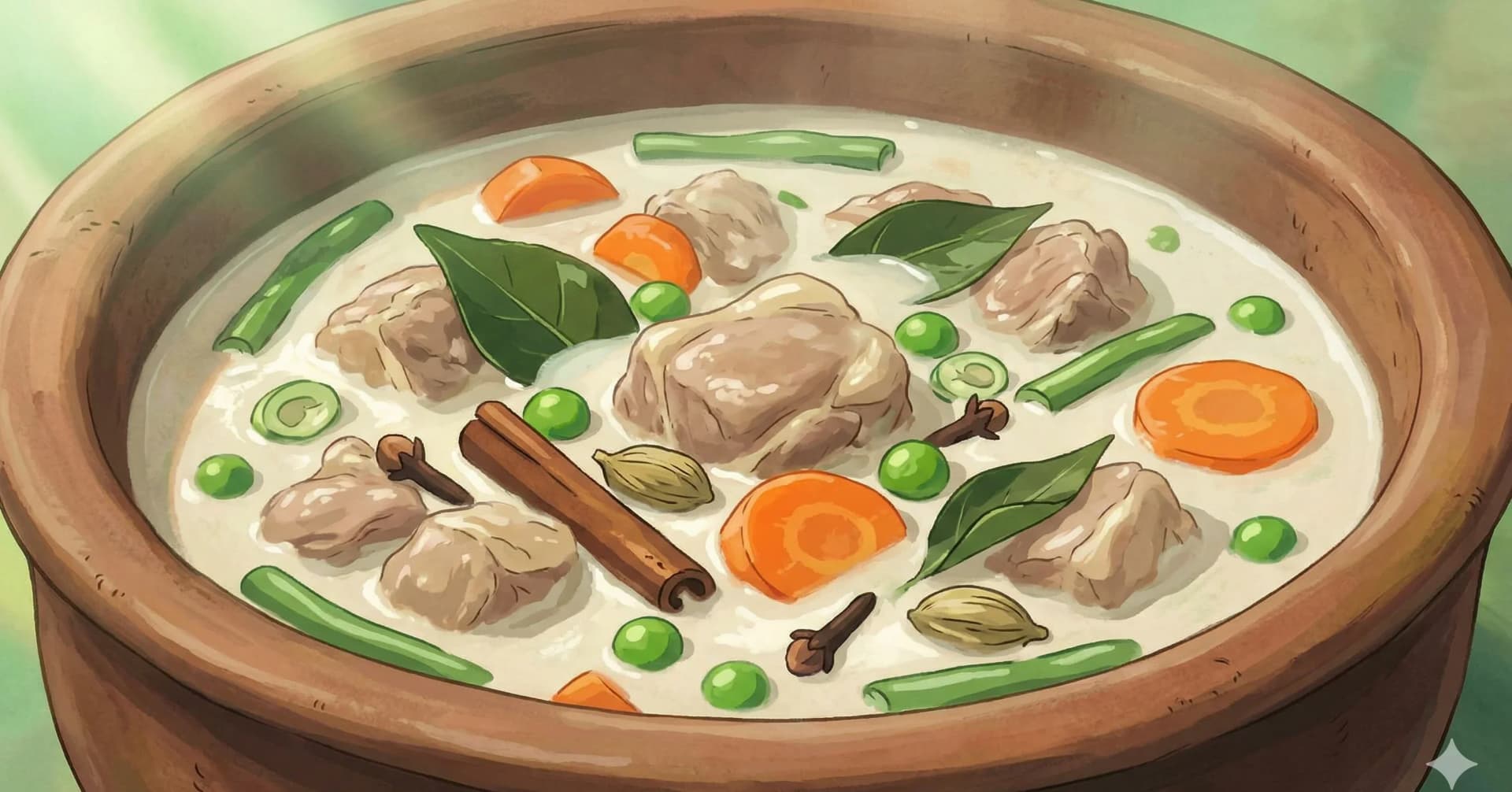
Mild Kerala coconut milk stew with lamb — fragrant with whole spices, vegetables and ginger juliennes, from the Syrian Christian table
"Ishtu" is the Keralite word for stew, and it is immediately recognizable as borrowed from English, brought into the kitchen by Kerala's Syrian Christian community through their long history of contact with colonial trading cultures and, before that, with Arab and Portuguese traders along the Malabar coast. The word is borrowed; the dish is entirely Keralite.
Ishtu is defined by its mildness and its pale, coconut-white color. There is no turmeric here to stain it yellow, no tomato to redden it, no deep-fried shallots to darken the gravy. It is built on the gentlest possible foundation: coconut oil, mustard seeds, sliced onions, curry leaves, whole spices, green chillies for warmth, and coconut milk. The coconut milk is added in stages. Thin extract first to cook the lamb through, thick extract at the end to round and enrich the stew without cooking it hard.
The vegetables in this ishtu (carrot, beans, green peas) are cooked gently within the stew, adding their own mildly sweet notes. Ginger juliennes, scattered at the end or added throughout, provide the most assertive flavor element: bright, warming, slightly sharp, cutting through the richness of the coconut.
This is the dish served with appam (the lacy, fermented rice crepe with its soft, cloud-like center) for Sunday breakfast in many Syrian Christian homes across Kerala. The combination is considered a pairing, each making the other more itself: the slight sourness of the appam against the mild sweetness of the ishtu.
At a Glance
Yield
4–6 servings
Prep
20 minutes
Cook
50 minutes
Total
1 hour 10 minutes
Difficulty
Medium
Ingredients
- ¾ lblamb boti (small bone-in lamb pieces), or boneless lamb cut into chunks
- ⅔ tspmustard seeds
- 2¼ tbspcurry leaves (about 8–10 leaves)
- 3 cupcoconut milk (use 500 ml thin / second extract for cooking, 200 ml thick / first extract to finish)
- 1¾ tbspginger, cut into fine juliennes
- 3¼ tbspgreen chillies, slit lengthwise
- 2¾ ozcarrot (about 1–1½ carrots), peeled and diced
- 1¾ ozgreen beans, de-stringed and cut
- 1¾ ozgreen peas (fresh or frozen)
- 2½ tspgarlic, sliced
- 3¼ ozonions (about ½–1 onion), thinly sliced
- ⅛ tspwhole black peppercorns (a very small pinch)
- ⅓ tspcinnamon stick
- ¼ ozbay leaf
- 3⅓ tbspcoconut oil
- —Salt to taste
- —Lamb stock or water, as needed
Method
- 1
Temper. Heat the coconut oil in a wide, heavy pot over medium heat. Add the mustard seeds and wait for them to crackle. Add the curry leaves (8–10 leaves). They will hiss. Let them crisp for 10 seconds.
- 2
Build the aromatic base. Add the sliced onions. Sauté for 4–5 minutes until translucent but not colored. Ishtu should remain pale. Add the sliced garlic and sauté for 1 minute. Add the slit green chillies.
- 3
Add lamb. Add the lamb pieces and sauté over medium-high heat for 4–5 minutes, turning to sear all sides. The lamb should be just colored, not deeply browned. Again, preserve the pale quality of the stew.
- 4
Add stock and whole spices. Add enough stock or water to just cover the lamb. Add the cinnamon stick, bay leaf, and peppercorns. Bring to a boil, then reduce heat to medium-low. Cover and cook for 25–30 minutes until the lamb is tender.
- 5
Add vegetables. Add the diced carrot, green beans, and ginger juliennes. Pour in the thin coconut milk. Stir and continue cooking at a gentle simmer for 8–10 minutes until the vegetables are tender.
- 6
Add green peas and finish with coconut milk. Add the green peas. Pour in the thick coconut milk. Stir gently. Heat through without allowing the stew to boil. Boiling thick coconut milk can cause it to split and become oily. Cook on low heat for 3–4 minutes. Taste for salt.
- 7
Garnish and serve. Serve hot, garnished with additional ginger juliennes if desired.
Key Ingredient Benefits
Lamb boti: Small bone-in cuts from the shoulder, neck, or rib area. The bones contribute gelatin to the cooking liquid, giving the stew a silky body that boneless lamb cannot produce. If using boneless lamb, add a lamb bone to the pot during cooking and remove before serving.
Coconut milk: A full, creamy stew requires good-quality coconut milk. The difference between freshly pressed and canned coconut milk is significant in a dish this mild. The coconut is not hiding behind strong spices. Fresh-pressed is ideal; a high-fat canned variety is a good substitute.
Ginger juliennes: Used here as a garnish and an aromatic ingredient simultaneously. The fine julienne softens gently in the stew's heat without disappearing. Ginger's warming compounds are present at comfortable levels in this stew. It adds brightness without sharpness.
Green chilli: The only source of heat in this otherwise mild stew. Slit chillies release heat gradually; removing them before serving reduces the heat level significantly for those who prefer a gentler stew.
Why This Works
The staged addition of coconut milk (thin extract for cooking, thick extract at the end) mirrors a traditional Kerala technique. The thin extract has a higher water content and can withstand sustained heat; it acts as the cooking liquid. The thick extract is higher in fat and more sensitive to heat; adding it at the end and not boiling it preserves its creamy texture and prevents the fat from separating.
Keeping the stew pale and mild requires restraint with both color and heat. No browning of onions, no turmeric, no extended high-heat cooking. All of these would darken the gravy. This restraint is a deliberate aesthetic and flavor choice: the coconut milk should be the dominant flavor, not a background note.
Mustard seeds and curry leaves in coconut oil create a flavor-infused cooking medium that carries their aromatic compounds through the entire stew without asserting themselves too strongly.
Substitutions & Variations
- Chicken ishtu: Replace lamb with bone-in chicken pieces. Reduce cooking time to 20–25 minutes.
- Vegetable ishtu: Omit the lamb entirely and increase the vegetables. Potato, cauliflower, and green peas work well. Use water or light vegetable stock instead of meat stock.
- Potato: Many versions include diced potato. Add with the carrot and beans for a more substantial stew.
- Fish ishtu: A coastal variation using firm fish (kingfish, pearl spot). Add fish only in the final 8–10 minutes to avoid overcooking.
Serving Suggestions
- The traditional pairing is with appam. Lacy fermented rice crepes, their slight sourness a perfect foil for the stew's sweetness.
- With pathiri (thin rice flour flatbreads) for a Malabar-coastal version.
- With plain steamed rice for an everyday presentation.
- Idiyappam (string hoppers) with ishtu is another classic Kerala combination.
Storage & Reheating
Ishtu keeps in the refrigerator for up to 2 days. The coconut milk will thicken as it cools. Reheat very gently over low heat. Do not boil. Add a splash of water or thin coconut milk to restore the consistency. The stew can be frozen for up to 1 month, though the coconut milk may separate slightly on thawing; stir well during reheating to recombine.
Cultural Notes
Lamb stew (ലാംബ് സ്റ്റ്യൂ, naadan attirachi stew) is the Kerala lamb-and-coconut-milk stew that belongs to the same broader Kerala stew family as vegetable-ishtu and the chicken stew that traditionally pairs with appam at Kerala Syrian Christian breakfasts. The dish is one of the gentlest of the Kerala curries, with no kashmiri red chili and no aggressive heat: the spicing comes from whole green and black cardamom, cinnamon, cloves, and fennel, balanced with a small amount of black pepper for warmth. The coconut milk provides a sweet creamy backdrop that lets the lamb flavor stay forward.
The dish is heavily associated with the Kerala Syrian Christian community, whose cuisine reflects centuries of trade-based cultural exchange. The "stew" name itself reflects the British colonial-era English borrowing that the Kerala Christian community adopted into their cooking vocabulary, distinguishing the dish from the older Kerala kuzhambu (curry) tradition. The Kerala stew format (coconut milk, whole spices, gentle simmer, vegetables and meat together in a single pot) has clear parallels with both British and Sri Lankan colonial-era cooking, and the Kerala Christian community's version sits at the intersection of these influences.
The technique cooks the lamb slowly to tenderness in the spiced coconut milk. Bone-in lamb shoulder or leg is cut into one-inch cubes, marinated briefly in turmeric, black pepper, and salt. A base of sliced shallots, ginger, garlic, green chilies, and curry leaves is softened in coconut oil with whole spices (green and black cardamom pods, cinnamon stick, cloves, fennel seeds), then the lamb is added and seared briefly. Thin coconut milk (second extract) thins the curry, and the pot covers and simmers at low heat for sixty to ninety minutes until the lamb is fork-tender. Cubed potatoes and carrots go in for the last twenty to thirty minutes. The dish is finished with thick coconut milk (first extract) added off the heat so it doesn't split, and a final scatter of fresh curry leaves. The pairing with appam at Kerala Christian Sunday lunch is the canonical serving format.
Nutrition Facts
Calories: 453kcal (23%)|Total Carbohydrates: 11.5g (4%)|Protein: 13.7g (27%)|Total Fat: 41g (53%)|Saturated Fat: 31.9g (160%)|Cholesterol: 37mg (12%)|Sodium: 75mg (3%)|Dietary Fiber: 1.3g (5%)|Total Sugars: 5.9g
You Might Also Like


Ratings & Comments
Ratings & Comments
Ratings
Share your thoughts on this recipe.
Sign in to rate and comment