Tamil Nadu · Indian Cuisine
Lentil Fritters (Parrupu Vada)
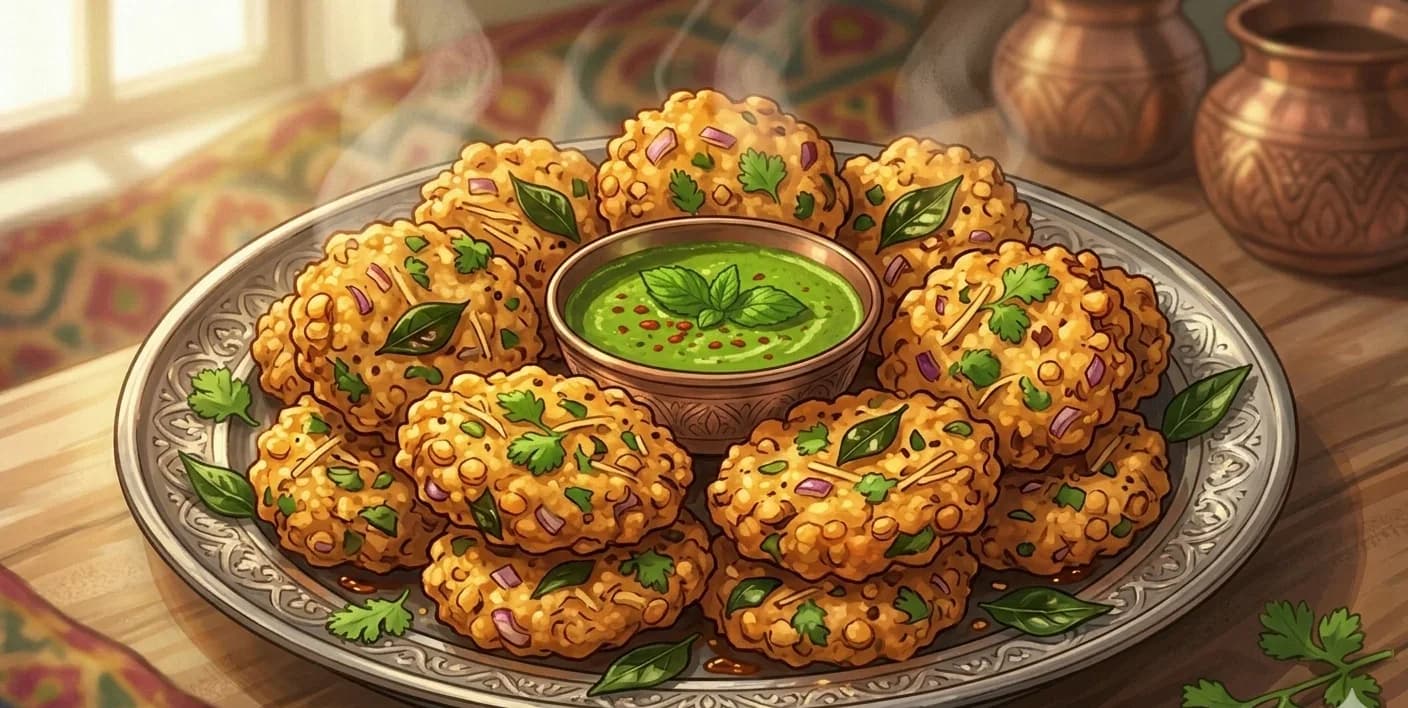
Tamil Nadu chana dal fritters — soaked dal coarsely ground with fennel seeds, onion and green chilli, fried until deeply crisp
Parrupu Vada occupies a specific and irreplaceable position in Tamil food culture. It is offered at temples. It is sold outside cinema halls. It arrives on banana leaf at weddings. It is the thing you eat at a tiffin center between a cup of filter coffee and a plate of idlis. Everyday and sacred simultaneously — a fritter so consistent, so present, that it has become a kind of baseline for what good fried food can be.
"Parrupu" is the Tamil word for dal; "vada" is the fried cake form found across South Asian cooking. This specific vada is made from chana dal — split Bengal gram — soaked until the skins slip off and the dal swells with water, then squeezed dry and ground coarsely. Not a paste. Not a smooth batter. A rough, slightly grainy mixture in which individual dal fragments are still visible, which is what gives the finished vada its characteristic cratered, crunchy surface.
The flavourings are straightforward but non-negotiable: onion, ginger, green chilli, fresh coriander, curry leaves, fennel seeds, asafoetida, and cinnamon. The cinnamon is the Tamil detail, present in small quantity but distinctive. Everything is mixed by hand. The mixture is shaped into flat discs and fried over medium heat — not high heat, which would brown the exterior before the interior is cooked through.
The finished vada should be deeply golden all over, crisp enough to snap at the edges, and still slightly yielding at the centre. It should smell of fennel and fried dal, warm with ginger and a good hit of green chilli. Eat it immediately.
At a Glance
Yield
20–25 vadas
Prep
15 minutes + 4 hours soaking
Cook
30 minutes (frying in batches)
Total
4 hours 45 minutes
Difficulty
Easy
Ingredients
- 1 lbchana dal, soaked 4 hours minimum
- 5½ ozonion (about 1 onion), finely chopped
- 1 cupginger, finely chopped
- 1¾ tbspgreen chilli, finely chopped
- ⅓ cupcurry leaves, finely shredded
- —Fennel seeds, to taste (about 1 teaspoon)
- ¾ tsphing (asafoetida)
- ¼ cupfresh coriander leaves, roughly chopped
- 1⅔ tspsalt
- ⅞ tspcinnamon, crushed to a coarse powder
- ⅔ cupwater (as needed during grinding only — aim to use as little as possible)
- —Oil, for deep frying
Method
- 1
Soak the dal. Cover the chana dal with cold water by several centimetres and soak for a minimum of 4 hours — 6 hours is better. The dal will swell significantly. Do not soak overnight in a warm kitchen; the dal can begin to ferment and the flavour changes.
- 2
Drain and squeeze thoroughly. Drain the soaked dal in a colander. Then, using your hands, squeeze handfuls of dal firmly to remove as much water as possible. This step is critical. Excess water in the mixture makes the vadas soft and prevents crisping. The dal should feel moist but not wet when squeezed.
- 3
Grind coarsely. Transfer the drained dal to a wet grinder or food processor. Grind coarsely — the goal is a rough, granular mixture with some whole or half-split dal pieces still visible, not a smooth paste. Add water only if absolutely necessary — a tablespoon at a time at most. The mixture should be stiff enough to hold its shape when pressed in the palm.
- 4
Mix in flavourings. Transfer the ground dal to a wide bowl. Add the chopped onion, ginger, green chilli, shredded curry leaves, fennel seeds, hing, fresh coriander, crushed cinnamon, and salt. Mix thoroughly with your hands, pressing and folding until everything is evenly combined. Taste for salt and spice. The mixture should be well-seasoned, slightly warm from the ginger and chilli.
- 5
Shape the vadas. Divide the mixture into portions — roughly 40 g each, about the size of a golf ball. Press each between your palms to form a round, flat disc about 1 cm thick. Press firmly but not so hard the vada becomes dense. If the edges crack as you press, wet your hands slightly and smooth them.
- 6
Fry on medium heat. Heat oil in a deep, heavy pan to 160–170°C. Add the vadas in batches — 4 to 5 at a time, depending on pan size. Do not crowd. Fry over medium heat, turning once, for 4–5 minutes per side. The vadas should be a deep, even golden brown — not pale gold, not dark brown. Adjust the heat as needed. Remove with a slotted spoon and drain on a rack or paper.
- 7
Serve immediately. Parrupu Vada is best eaten within minutes of frying.
Key Ingredient Benefits
Chana dal (split Bengal gram): High in plant protein (around 20 g per 100 g dry weight) and dietary fibre. It has a lower glycemic index than many other legumes because of its high amylose content. Deep-frying adds fat, but the dal itself is nutrient-dense.
Asafoetida (hing): Used in small amounts, hing provides a savoury, allium-adjacent depth. It is particularly associated in traditional cooking with improving the digestibility of legumes — and some preliminary research supports the idea that it may reduce certain gas-producing compounds in lentils.
Fennel seeds: The defining aromatic of this vada. In Tamil cooking, fennel appears in both savoury and sweet preparations. Its anise-like volatile oils are released during frying, permeating the vada with warmth and a faintly sweet fragrance.
Cinnamon: A small amount of crushed cinnamon — a distinctly Tamil touch — adds a warm, slightly woody note that does not read as sweet in this savoury context. Ceylon cinnamon (true cinnamon, soft sticks) is finer and more fragrant than cassia; either works.
Ginger: Used generously here, providing a pronounced warmth and sharpness that raw ginger brings. Cooked ginger in the vada mellows slightly but remains present.
Why This Works
Squeezing out the excess water from the soaked dal before grinding is the most important step. Chana dal absorbs a great deal of water during soaking; if this water remains in the mixture, it steams the vada from the inside during frying, producing a soft, spongy interior and a pale, non-crunchy exterior. Squeezed dry, the mixture fries rather than steams — the result is that characteristic cratered, deeply golden crust.
Coarse grinding (rather than a smooth paste) creates air pockets and structural variation in the vada. When these air pockets hit hot oil, they expand and open on the surface, creating the rough, cratered texture. A smooth batter would produce a compact, smooth-surfaced fritter — very different in texture and mouth feel.
Medium heat (not high) is essential for a thick fritter like this. High heat cooks the surface quickly but the centre remains raw and gummy by the time the exterior is dark. Medium heat allows heat to penetrate gradually, cooking the centre through before the outside over-darkens.
Substitutions & Variations
- Moong dal vada: Replace chana dal with soaked split moong dal for a lighter, less dense vada. The technique is identical.
- Without onion: Omit onion for a plain dal vada. Increase ginger and curry leaves to compensate.
- With coconut: A tablespoon of fresh grated coconut added to the mixture gives a moist, slightly sweet interior note — common in some southern Tamil Nadu versions.
- Spicier version: Increase green chilli and add a small amount of crushed black pepper for a more pungent vada.
- Baked/air-fried: Brush shaped vadas with oil and cook in an air fryer at 180°C for 12–14 minutes, turning once. The texture will be less deeply crisp but the flavour is largely preserved.
Serving Suggestions
- With coconut chutney — the canonical pairing. The cool, fresh chutney against the hot, crisp vada is the combination.
- With sambar as a dipping sauce for a more substantial snack.
- On a South Indian tiffin plate alongside idli, dosa, and filter coffee.
- As a temple prasad — Parrupu Vada is offered at many Tamil temples and distributed to worshippers.
- With a wedge of lime and raw sliced onion for a street-style presentation.
Storage & Reheating
Parrupu Vada is best eaten immediately. The crust softens within 20–30 minutes as residual moisture from the interior redistributes to the surface. Leftover vadas can be re-crisped in a dry pan over medium heat for 2 minutes per side, or in an oven at 180°C for 5 minutes. Do not microwave — it makes them rubbery. The unfried shaped vadas can be refrigerated on a tray for up to 4 hours before frying. Do not freeze the shaped vadas — the moisture content makes them difficult to fry after freezing.
Cultural Notes
Paruppu vada (பருப்பு வடை, "lentil fritter"; sometimes spelled parrupu vada or parippu vada) is the South Indian deep-fried fritter of coarsely ground chana dal (split chickpea) mixed with whole curry leaves, finely chopped onions, ginger, green chilies, and asafoetida. The fritter is distinct from the soft fluffy medu-vada (made with urad dal) in both texture and flavor: paruppu vada is denser, crunchier, more aggressively spiced, and made from coarsely ground rather than smoothly ground dal. The dish is one of the standard tea-time snacks across Tamil Nadu, Kerala, and Andhra Pradesh, eaten in the late afternoon with coffee or chai.
The texture is the defining feature. Chana dal is soaked for two to three hours, then drained and ground coarsely. The ideal texture is that of wet sand or couscous, with most of the dal broken but some larger pieces remaining intact. Smooth grinding produces a dense heavy fritter; coarse grinding produces the crunchy, almost crumbly texture that paruppu vada is known for. The ground dal is mixed with the aromatics (curry leaves chopped fine, raw onion in small dice, finely minced ginger and green chilies, a pinch of asafoetida) and salt, then formed into small flat patties about two inches across and a quarter inch thick.
The frying produces the crisp golden exterior. The patties slide into hot oil (around 180°C) and fry for three to four minutes, turned once, until both sides develop a deep golden color and the surface texture shows the irregular ridges and crumbles of the coarse dal. The dish is served immediately, since the crunch deteriorates as the fritters cool. The standard accompaniment is coconut chutney or a small bowl of strong filter coffee. In Kerala, paruppu vada is one of the standard offerings at small tea shops (chaya kada), and in Tamil Nadu and Andhra Pradesh, the dish appears at the bonda and vada stalls that serve evening snack food across small towns and large cities alike. The dish is also a fixture of temple food and festival distributions, where its keeping qualities (the fritters stay crisp for several hours) make it an efficient option for serving large crowds.
Nutrition Facts
Calories: 400kcal (20%)|Total Carbohydrates: 55.8g (20%)|Protein: 17.7g (35%)|Total Fat: 13.3g (17%)|Saturated Fat: 1.8g (9%)|Cholesterol: 0mg (0%)|Sodium: 1688mg (73%)|Dietary Fiber: 14.9g (53%)|Total Sugars: 10g
You Might Also Like
Ratings & Comments
Ratings & Comments
Ratings
Share your thoughts on this recipe.
Sign in to rate and comment