Indian Cuisine
Turmeric Leaf Rice Cakes (Patoli)
Goan steamed rice parcels filled with coconut and jaggery
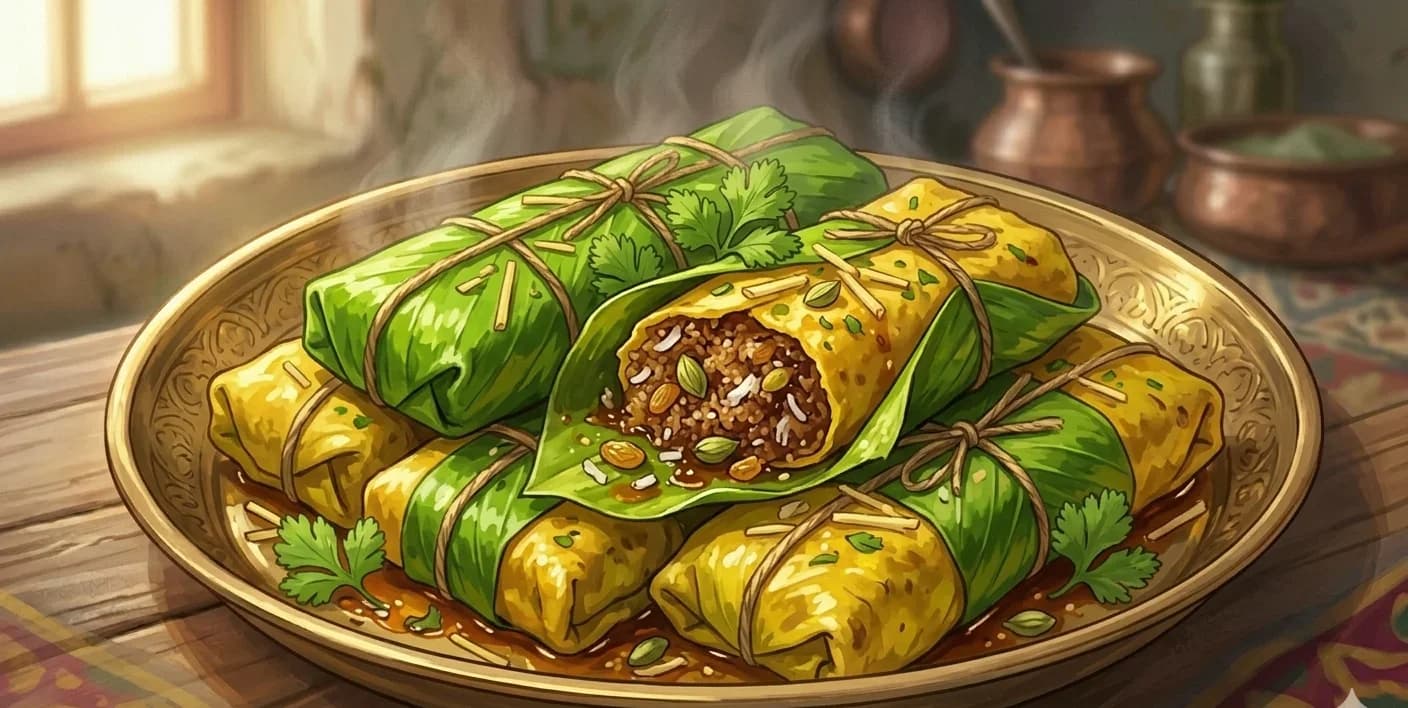
Patoli is one of Goa's most distinctive festival sweets, made specifically during Nag Panchami (the serpent festival in August) and for other auspicious occasions. The turmeric leaf (halad paan) that wraps each parcel is not merely a cooking vessel. It is an ingredient. As the patoli steams, the leaf's essential oils (earthy, slightly peppery, with a distant relation to the fragrance of raw turmeric root) penetrate the rice flour casing, giving the sweet an aromatic quality that no other wrapping can replicate.
The sweet is a balance of two contrasting textures: the slightly firm, almost doughy rice flour exterior and the yielding, intensely sweet coconut and jaggery filling. Jaggery provides a warmth and depth here. Its mineral, molasses-like sweetness is entirely different from refined sugar's clean, neutral sweetness. Green cardamom adds the perfume that lifts the coconut without competing with the turmeric leaf's subtle presence.
The technique requires fresh turmeric leaves, which have a pleasant, slightly waxy surface that releases easily from the cooked rice. The batter is spread on the inner (lighter green) side of the leaf: the surface in direct contact with the filling and the steam. The outer side remains exposed and becomes the presentation surface.
In Goa, patoli is served warm, directly from the steamer, as a festival sweet. Always made in small batches, because the turmeric leaf's fragrance fades as the patoli cools.
At a Glance
Yield
Makes 5 patolis
Prep
20 minutes
Cook
15 minutes
Total
35 minutes
Difficulty
Medium
Ingredients
Filling Ingredients
Batter Ingredients
- 2½ ozrice flour
- —A pinch of salt
- —Approximately 200 ml warm water
Wrappers
- 5fresh turmeric leaves (*Curcuma longa* leaves)
- —A little neutral oil, for the leaves
Method
- 1
Make the filling. Combine the grated jaggery (18 g), grated coconut, and ground cardamom (2 g) in a small bowl. Mix well. The jaggery will soften into the coconut as you mix. Set aside.
- 2
Make the batter. Combine the rice flour (70 g) and salt in a bowl. Add the warm water gradually, whisking or stirring, until you have a thick, spreadable batter — similar in consistency to thick porridge or cream of wheat. It should spread easily but hold its shape when applied to the leaf. Adjust with more water or flour if needed.
- 3
Prepare the leaves. Wipe each turmeric (5) leaf clean with a damp cloth. Lightly brush the inner (lighter, slightly concave) side of each leaf with a thin layer of neutral oil.
- 4
Assemble. Working one leaf at a time, spread a thin, even layer of the rice flour batter over the entire inner surface of the leaf, leaving a 1 cm border at the edges. The layer should be about 3–4 mm thick. Place 1–2 teaspoons of the coconut-jaggery filling in a line down the centre of the battered leaf. Fold the leaf in half lengthways, pressing the edges gently together to enclose the filling within the batter.
- 5
Steam. Arrange the folded patolis in a steamer basket in a single layer, fold-side down. Steam over boiling water for 12–15 minutes until the rice flour batter is cooked through. It should feel firm and set to the touch, not soft or wet when gently pressed through the leaf.
- 6
Serve. Allow to cool slightly for 2–3 minutes. The patoli can be served folded or opened — unfold the leaf to eat, peeling it away from the now-set rice casing. The inner surface of the leaf will have transferred its fragrance to the rice casing throughout.
Key Ingredient Benefits
Jaggery (gur or gul) is made from concentrated sugarcane juice or palm sap. Unlike refined white sugar (primarily pure sucrose), jaggery retains some iron, magnesium, and potassium from the plant sap along with small amounts of other minerals. In Ayurvedic tradition, jaggery is considered a warming sweetener associated with improved digestion, and is used instead of white sugar in festival preparations. The glycaemic impact of jaggery is slightly lower than refined sugar due to its trace mineral content affecting sucrose metabolism, though it is still a high-sugar food.
Rice flour (Oryza sativa flour) is naturally gluten-free and has a finer, lighter texture than wheat flour. It gelatinises more readily in steam than wheat starch, which is why steamed rice flour preparations have a characteristic smooth, slightly translucent quality that wheat-based steamed dishes do not. In Indian coastal cooking, rice flour is a fundamental pantry ingredient used in everything from festival sweets to everyday savouries.
Turmeric leaves (Curcuma longa leaves) are the leaves of the same plant that produces turmeric root. They contain different aromatic compounds from the root (less curcumin, but a range of terpenes that produce the characteristic floral-earthy fragrance of the leaf). They are available fresh at Indian grocery stores in season.
Why This Works
The rice flour batter's water-to-flour ratio is the key variable in patoli texture. A batter that is too thin will produce a fragile, papery casing that tears when peeled; too thick, and it will be dense and doughy at the centre. The right consistency (thick but still pourable) steams to a slightly chewy, just-firm casing that holds together and peels cleanly from the leaf.
Fresh turmeric leaves are not replaceable by dried ones or by any other leaf. Banana leaves, used in some patoli recipes, produce a moister environment during steaming but lack the specific aromatic compounds of turmeric leaves. The essential oils in fresh turmeric leaves are volatile and diminish with heat. The fragrance is most pronounced in the first few minutes after the patoli comes off the steamer, which is why immediate serving is traditional.
Jaggery (unrefined cane or palm sugar) behaves differently from white sugar as a filling: it melts and sets at different temperatures, producing a slightly fluid, intensely flavoured filling when hot that firms slightly as it cools. The mineral quality of jaggery (its trace molasses content) is what gives patoli its characteristic deep, rounded sweetness rather than the flat sweetness of a sugar-filled version.
Substitutions & Variations
No turmeric leaves: Banana leaves are the closest substitute. Cut into 15 × 20 cm pieces, wilt briefly over a flame to make them pliable, then use as above. The fragrance will be different (grassy-herbaceous rather than turmeric-earthy) but the technique is identical.
Desiccated coconut: If fresh coconut is unavailable, desiccated coconut soaked in warm water for 10 minutes, then squeezed to remove excess water, works well. The texture will be slightly drier but the flavour is similar.
Dates: Adding a few finely chopped medjool dates to the filling alongside the jaggery deepens the sweetness and adds a chewier texture.
Serving Suggestions
Patoli is a festival sweet, served warm as part of a celebration spread. Two per person is a generous serving — they are rich from the coconut and jaggery. They are traditionally served on a banana leaf at Goan festivals. At home, they work beautifully as a dessert following a Goan meal, served while still slightly warm from the steamer with a small cup of strong, sweet South Indian coffee or tea.
Storage & Reheating
Patolis are best eaten within 2–3 hours of making. As they cool, the turmeric leaf fragrance diminishes and the rice casing firms. They can be refrigerated for 1 day and re-steamed for 2–3 minutes, which partially restores the texture. Do not freeze.
Cultural Notes
Patoli (पातोळी) is the Konkani Hindu festival sweet of a thin rice-flour-and-coconut dough spread on a turmeric leaf, topped with a sweet filling of grated coconut and jaggery, folded over, and steamed until the rice dough cooks through and the turmeric leaf perfumes the dish with its grassy aromatic compounds. The dish is the central festival preparation of Nag Panchami (the Konkani snake-worship festival held in the Hindu month of Shravan, typically July or August) and one of the most strongly Konkani-Hindu sweets, distinct from both the broader Indian sweet tradition and the Catholic Goan Christmas sweets like bebinca.
The turmeric leaf is the technical and cultural signature. Curcuma longa (the turmeric plant) produces broad green leaves that have a delicate grassy fragrance unrelated to the more aggressive flavor of the turmeric rhizome. The leaves are harvested during the monsoon when the plant is in full growth, and they release their aromatic compounds when steamed, perfuming whatever food they wrap with a faint floral-grassy character that is one of the strongest sensory markers of Konkani Hindu festival cooking. The leaves are also imbued with cultural significance: turmeric is auspicious in Hindu tradition (used in marriage ceremonies, religious rituals, and home blessings), and using turmeric leaves to wrap festival food connects the dish to broader Hindu ceremonial practice.
The technique builds the dish from rice dough and coconut filling. Rice flour is mixed with a small amount of grated coconut, salt, and warm water to form a thick smooth paste. The paste is spread thinly on the upper surface of a fresh turmeric leaf (about a quarter inch thick, spread evenly across the leaf surface). A spoonful of sweet filling (grated fresh coconut cooked briefly with jaggery, cardamom, and a small pinch of nutmeg) is placed on one half of the spread paste, and the leaf is folded over to enclose the filling between the two halves of paste. The folded patoli is steamed in a vegetable steamer or a covered pot over boiling water for fifteen to twenty minutes until the rice dough cooks through and the leaf has thoroughly perfumed the dish. The cooked patoli is unwrapped at the table, with the leaf typically discarded after the diner has eaten the sweet filling and dough inside.
Nutrition Facts
Calories: 223kcal (11%)|Total Carbohydrates: 38.2g (14%)|Protein: 3.1g (6%)|Total Fat: 6.8g (9%)|Saturated Fat: 5.2g (26%)|Cholesterol: 0mg (0%)|Sodium: 9mg (0%)|Dietary Fiber: 3.2g (11%)|Total Sugars: 8.6g
You Might Also Like
Ratings & Comments
Ratings & Comments
Ratings
Share your thoughts on this recipe.
Sign in to rate and comment