Thai Cuisine
Steamed Fish with Lime (Pla Nueng Manao)
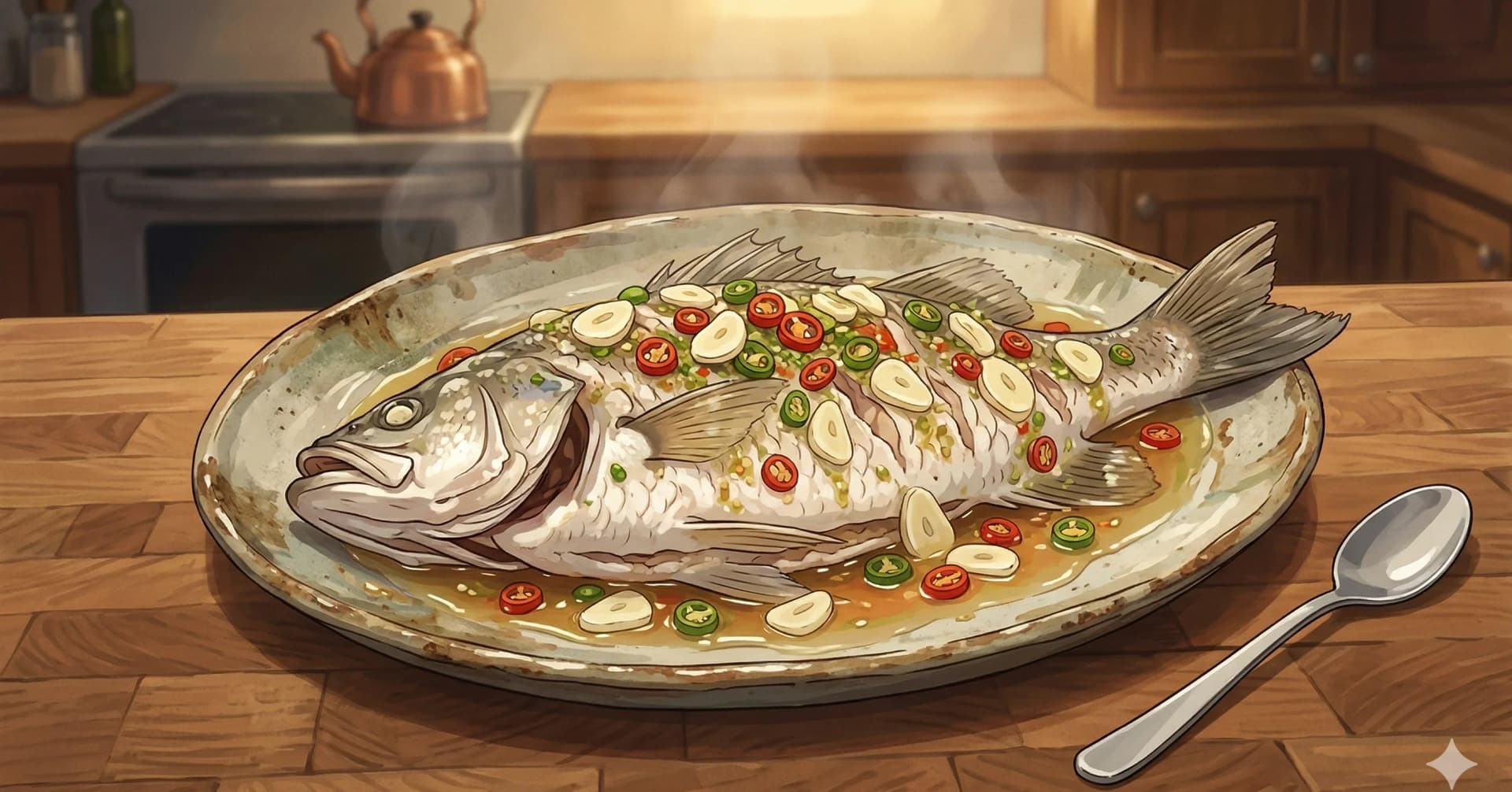
Thai steamed fish with lime, garlic, and chili sauce
Walk into any seafood restaurant in Thailand and you will almost certainly find pla nueng manao on the menu. The name is straightforward: pla means fish, nueng means steamed, and manao means lime. It is a dish that trusts its ingredients completely. A whole fish, steamed until the flesh just pulls from the bone, is blanketed in a sauce that barely qualifies as cooked: raw garlic, sliced chilies, palm sugar dissolved in warm stock, fish sauce, and enough fresh lime juice to make you close your eyes. The sauce is closer to a brothy dressing than a gravy, and in Thailand it is spooned over rice and eaten as much for the liquid as for the fish itself.
What makes pla nueng manao so appealing is the contrast between the gentle, clean flavour of steamed fish and the aggressive punch of the sauce. The fish contributes almost nothing in terms of seasoning. Its job is to be fresh, moist, and delicate. The lemongrass stuffed into the cavity adds a subtle fragrance and helps temper any fishiness, but the real character of the dish comes entirely from the dressing poured over the top at the last moment. This is a common pattern in Thai cooking: a simply prepared protein meets a sauce that does all the talking.
The technique is forgiving and fast. If you can boil water and squeeze limes, you can make this dish. The only real requirement is a fresh fish. Barramundi (pla kapong) is the traditional choice, but any mild, firm white fish will work. Fillets or steaks are fine if a whole fish feels intimidating, though the presentation at the table is part of the experience. If you enjoy the bright, sour flavours of tom yum goong or the tamarind acidity of gaeng som, pla nueng manao belongs in your repertoire. It is one of the fastest, most satisfying ways to cook fish.
At a Glance
Yield
Serves 4
Prep
15 minutes
Cook
15 minutes
Total
30 minutes
Difficulty
Easy
Ingredients
Fish Ingredients
- 1 wholebarramundi, about 700 g to 1 kg, scaled, gutted (1½–2 lb), and gills removed (see substitutions)
- 1 stalklemongrass, bottom half only, smashed and cut into 5 cm chunks
Sauce Ingredients
- ½ cupgood chicken stock or fish stock (about 1/2 cup)
- 1¼ tbsppalm sugar, finely chopped
- ¼ cupfresh lime juice (about 4 tablespoons, from 3 to 4 limes)
- 3 tbspfish sauce
- 1head of garlic (about 30 g), cloves peeled and coarsely chopped
- 3to 8 Thai bird's eye chilies, finely chopped (adjust to taste)
- 8to 10 sprigs cilantro, roughly chopped
To Serve
- 1 stalkChinese celery, leaves picked, stems cut into 2.5 cm pieces
- —Jasmine rice
Method
- 1
Score the fish by making 3 diagonal cuts on each side, slicing through the flesh down to the bone. Angle the cuts on one side perpendicular to the cuts on the other. This helps the fish cook evenly and allows the sauce to reach into the meat. Stuff the smashed lemongrass chunks into the belly cavity. Place the fish on a heatproof plate that fits inside your steamer.
- 2
Fill a wok or steamer pot with water and bring it to a vigorous, rolling boil before placing the fish inside. Set the plate of fish on the steamer rack, cover tightly, and steam over high heat for 10 to 12 minutes. The fish is done when the flesh at the thickest part of the body has turned opaque white and feels firm when pressed gently with a fork. For a larger fish, closer to 1.5 kg, allow up to 15 minutes. Resist the urge to check constantly, as each time you lift the lid you lose steam and extend the cooking time.
- 3
While the fish steams, prepare the sauce. Pour the stock into a small saucepan and bring it to a boil over medium-high heat. Add the palm sugar and stir until it dissolves completely, about 30 seconds. Remove from the heat and pour the sweetened stock into a mixing bowl. Let it cool for a minute or two.
- 4
Add the garlic and chilies to the warm stock. The residual heat will soften their raw edge just slightly without cooking them, so they retain a sharp, pungent bite. Stir in the fish sauce and lime juice. Taste the sauce. It should be bracingly sour, salty enough to stand up to plain rice, with a gentle sweetness holding the background. The garlic should be assertive and the chili heat should build. Adjust any element until the balance feels right: more lime for sourness, more fish sauce for salt, more sugar if the acid feels too sharp.
- 5
When the fish is cooked, carefully lift the plate from the steamer. There will be liquid pooled around the fish from the steaming process. Gently pour this off, or if you prefer, transfer the fish to a clean serving platter with raised edges that can hold the sauce.
- 6
Tuck the Chinese celery leaves around and underneath the fish. Stir the chopped cilantro into the sauce. Spoon the garlic, chilies, and chunky bits of the sauce over the top of the fish first, distributing them evenly along the length of the body. Then pour the remaining liquid sauce over the fish, making sure it pools around the base. Serve immediately with jasmine rice.
Key Ingredient Benefits
Barramundi (Lates calcarifer), known as pla kapong in Thai, is a large, mild-flavoured white fish native to the waters of Southeast Asia and Australia. It is the traditional choice for pla nueng manao because its firm, moist flesh holds together well during steaming and its flavour is clean enough to let the sauce shine. Barramundi is a good source of lean protein and omega-3 fatty acids, particularly EPA and DHA, which have been studied extensively for their roles in cardiovascular health and inflammation modulation. If barramundi is unavailable, sea bass (branzino), tilapia, red snapper, or striped bass all work well.
Garlic (Allium sativum) is used raw in this sauce, which is significant because allicin, the sulfur compound responsible for garlic's characteristic bite, forms when raw garlic is crushed or chopped and is largely destroyed by heat. Allicin has been studied for potential antimicrobial, anti-inflammatory, and cardiovascular effects, though much of the evidence comes from laboratory and animal studies rather than clinical trials. In Thai traditional medicine, garlic is considered warming and is believed to support digestion and circulation. Chopping the garlic coarsely rather than mincing it to a paste keeps the flavour assertive without becoming overwhelming.
Lime (Citrus aurantiifolia), or manao in Thai, is the backbone of this dish. Thai limes tend to be smaller, thinner-skinned, and more aromatic than the Persian limes commonly found in Western supermarkets, though Persian limes work perfectly well here. Lime juice provides citric acid as the primary souring agent and is rich in vitamin C. The juice also contains small amounts of flavonoids, including hesperidin and naringenin, which have shown antioxidant activity in laboratory studies. Use freshly squeezed juice only. Bottled lime juice lacks the volatile aromatics that make this sauce come alive.
Thai bird's eye chilies (Capsicum frutescens) are small, potent, and integral to the sauce's character. Their heat is immediate and sharp, and it builds with each bite. Capsaicin, the active compound, stimulates the TRPV1 pain receptor, producing the sensation of heat. Beyond flavour, capsaicin has been studied for potential metabolic effects, including increased thermogenesis and modulation of pain signalling pathways. Start with fewer chilies and add more after tasting if you prefer a controlled approach to heat.
Palm sugar (Borassus flabellifer or Arenga pinnata) adds a rounded, caramel-like sweetness that is distinct from refined white sugar. It contains small amounts of minerals including potassium, iron, and zinc, and has a lower glycaemic index than white sugar, though the amount used in this recipe is modest enough that the nutritional difference is negligible. Its primary role here is to balance the acidity of the lime juice and the salinity of the fish sauce.
Why This Works
Steaming is one of the gentlest cooking methods available, and for a delicate white fish it is ideal. The moist heat cooks the protein evenly without the risk of drying out the surface the way grilling or pan-frying can, and it adds no fat. The result is flesh that is silky, tender, and clean-tasting, which is exactly what this dish needs. The fish is a blank canvas, and the sauce provides all the colour.
Dissolving the palm sugar in hot stock before adding the raw garlic and lime juice serves two purposes. First, palm sugar is dense and sticky. It dissolves unevenly in cold liquid and can leave gritty pockets of sweetness. Heating it in stock ensures it distributes uniformly. Second, pouring the warm stock over the raw garlic and chilies wilts them just enough to take the harshest edge off their flavour without actually cooking them. This is a deliberate halfway point: you want the garlic to taste raw and pungent but not abrasive.
Adding the lime juice off the heat is critical. Citric acid in lime juice has volatile aromatic compounds (limonene, linalool) that evaporate rapidly when heated. If you boil the lime juice with the stock, you lose the bright, fragrant quality and are left with a flat, one-dimensional sourness. By combining it at the end, the sauce retains the sharp, alive quality that defines this dish.
Scoring the fish perpendicular on each side is not just decorative. The cuts create channels for steam to penetrate the thickest part of the fillet, reducing cooking time and ensuring the flesh near the bone cooks through before the thinner tail section dries out. The same channels later catch and hold the sauce, so every bite of fish carries flavour.
Substitutions & Variations
Fish options: If a whole fish is not available or feels daunting, use 500 to 700 g of thick white fish fillets or steaks. Reduce the steaming time to 6 to 8 minutes, checking early. Cod, halibut, mahi mahi, red snapper, and sea bass all work. The presentation changes, but the flavour remains true. For a special occasion, a whole red snapper or grouper makes a dramatic table centrepiece.
Shrimp version: Replace the whole fish with 500 g of large shrimp, shell-on or peeled. Steam the shrimp for 3 to 4 minutes until they curl and turn pink. Pour the sauce over and serve. This is faster and works well for weeknight cooking. Pailin Chongchitnant includes a shrimp variation of this dish in her cookbook Sabai.
Stock alternatives: Vegetable stock works for a lighter version. In a pinch, plain water with an extra splash of fish sauce will do, though the sauce will have less body. Dashi (Japanese fish stock) is an interesting cross-cultural substitute that adds umami depth.
Chili adjustments: For a milder dish, seed the chilies before chopping, or use a single large red chili (such as Fresno or red serrano) for colour and gentle warmth without the searing heat of bird's eye chilies. For more heat, leave the seeds in and increase the quantity.
Palm sugar unavailable: Substitute light brown sugar or coconut sugar in equal amounts. White sugar works in a pinch but lacks the caramel depth.
Chinese celery unavailable: Regular celery leaves (the small, pale ones from the inner heart) are a reasonable substitute, though they lack the intensity of Chinese celery. A few thin slices of regular celery stalk will approximate the mild bitterness.
Lemongrass unavailable: A strip of lemon zest (about 5 cm) placed in the belly cavity provides a faint citrus note, though it will not replicate the floral, herbal character of lemongrass. This is one substitution where the original ingredient is genuinely worth seeking out.
Serving Suggestions
Pla nueng manao is a centrepiece dish. Set it in the middle of the table with a large serving spoon and let everyone pull pieces of fish directly from the platter, spooning sauce over their rice. In Thailand, this would be one dish among several in a shared meal. Its light, brothy character makes it an ideal counterpoint to richer or drier preparations.
Pair it with green curry for a contrast between coconut richness and sharp lime acidity, or with som tam for a meal that leans fully into sour and spicy flavours. A plate of stir-fried morning glory or Chinese broccoli with oyster sauce provides a simple vegetable side that does not compete with the fish.
For a seafood-focused meal, serve alongside gaeng som and a plate of turmeric-fried fish for three very different approaches to cooking fish in Southeast Asian kitchens. If you enjoy the idea of whole fish dressed with bold, aromatic sauces, cha ca la vong, the turmeric- and dill-scented pan-fried fish from Hanoi, is a natural next recipe to explore.
Always serve with plenty of steamed jasmine rice. The sauce is meant to be eaten as much as a broth as a dressing, and rice is essential for soaking it up.
Storage & Reheating
Pla nueng manao is best eaten immediately after assembly. The sauce loses its bright, raw garlic edge and the lime juice flattens within a few hours. The steamed fish itself keeps well in a sealed container in the refrigerator for up to 2 days and can be gently reheated by steaming for 3 to 4 minutes or microwaving briefly with a damp paper towel over the top to prevent drying.
If you have leftover fish, the best approach is to make a fresh batch of sauce. The sauce ingredients are inexpensive and take only 5 minutes to assemble. Pour the fresh sauce over the reheated fish and the dish will taste nearly as good as the first time. Do not freeze the assembled dish, as the fish texture degrades and the raw garlic develops off-flavours during thawing. The cooked fish without sauce can be frozen for up to 2 weeks if needed.
Cultural Notes
Pla nueng manao (ปลานึ่งมะนาว, "steamed fish with lime") is the central Thai seafood dish that demonstrates how a simple steamed fish can become a defining preparation through the strength of the dressing alone. The fish itself, typically a whole sea bass, snapper, or freshwater barramundi, is steamed unseasoned over high heat with a few slices of ginger or lemongrass tucked inside the cavity. The defining element is the chili-lime-garlic dressing that gets ladled over the cooked fish at the table, where the heat of the fish wilts the garlic and chilies and the dressing pools around the steamed flesh.
The dressing is built quickly but deliberately. Bird's eye chilies, garlic, and cilantro root are pounded together in a mortar to a coarse paste, then thinned with fresh lime juice, fish sauce, palm sugar, and a small amount of the stock or water from the steamer. The balance is hot, sour, salty, and lightly sweet, with the pounded raw chili giving the dressing a fresh, sharp burn that cooked chili cannot match. Some versions add finely chopped lemongrass or kaffir lime peel for an extra aromatic top note.
The dish is most associated with Thai-Chinese seafood restaurants along the eastern Thai coast (Chonburi, Rayong, Trat) and with sit-down dining rather than street stalls, since the whole-fish format requires a proper steamer and serving platter. In Bangkok, dedicated seafood houses like the long-running Somboon Seafood and Laem Charoen Seafood feature the dish prominently on their menus and have built reputations on the sourcing of fresh whole fish. The eating ritual is fixed: a piece of fish flaked off with a spoon, a generous splash of the chili-lime dressing, eaten with steamed rice and a cooling vegetable side like raw cabbage or blanched morning glory.
Nutrition Facts
Calories: 169kcal (8%)|Total Carbohydrates: 9.9g (4%)|Protein: 26.7g (53%)|Total Fat: 1.8g (2%)|Saturated Fat: 0.4g (2%)|Cholesterol: 63mg (21%)|Sodium: 1044mg (45%)|Dietary Fiber: 0.5g (2%)|Total Sugars: 4.6g
You Might Also Like
Ratings & Comments
Ratings & Comments
Ratings
Share your thoughts on this recipe.
Sign in to rate and comment