Chinese Cuisine
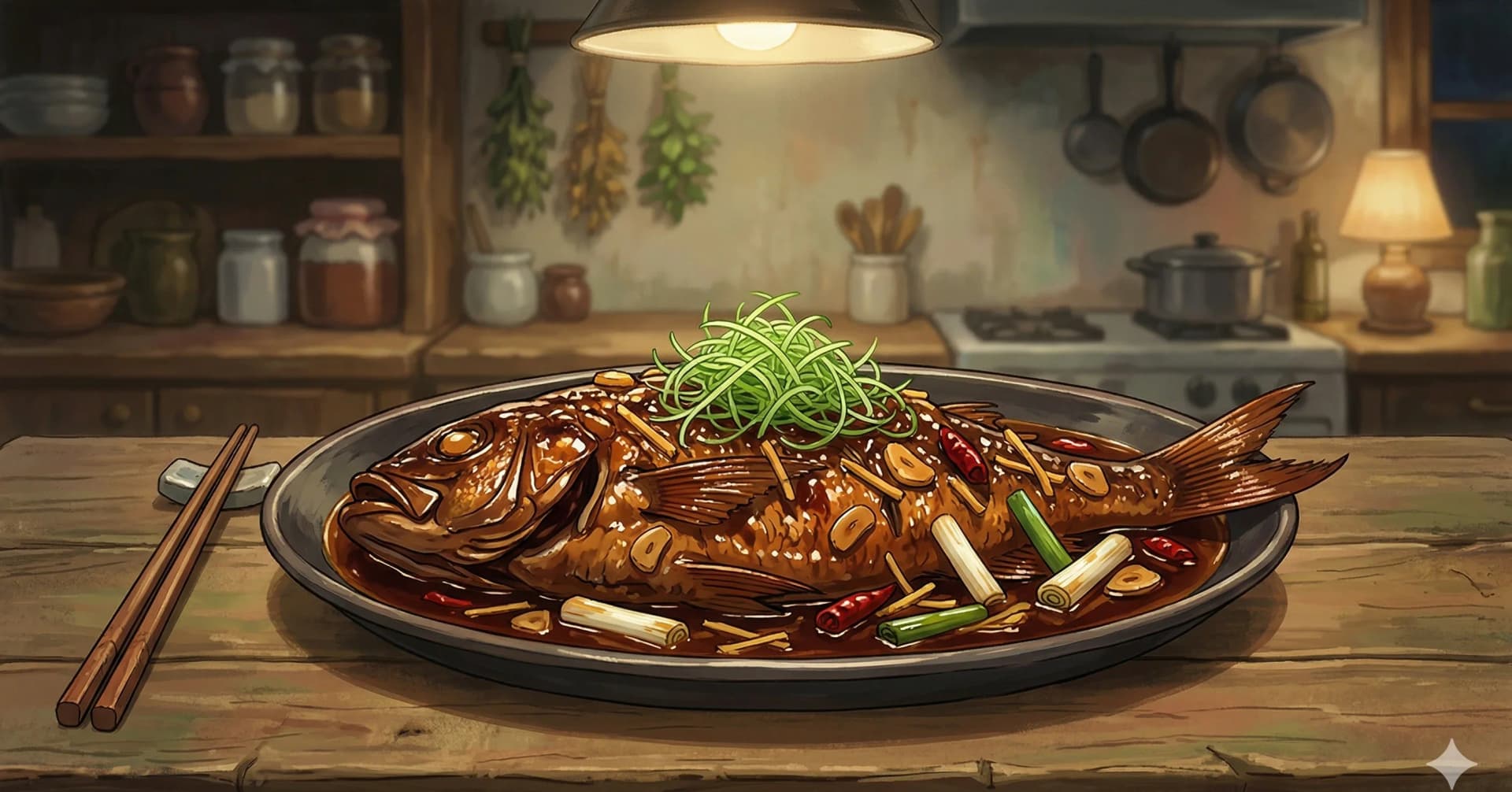
Hong Shao Yu (Red Braised Fish)
A whole fish braised in a rich soy-sugar sauce with ginger, scallions, and a touch of vinegar
The moment the sauce in the wok begins to reduce around the fish, it releases a perfume that is unmistakably Chinese: soy sauce deepened by sugar, brightened by ginger, and lifted by a splash of Shaoxing wine. The fish itself, skin crisped from an initial sear and now glistening in a dark, lacquered glaze, is tender enough that the flesh lifts cleanly from the bone with chopsticks. This is hong shao yu, the red-braised fish that graces tables across China, particularly during Lunar New Year celebrations, where a whole fish symbolizes abundance and surplus.
Red braising is one of the foundational techniques of Chinese cooking, and when applied to fish, it produces something that balances the delicacy of fresh seafood with the deep, savory-sweet richness of the sauce. Unlike red braised pork, which requires hours of slow cooking, red braised fish comes together quickly, making it practical for weeknight dinners despite its impressive presentation.
The key practical insight is achieving a good sear on the fish before braising. A hot wok, a thin coating of oil, and the patience to let the skin crisp without moving the fish for the first few minutes will prevent sticking and create a foundation of flavor. Scoring the fish on both sides allows the sauce to penetrate the flesh, and the braising time is short enough that the meat stays moist and flaky rather than falling apart.
At a Glance
Yield
4 servings
Prep
15 minutes
Cook
25 minutes
Total
40 minutes
Difficulty
Medium
Ingredients
- 1 wholefish, such as sea bass, carp, or tilapia (about 600–800 g), cleaned and scaled
- ⅞ tspsalt
- 1¾ tbspcornstarch
- 3 tbspvegetable oil
- 3¼ tbspfresh ginger, julienned
- 4 clovesgarlic, sliced
- 3scallions, white parts cut into 5 cm pieces, green parts julienned for garnish
- 3dried red chilies (optional)
- 2 tbspShaoxing wine
- 1¼ tbsplight soy sauce
- 2 tspdark soy sauce
- 1¼ tbspsugar
- ⅞ cuphot water
- 1 tspChinkiang black vinegar
- 1 tspsesame oil
Method
- 1
Rinse the fish and pat it very dry inside and out with paper towels. Using a sharp knife, make 3 diagonal slashes on each side of the fish, cutting down to the bone. These cuts should be about 2 cm apart.
- 2
Season the fish lightly with salt on both sides and inside the cavity. Dust a thin, even layer of cornstarch over the entire surface, including the scored cuts. This coating helps create a crispy exterior and prevents the skin from sticking to the wok.
- 3
Heat a wok or large skillet over high heat until it begins to smoke. Add the vegetable oil and swirl to coat the surface generously. The oil must be hot enough that a pinch of cornstarch sizzles immediately on contact.
- 4
Carefully lower the fish into the hot oil, laying it away from you to avoid splashing. Let it cook undisturbed for 3 to 4 minutes. Resist the urge to move it. The skin will release naturally from the wok once it is properly crisped.
- 5
Gently flip the fish using two spatulas or a spatula and a pair of tongs. Sear the second side for another 2 to 3 minutes, until golden and crisp.
- 6
Push the fish to one side or carefully remove it. Add the ginger, garlic, scallion whites, and dried chilies to the wok. Stir them in the remaining oil for 20 seconds, until fragrant.
- 7
Pour the Shaoxing wine into the wok. It will sizzle and steam. Let the alcohol cook off for 10 seconds.
- 8
Add the light soy sauce, dark soy sauce, and sugar. Stir briefly to dissolve the sugar.
- 9
Pour in the hot water. It should come about halfway up the sides of the fish. Bring to a gentle boil.
- 10
If you removed the fish, return it to the wok. Reduce the heat to medium-low. Cover and let the fish braise for 8 to 10 minutes, spooning the sauce over the top of the fish every 2 to 3 minutes to baste the upper surface.
- 11
Remove the lid. Increase the heat to medium-high and let the sauce reduce for 3 to 4 minutes, continuing to baste. The sauce should thicken to a glossy consistency that coats the spoon and clings to the fish. Be gentle when basting to avoid breaking the fish.
- 12
Add the Chinkiang vinegar to the sauce. Stir gently. The vinegar adds a subtle brightness that rounds out the sweet-savory richness.
- 13
Carefully transfer the fish to a serving platter using two spatulas. Spoon the sauce over and around the fish.
- 14
Drizzle with sesame oil and garnish with the julienned scallion greens. Serve immediately.
Key Ingredient Benefits
Whole fish cooked on the bone tends to retain more moisture and flavor than fillets. Fish is an excellent source of complete protein and, depending on the species, omega-3 fatty acids. Research suggests regular fish consumption is associated with cardiovascular health benefits.
Ginger contains gingerol, a bioactive compound that has been traditionally used to counter the "fishy" quality of seafood in Chinese cooking. Modern research supports ginger's anti-inflammatory properties and its traditional use as a digestive aid.
Dark soy sauce is aged longer than light soy sauce and contains added molasses or caramel. It provides color and a subtle sweetness without adding excessive saltiness.
Why This Works
Scoring the fish serves two purposes. It allows heat to penetrate the thickest parts of the flesh evenly, and it creates channels for the braising sauce to seep into the meat. Without scoring, the sauce would glaze only the surface, and the interior would taste bland.
The cornstarch coating creates a thin barrier between the fish skin and the wok, reducing sticking. More importantly, it forms a crispy shell that holds up during braising, giving the finished dish a textural contrast between the crunchy exterior and the tender, flaky flesh within.
The sauce achieves its glossy consistency through a combination of the natural gelatin released from the fish, the reduced soy-sugar liquid, and the small amount of cornstarch that dissolves from the coating. This is a self-thickening sauce that requires no additional starch slurry.
Substitutions & Variations
- Fish: Almost any whole white-fleshed fish works. Sea bass, carp, tilapia, porgy, and snapper are all traditional choices. Avoid very delicate fish like sole, which will fall apart during braising.
- Fillets: If cooking a whole fish feels daunting, thick fish fillets (such as cod or halibut) can be used. Reduce the braising time to 5 to 6 minutes.
- Chinkiang vinegar: Rice vinegar is a lighter substitute. The Chinkiang provides a deeper, more mellow acidity.
- Spicy version: Add a tablespoon of doubanjiang with the aromatics for a Sichuan-influenced preparation.
Serving Suggestions
Present the fish whole on a serving platter at the center of the table. In Chinese dining tradition, the fish head is pointed toward the guest of honor. Serve with steamed rice to soak up the sauce, a stir-fried green vegetable, and a light soup. The sauce is rich enough that the accompanying dishes should be simple and clean.
Storage & Reheating
Leftover fish can be refrigerated in its sauce in an airtight container for up to 2 days. The sauce will gel when cold. Reheat gently in a covered skillet over low heat, adding a tablespoon of water to thin the sauce. Be careful when reheating, as the fish will be more fragile and prone to breaking apart. Whole braised fish does not freeze well due to textural changes in the flesh.
Cultural Notes
Hong shao yu (紅燒魚, "red-braised fish") is the Chinese braising technique applied to a whole fish, in which a scaled, gutted, and scored fish (most often a freshwater carp, grouper, or sea bass) is pan-fried to color the skin, then simmered in a sauce of soy sauce, rock sugar, Shaoxing wine, ginger, garlic, scallion, and chili until the flesh is just cooked through and the sauce reduces to a glossy mahogany glaze that coats the fish. The dish is one of the standard preparations of the broader hong shao (red-braising) tradition that also produces hong shao rou and red-braised eggs, lotus root, and tofu.
The fish chosen matters as much as the technique. In the Shanghai and Jiangnan tradition, the dish often uses gui yu (Chinese perch or Mandarin fish), a prized freshwater fish with firm white flesh that holds together during the brief braise. In coastal Cantonese cooking, sea bass, grouper, or pomfret are common. The traditional choice for a Hunan-style hong shao yu is cao yu (grass carp). Whatever the fish, freshness is the foundational requirement, since the braising sauce will not mask off-flavors and the brief cooking time means the dish lives or dies on the underlying fish quality.
The serving has cultural significance at Lunar New Year and at formal Chinese banquets. The Chinese word for fish (yu) is a homophone of the word for "abundance" or "surplus" (yu), and serving a whole fish at New Year carries the symbolism of accumulated wealth and surplus for the coming year. The traditional protocol for fish at the New Year table calls for the fish to be served with the head and tail intact (representing a beginning and a happy end), and for the diner of highest status (typically the family elder) to be served from the head. A small portion of the fish is sometimes deliberately left uneaten as a symbolic gesture of "leaving surplus" (nian nian you yu, "year after year there is surplus"). Hong shao yu fills this role at Lunar New Year and at large family banquets across the country.
Nutrition Facts
Calories: 190kcal (10%)|Total Carbohydrates: 10.7g (4%)|Protein: 15.8g (32%)|Total Fat: 8.7g (11%)|Saturated Fat: 0.8g (4%)|Cholesterol: 41mg (14%)|Sodium: 965mg (42%)|Dietary Fiber: 0.5g (2%)|Total Sugars: 4.5g
You Might Also Like
Ratings & Comments
Ratings & Comments
Ratings
Share your thoughts on this recipe.
Sign in to rate and comment