Maharashtrian · Indian Cuisine
Shrikhand
Maharashtra's Silkiest Festival Dessert — Hung Yogurt, Saffron, and Patience
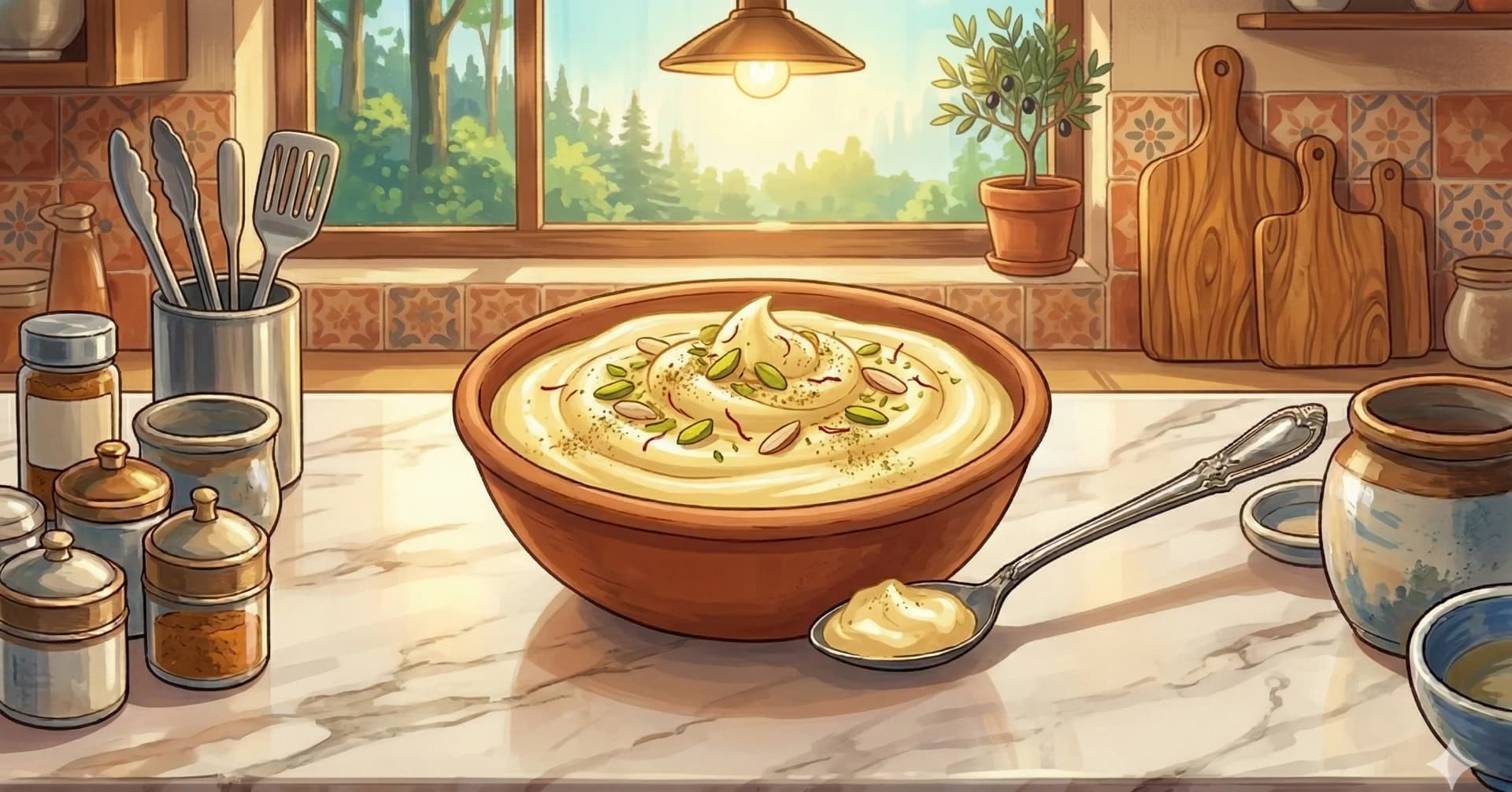
Shrikhand asks almost nothing of you except time. There is no cooking involved, no technique more demanding than whisking, and yet the result is one of the most texturally satisfying desserts in the Indian repertoire: dense and creamy as the richest cheesecake, laced with saffron's faint metallic sweetness, perfumed with cardamom, and punctuated by the gentle resistance of pistachios. It looks simple. It is simple. But the simplicity is the whole point.
The dessert belongs to Maharashtra and Gujarat both, where it appears at festivals, weddings, and the celebration meal of Gudhi Padwa (Maharashtrian New Year). In Gujarat it is often served alongside hot puris. The combination of deep-fried bread dipped into chilled sweet yogurt is one of those pairings that sounds unlikely until you try it. In Maharashtra, it tends to appear at the end of a thali, a small cold serving to close a large warm meal.
The base is chakka: hung yogurt from which all whey has been drained through muslin cloth until it is thick as cream cheese. The quality of your chakka determines everything. Use full-fat yogurt, hang it overnight in the refrigerator, and don't rush the draining. Yogurt that has released all its whey will whisk to a smooth, glossy cream. Yogurt that hasn't will remain slightly grainy no matter how long you whisk.
The practical insight: bloom the saffron in warm (not hot) milk for at least 15 minutes before adding it. Saffron releases its color and fragrance gradually, and if you add it to cold chakka immediately, it will streak rather than infuse. The result should be an even, warm-toned golden cream, not white yogurt with orange threads.
At a Glance
Yield
4 servings
Prep
15 minutes active (plus 8 hours or overnight draining)
Cook
0 minutes
Total
8 hours 15 minutes
Difficulty
Easy
Ingredients
- 2¼ lbfull-fat plain yogurt, not Greek yogurt; use regular full-fat dahi
- 1 lbchakka (hung yogurt), drained from 1kg yogurt
- ¾ cupicing sugar (powdered sugar), sifted, adjusted to taste
- ¼ ozsaffron strands, bloomed in 2 tbsp warm milk for 15 minutes
- 2½ tspcardamom powder, ground from 6–7 green cardamom pods, or pre-ground
- ¾ ozpistachios, slivered or roughly chopped, divided
- ¾ ozblanched almonds, slivered, divided
Method
- 1
Hang the yogurt (8 hours or overnight). Line a large colander with a double layer of clean muslin cloth (cheesecloth) or a clean thin cotton cloth. Pour in the yogurt. Gather the corners of the cloth and tie them together. Suspend over a bowl in the refrigerator: hang the bundle from a shelf with the bowl beneath to catch the whey, or simply set the colander over the bowl. Refrigerate for 8 hours or overnight. The yogurt will lose roughly half its weight in whey. What remains is the chakka. Thick, dense, and slightly tangy. Do not try to rush this by squeezing the cloth.
- 2
Bloom the saffron. Place the saffron strands (1 g) in a small bowl. Heat 2 tablespoons of milk until warm. Not boiling, just warm to the touch. Pour over the saffron. Leave to steep for at least 15 minutes. The milk will turn a deep golden-orange and the saffron aroma will become pronounced.
- 3
Transfer chakka to a bowl. Remove the chakka from the muslin and transfer to a large mixing bowl. Break it up with a spatula. It will look like very firm yogurt or soft cream cheese.
- 4
Whisk until smooth. Using a whisk or a hand mixer on medium speed, beat the chakka for 2–3 minutes until completely smooth, creamy, and glossy. Any remaining graininess should disappear.
- 5
Add sugar. Sift the icing sugar (150 g) directly over the chakka in three additions, whisking well after each. Continue whisking for a full 5 minutes, longer than seems necessary. The shrikhand should become noticeably silkier and lighter as you whisk. Taste for sweetness; adjust if needed.
- 6
Add saffron and cardamom. Pour the bloomed saffron milk, strands and all, into the shrikhand and whisk to combine. The color will shift to a warm, pale gold. Add the cardamom powder (5 g) and whisk again. The aroma at this point is extraordinary.
- 7
Fold in half the nuts. Add half the slivered pistachios (20 g) and half the almonds and fold gently with a spatula to distribute.
- 8
Chill. Cover the bowl and refrigerate for a minimum of 2 hours, or up to overnight. Cold shrikhand is significantly better than shrikhand served immediately. The flavours meld and the texture becomes even denser and more set.
- 9
Serve. Spoon into individual serving bowls or small cups. Garnish with the remaining slivered pistachios and almonds. A few additional saffron strands on top is a traditional finishing touch.
Key Ingredient Benefits
Full-fat yogurt (curd): The foundation of the dessert. Whole-milk curd provides about 9 g of protein and 8 g of fat per cup, and the long straining process concentrates both. The fermented milk culture contributes lactic acid bacteria (Lactobacillus) traditionally believed to support digestion. Homemade curd produces the most distinct character; commercial Greek yogurt works but produces a slightly different result.
Saffron: The world's most expensive spice by weight, contributing the dessert's golden color and signature honeyed-floral aroma. Saffron contains crocin (the pigment), picrocrocin (the bittersweet flavor), and safranal (the aroma). Studies have associated saffron with mood and cognitive benefits, though the quantities used culinarily are far below clinical doses. Roasting and powdering before adding maximizes the color and aroma transfer.
Cardamom: Provides the clean, resinous warmth that pairs particularly well with dairy desserts. Green cardamom pods (the standard variety) contain cineole and limonene, the same aromatic compounds found in eucalyptus and citrus peel. Freshly ground from pods is dramatically more aromatic than pre-ground powder.
Sugar: Standard granulated white sugar is traditional. The amount varies regionally — Gujarati shrikhand is sweeter than Maharashtrian. Adjust to taste; the curd's tartness needs balancing but the dessert should not be cloying.
Nutmeg: A small pinch adds an earthy, almost faintly meaty depth that rounds out the saffron-cardamom pairing. Easy to overdo; less than 1/8 teaspoon for a full batch is typical.
Pistachios and almonds (garnish): Added as a final textural and visual element. The nuts contribute healthy monounsaturated fats, vitamin E, and a slight crunch against the silky chakka.
Why This Works
The hanging-and-straining technique transforms ordinary curd into chakka, a dense, concentrated cream of strained milk solids. Five hours of dripping removes about half the curd's volume as whey; overnight removes more. The longer the straining, the denser the chakka and the more concentrated the final flavor. Maharashtrian-style shrikhand uses overnight chakka and produces a dessert dense enough to hold a spoon upright; Gujarati-style uses shorter straining for a looser, creamier finish.
A second straining through fine muslin or a fine sieve — after the sugar is added — is the technique that produces the impossibly smooth, mousse-like texture. The straining catches lumps of undissolved sugar and lingering curd particles, leaving a uniform, silky cream. Restaurant-quality shrikhand often goes through this step twice. Home cooks sometimes skip it; the dessert is still good but visibly less refined.
Roasting and powdering the saffron before adding it intensifies both the color and the aroma. The brief dry heat (2 to 3 seconds in a warm pan, or microwave on a small plate for 10 seconds) crisps the threads, which then crumble easily into a fine powder. Soaking in a tablespoon of warm milk for 10 minutes before adding extracts the most pigment and aroma; the milk pulls the carotenoid crocin into solution.
Sugar dissolves into chakka without any heat. The dessert is never cooked. The natural moisture in the chakka is sufficient to dissolve granulated sugar completely when strained together. This raw assembly is what preserves the live cultures from the curd, and it is what gives shrikhand its distinctive cool, fresh, almost yogurt-mousse quality. Heating would kill the cultures and produce something more like a custard.
Serving cold is non-negotiable. Shrikhand at room temperature loses its characteristic textural firmness and the saffron-cardamom aroma becomes muted. Refrigerate for at least 2 hours before serving, and serve in small chilled bowls or clay pots (matka) for best results.
Substitutions & Variations
Yogurt: Full-fat plain Greek yogurt is the standard substitute and works very well — it skips the straining step almost entirely. Use about 2 cups Greek yogurt to replace 4 cups regular curd. Low-fat yogurt produces a thinner, less rich result. Goat milk yogurt works and produces a tangier, more pronounced flavor.
Sugar: Caster sugar dissolves slightly more easily than granulated. Powdered/icing sugar is fastest but produces a smoother, slightly thinner result and can taste slightly chalky. Jaggery (gud) is used in some traditional versions and produces a darker, more caramel-flavored shrikhand.
Saffron: Cannot really be substituted for the signature flavor. A pinch of turmeric provides color but no aroma. Cardamom alone is the simplest alternative — call the result elaichi shrikhand (cardamom shrikhand), which is a recognized variation.
Cardamom: Pre-ground cardamom works but loses aroma quickly. Black cardamom is too smoky for this dessert.
Nutmeg: Optional but traditional. Can be omitted. Mace (the lacy outer covering of nutmeg) is a close substitute with a similar but lighter flavor.
Fruit shrikhand: Mango shrikhand (amrakhand) is the most popular variation — fold 1/2 cup of mango pulp into the finished chakka. Strawberry, lychee, and pineapple versions also exist. Add fruit puree at the end after the sugar has dissolved.
Without straining (cheat method): Use thick Greek yogurt and skip the hanging step. Or stir 1 tablespoon of milk powder per cup of regular yogurt to thicken without straining. Both methods produce acceptable but slightly less authentic results.
Vegan version: Cashew-based yogurt or thick coconut yogurt produces a vegan shrikhand. Almond yogurt is too thin. Sweeten with maple syrup or coconut sugar for additional complexity.
Serving Suggestions
Shrikhand is a celebration dessert in Maharashtrian and Gujarati cuisine, particularly associated with festivals like Gudi Padwa, Diwali, and Janmashtami. The dessert is served in small individual portions because of its richness — typically 1/4 to 1/3 cup per person.
The traditional pairing is with puris (puffed deep-fried bread) — shrikhand-puri is a classic Maharashtrian and Gujarati meal that combines the cool, sweet dessert with hot, savory fried bread. The contrast in temperature, texture, and flavor is the entire point.
For a more elaborate dessert spread, pair with gulab jamun, jalebi, or kheer on a thali. Each provides different textural and flavor contrasts.
Garnish with a generous sprinkle of slivered pistachios, slivered almonds, and a final pinch of saffron threads. Some versions add chopped charoli (chironji seeds) for additional crunch. A few rose petals provide visual elegance for special occasions.
Serve in small clay pots (matka or kulhad) for the most traditional presentation — the clay slightly cools and absorbs excess moisture. Glass dessert cups or stainless steel katoris are common modern alternatives.
Pair with chilled water, masala chai (after the meal), or — for adult festivals — a small glass of sweet white wine like Moscato or Sauternes, which echoes the dessert's sweet-floral profile.
Storage & Reheating
Refrigerator: Stores excellently for up to 4 days in an airtight container. The flavor genuinely improves over the first 24 hours as the saffron and cardamom continue to infuse. Shrikhand never needs to be served warm — straight from the fridge is correct.
Make-ahead: Designed to be made ahead. Most Maharashtrian and Gujarati households make shrikhand 1 to 2 days before serving for festivals. The straining of curd alone takes 5 hours to overnight, so this is not a same-day dessert.
Freezing: Acceptable for up to 2 months but the texture suffers slightly on thawing — slight graininess can develop as ice crystals form in the dairy. If freezing, thaw overnight in the fridge and whisk vigorously to restore texture before serving.
Strained chakka storage: The strained chakka (before sweetening) can be refrigerated for up to 5 days. Whip in the sugar and flavorings just before serving for the freshest result.
Whey (the strained-off liquid): Do not discard. The whey is high in protein, vitamins, and minerals. Use it to ferment dough for chapati, in dosa batter, or as a base for a refreshing summer drink (mix with salt, cumin, and mint for takra or chaas).
Restaurant trick: Many sweet shops in Maharashtra make shrikhand in massive batches and portion into individual containers. The portion sizes are small (about 1/3 cup each) to maintain freshness — large quantities sitting open at room temperature spoil quickly.
Cultural Notes
Shrikhand is one of the foundational sweets of Maharashtrian and Gujarati cuisine, two neighboring regional traditions in western India that share many ingredients and techniques. The name shrikhand (श्रीखंड) derives from Sanskrit — shri meaning auspicious or revered, khand meaning sugar or pieces. The dessert appears in early Indian literature, including the 12th-century Manasollasa (a Sanskrit text on royal court life), where it is described as a preparation of strained yogurt mixed with sugar and aromatic spices.
The dessert holds particular significance in Maharashtrian Brahmin cuisine, where it is traditionally prepared for festivals and special occasions. Shrikhand-puri is the classic festival meal — the cool sweet dessert paired with hot deep-fried puffed bread. This combination is so central to Maharashtrian food culture that the phrase "shrikhand-puri" itself evokes celebration and abundance.
In Gujarat, shrikhand appears in slightly different variations. Gujarati shrikhand tends to be sweeter than Maharashtrian, and the texture is often slightly looser. Fruit variations like amrakhand (mango shrikhand) are particularly popular in Gujarat, where the dessert appears at weddings, festivals, and family gatherings.
The cultural symbolism of yogurt in Indian cuisine is significant. Curd is considered satvik (pure, balanced) in Ayurvedic terms, and is one of the most auspicious dairy preparations. Shrikhand, as a curd-based sweet, carries this auspicious quality and is therefore appropriate for offering at temples and serving to guests.
The dessert's preparation also reflects a broader pattern of "transformation" cooking in Indian dessert tradition. Many of India's signature sweets — rasgulla, sandesh, kheer, gulab jamun — begin with simple dairy ingredients (milk, curd, paneer) transformed through patience and technique. Shrikhand exemplifies this tradition: ordinary household curd, with nothing more than time and gentle care, becomes a dessert worthy of festivals.
Modern variations have proliferated. Mango shrikhand (amrakhand) is the most popular. Strawberry, pineapple, chocolate, and even savory versions exist in modern Indian fusion cooking. The traditional saffron-cardamom version remains the most authentic and most widely served at religious and family festivals.
Nutrition Facts
Calories: 360kcal (18%)|Total Carbohydrates: 50g (18%)|Protein: 10g (20%)|Total Fat: 14g (18%)|Saturated Fat: 6g (30%)|Cholesterol: 25mg (8%)|Sodium: 80mg (3%)|Dietary Fiber: 1g (4%)|Total Sugars: 46g
You Might Also Like


Ratings & Comments
Ratings & Comments
Ratings
Share your thoughts on this recipe.
Sign in to rate and comment