Japanese Cuisine
Takikomi Gohan (Japanese Mixed Rice)
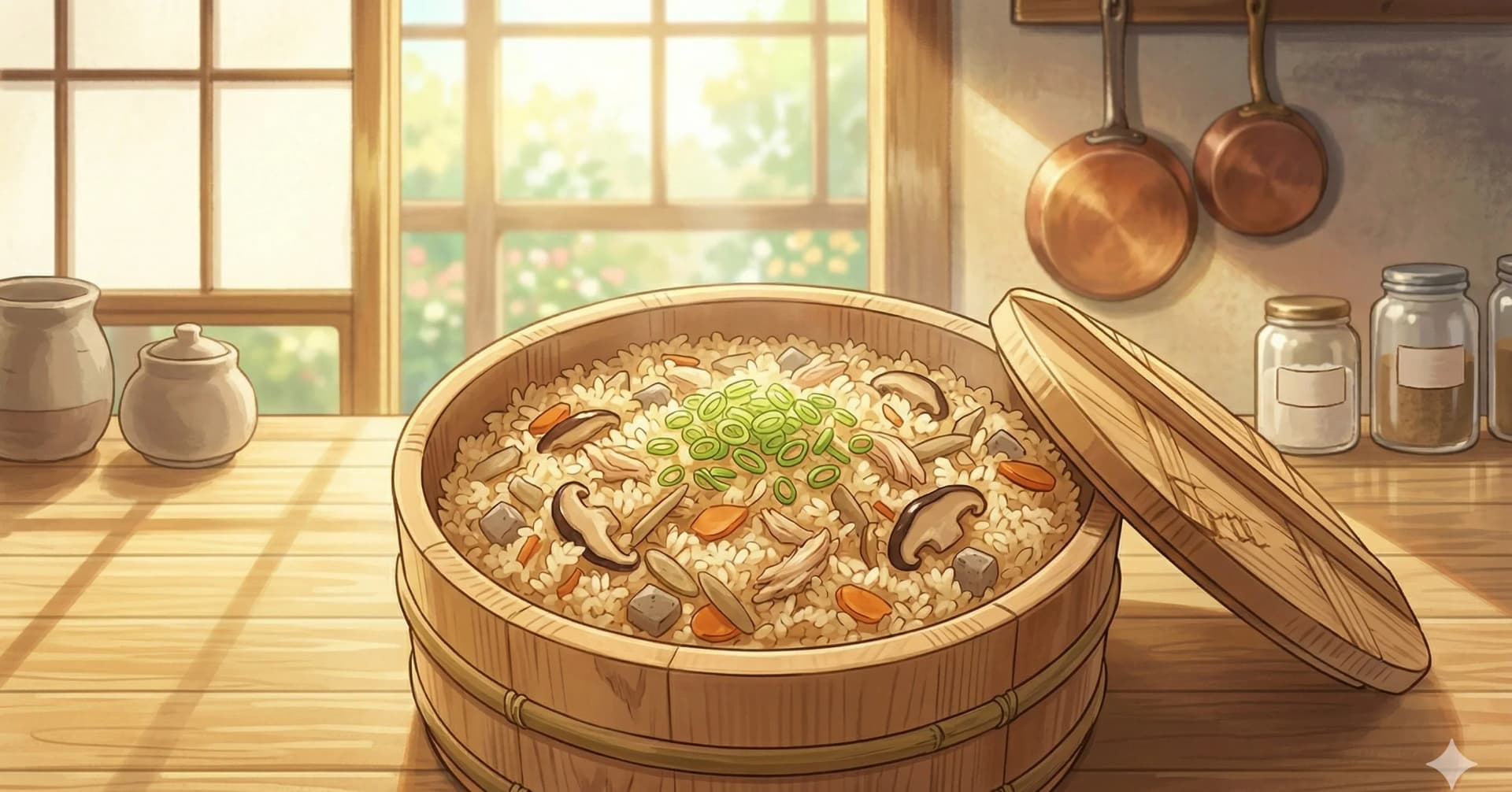
Seasoned rice simmered with chicken, mushrooms, burdock root, and soy in a single pot
Takikomi gohan belongs to a family of one-pot rice dishes found across East and Southeast Asia, each shaped by what grows nearby and what the season offers. In Japan, this particular version dates back at least to the Edo period, when rice was precious enough that home cooks stretched it with seasonal vegetables, wild mushrooms, and whatever protein was at hand. The technique is always the same: layer raw ingredients over soaked rice, pour in seasoned dashi, and let everything cook together so the grains absorb flavor from the bottom of the pot upward.
What sets takikomi gohan apart from a stir-fried rice like bibimbap is patience. You do not touch the pot once it starts cooking. The rice steams undisturbed while the chicken releases its juices, the shiitake give up their earthy perfume, and the soy and mirin caramelize against the bottom to form okoge, a thin crust of toasted rice that Japanese cooks consider the best part. The restraint pays off. When you lift the lid, the kitchen fills with a fragrance that smells like dashi and roasted soy and autumn.
The vegetable selection here is a classic autumn combination: burdock root for its mineral crunch, carrot for sweetness, shiitake for depth, and konnyaku for its strange, satisfying chew. But takikomi gohan is a template more than a fixed recipe. In spring, you might add bamboo shoots and peas. In summer, edamame and corn. The principle stays the same: choose ingredients that release flavor slowly, layer them over rice, and let the pot do the thinking.
Serve it alongside miso-shiru and a small plate of kinpira gobo, and you have a weeknight dinner that feels both modest and deeply nourishing.
At a Glance
Yield
4 servings
Prep
20 minutes
Cook
60 minutes
Total
80 minutes
Difficulty
Easy
Ingredients
- ½ lbuncooked Japanese short-grain white rice (about 1.5 rice-cooker cups)
- 1½ cupdashi stock (homemade or instant)
- —1.5 tablespoons mirin
- —1.5 tablespoons soy sauce
- 3dried shiitake mushrooms (about 15 g)
- ½ cupwater, for soaking
- 5 ozboneless (about 1 small thigh), skinless chicken thigh
- 1 ozgobo (burdock root), about 10 cm
- 2 ozcarrot (about ½–1 carrot), about 8 cm
- 3 ozkonnyaku (konjac), about one-third of a standard block
- 1sheet aburaage (deep-fried tofu pouch), about 20 g
- —Mitsuba (Japanese parsley) or green onion, chopped
Method
- 1
Place the rice in a large bowl and cover with cold water. Swirl gently with your hand, drain, and repeat three or four times until the water runs mostly clear. The goal is to remove surface starch so the finished rice is distinct and tender rather than gummy.
- 2
Transfer the rinsed rice to a clean bowl, cover with fresh water, and soak for 20 to 30 minutes. This allows the grains to absorb moisture evenly before the seasoning liquid is added. Drain in a fine-mesh strainer and leave to sit for at least 15 minutes so excess water drips away. ### Prepare the shiitake
- 3
Place the dried shiitake mushrooms in a small bowl with 120 ml of water. Let them soak for 15 minutes or until softened. Remove the mushrooms, cut away the tough stems, and slice the caps thinly. Strain the soaking liquid through a fine-mesh strainer to catch any grit and set it aside. This liquid carries concentrated mushroom umami and will become part of the cooking broth. ### Prepare the remaining ingredients
- 4
Bring a small pot of water to a rolling boil. Blanch the konnyaku for 1 minute to remove its alkaline odor, then drain and cut into thin strips about 3 cm long. In the same water, blanch the aburaage for 1 minute to wash away excess surface oil, then drain, press gently between paper towels, and cut into thin strips.
- 5
Using the back of a knife, lightly scrape the skin from the burdock root. Make a shallow cross-shaped incision at the thick end, then shave the root pencil-style, rotating it as you go, so you produce thin curls. Drop the shavings immediately into a bowl of cold water. They will oxidize and darken quickly otherwise. Let them soak for 2 to 3 minutes, then drain.
- 6
Cut the carrot into thin diagonal slices, then stack the slices and cut into fine matchsticks.
- 7
Slice the chicken thigh at a 45-degree angle into pieces about 2 cm wide. Cutting on the bias (sogigiri) exposes more surface area, which helps the chicken release its flavor into the rice as it cooks. ### Combine the seasoning liquid
- 8
Measure the strained shiitake soaking liquid and add enough dashi stock to bring the total to 360 ml. Stir in the mirin and soy sauce. The liquid should smell gently sweet and savory, with a noticeable mushroom undertone. ### Cook the rice
- 9
Place the drained rice in the inner pot of a rice cooker (or a heavy-bottomed pot with a tight lid). Pour in the seasoning liquid and use your fingers or chopsticks to level the rice into an even layer.
- 10
Scatter the chicken pieces evenly over the surface of the rice. Do not stir. The rice must remain in direct contact with the liquid so it cooks through properly. If the ingredients are mixed in, the rice will not absorb enough water and will turn out hard and unevenly cooked.
- 11
Layer the remaining vegetables and aromatics over the chicken: burdock shavings first, then carrot, shiitake, konnyaku, and aburaage. Harder ingredients go closer to the rice; softer ones on top.
- 12
Close the lid immediately and start the rice cooker using the mixed rice setting if available. If using a stovetop pot, bring to a boil over medium-high heat, reduce to the lowest setting, cover tightly, and cook for 15 minutes without lifting the lid. Then turn off the heat and let the pot stand, still covered, for 10 minutes to finish steaming. ### Rest and serve
- 13
Open the lid. The surface should look studded with glistening vegetables and chicken, and a fragrant cloud of soy-scented steam should rise from the pot. Using a rice paddle or silicone spatula, gently fold the rice from the bottom upward, using a slicing-and-tossing motion rather than stirring. This distributes the ingredients evenly without crushing the grains.
- 14
Check the bottom of the pot for okoge, the thin layer of caramelized rice where the soy and mirin have toasted against the surface. It should be golden to light brown, slightly crunchy, and deeply savory. Scrape it up and fold it through.
- 15
Mound the rice into individual bowls and scatter chopped mitsuba or green onion over the top. Serve immediately.
Key Ingredient Benefits
Japanese short-grain rice: Varieties labeled Koshihikari or Akitakomachi produce the best texture, with a soft, slightly sticky quality that holds the seasonings well. Rice sold as "sushi rice" in Western supermarkets is the same grain type and works perfectly.
Dashi: The foundation of Japanese cooking. For this recipe, an awase dashi (made from both kombu and bonito flakes) provides the fullest flavor. Instant dashi granules dissolved in hot water are a practical shortcut that still delivers good results.
Dried shiitake mushrooms: Drying concentrates the guanylate content, making dried shiitake significantly more flavorful than fresh. The soaking liquid is as valuable as the mushrooms themselves. Do not discard it.
Gobo (burdock root): A long, slender root vegetable with an earthy, mineral flavor and a satisfying crunch that holds up through cooking. It is rich in inulin, a prebiotic fiber. Gobo oxidizes rapidly when cut, so keep it in water until you are ready to add it to the pot.
Konnyaku: Made from the konjac yam, konnyaku is almost entirely water and fiber, with a firm, bouncy texture that adds body to the dish without heaviness. It absorbs surrounding flavors well.
Aburaage: Thin tofu sheets that have been deep-fried until golden. They act like little sponges in the rice, soaking up the seasoned broth and releasing it with each bite.
Chicken thigh: Dark meat holds up better than breast in a slow-cooking environment. It stays moist and tender while contributing gelatin and fat that enrich the cooking liquid.
Why This Works
The layering order matters. Raw ingredients placed directly on soaked rice create a barrier that prevents the seasoning liquid from evaporating too quickly. The rice sits submerged in flavored broth and absorbs it steadily, while the chicken and vegetables steam above, releasing their juices downward into the grains. Mixing the ingredients in at the start would disrupt this flow and leave the rice undercooked in patches.
Dashi provides a baseline of glutamate (from kombu) and inosinate (from bonito), two umami compounds that work synergistically. When you add the shiitake soaking liquid, you introduce guanylate, a third umami compound. The combination of all three creates a depth of flavor far greater than any single source could achieve alone.
Soaking the rice before cooking is essential because the seasoning liquid contains dissolved sugars and salts from the mirin and soy sauce. These solutes slow water absorption. If the rice goes into the pot dry, the grains closest to the ingredients never fully hydrate, and you end up with a crunchy, underdone center. Pre-soaking gives the grains a head start.
Blanching the konnyaku and aburaage is not cosmetic. Konnyaku has a naturally alkaline, slightly fishy odor that dissipates with brief boiling. Aburaage carries a layer of oxidized frying oil on its surface that would muddy the clean dashi flavor if left untreated.
Substitutions & Variations
Protein: Replace chicken thigh with thinly sliced pork belly, cubed firm tofu, or shelled edamame for a vegetarian version. If omitting meat entirely, increase the dashi quantity slightly and consider adding a splash more soy sauce for depth.
Vegetables: Takikomi gohan is seasonal by nature. In spring, use bamboo shoots (takenoko) and green peas. In summer, try sweet corn kernels and shiso leaves. In autumn, add chestnuts or ginkgo nuts alongside the mushrooms. Thinly sliced lotus root or snow peas also work well.
Mushrooms: If dried shiitake are unavailable, use 80 g of fresh shiitake (sliced) or a mix of fresh shimeji and maitake mushrooms. You will lose the soaking liquid, so increase the dashi to compensate.
Gobo substitute: If burdock root is difficult to find, thinly sliced celery root or parsnip provides a similar earthy quality, though the texture will be softer.
Konnyaku substitute: Omit if unavailable. There is no close substitute for its unique texture, but the dish works well without it.
Rice cooker alternatives: A cast-iron Dutch oven or donabe (Japanese clay pot) both produce excellent results with a particularly good okoge crust. An Instant Pot set to the rice function also works; follow the manufacturer's water ratios.
Vegan version: Use kombu dashi instead of awase dashi, replace the chicken with 100 g of cubed extra-firm tofu or additional mushrooms, and keep the aburaage for protein. The dish becomes lighter but retains its savory character.
Serving Suggestions
Takikomi gohan is a complete meal when served with a bowl of miso-shiru and a small vegetable side. A plate of hijiki salad brings a contrasting texture and a briny, mineral note that pairs naturally with the earthy rice. Kinpira gobo offers a sweet-savory counterpoint if you want to celebrate burdock root in two forms at the same table.
For a more substantial spread, add grilled fish, a few slices of pickled daikon, and a simple green salad dressed with rice vinegar and sesame oil. The rice is savory enough to serve as the centerpiece, so keep the sides clean and understated.
Leftover takikomi gohan makes exceptional onigiri. The rice is already seasoned, so you can shape it into triangles without any additional filling. Wrap in nori and pack for lunch the next day. In Southeast Asia, a similar instinct to cook rice with aromatics and protein appears in dishes like nasi lemak, where coconut milk and pandan leaf do what dashi and soy do here: transform plain grains into something that needs very little beside it.
Storage & Reheating
Same day: Takikomi gohan is best served fresh and warm. It holds well at room temperature for up to 2 hours, loosely covered.
Refrigerator: Not recommended. Refrigeration causes the starch in short-grain rice to retrograde rapidly, making the grains dry, chalky, and hard. If you must store it briefly, wrap individual portions tightly in plastic wrap and refrigerate for no more than 1 day.
Freezer: This is the best option for leftovers. Divide the rice into individual portions (about 150 g each), wrap each tightly in plastic wrap while still warm, and freeze flat. The steam trapped inside the wrap helps maintain moisture when reheated. Frozen takikomi gohan keeps well for up to 1 month.
Reheating: From frozen, microwave a single wrapped portion for 2 to 3 minutes, flipping once halfway through, until hot all the way to the center. The rice should return to a soft, slightly sticky texture. From refrigerated, unwrap, place in a microwave-safe bowl with a damp paper towel draped over the top, and heat for 1 to 2 minutes.
Repurposing leftovers: Cold takikomi gohan makes excellent onigiri or can be pan-fried with a beaten egg and a splash of sesame oil for a quick fried rice. The existing seasonings mean you need very little additional flavoring.
Cultural Notes
Takikomi gohan (炊き込みご飯), "cooked-together rice," is one of the oldest documented Japanese rice preparations. Cooking rice and additions in the same pot dates back at least to the Heian period (794-1185), making it older than most of the dishes Japanese cooks now think of as foundational. It belongs to a broader category called kayaku gohan (加薬ご飯), "rice cooked with additions," that has regional variants all over the country: Osaka's kayaku-gohan, Kyoto's karasumi-gohan with mullet roe, Hiroshima's oyster version, dozens more.
Two distinct techniques split the category. Takikomi proper cooks the rice and the additions together in dashi from the start, so the grains absorb the broth and the ingredient flavors during the cook. Maze gohan (混ぜご飯), "mixed rice," cooks the rice and the additions separately, then folds them together at the end. Takikomi produces a more unified, fully integrated flavor. Maze gohan keeps each ingredient distinct and cleaner. Both methods sit comfortably in Japanese home cooking, and regional and family preferences decide which one a given cook reaches for.
On a weeknight, takikomi gohan with chicken, dried shiitake, and burdock root is one of the reliable Japanese family dinners. Almost every Japanese adult has a childhood memory of it. As a seasonal dish it shifts noticeably across the year. Spring brings bamboo shoots and butterbur sprouts. Summer might pull in young soybeans and corn. Autumn is matsutake season, with matsutake takikomi gohan being one of the more prestigious seasonal Japanese dishes and chestnut versions following close behind. Winter wants oyster or yellowtail.
The dish also moves well into o-bento (お弁当) lunchboxes. Protein, vegetables, and rice are already combined, the flavor holds for hours, and the box stays a single self-contained meal.
Nutrition Facts
Calories: 372kcal (19%)|Total Carbohydrates: 60g (22%)|Protein: 12g (24%)|Total Fat: 6g (8%)|Saturated Fat: 1g (5%)|Cholesterol: 35mg (12%)|Sodium: 580mg (25%)|Dietary Fiber: 2g (7%)|Total Sugars: 3g
You Might Also Like
Ratings & Comments
Ratings & Comments
Ratings
Share your thoughts on this recipe.
Sign in to rate and comment