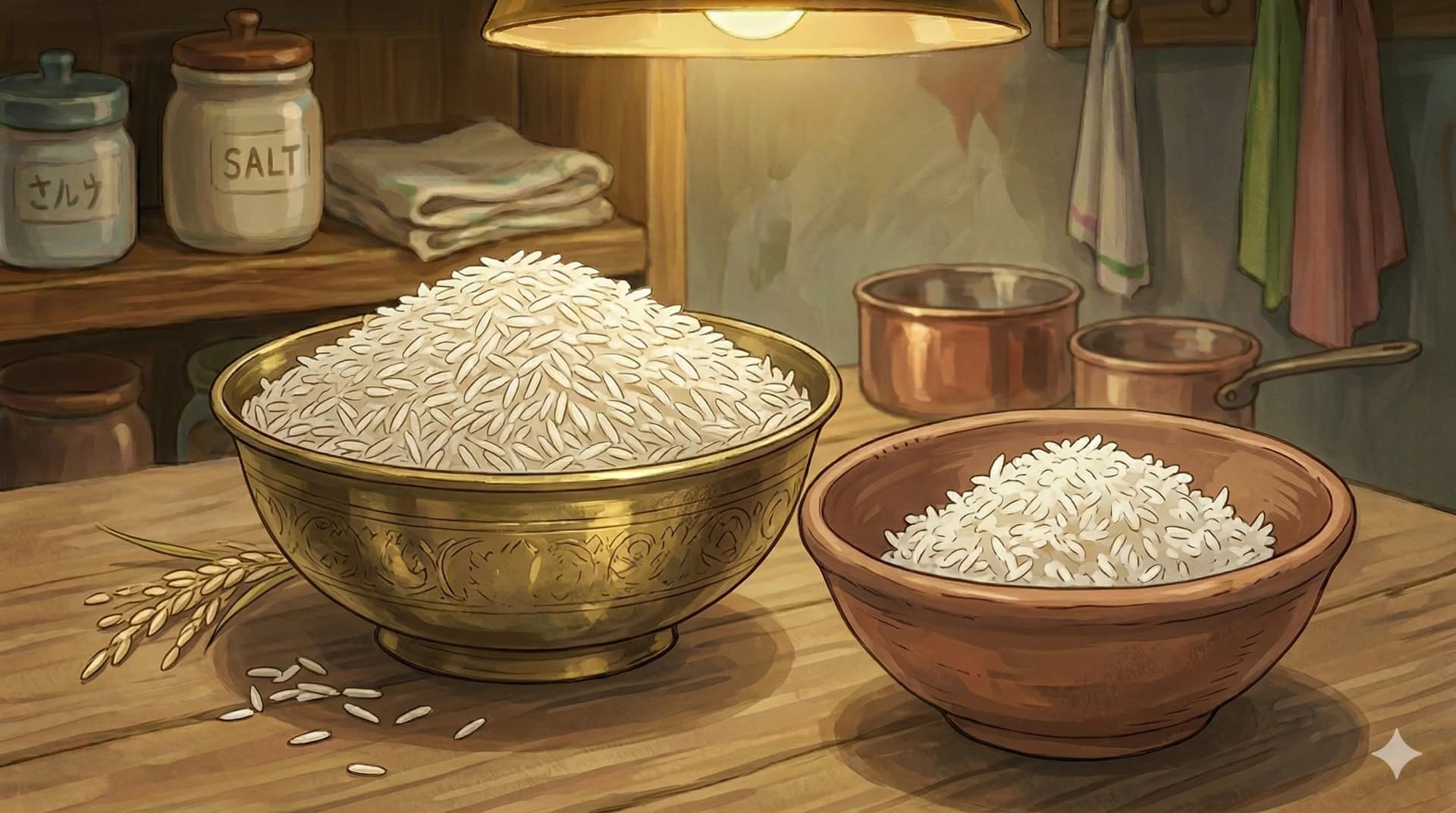
Basmati Rice
Also known as: Bas Mati, Fragrant Rice, King of Rice, Oryza sativa var. indica
Basmati is the most celebrated long-grain aromatic rice in the world, prized for a fragrance so distinctive it has been chemically characterized as a single compound. The name derives from the Sanskrit words vas (fragrance) and mati (ingrained), meaning essentially "fragrance incarnate." The grains are exceptionally slender and elongated, and when cooked correctly, each grain separates cleanly and elongates further, sometimes nearly doubling in length from its raw state.
This is not cosmetic. The elongation is a direct expression of the grain's specific starch architecture and moisture content.
The fragrance of basmati comes primarily from 2-acetyl-1-pyrroline, an aromatic compound formed during cooking that gives the rice its characteristic popcorn-like, slightly floral scent. This same compound appears in lesser concentrations in Thai jasmine rice and a few other aromatic varieties, but in basmati it is present at concentrations that are clearly perceptible from across a room. The compound develops during the Maillard-adjacent reactions of cooking and is volatile enough to dissipate if the rice sits uncovered for too long, which is why basmati should be served promptly.
The geographic origin of basmati is inseparable from its quality. Traditional basmati is grown in the foothills of the Himalayas, in the particular soil and climatic conditions of Punjab, Haryana, and Uttarakhand in India, and across the border in Pakistan's Punjab and Sindh provinces. The Himalayan snowmelt irrigation, the alluvial soil, and the temperature variation between day and night in the growing season all contribute to the chemistry that produces genuine basmati character.
Varieties grown outside this region, even using the same seed stock, typically produce rice with less fragrance and shorter grain elongation.
Key facts at a glance:
- The name — Derives from the Sanskrit words vas (fragrance) and mati (ingrained), meaning essentially "fragrance incarnate.
- The elongation — Is a direct expression of the grain's specific starch architecture and moisture content.
- The geographic — Origin of basmati is inseparable from its quality.
- Varieties grown — Outside this region, even using the same seed stock, typically produce rice with less fragrance and shorter grain elongation.
Flavor Profile
Origin
Indian subcontinent, Himalayan foothills, Punjab, Uttarakhand
Traditional Medicine Perspectives
Ayurveda:
Basmati rice holds a position of high esteem in Ayurveda, considered one of the most sattvic and easily digestible foods available. White basmati is classified as laghu (light), snigdha (slightly unctuous), and cooling in nature. It is among the few grains recommended for all three doshas without significant reservation. For those recovering from illness or digestive weakness, basmati cooked as congee with ghee is a classical first food, considered gently nourishing without taxing a depleted digestive system. It is one of the foods most consistently recommended by Ayurvedic practitioners as part of a cleansing or restorative diet. Brown basmati, while more nutritious by Western metrics, is considered harder to digest in Ayurveda and less suitable for those with weakened digestion.
Modern Scientific Research
Basmati rice has a lower glycemic index than most common white rice varieties, including standard long-grain and short-grain white rice. The specific starch structure of basmati, with a higher proportion of amylose to amylopectin, means that the starch is digested and absorbed more slowly, producing a more gradual rise in blood glucose. Research published in nutrition journals has confirmed glycemic index values for basmati in the range of 50 to 58, compared to 72 or higher for standard white rice.
This makes it a meaningful choice for blood sugar management relative to other white rice options.
The 2-acetyl-1-pyrroline compound has been the subject of considerable research by rice breeders and food scientists seeking to develop basmati-like fragrance in other rice varieties. The biosynthetic pathway is now well characterized, driven primarily by a single gene (BADH2), and this has informed efforts in both traditional plant breeding and genomic research. Separately, studies comparing arsenic content across rice types have found that basmati rice, particularly Indian and Pakistani varieties, typically contains lower levels of inorganic arsenic than rice grown in other regions, including domestic US rice, due to differences in soil composition and irrigation water sources.
Cultural History
Long-grain aromatic rice has been cultivated in the foothills of northwestern India for at least two thousand years. Sanskrit literature references fragrant rice called sugandhi, and medieval Persian and Mughal texts consistently describe aromatic rice from the region around Dehra Dun as the finest available. The Mughal emperors, who transformed Indian court cuisine into one of the most sophisticated culinary traditions in history, built their great rice dishes around basmati, and the biryani, arguably the most complex and beloved rice preparation in South Asian cooking, would not exist without it.
The Dehra Dun region of Uttarakhand, sometimes called the home of "Dehraduni basmati," remains the prestige origin for the finest Indian basmati. The elevation, the specific soil mineral profile, and the traditional cultivation practices of this valley produce rice with a fragrance and elongation that commands premium prices in global markets. Traders and cooks have recognized this origin advantage for centuries, and the name "Dehraduni" functions as a quality marker in the way that specific appellations function in wine.
Basmati holds geographic indication status, and the question of which regions legitimately produce "true" basmati has been the subject of ongoing trade disputes between India and Pakistan, the two primary exporting nations, as well as challenges from other countries that grow aromatic long-grain rice but sell it under names designed to trade on basmati's reputation. The GI protection reflects the genuine territorial specificity of basmati quality.
One practice central to basmati quality is aging. Freshly harvested basmati contains higher moisture levels that cause the grains to stick together and elongate less during cooking. Rice aged for one to two years after harvest loses moisture gradually, develops deeper flavor complexity, and cooks to the separate, elongated grains that distinguish premium basmati from ordinary long-grain rice.
Experienced cooks and buyers specifically seek aged basmati, and premium brands label the age of their stock.
Culinary Uses
The preparation of basmati for cooking is as important as the cooking itself. The rice should be rinsed in cold water at least three times, until the water runs nearly clear, to remove surface starch that would cause the grains to clump. For biryani and pilaf preparations, soaking for 30 minutes after rinsing is strongly recommended: the grains absorb water and soften, allowing them to cook more evenly and elongate further.
This step should not be skipped for premium preparations.
For plain steamed basmati, the absorption method (also called the pilaf method) is standard: bring water with salt to a boil, add the soaked and drained rice, stir once, reduce heat to the lowest possible setting, cover tightly, and cook undisturbed for 15 minutes. Remove from heat and allow to steam in the covered pot for an additional 5 to 10 minutes. Fluff with a fork, never a spoon, to avoid breaking the grains.
The result should be separate, fluffy grains that have elongated visibly from their raw state.
For biryani, parboiling (cooking the rice to 70 percent doneness in heavily salted boiling water before layering and dum cooking) is the classic technique. The rice finishes cooking in the sealed pot, absorbing the aromatics of the meat, saffron, and spice-infused fat from below.
Preparation Methods
Rinse the rice in a bowl with cold water, swirling and draining at least 3 times until water is mostly clear. For pilaf or biryani: soak in fresh cold water for 30 minutes after rinsing, then drain before cooking.
For the absorption method (serves 4): combine 1.5 cups rinsed and soaked basmati with 2.25 cups cold water and 1 teaspoon salt in a heavy-bottomed saucepan.
Bring to a boil uncovered, stir once, then reduce heat to minimum and cover tightly. Cook 15 minutes without lifting the lid. Remove from heat and rest covered for 10 minutes.
Fluff with a fork before serving.
Store uncooked basmati in an airtight container at room temperature, away from light and moisture. Properly stored, it will keep for years, and as noted, aged rice often performs better than fresh.
Traditional Dishes
- Biryani (chicken
- lamb
- vegetable)
- Pulao
- Kheer (rice pudding)
- Persian-style polo rice
- Mujaddara
- Steamed basmati with dal
- Zarda (sweet saffron rice)
- Tahdig
- Egg biryani
- Curd rice with basmati
Comments
Share your thoughts on this ingredient.
Sign in to comment0 Comments