Thai Cuisine
Thai Sweet Chili Sauce (Nam Jim Kai)
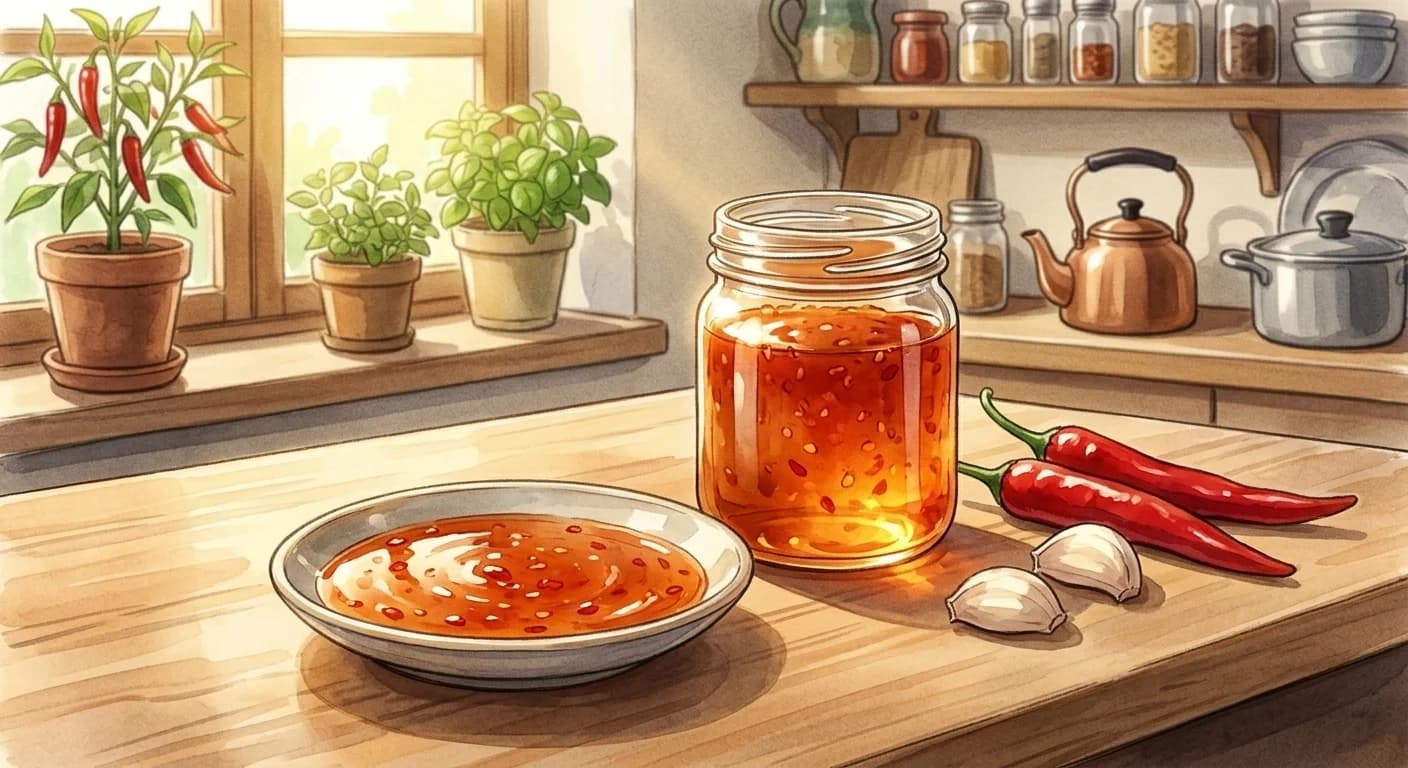
The garlicky sweet-and-sour dip Thai cooks serve with grilled chicken, with a slow heat from fresh red chilies
Most of us know this sauce from a bottle, orange-red and very sweet, sitting next to a plate of spring rolls. Homemade, it tastes like a different thing. The garlic is loud, the vinegar is sharp enough to make you notice it, and the flecks of fresh red chili bring a heat that builds instead of disappearing under the sugar.
In Thai it is called nam jim kai, which means chicken dipping sauce, because it is the sauce people reach for with grilled chicken. It turned out to suit almost everything fried as well, and it is now a common sauce on Thai tables, with fish cakes, wings, spring rolls and omelets.
It takes about 25 minutes, most of it simmering. The chilies and garlic get blended with water into a coarse slush, cooked briefly with sugar, vinegar and salt, and then thickened with a little tapioca starch. The starch is what keeps this version fresh. Many recipes thicken the sauce by boiling it down, and the longer it boils, the more the garlic and chili cook out and the color dulls. Two teaspoons of starch thicken it in a minute, so the garlic stays sharp and the color stays red.
Don't judge the thickness while it is hot. It looks thin in the pan and sets to a slow-pouring syrup as it cools.
Inspired by Hot Thai Kitchen and Hungry in Thailand.
At a Glance
Yield
About 1½ cups (twelve 2-tablespoon servings)
Prep
10 minutes
Cook
15 minutes
Total
25 minutes
Difficulty
Easy
Ingredients
- 3large red chilies (Fresno or prik chi fa), about 45 g, stemmed, seeds partly removed
- 3–6red Thai bird's eye chilies, stemmed, to taste
- 6 clovesgarlic, about 20 g, peeled
- ½ cupwater
- ¾ cupgranulated sugar
- ½ cupdistilled white vinegar
- 1 tspfine salt
- 2 tsptapioca starch
- 2 tbspcold water, for the starch slurry
Method
- 1
Roughly chop the large chilies, the bird's eye chilies and the garlic. Start with 3 bird's eye chilies; you can add heat later, but you can't take it out. For a medium sauce, scrape the seeds out of 2 of the large chilies and leave them in the third.
- 2
Put the chilies and garlic in a small blender with the 1/2 cup of water and pulse until you have a coarse slush with small flecks of chili, not a smooth purée. Those flecks are what you see floating in the finished sauce. A mortar and pestle works too: pound the garlic and chilies to a coarse paste, then stir in the water.
- 3
Pour the slush into a small, heavy saucepan and add the sugar, vinegar and salt. Stir over medium heat until the sugar dissolves, then bring it to a boil. Don't lean over the pot, because hot vinegar and chili steam stings your eyes.
- 4
Lower the heat to a steady simmer and cook for 5 to 7 minutes, stirring now and then, until the sauce has reduced slightly and the raw garlic smell has mellowed. If sugar crystals form on the sides of the pan, brush them down with a pastry brush dipped in water so they don't burn.
- 5
Stir the tapioca starch into the 2 tablespoons of cold water until smooth. Pour it into the simmering sauce while stirring. Bring the sauce back to a boil and cook for 30 to 60 seconds, until it turns glossy and coats a spoon. It will look thinner hot than it will once cool.
- 6
Taste a little on a spoon once it has cooled for a moment. It should taste sweet first, then sour, with garlic, a little salt and a slow heat at the end. Add a pinch of salt if it tastes flat. Let it cool completely in the pan, where it thickens to a syrup that pours slowly, then pour it into a clean jar. You should have about 1 1/2 cups.
Key Ingredient Benefits
Sugar: This is a sweet sauce, and there is no getting around that. A 2-tablespoon serving has about 13 grams of sugar, nearly all of it added. The FDA sets the Daily Value for added sugars at 50 grams a day on a 2,000-calorie diet, so a serving is about a quarter of that. Use it as a dip, not a pour.
Chilies: Bird's eye chilies carry most of the heat, from capsaicin, the compound that makes chilies burn. The large red chilies are mostly there for color and a fruity flavor.
Garlic: Raw garlic's sharp smell comes from allicin, which forms when the cloves are cut or crushed. A short simmer softens it without taking it away.
Tapioca starch: Made from the cassava root, it is naturally gluten-free. With distilled vinegar, the whole sauce is vegan and gluten-free.
Salt: About 195 mg of sodium per serving, much less than most soy- or fish sauce-based dips.
Why This Works
Blending the chilies and garlic with the water, instead of chopping them, breaks them into small, even flecks. They release flavor quickly into the syrup, and they stay suspended once the sauce is thickened instead of sinking to the bottom of the jar.
Tapioca starch thickens when its granules absorb water and swell as the sauce comes to a boil. It sets clear and glossy, where cornstarch can look slightly cloudy, so the red flecks stay visible. Acid slowly breaks starch down if it cooks for a long time, which is why the starch goes in at the end and only boils for a minute.
The sugar and vinegar are roughly 3 parts to 2 by volume. That keeps the sauce sweet but sour enough to cut through fried food. The short simmer softens the raw garlic without cooking away its punch.
Substitutions & Variations
Cornstarch: Use 2 teaspoons in place of the tapioca starch and boil the sauce for a full minute after adding it, so the starch loses its raw taste. The sauce will be slightly cloudier.
No starch: Leave out the starch and simmer the sauce for 12 to 15 minutes, until it has reduced by about a third. It will be thinner and a little darker, and the garlic will be milder.
Chilies: Red Fresno chilies or red jalapeños stand in well for prik chi fa. Red serranos can replace the bird's eye chilies. With no fresh chilies, use 1 to 2 teaspoons of red pepper flakes.
Vinegar: Rice vinegar is a little less sharp, so the sauce tastes sweeter. Apple cider vinegar adds a fruity note.
Sugar: Palm sugar gives a darker, caramel-tasting sauce.
Savory version: Stir in 1 to 2 teaspoons of fish sauce at the end. The sauce will taste rounder and saltier, but it won't be vegan.
Serving Suggestions
Serve it with gai yang, the grilled chicken it is named for, and with anything fried: spring rolls, fish cakes, chicken wings, shrimp tempura or turmeric fried fish. A bowl of it next to a Thai omelet and rice makes a quick dinner.
It also makes a good dressing. Whisk 2 tablespoons with 1 tablespoon of lime juice and 1 teaspoon of fish sauce, then toss it with sliced cucumber, shallot and cilantro.
Storage & Reheating
Fridge: Keep it in a clean, airtight jar in the fridge for up to 2 weeks. It is not shelf-stable, so don't leave it in the pantry. Always use a clean spoon.
Freezer: It freezes for up to 3 months. It may separate a little after thawing; stir it well, or warm it gently in a small pan for a minute.
Cold sauce: It thickens in the fridge. Let it sit at room temperature for 15 minutes before serving, or stir in a teaspoon of warm water.
Cultural Notes
Nam jim means dipping sauce and kai (also spelled gai) means chicken. According to Wikipedia's entry on Thai dipping sauces, nam chim kai is a very common all-round chili dipping sauce, medium-spicy, very sweet and thick as syrup. It is often served with kai yang, grilled chicken, and in English it usually goes by sweet Thai chili sauce.
The bottled versions sold around the world are this same sauce, made on a factory scale. In Thailand it sits alongside sharper, saltier dips such as nam jim jaew, and a plate of grilled chicken often comes with both.
Nutrition Facts
Calories: 56kcal (3%)|Total Carbohydrates: 13.9g (5%)|Protein: 0.2g (0%)|Total Fat: 0g (0%)|Saturated Fat: 0g (0%)|Cholesterol: 0mg (0%)|Sodium: 194mg (8%)|Dietary Fiber: 0.1g (0%)|Total Sugars: 12.7g
You Might Also Like
Ratings & Comments
Ratings & Comments
Ratings
Share your thoughts on this recipe.
Sign in to rate and comment