Japanese Cuisine
Agedashi Tofu (Fried Tofu in Dashi Broth)
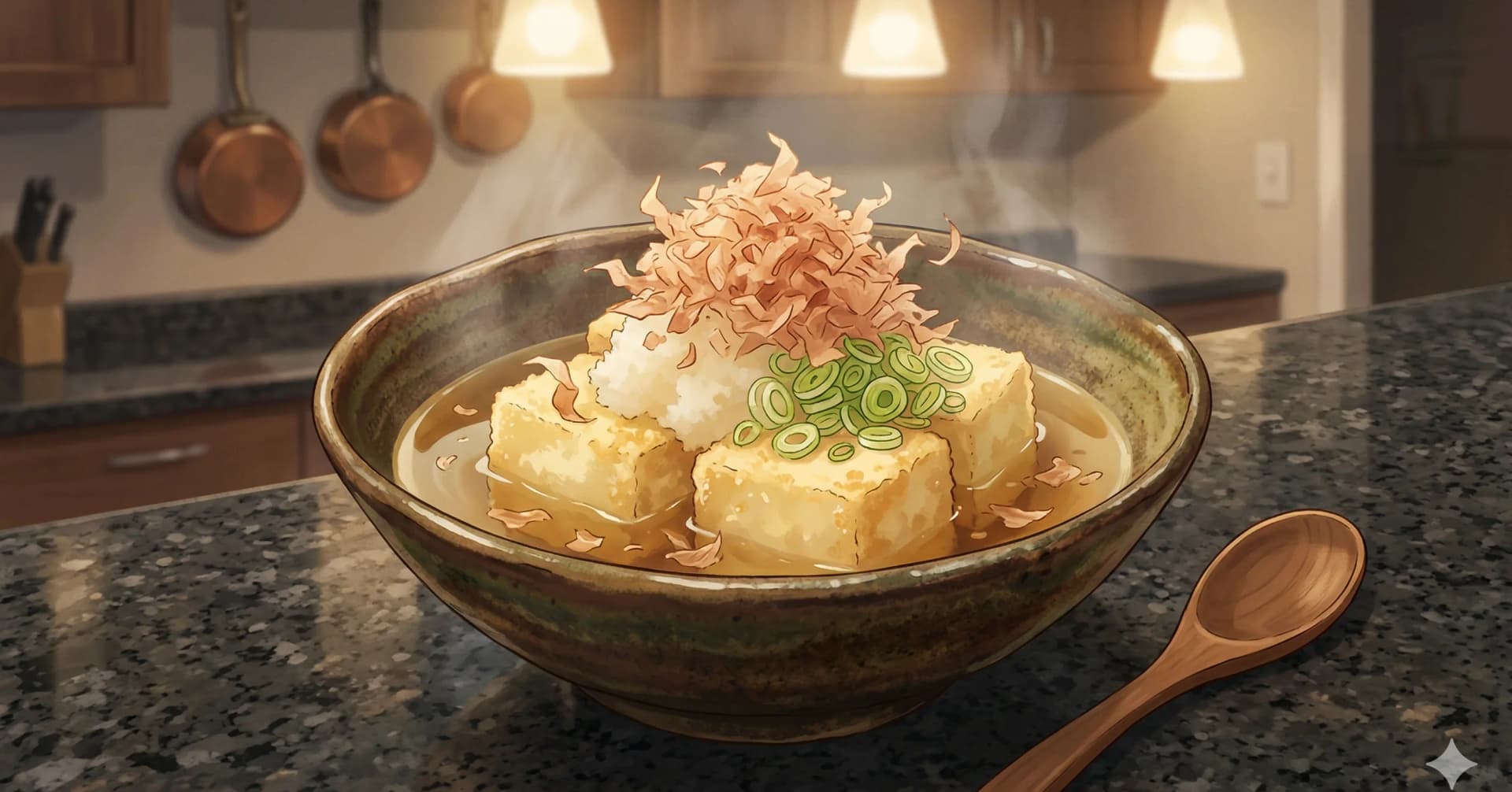
Silken tofu dusted in potato starch and fried until golden, served in a warm pool of dashi-soy broth with grated daikon and ginger
The contrast is immediate and startling. The outside of the tofu is crisp, a shell of fried potato starch that crackles when your chopsticks press into it. The inside is pure cream, warm and barely holding its shape, yielding completely the moment you bite down. And then the broth arrives at your palate, warm and savory, carrying the clean depth of dashi, the saltiness of soy sauce, and the gentle sweetness of mirin. All of this happens in one bite, and it takes about two seconds. It is one of the most elegant things in Japanese cooking.
Agedashi tofu is a standard dish at izakaya (Japanese pubs) and a common first course at traditional restaurants. It appears simple, and it is, but it requires careful handling because the main ingredient is fragile. Silken tofu is essentially a set custard made from soy milk, and it breaks apart easily. Draining it thoroughly, cutting it gently, and coating it in potato starch without crushing it are all small acts of attention that determine whether the finished dish holds together or collapses into the oil.
The dashi broth is heated separately and poured around, not over, the fried tofu at the moment of serving. This keeps the top of the tofu crisp for as long as possible while the bottom absorbs the sauce and softens. The traditional garnishes of grated daikon, ginger, scallion, and bonito flakes are not optional. Each one serves a purpose: the daikon provides cooling freshness and enzymes that cut through the oil, the ginger adds warmth, the scallion brings sharpness, and the bonito flakes contribute another layer of umami. Together they transform a simple piece of fried tofu into something composed and complete.
At a Glance
Yield
4 servings
Prep
15 minutes
Cook
10 minutes
Total
25 minutes
Difficulty
Easy
Ingredients
- 1¼ lbsilken tofu (firm silken or kinugoshi, not regular firm tofu)
- 2 ozpotato starch (katakuriko), for coating
- ⅞ cupdashi stock
- 2¾ tbspsoy sauce
- 2¾ tbspmirin
- —Neutral oil such as vegetable or rice bran, enough for 3 to 4 cm depth
- 2¾ ozdaikon radish (about 1 radish), finely grated and lightly squeezed of excess moisture
- 1¾ tbspfresh ginger, finely grated
- 2scallions, thinly sliced
- —Katsuobushi (bonito flakes), a small handful
- —Shichimi togarashi, optional
Method
- 1
Drain the tofu. Remove it from its packaging and place it on a plate lined with paper towels. Set another layer of paper towels on top and let it rest for 10 to 15 minutes to draw out excess moisture. Do not press it with weight, as silken tofu is too delicate for pressing. Simply letting gravity work is sufficient.
- 2
While the tofu drains, prepare the dashi broth. Combine the dashi stock, soy sauce, and mirin in a small saucepan. Bring to a brief simmer over medium heat, then reduce the heat to the lowest setting and keep warm. The broth should be hot but not boiling when you serve it.
- 3
Prepare the garnishes. Grate the daikon on a fine grater, then gather it in your hand and squeeze gently to remove excess liquid. It should be moist but not dripping. Grate the ginger separately. Slice the scallions.
- 4
Cut the drained tofu into 8 pieces, roughly 4 by 4 cm cubes. Handle them gently. Silken tofu fractures easily, so use a sharp knife and avoid pushing down. Lift each piece rather than sliding it.
- 5
Pour oil into a heavy-bottomed pot or deep pan to a depth of 3 to 4 cm. Heat to 180 degrees Celsius over medium-high heat. Test the temperature by dropping a pinch of potato starch into the oil; it should sizzle vigorously and float to the surface within a second.
- 6
Spread the potato starch on a plate. Gently coat each piece of tofu on all sides, turning it carefully. The starch should cling to the damp surface of the tofu in a thin, even layer. Shake off any excess by holding each piece briefly over the plate.
- 7
Carefully lower the coated tofu pieces into the hot oil, 4 pieces at a time. Use a slotted spoon or spider and lower them close to the oil surface to minimize splashing. Fry for 2 to 3 minutes, turning once, until the coating is golden and crisp and the tofu has puffed slightly. The coating will be quite thin and almost lace-like in places, which is correct.
- 8
Remove the fried tofu to a wire rack set over a paper towel-lined plate. Let excess oil drain for about 30 seconds. The coating will continue to crisp as it drains. Fry the remaining pieces.
- 9
Move quickly now, as the tofu is best served within a minute or two of frying. Place 2 pieces of fried tofu in each serving bowl, positioning them so they do not overlap.
- 10
Carefully pour the warm dashi broth around the tofu, not over it. The broth should come about one-third of the way up the sides of the tofu, leaving the top and upper surfaces exposed and crisp. Use about 50 ml of broth per bowl.
- 11
Place a small mound of grated daikon on top of one piece of tofu and a small mound of grated ginger on the other. Scatter scallion slices and bonito flakes over both pieces. Offer shichimi togarashi on the side.
- 12
Serve immediately. Instruct everyone to eat quickly. The beauty of agedashi tofu is the contrast between the crisp top and the sauce-soaked bottom, and this contrast begins fading within 2 to 3 minutes as the broth climbs the coating. Eat the first bite before doing anything else.
Key Ingredient Benefits
Tofu is a complete plant protein source and provides all nine essential amino acids. It is also a source of isoflavones, which research suggests may support cardiovascular health and bone density. Silken tofu has a higher water content and lower calorie density than firm varieties. Daikon radish contains the enzyme diastase, traditionally believed in Japanese cuisine to aid digestion of oily foods, which is why grated daikon accompanies many fried dishes. Ginger provides gingerol, a compound studied for its potential anti-inflammatory and digestive properties. Bonito flakes contribute inosinic acid, a natural umami compound.
Why This Works
Potato starch, when fried, creates a coating that is thinner and crispier than wheat flour. It forms a glassy, almost transparent shell that shatters on contact with the teeth. This thinness is crucial: a thick coating would overwhelm the delicate tofu inside and would take too long to fry, during which the soft tofu might break apart. The thin starch layer fries in seconds and provides just enough structural integrity to hold the tofu together.
The dashi broth is more than a garnish; it is a contrasting element. The warm, savory liquid softens the bottom of the fried tofu, creating a texture gradient within each piece. The top stays crisp, the middle is warm and custard-like, and the bottom is infused with dashi and beginning to dissolve. This layering of textures within a single bite is what makes agedashi tofu more compelling than either plain fried tofu or plain tofu in broth.
Using silken tofu rather than firm tofu is non-negotiable. Firm tofu lacks the custard-like interior that defines the dish. The high water content of silken tofu, often seen as a liability, becomes an asset here: it creates a creamy core that contrasts perfectly with the crisp exterior.
Substitutions & Variations
- Firm silken tofu: If standard silken tofu is too delicate to handle, use firm silken tofu (available in shelf-stable packages). It is slightly sturdier but still has a creamy interior.
- Potato starch: Cornstarch works as a substitute but produces a slightly different texture, less crisp and more chewy.
- Vegan version: Replace the dashi with kombu dashi (kombu seaweed simmered in water) and omit the bonito flakes. Top with shredded nori instead.
- Ankake style: Thicken the dashi broth with a potato starch slurry to create a glossy, clingy sauce instead of a thin broth.
- Deep-fried garnish: Add a few pieces of fried shiso leaf alongside the tofu for an herbal, aromatic contrast.
- Mentaiko agedashi: Top each piece with a spoonful of mentaiko (spicy cod roe) instead of grated daikon.
Serving Suggestions
Agedashi tofu is a classic first course or side dish. It pairs naturally with grilled fish dishes like saba shioyaki, noodle dishes like soba, or as part of a multi-dish Japanese dinner. At izakaya, it is ordered alongside beer or sake as a light snack. It also works beautifully as part of a vegetarian Japanese meal alongside rice, miso soup, pickles, and hijiki salad.
Storage & Reheating
Agedashi tofu should not be stored or reheated. The dish relies entirely on the contrast between the crisp coating and the soft interior, which is lost within minutes of assembly. Prepare and serve immediately. If you want to work ahead, the dashi broth can be made up to 2 days in advance and refrigerated, and the tofu can be drained and cut in advance. The frying and assembly must happen just before serving.
Cultural Notes
Agedashi-dōfu (揚げ出し豆腐), "deep-fried and served tofu," is an izakaya (居酒屋) dish first and foremost. It belongs to the small-plate tradition that grew up around Tokyo's commercial sake houses in the Edo period (1603-1868), when drinking spots competed by serving carefully composed bites alongside their sake. The crisp shell and silky cool interior were built for that. So is the size: one or two cubes, eaten between sips.
Tofu itself arrived in Japan from China in the 8th century, carried by Buddhist monks along with their meditation. Japanese cooks took it somewhere quieter and more delicate than the Chinese version. Each region developed its own house style. Kyoto became known for kinugoshi (silken tofu), Kyushu for zarudōfu strained through a basket, Niigata for kannondōfu frozen and thawed. Agedashi calls for the most fragile of these, kinu-goshi tōfu (絹ごし豆腐), because the dish lives or dies on the contrast between potato-starch crackle and a custard-soft inside.
You see the dish in three different rooms. At an izakaya it arrives early, eaten with chopsticks at the pace of cold sake. At a shōjin ryōri (精進料理) Buddhist temple meal it appears in vegan form, the dashi swapped for a kombu-and-shiitake stock so the dish stays within the precepts. At home it shows up as one of the small fukusai (副菜) accompanying the main course.
Outside Japan, agedashi has become a reliable vegetarian opener at Japanese-American restaurants. It is often the first dish a Western diner meets that uses dashi at all.
Nutrition Facts
Calories: 261kcal (13%)|Total Carbohydrates: 23g (8%)|Protein: 9g (18%)|Total Fat: 15g (19%)|Saturated Fat: 2g (10%)|Cholesterol: 0mg (0%)|Sodium: 680mg (30%)|Dietary Fiber: 1g (4%)|Total Sugars: 5g
You Might Also Like
Ratings & Comments
Ratings & Comments
Ratings
Share your thoughts on this recipe.
Sign in to rate and comment