Traditional Chinese Medicine · China
Beef Brisket Soup (清湯牛腩)
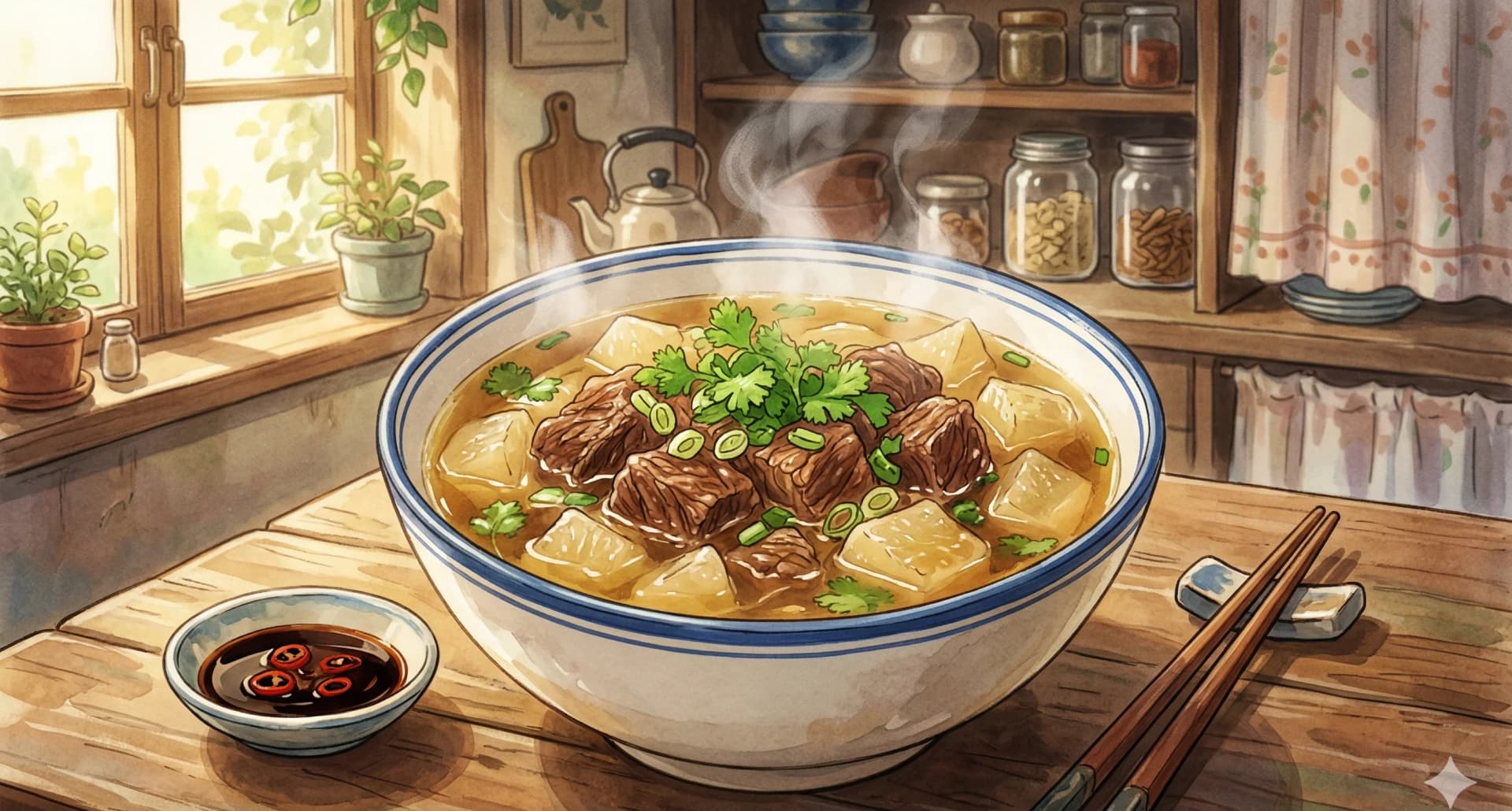
Cantonese clear broth soup with tender brisket, daikon radish, star anise, Sichuan peppercorn, and dried mandarin peel, served with a chili-soy dip
Clear broth beef brisket soup is Cantonese comfort food at its most fundamental: a pot of water, a piece of beef, some dried aromatics, and time. The broth is supposed to be clear, not murky, which means the brisket gets parboiled first in a separate pot of water with ginger and cooking wine to remove the scum and blood proteins that would otherwise cloud the soup. The parboiled brisket goes into a clean pot with fresh water, and everything simmers for about two hours.
The aromatics are modest: star anise, Sichuan peppercorn, dried mandarin peel, dried scallops, and ginger. They infuse the broth with a warm, aromatic depth without overwhelming the clean beef flavor. Dried scallops add a layer of umami that chicken bouillon alone cannot provide. The mandarin peel, rehydrated from dried, gives the broth a faint citrus note that lifts the heaviness.
Daikon radish goes in during the last 30 to 45 minutes. It absorbs the beefy broth and turns translucent and sweet, becoming one of the best parts of the dish. The brisket is removed, cooled slightly, and sliced across the grain into thick pieces that go back into the bowl with the radish and broth. A dipping sauce of chili sauce and soy sauce on the side lets you season each bite.
At a Glance
Yield
4 servings
Prep
25 minutes
Cook
120 minutes
Total
145 minutes
Difficulty
Easy
Ingredients
Broth Ingredients
- 1.5 lbsbeef brisket, 680g
- 1.25 lbsdaikon radish (570 g), peeled and cut into chunks
- 10 cupswater
- 2star anise
- 1 tspSichuan peppercorns, in a tea strainer
- 1/4 ozdried mandarin peel, soaked in warm water
- 1 ozdried scallops, rinsed
- 1 ozfresh ginger, sliced thin
- 3scallion stalks, green part only, diced for garnish
- 1 tbspchicken bouillon powder
- 1 tspsalt
- 1/4 tspwhite pepper
- 2 tbspcooking wine, for parboiling
Dipping Sauce Ingredients
- 1 tspchili sauce
- 2 tbsplight soy sauce
Method
- 1
Parboil brisket: place in cold water with 2-3 ginger slices and cooking wine. Bring to boil, reduce to medium-low for 5 min. Transfer to cold water, rinse off scum. Cut into large pieces.
- 2
In a clean pot, add remaining ginger, mandarin peel, dried scallops, water, spice packet (star anise + peppercorns in strainer), chicken powder, salt, and parboiled beef. Bring to boil.
- 3
Cover with lid slightly askew, cook 1.5-2 hours on low. Add daikon during the last 30-45 min.
- 4
Remove beef when it pulls apart easily. Cool slightly, slice across the grain into 1-inch pieces.
- 5
Portion radish into bowls, lay sliced brisket over, ladle hot broth on top. Garnish with scallion and white pepper. Serve with chili-soy dipping sauce.
Key Ingredient Benefits
Beef brisket: A well-marbled, collagen-rich cut from the chest of the cow. The connective tissue breaks down into gelatin during long simmering, giving the broth its characteristic body and the meat its meltingly tender texture. Brisket is high in iron, zinc, and B vitamins, and the slow-cooked form is one of the most easily digested ways to consume red meat.
Daikon radish: Adds sweetness, body, and the characteristic translucent chunks of vegetable that float in the finished broth. As it simmers, daikon releases water-soluble compounds that contribute to the broth's clean, slightly sweet character. Daikon is also high in vitamin C and contains enzymes traditionally associated with digestion in Chinese medicine.
Star anise and Sichuan peppercorns: A small amount of both adds a warming aromatic backbone to the broth without dominating. Star anise contains anethole, the same aromatic compound found in licorice and fennel. Sichuan peppercorn adds a subtle citrus-like note and a faint, pleasant numbing quality.
Dried tangerine peel (chenpi): Aged dried citrus peel contributes a complex, slightly bitter aroma that cuts through the richness of the beef. The peel is essential to authentic Cantonese-style beef brisket and is one of the ingredients that distinguishes the dish from generic beef soup.
Dried scallops (conpoy): A small handful adds concentrated seafood umami to the broth, working synergistically with the beef's glutamates. Conpoy is one of the most prized dried seafood ingredients in Cantonese cooking.
Why This Works
Parboiling the brisket before the main simmer is the technique that produces a clear, clean broth. The brief boil draws out blood and impurities that would otherwise muddy the soup. The cooking water is discarded entirely before the proper braise begins. This step is non-negotiable for clear Cantonese-style soups.
The combination of beef bones (within the brisket), dried scallops, and tangerine peel creates layered umami. Each ingredient contributes a different family of flavor compounds — animal glutamates from the beef, marine umami from the scallops, terpene aromatics from the peel — and the combination is richer than any single ingredient could produce.
Low, gentle simmering is essential. A hard boil would emulsify the fat into the broth, making it cloudy and greasy. The proper technique keeps the liquid at the smallest possible bubble for the full cook time, which allows fat to rise to the surface where it can be skimmed off, leaving a clear, clean broth.
The daikon is added in the second half of the simmer, not at the start. Daikon cooks much faster than brisket; adding it early would result in mush by the time the meat is tender. Staging the additions is what separates good Chinese soup from one with overdone vegetables.
Substitutions & Variations
Beef brisket: Chuck roast, beef shanks, or oxtail all work and produce excellent results. Each contributes slightly different characteristics — chuck is leaner, shanks have more bone-derived gelatin, oxtail is rich and gelatinous. Boneless cuts will produce a less viscous broth.
Daikon radish: Korean radish (mu) is essentially identical. Turnip works in a pinch but is sharper. Carrots can be added alongside or instead for a different flavor.
Dried scallops: Can be skipped without ruining the dish, but the broth loses some depth. A teaspoon of fish sauce or a small piece of dried shrimp can substitute for some of the marine umami.
Dried tangerine peel: Fresh orange or tangerine zest substitutes acceptably. Skipping entirely results in a less complex broth but still a good one.
Star anise and Sichuan peppercorns: Both can be omitted for a plainer broth. A few black peppercorns and a bay leaf produce a different but acceptable result.
Chicken bouillon powder: Korean or Chinese MSG/bouillon powder is traditional but can be skipped if the broth is properly built from fresh ingredients.
Serving Suggestions
Beef brisket soup is a complete meal in itself, traditionally served with steamed jasmine rice and a small dish of chili sauce or chili oil for diners to add to taste. The hot, rich broth is meant to be sipped between bites of rice, with the tender brisket and daikon eaten with chopsticks.
For a fuller table, pair with a simple stir-fried green vegetable like gai lan or bok choy. The vegetable's fresh, slightly bitter quality balances the rich broth.
In Hong Kong, beef brisket soup is also famously served with noodles, typically thick wheat noodles or e-fu noodles, as a one-bowl meal called ngau lam min (牛腩麵). To make this variation, cook noodles separately and place in a bowl, then ladle the brisket and broth over the top.
Pair with hot Chinese tea (pu-erh, jasmine, or oolong). Avoid white wine, which clashes with the savory broth.
Storage & Reheating
Refrigerator: Stores beautifully in an airtight container for up to 5 days. Beef brisket soup actually improves over 24 hours as the flavors continue to meld.
Reheating: Bring back to a gentle simmer over medium-low heat. The broth will solidify slightly in the fridge from the gelatin; this is a sign of good broth and will re-melt with gentle heat.
Make-ahead: Designed to be made ahead. The full dish can be cooked 2 days in advance and reheated; the flavor genuinely deepens with time. Many Hong Kong-style restaurants pre-cook large pots of brisket and serve it over days.
Freezing: Freezes excellently for up to 3 months. The brisket holds up well; the daikon texture suffers slightly but is still acceptable. Thaw overnight in the fridge before reheating.
Skim the fat: Beef fat will solidify on top after refrigeration. Skim before reheating for a cleaner broth.
Cultural Notes
Cantonese clear beef brisket soup (qīng tāng niú nǎn in Mandarin, cing tong ngau lam in Cantonese) is one of the most beloved comfort foods in Hong Kong and the Pearl River Delta. The dish is a centerpiece of cha chaan teng (Hong Kong tea restaurant) menus and dedicated noodle shops, where it is served all day, every day, in massive quantities.
The dish reflects two foundational principles of Cantonese cooking: qing (清, "clear/clean"), the cultivation of broths and stocks that taste deeply of their ingredients without muddiness or excess seasoning; and jian (鉴, "appreciating"), the recognition that simple ingredients prepared with care can produce extraordinary results. Beef brisket soup is the everyday application of these principles — nothing fancy, just brisket and daikon and time.
Hong Kong-style beef brisket soup has its own subcategories. Qīng tāng (清湯, clear broth) is the most refined version, with a transparent, deeply flavored broth and no thickening agents. Jiu pai (招牌, "signature style") restaurants in Hong Kong have famously thick, glossy beef brisket sauces that are closer to a stew than a soup. The clear-broth version represented here is the version most associated with comfort food and home cooking.
The dish also serves as a base for one of Hong Kong's most famous noodle dishes, ngau lam min (牛腩麵, beef brisket noodles), which can be ordered in thousands of noodle shops across the territory. The same broth is also used for ngau cha pai gwat (beef ribs) and many other Cantonese braised beef preparations.
Nutrition Facts
Calories: 331kcal (17%)|Total Carbohydrates: 12.7g (5%)|Protein: 42.1g (84%)|Total Fat: 11.4g (15%)|Saturated Fat: 4.6g (23%)|Cholesterol: 114mg (38%)|Sodium: 1669mg (73%)|Dietary Fiber: 3.4g (12%)|Total Sugars: 4.7g
You Might Also Like
 Easy
EasyCross-Cultural · China
Braised Pork with Potatoes (薯仔炆豬肉)
40 minutes
 Easy
EasyTraditional Chinese Medicine · China
Bok Choy in Ginger Sauce (姜汁白菜)
6 minutes
 Medium
Vietnamese Cuisine
Spicy Beef Noodle Soup (Bún Bò Huế)
3 hours 45 minutes
 Medium
Chinese Cuisine
Niu Rou Yang Cong Jiaozi (Beef and Onion Dumplings)
60 minutes
Ratings & Comments
Ratings & Comments
Ratings
Share your thoughts on this recipe.
Sign in to rate and comment