Korean Cuisine
Jeonbokjuk (Abalone Porridge)
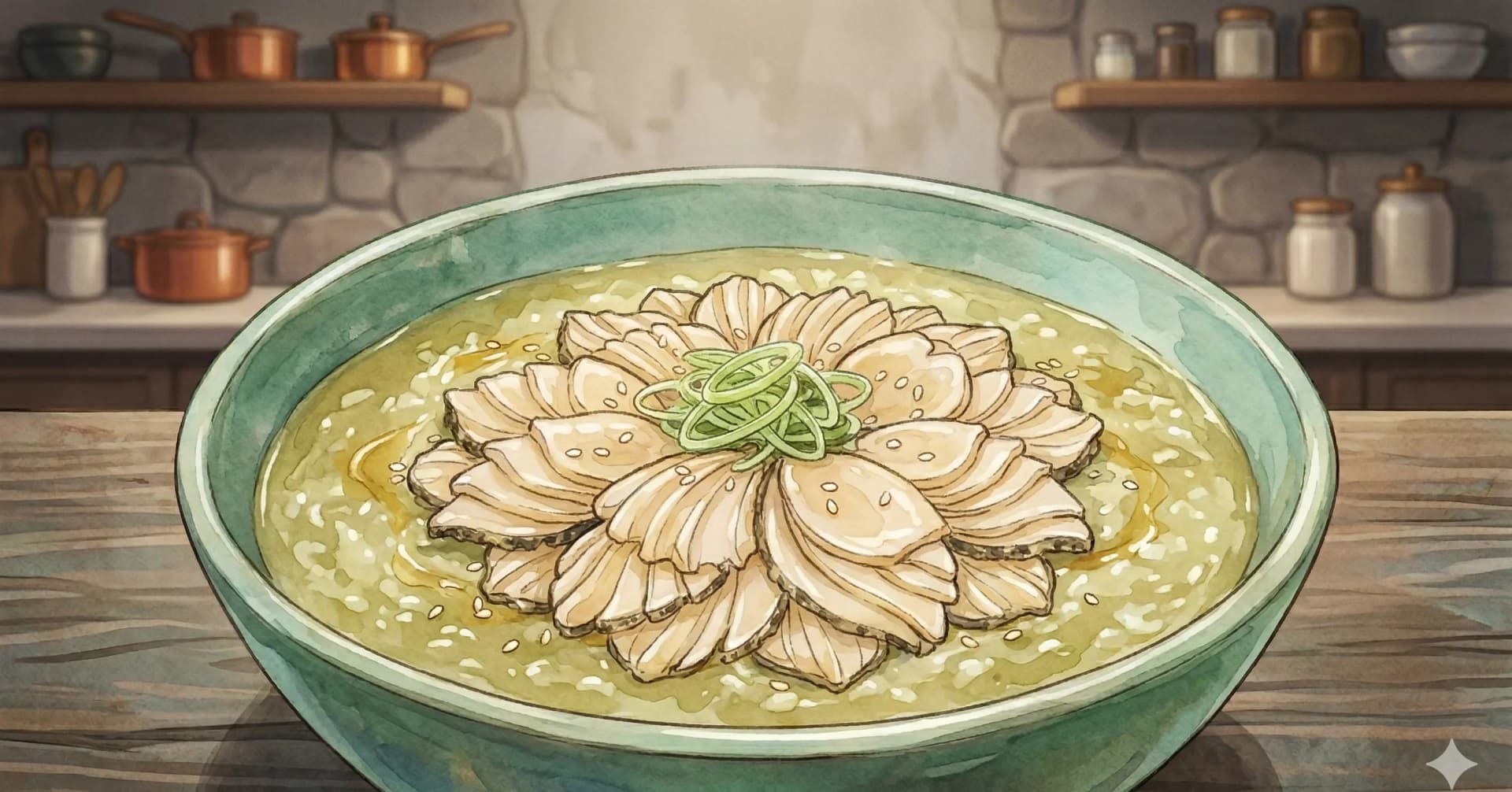
A silky rice porridge cooked with abalone and its nutrient-rich viscera until the broth turns pale green
On Jeju Island, the volcanic island off the southern coast of Korea, jeonbokjuk is the porridge of the sea. For centuries, the haenyeo, the women divers of Jeju, dove deep into the ocean floor without breathing equipment to harvest abalone, sea urchins, and other shellfish. The abalone they brought up were prized throughout Korea, and the simplest, most traditional way to prepare them was in this porridge.
What makes Jeju-style jeonbokjuk distinctive is the use of the abalone's viscera, the soft internal organs that include the dark green digestive gland. When chopped and cooked with rice and sesame oil, these organs release a green pigment that tints the entire porridge a pale, almost jade-like color. The flavor they contribute is deeply briny and rich, like a concentrated essence of the ocean. It is this quality, more than anything, that makes jeonbokjuk feel nourishing in a way that goes beyond ordinary porridge.
The preparation is deliberately simple. Soaked rice is stirred with sesame oil and the chopped viscera until the grains turn translucent. The sliced abalone meat is added, followed by water. The pot simmers for about 25 minutes, with occasional stirring, as the rice breaks down into a creamy porridge and absorbs all the flavors of the abalone. The finished dish is mild, savory, and deeply comforting, the kind of food that Korean families prepare when someone is recovering from illness or simply needs something gentle and sustaining.
If the idea of cooking with abalone viscera gives you pause, you can leave them out and still make a delicious porridge with just the abalone meat. The color will be white rather than green, and the flavor will be lighter, but it will still be a beautiful dish. You can also add chopped vegetables like carrot, zucchini, or mushrooms for variety.
At a Glance
Yield
4 servings
Prep
15 minutes (plus 1 hour soaking rice)
Cook
35 minutes
Total
1 hour 50 minutes
Difficulty
Medium
Ingredients
- 6½ ozshort-grain rice, rinsed and soaked for at least 1 hour
- 2to 3 medium abalone (100 to 115 g each), fresh or frozen
- 2 tbsptoasted sesame oil
- —1.4 to 1.7 L water
- —Salt or soup soy sauce (gukganjang) to taste
- 1 tsptoasted sesame seeds for garnish (optional)
Method
- 1
Soak the rice. Rinse the rice under cold water until the water runs clear. Soak in cold water for at least 1 hour. Drain thoroughly.
- 2
Clean the abalone. Scrub the dark edges of each abalone with a kitchen brush or toothbrush. Separate the abalone from the shell by working a spoon or small spatula around the muscle attached to the shell.
- 3
Remove and prepare the viscera. Carefully cut off the viscera (the soft, greenish-brown guts) from the abalone. Chop the viscera into small pieces and set aside in a small bowl. Cut off the tough pointed end of the abalone. Slice the abalone meat into pieces about 1/4 inch thick.
- 4
Toast the rice with viscera. Add the drained rice and chopped viscera to a medium pot. Mix them together well, breaking up any lumps of viscera. Add the sesame oil and set the pot over medium heat. Stir continuously for about 5 minutes, until the rice begins to turn translucent and the mixture is fragrant.
- 5
Add the abalone. Add the sliced abalone pieces to the pot and stir for another 2 minutes, allowing them to begin cooking.
- 6
Simmer the porridge. Add 6 cups of water and bring to a boil over medium-high heat. Reduce the heat to medium and continue to boil, stirring occasionally, for about 25 minutes. As the porridge thickens, stir more frequently to prevent the rice from sticking to the bottom of the pot.
- 7
Adjust the consistency. The porridge should be creamy but still fluid. If it is too thick, add up to 1 more cup of water and cook for a few more minutes. Reduce the heat to medium-low as necessary.
- 8
Season just before serving. Add salt or soup soy sauce to taste. Season the porridge just before serving, as it can become watery over time if seasoned too early.
- 9
Serve hot. Ladle into bowls and sprinkle with sesame seeds if desired. Serve with a small dish of salt on the side for individual adjustment.
Key Ingredient Benefits
Abalone: A highly prized shellfish in East Asian cuisines. Abalone meat is lean, firm, and rich in protein, iodine, selenium, and iron. It also contains omega-3 fatty acids. In Korean and Chinese traditional medicine, abalone is considered a restorative food that supports liver and kidney health, improves eyesight, and nourishes the blood. Modern research has identified bioactive peptides in abalone with antioxidant properties, though clinical applications remain under study.
Abalone viscera: The internal organs, particularly the digestive gland, are rich in carotenoids (which produce the green color) and concentrated micronutrients. In Jeju tradition, discarding the viscera is considered wasteful, and their inclusion is what distinguishes authentic island-style jeonbokjuk.
Rice porridge (juk): Porridge made from well-cooked rice is one of the most easily digestible foods in the Korean diet. It has been used for centuries as recovery food for the sick, the elderly, and those with weakened digestion. See also hobakjuk for a sweet pumpkin variation and congee for the Chinese tradition.
Why This Works
Toasting the soaked rice in sesame oil before adding water serves two purposes. First, the oil coats the rice grains and prevents them from clumping as they cook, producing a smoother porridge. Second, the heat activates the starches on the surface of the grains, which thicken the porridge more effectively and create a creamier texture.
Mixing the chopped viscera with the rice during the toasting step allows the green pigment and briny flavor to distribute evenly through the porridge from the beginning. If the viscera were added later, the color and flavor would be less uniform.
Stirring more frequently as the porridge thickens prevents the rice from settling on the bottom of the pot and scorching. The porridge should move slowly when stirred, like a thick soup.
Substitutions & Variations
Without viscera: Simply omit the viscera if you prefer. The porridge will be white and milder in flavor. Increase the sesame oil to 3 tablespoons for more richness.
Frozen abalone: Frozen abalone (still in the shell) works well. Thaw overnight in the refrigerator before cleaning and slicing.
With vegetables: Chopped carrot, zucchini, or mushrooms can be added along with the abalone for a more substantial porridge.
Chicken porridge (dakjuk): For a similar comforting porridge without seafood, replace the abalone with shredded cooked chicken and use chicken broth instead of water.
Serving Suggestions
Jeonbokjuk is traditionally served as a nourishing meal on its own, particularly for breakfast or when someone is recovering from illness. Accompaniments are kept minimal: a small dish of salt or soup soy sauce, perhaps some kkakdugi for crunch and contrast. Gyeran-jjim alongside adds another layer of gentle comfort. For a more substantial meal, serve with oi muchim and baek-kimchi.
Storage & Reheating
Refrigerator: Store in a sealed container for up to 2 days. The porridge will thicken considerably as it cools.
Reheating: Warm gently in a pot over medium-low heat, stirring frequently and adding water as needed to restore the desired consistency. Season again after reheating, as the flavors may have muted.
Freezer: Can be frozen for up to 1 month. Thaw overnight in the refrigerator before reheating.
Cultural Notes
Jeonbokjuk (전복죽) is inseparable from Jeju Island, the volcanic island off Korea's southern coast where abalone (jeonbok, 전복) has been harvested for centuries by the haenyeo (해녀, "sea women"). The haenyeo are a community of female free-divers whose traditions UNESCO inscribed onto its Intangible Cultural Heritage list in 2016. They dive without scuba equipment, holding their breath for up to two minutes at depths of ten meters or more, to harvest abalone, sea urchin, and other shellfish from the volcanic seabed. The eldest haenyeo still actively diving today are in their seventies and eighties.
Abalone has long held a special place in Korean cuisine as a luxury restorative food, reserved historically for nobility and ceremonial occasions. The dark green color of jeonbokjuk's broth comes from the abalone's viscera (nae-jang, 내장), which gets mixed into the rice during cooking. This is what distinguishes a proper Korean jeonbokjuk from the simpler Chinese or Western abalone porridges. The inclusion of the viscera is considered essential both for its deep umami and for its perceived medicinal value.
Jeonbokjuk sits firmly in the Korean boyangsik (보양식, restorative food) tradition alongside samgyetang, baeksuk, and dak gomtang. It is the porridge served to expectant and postpartum mothers, to the elderly, to those recovering from illness, and to anyone whose body needs gentle nourishment.
On Jeju, jeonbokjuk restaurants line the coastal roads, many of them operated by haenyeo themselves or by their families. A bowl of locally-sourced jeonbokjuk is a defining culinary experience of any Jeju trip. The dish is widely considered one of Korean cuisine's most refined expressions of the sea-to-table principle.
Nutrition Facts
Calories: 293kcal (15%)|Total Carbohydrates: 39.9g (15%)|Protein: 12.3g (25%)|Total Fat: 8.5g (11%)|Saturated Fat: 1.2g (6%)|Cholesterol: 45mg (15%)|Sodium: 162mg (7%)|Dietary Fiber: 0.3g (1%)|Total Sugars: 0g
You Might Also Like
 Medium
Korean Cuisine
Baek Kimchi (White Kimchi)
3 hours (plus 1 to 3 days fermentation)
 Easy
EasyVietnamese Cuisine
Cháo Gà (Vietnamese Chicken Rice Porridge)
1 hour 30 minutes
 Medium
Korean Cuisine
Bibimbap (Mixed Rice Bowl)
1 hour 10 minutes
 Easy
EasyKorean Cuisine
Bibim Naengmyeon (Spicy Mixed Cold Noodles)
30 minutes
Ratings & Comments
Ratings & Comments
Ratings
Share your thoughts on this recipe.
Sign in to rate and comment