Cross-Cultural · Korea
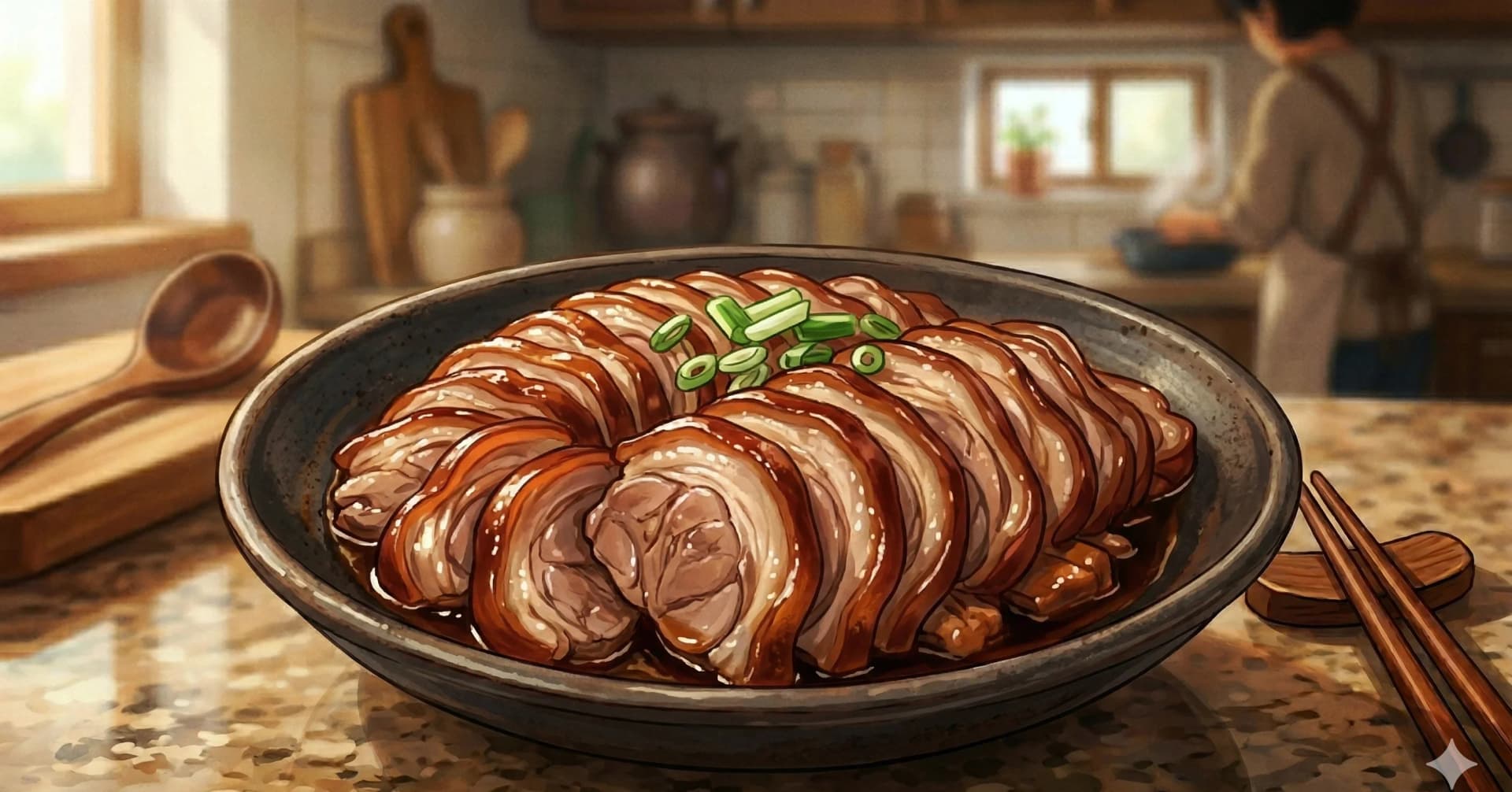
Braised Pig's Feet (Jokbal / 족발)
Pig's trotters braised in soy sauce, doenjang, star anise, and cinnamon with jujubes and apple, sliced and served with shrimp dipping sauce
Jokbal is Korean braised pig's trotters, and it is one of the great drinking foods of Korea. The trotters are soaked overnight, blanched, scrubbed, and then braised for two hours in a liquid that reads like a spice merchant's inventory: soy sauce, doenjang, mirin, brown sugar, rice syrup, apple chunks, jujubes, garlic, ginger, onion, dried red chilies, green onion, star anise, cinnamon, and a sachet of black peppercorns and ground coffee.
The coffee is the detail that makes people do a double take. It goes into the initial blanching water and into the braising sachet, where it helps remove impurities and adds a faint, almost imperceptible bitterness that rounds out the sweetness of the braising liquid. It is a technique that jokbal sellers in Korea have used for years.
The trotters braise for about two hours, flipped halfway, until a chopstick slides through the meat with no resistance. The final ten minutes on high heat, uncovered, with the broth ladled repeatedly over the surface, glazes the skin into a deep, mahogany sheen. After cooling, the meat is sliced into thin pieces, revealing layers of tender meat, rendered fat, and gelatinous skin.
The traditional accompaniment is a dipping sauce made from saeujeot (salted fermented shrimp), garlic, gochugaru, and scallion. The salty, pungent shrimp sauce cuts through the richness of the pork perfectly. Jokbal is typically served late at night with beer or soju, in the company of friends, eaten slowly and talked over.
At a Glance
Yield
4 servings
Prep
12 hours
Cook
2 hours 30 minutes
Total
15 hours
Difficulty
Involved
Ingredients
Pork Ingredients
- 3-4 lbspig's trotter, soaked in cold water 12 hours, changing water 3-4 times
- 8 cupswater, for braising
- 1can chicken broth, low sodium
- 2 tbspdoenjang
- 1/4 cupmirin
- 1/3 cupsoy sauce
- 1/4 cupdark brown sugar
- 1 tbspsalt
- 1/4 cuprice syrup or corn syrup
- 1apple, cored and chunked
- 8large jujubes (optional)
- 1head of garlic, halved
- 1 tbspfresh ginger, sliced
- 1medium onion, chunked
- 7-8small dried red chili peppers
- 4-5scallions, cut into 2-inch pieces
- 1star anise
- 1cinnamon stick
- 1 tspwhole black peppercorns, in cheesecloth pouch
- 1 tbspground coffee, in cheesecloth pouch with peppercorns
Method
- 1
Soak trotter in cold water 12 hours, changing water 3-4 times. Squeeze to push out blood, shave any hair.
- 2
Blanch in boiling water with 1 tsp ginger for 20-25 minutes. Scrub thoroughly under running water.
- 3
Place cleaned trotter in pot with all braising ingredients and the peppercorn-coffee pouch. Cover, cook 1 hour on medium-high.
- 4
Flip trotter, press pouch down with a spoon. Reduce to medium, cover, cook 1 more hour.
- 5
Check doneness (chopstick should slide through). Cook uncovered on high 10 min, ladling broth over for glazing.
- 6
Cool 10-20 min. Slice into bite-sized pieces. Serve with shrimp dipping sauce (saeujeot + garlic + gochugaru + scallion + water + sugar + pepper + sesame seeds).
Key Ingredient Benefits
Pork trotters: The cut that defines the dish. Trotters are extraordinarily high in collagen, which breaks down into gelatin during the long braise, producing the unctuous, almost gummy texture that distinguishes jokbal from regular pork. The bones and tendons release minerals and amino acids into the braising liquid, building a deeply savory broth. Trotters are also rich in glycine and proline, amino acids associated with skin, joint, and connective tissue health.
Doenjang: Added to the braising liquid both for umami and to absorb any gamey or off-aromas from the trotters. The fermented soybean paste also subtly tenderizes the meat through enzymatic action.
Soy sauce and dark brown sugar: The combination that produces jokbal's characteristic deep mahogany color and sweet-savory flavor. The sugar caramelizes slightly during the long braise, contributing complexity beyond simple sweetness.
Aromatics (garlic, ginger, onion, scallions): A massive quantity of aromatics is added to the braise, both for flavor and to mask any porky aromas. A whole head of garlic, fresh ginger, a whole onion, and multiple scallions are standard. This generous aromatics is one of the hallmarks of Korean braising.
Star anise, cinnamon, peppercorns: Whole spices that contribute warming aromatic depth. The combination shows clear influence from Chinese braising traditions, which arrived in Korea via Chinese-Korean (Han-Jung) cooking and were adapted into Korean braising.
Ground coffee: An unusual but traditional Korean addition. The coffee deepens the color of the braising liquid and adds subtle bitter notes that balance the sweetness. This trick comes from Korean restaurant practice and is one of the secrets of professional jokbal.
Saeujeot (fermented shrimp): A small spoonful added to the braise contributes additional umami complexity from fermented seafood.
Why This Works
The overnight soaking and aggressive scrubbing of the trotters is non-negotiable. Pork trotters carry surface impurities, residual blood, and slight gamey aromas that must be removed before cooking. Soaking draws out blood; scrubbing removes any debris. Many home cooks skip this step and produce jokbal that has a faint off-flavor; professional Korean kitchens do not skip it.
Blanching the trotters before braising is the second cleansing step. A quick boil pulls out additional impurities that surface as scum, which is poured off entirely before the proper braise begins. This double-clean approach produces the clear, deeply colored braising liquid that defines great jokbal.
The braising liquid is intentionally massive and aromatic. The combination of doenjang, soy sauce, sugar, mirin, aromatics, whole spices, coffee, and fermented shrimp builds layers of flavor that no single ingredient can provide. Two hours of low simmering allows all of these flavors to meld and the trotters to absorb them deeply.
The slicing technique matters. Properly cooked jokbal should be cooled slightly before slicing — fully hot trotters are hard to slice cleanly. Cooling for 15 to 20 minutes firms the gelatin enough that you can slice the meat into thin, neat pieces that retain shape.
Serving jokbal at room temperature rather than hot is traditional. The gelatin is more pleasantly textured at room temp than scalding hot, and the flavors are more nuanced.
Substitutions & Variations
Pork trotters: This is a trotter-specific dish. Pork hocks (knuckles) can substitute and produce a similar though slightly meatier result. Pork shanks work but lack the gelatin content that defines the texture. There is no real substitute for trotters in this dish.
Doenjang: Japanese miso (red or barley) substitutes well. Avoid sweet miso varieties.
Saeujeot (fermented shrimp): Anchovy paste or 2 mashed anchovy fillets can substitute for the umami contribution. Plain fish sauce also works.
Dark brown sugar: Light brown sugar works but use slightly more. Regular sugar plus a teaspoon of molasses approximates the flavor.
Coffee: Can be skipped, but the color and complexity suffer slightly. A tablespoon of cocoa powder is an alternative for color and subtle bitterness.
Star anise, cinnamon, peppercorns: All three can be reduced or modified to taste. The Korean home cooking style is generous with whole spices, but personal preference matters.
Apple: Other firm sweet fruits (Asian pear, quince, even half a quartered onion) can substitute for the fruit-based mellowness.
Serving Suggestions
Jokbal is one of the great Korean anju (drinking foods) and is typically served at dedicated jokbal restaurants, where it arrives at the table sliced thin and arranged on a wide platter. The traditional accompaniments include:
- Saewu-jeot (small dish of fermented shrimp) for dipping
- Ssamjang (fermented soybean dipping paste) for dipping
- Garlic cloves, raw or pickled
- Sliced green chili
- Red leaf lettuce, perilla leaves, and shiso for wrapping
- A small dish of mustard-vinegar sauce
The canonical way to eat jokbal is ssam-style: place a slice of pork on a lettuce leaf, top with garlic, chili, ssamjang, and saewu-jeot, wrap, and eat in one bite. The combination of rich pork, sharp condiments, and cool greens is the soul of Korean drinking food.
Pair with chilled soju, makgeolli, or a Korean beer. Jokbal and soju is one of the most cherished pairings in Korean food culture.
For a more substantial meal, serve jokbal with steamed short-grain rice, kimchi, and several banchan. Many Korean restaurants serve jokbal as part of a larger Korean banchan-and-rice meal as well as in its anju form.
Storage & Reheating
Refrigerator: Keeps in an airtight container for up to 5 days. Jokbal actually improves over 1 to 2 days as the flavors continue to meld and the gelatin firms up.
Serving temperature: Traditionally served at room temperature or slightly chilled. The gelatin is at its most pleasantly textured between cold and warm. Avoid serving piping hot.
Reheating: If desired warm, steam the slices for 3 to 4 minutes or microwave on medium power for 30 seconds. Avoid high heat, which renders out the gelatin and produces dry meat.
Make-ahead: Jokbal is designed to be made ahead. The braising can be done up to 3 days in advance; let the trotters cool in the liquid and refrigerate together. Slice and serve at room temperature.
Freezing: Freezes well for up to 2 months. Thaw overnight in the refrigerator. The texture suffers slightly but is still very good.
Cultural Notes
Jokbal is one of Korea's most beloved anju (drinking foods), with dedicated jokbal restaurants found in every Korean city. The dish has roots in gungjung-eumsik (royal court cuisine), where slow-braised pork trotters were prized for their texture and warming properties, particularly in the cold winter months. The modern restaurant style developed in the postwar era and has been continuously refined since.
The dish is closely associated with Jangchung-dong, a neighborhood in Seoul known as Jokbal Street (Jokbal-golmok). The street has been home to dozens of jokbal restaurants since the 1960s, when refugees from northern Korea opened the first establishments and gradually attracted others. The neighborhood remains the most famous destination for jokbal in Korea, and "Jangchung-dong style" is a recognized regional variant of the dish.
A close relative of jokbal is bossam — boiled pork belly served with lettuce wraps and ssamjang. The two dishes are often served together at Korean drinking establishments, and many restaurants specialize in both. The combination of jokbal, bossam, and chilled soju is one of the canonical Korean drinking meals.
The use of coffee in the braising liquid is a uniquely Korean adaptation that emerged in the 1980s as restaurant chefs experimented with ways to deepen the color and complexity of the braising liquid. The technique spread through professional kitchens and is now considered traditional, despite its modern origin. Home cooks vary on whether to include coffee, with some considering it essential and others preferring the more delicate flavor of coffee-free versions.
Nutrition Facts
Calories: 511kcal (26%)|Total Carbohydrates: 35.6g (13%)|Protein: 41.2g (82%)|Total Fat: 23.5g (30%)|Saturated Fat: 7.8g (39%)|Cholesterol: 160mg (53%)|Sodium: 1285mg (56%)|Dietary Fiber: 2.1g (8%)|Total Sugars: 18.4g
You Might Also Like
Ratings & Comments
Ratings & Comments
Ratings
Share your thoughts on this recipe.
Sign in to rate and comment