Awadhi · Indian Cuisine
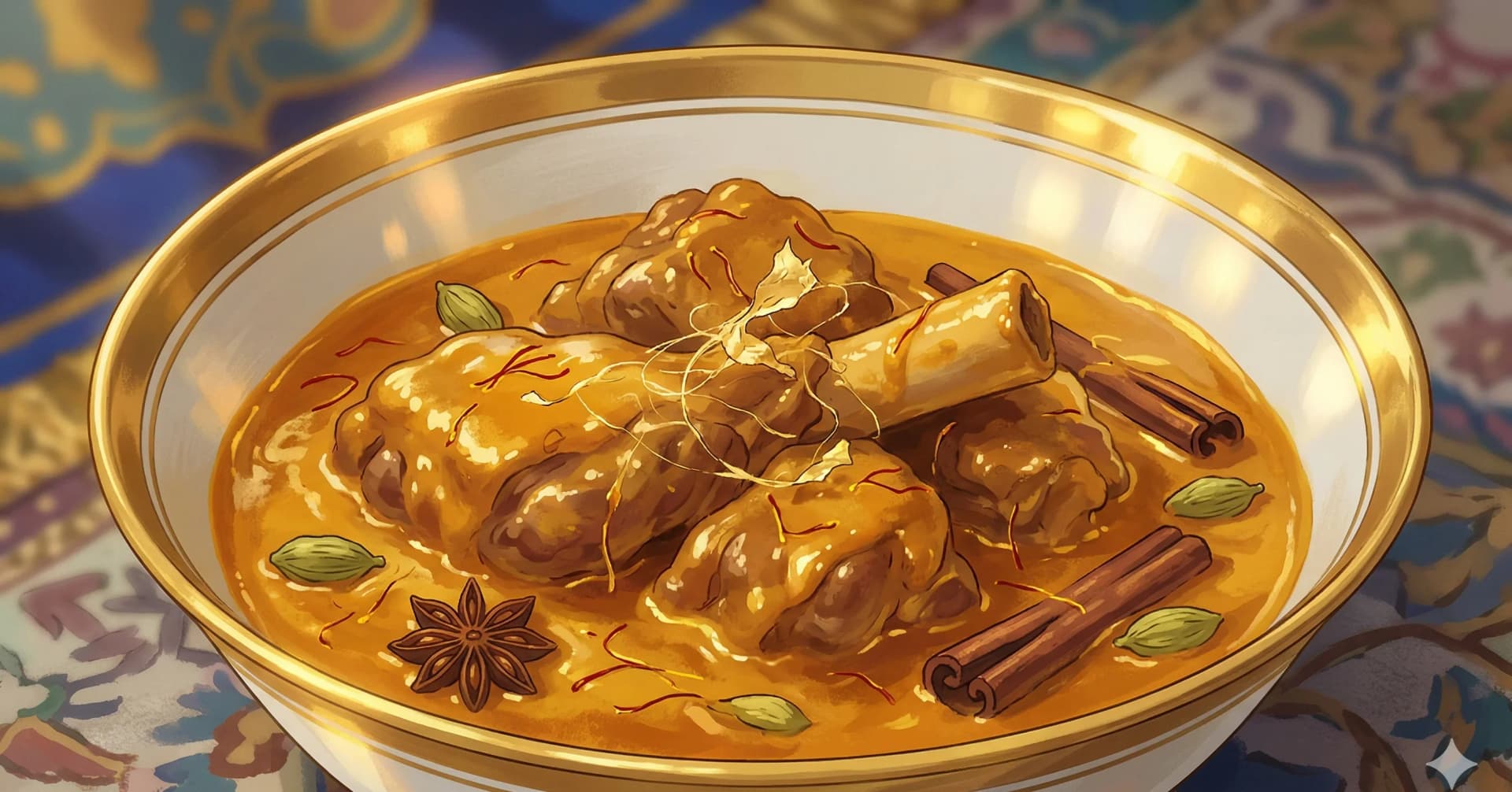
Golden Mughlai Curry (Kundan Kaliyan)
Awadhi golden blossoms — mutton in a strained saffron gravy, dressed in edible gold
The name tells you everything and nothing at once. Kundan means gold — the pure, refined kind, the word used for a gemstone setting in which a jewel is held by fine gold wire without a visible claw. Kaliyan means blossoms. Golden blossoms. In the kitchens of the Awadhi nawabs, where cuisine was as much about ceremony as sustenance, this dish was not merely served — it was presented. Five pieces of mutton, precisely carved, each one draped in a single sheet of edible gold leaf that catches the candlelight and trembles at the slightest movement. The remaining gold is stirred into the gravy with a fork until the sauce itself gleams, emulsified with light.
This is court food in the truest sense — food that understood its role was partly theatrical. The Nawabs of Lucknow refined Persian culinary traditions over generations, and kundan kaliyan sits at the peak of that tradition. The technique is layered: mutton is blanched first to draw out impurities and firm the flesh, then carved into regular shapes so it carries its gold leaf like a jewel in a setting. The gravy is cooked with patience — curd added one tablespoon at a time, ghee teased into separation — then strained through muslin cloth until it is completely smooth. Balai, the thick clotted cream that rises on slowly simmered milk, is stirred in at the end. The result is a sauce that is pale as moonstone and barely thickened, with saffron pooling gold at its surface.
The gold leaf itself is tasteless and harmless — its role is purely visual and ceremonial. But that ceremony is the point. To eat this dish is to understand that there was a time when cooking aspired to be something more than nourishment.
At a Glance
Yield
4 portions
Prep
40 minutes
Cook
1 hour 30 minutes
Total
~2 hours 10 minutes
Difficulty
Involved
Ingredients
- 1 lbmutton boti (boneless shoulder or leg), in larger pieces for carving
- ⅔ cupghee
- ½ lbonions (about 1½–2 onions), finely sliced
- ¼ cupfresh ginger, peeled
- ¼ cupgarlic
- 5½ ozcurd (whole-milk, well-set), beaten smooth
- 3½ ozbalai (clotted cream) — or thick, reduced fresh cream
- ¼ ozsaffron, dissolved in 2 tablespoons warm water
- ½ tspmace
- ⅞ tspcinnamon
- ¼ ozlarge cardamom (black cardamom), seeds only
- ⅓ tsppeppercorns
- ¼ ozgreen cardamom, seeds only
- 2¾ tspcoriander powder
- 1⅞ tspturmeric powder
- 2¾ tspred chilli powder
- 1⅔ tspsalt
- ¼ ozsone ka warq (edible gold leaf), 5–7 sheets
Method
- 1
Blanch the mutton. Place mutton pieces in a pot of cold water. Bring to a boil and blanch for 8–10 minutes. Drain, rinse under cold water, and pat dry. The blanching firms the meat and clarifies the final gravy.
- 2
Carve the mutton. Cut the blanched mutton into neat square or round portions of roughly even size. Uniformity matters here — this is a dish that values symmetry. Set aside.
- 3
Fry and crush the onions (250 g). Heat the ghee (150 g) in a heavy *deghchi* or wide pot. Add the sliced onions and fry over medium heat until deep golden brown — this will take 20–25 minutes. Remove the onions with a slotted spoon and crush or grind them to a fine paste while still warm.
- 4
Prepare the ginger (25 g) and garlic (25 g). Grate or blend the ginger to a paste. Squeeze the garlic through a fine press or blend and pass through a sieve — you want garlic *juice* rather than paste, to keep the gravy pale and clean.
- 5
Begin cooking the mutton. In the same ghee (add a little more if needed), place the carved mutton pieces and the fried onion paste. Add the ginger paste and garlic juice. Fry over medium-high heat for 10 minutes, turning the mutton to colour all sides.
- 6
Add powdered spices. Sprinkle in the coriander powder (5 g), turmeric (5 g), red chilli powder (5 g), and salt (10 g). Stir for 5 minutes over medium heat until the spices are thoroughly coated on the mutton and the raw smell has cooked out.
- 7
Add curd (150 g) slowly. This is the most important step. Reduce heat to low. Add the beaten curd one tablespoon at a time, stirring constantly after each addition. Do not rush — each addition must be fully absorbed before the next goes in. Continue until all the curd is incorporated. Increase heat slightly and fry until the ghee visibly separates and pools at the edges of the pan. The mutton and spices will look dry and darkened at this point.
- 8
Finish cooking the mutton. Add one cup of water and the ground garam masala. Stir to combine. Cover tightly and cook on low heat until the mutton is completely tender — about 20–30 minutes. Test by pressing a piece between your fingers; it should yield without resistance.
- 9
Separate mutton and strain the gravy. Remove the mutton pieces carefully and set aside. Pour the remaining gravy through a muslin cloth or very fine sieve into a clean pot, pressing gently to extract all the liquid. What you are left with should be a smooth, deeply flavoured sauce with no fibrous remnants.
- 10
Enrich the gravy. Mash the balai (100 g) until smooth and whisk it into the strained gravy. Add the saffron (0.1 g) water. Place over low heat and stir until the gravy is warm and emulsified — pale gold, faintly fragrant.
- 11
Reunite and warm. Add the reserved mutton pieces to the gravy. Cook on low flame for 5 minutes, just to let the meat absorb the finishing flavours. Taste and adjust salt.
- 12
Plate with gold. Arrange the mutton pieces in a shallow serving dish. Drape one sheet of gold leaf carefully over each of the five prominent pieces — the leaf is extremely delicate; use a small brush or the backing paper to lift and lay it. Take the remaining gold leaf sheets and crumble or break them gently into the gravy, then stir with a fork until the gravy shimmers with dispersed flecks of gold. Pour the gleaming gravy around and over the plated mutton. Serve immediately.
Key Ingredient Benefits
Balai (clotted cream). This is the thick cream that settles on the surface of milk that has been brought slowly to near-boiling and then left undisturbed. In texture it is somewhere between crème fraîche and whipped butter — thick, slightly tangy, very rich. It is not the same as double cream, though gently reduced fresh cream makes a reasonable substitute. Traditional Awadhi cooking uses balai throughout; its mild acidity and high fat content make it ideal for finishing gravies.
Sone ka warq (edible gold leaf). Pure 24-karat gold, beaten to extreme thinness. It is inert in the body, passes through without absorption, and is used in Indian confectionery and cuisine primarily for ceremony and aesthetics. It has no significant nutritional effect. Buy from reputable food-grade sources; silver warq (the more common variant) is sometimes adulterated — gold warq from established suppliers is reliably pure.
Mutton. Mature sheep meat has a deeper flavour than lamb and more collagen in its connective tissue. Slow cooking breaks that collagen into gelatin, which thickens and enriches the gravy naturally. Leg or shoulder boneless boti is traditional — choose pieces with some intramuscular fat.
Ghee. Clarified butter with the milk solids removed. Its high smoke point makes it suitable for the long frying stage in this recipe. It also contributes a nutty, slightly caramel flavour that butter alone cannot replicate.
Why This Works
The blanching step — often omitted in adapted recipes — is structural, not merely about impurity removal. By firming the meat before carving, blanching allows you to cut clean, regular shapes that hold their form through further cooking. A piece of raw mutton carved to a square and then cooked will swell and distort; blanched mutton maintains its geometry.
Adding curd one tablespoon at a time, with constant stirring, is the method that prevents splitting and builds flavour progressively. Each addition cooks against the hot spices and fat before the next arrives. By the time all the curd is in, it has been thoroughly cooked down and integrated rather than merely stirred in. The separation of ghee that follows is a visual signal: all the water in the curd has evaporated, and the dish is ready to receive liquid.
Straining the gravy through muslin is what transforms a good dish into a court dish. It removes every fragment of fried onion, every broken spice, every bit of browned residue — leaving only flavour. The addition of balai into this strained base creates something that cannot be achieved any other way: a gravy that is simultaneously rich and weightless, coating the meat and the tongue without heaviness.
The gold leaf, stirred into the gravy with a fork, disperses in emulsified flecks that catch the light differently depending on the angle. The nawabs called this dish golden blossoms not just because of how it looked on the plate, but because of how the light moved in the sauce.
Substitutions & Variations
- Lamb can replace mutton for a milder, quicker-cooking version. Reduce final covered cooking time to 15–20 minutes.
- Balai can be approximated by simmering 250 ml fresh cream over low heat, stirring occasionally, until it reduces to a very thick, almost solid consistency. Cool slightly before using.
- Gold leaf can be omitted entirely — the dish stands fully on its own without it. Some versions garnish with kewra water (screwpine) instead for a floral note.
- For a fuller spice profile, a few strands of kewra (screwpine) essence can be added with the saffron water.
Serving Suggestions
Kundan Kaliyan is traditionally served in a shallow dish so the gold on the gravy is visible. Pair with sheermal — the saffron-kissed flatbread of Lucknow — or with thin roomali roti. A scattering of crushed dried rose petals over the top is an optional but beautiful addition that echoes the floral notes in the gravy. Serve alongside a simple kachumber of diced cucumber, tomato, and red onion dressed with lime and black salt. Nothing too assertive — this dish deserves the table to itself.
Storage & Reheating
Refrigerate the mutton and gravy together in an airtight container for up to 2 days. The gravy will solidify as the ghee cools — this is normal. Reheat very gently on the stovetop over the lowest possible heat, stirring occasionally. Add a spoonful of warm water if needed to loosen the gravy. The gold leaf will break apart and blend further into the gravy upon reheating, which is acceptable. Do not freeze — the strained balai gravy will separate and lose its silky character.
Cultural Notes
Kundan kaliyan (कुंदन कलियां, "gold kaliya") is the Awadhi-Hyderabadi lamb preparation built on the Mughlai kaliya technique (a yellow-gold curry colored with turmeric and saffron) and named for its gleaming gold color from the combination of turmeric, saffron, and a small amount of edible silver or gold leaf garnish. Kundan in the Awadhi-Urdu vocabulary refers to pure refined gold, and the name signals the dish's status as a banquet or wedding preparation rather than an everyday meal. The dish belongs to the Awadhi and Hyderabadi banquet tradition and appears at formal Indian Muslim weddings, large family celebrations, and elaborate Mughlai-tradition restaurant menus.
The kaliya family is distinct from the broader korma tradition. Where Mughlai kormas are built on cream-and-nut-paste-rich gravies that finish in pale ivory colors (see murgh-korma), the kaliya preparations are built on a yellow-orange spice base that includes turmeric, ground coriander, and a saffron infusion, producing a brighter colored gravy with a slightly different aromatic profile. The kaliya tradition documented in the Mughlai and Awadhi cookbook literature includes variants for lamb, chicken, paneer, and vegetables, with the kundan kaliyan specifically referring to the banquet-grade golden version that adds saffron infusion and the precious-metal leaf garnish for visual ceremony.
The technique builds the golden gravy on yogurt, turmeric, and saffron. Bone-in lamb is marinated in yogurt, ginger-garlic paste, salt, and turmeric for at least two hours. Onions are sliced thinly and lightly fried (not deep brown like the standard korma birista, but pale golden, so they don't darken the gravy color). The lightly fried onions are ground into a smooth paste with soaked almonds (almonds chosen over cashews because almonds keep the gravy lighter). The marinated lamb is sautéed in ghee until lightly colored, then the onion-almond paste, additional turmeric, ground coriander, white pepper, green cardamom, and a small amount of water are added. The pot is covered and cooked over low heat for ninety minutes until the lamb is tender. A pinch of saffron infused in warm milk is added off the heat for the deep gold color and the aromatic finish, and the dish is garnished with silver or gold leaf (varak) and a scatter of slivered almonds before serving with sheermal or basmati pulao.
Nutrition Facts
Calories: 623kcal (31%)|Total Carbohydrates: 11.5g (4%)|Protein: 28.2g (56%)|Total Fat: 51.3g (66%)|Saturated Fat: 27.8g (139%)|Cholesterol: 170mg (57%)|Sodium: 118mg (5%)|Dietary Fiber: 1.3g (5%)|Total Sugars: 5.3g
You Might Also Like
Ratings & Comments
Ratings & Comments
Ratings
Share your thoughts on this recipe.
Sign in to rate and comment