Chinese Cuisine
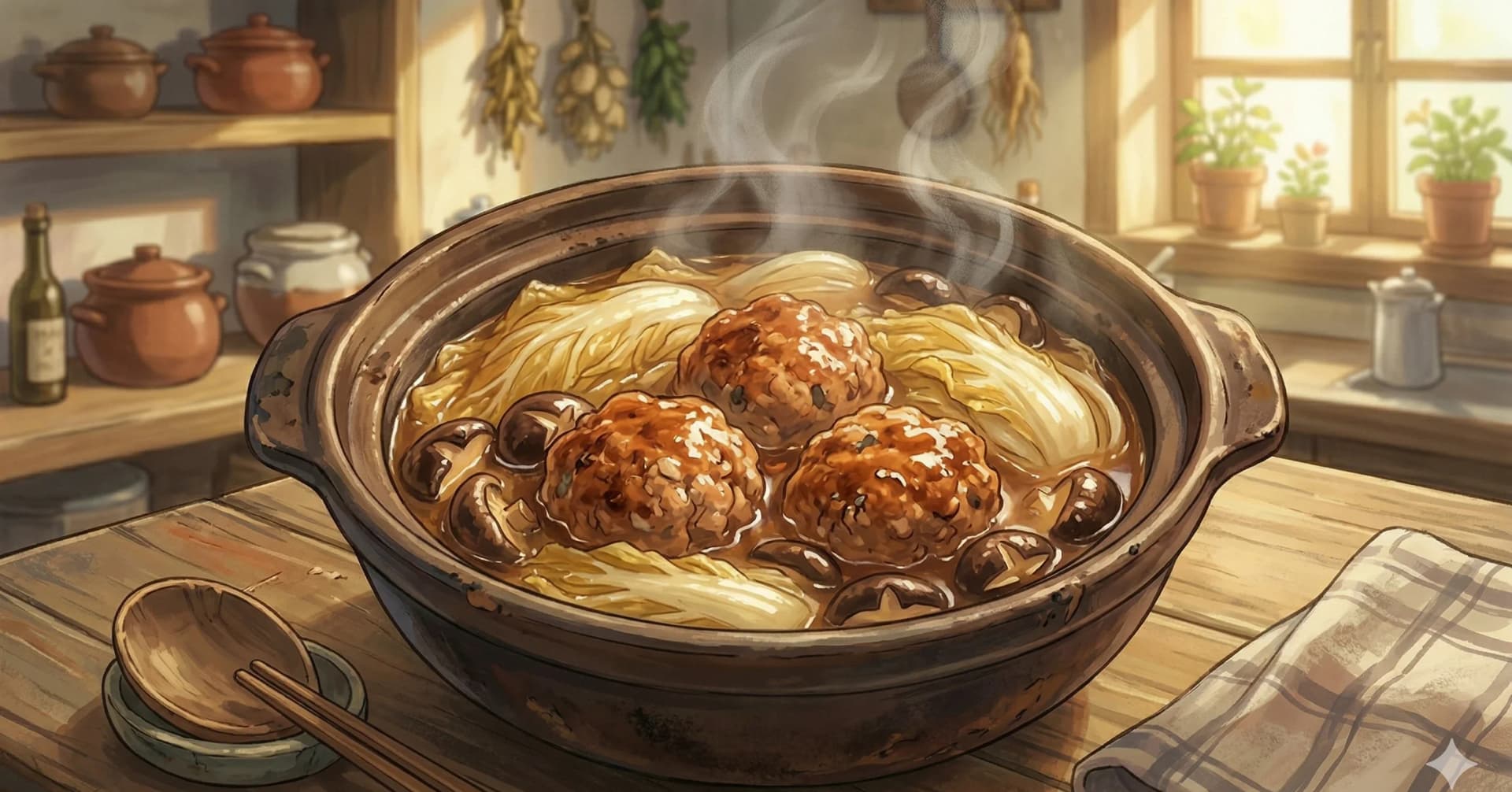
Shi Zi Tou (Lion's Head Meatballs)
Giant pork meatballs braised with napa cabbage in a fragrant broth
The name comes from the way this dish looks on the plate. Each meatball is the size of a tennis ball, and when it sits surrounded by a mane of soft napa cabbage, it does look a bit like a lion's head. That whimsical name belies a dish of real sophistication. Shi zi tou is one of the signature preparations of Huaiyang cuisine, the refined cooking tradition from the Yangtze River delta, and it appears at banquets, festivals, and New Year tables across eastern China.
What sets these meatballs apart from Western-style ones is the texture. The pork mixture is stirred vigorously in one direction until it becomes smooth, sticky, and almost paste-like. This technique aligns the protein strands and creates a meatball that is remarkably tender and holds together without crumbling. Water chestnuts are folded in at the end, adding a crunch that is subtle but important. Without them, the meatball feels one-dimensional.
The cooking is a two-stage process. First, the meatballs are fried until golden, which develops a crust and concentrates flavor on the surface. Then they are braised gently in a mushroom-infused broth with napa cabbage until everything melts into something soft and deeply savory. The cabbage absorbs the pork fat and mushroom liquid, and by the end of cooking, some people find the cabbage more satisfying than the meatballs themselves.
This is not a quick weeknight dish, but it is not difficult either. Shape the meatballs with care, fry them with patience, and let the braise do the rest. The reward is a centerpiece that looks impressive and tastes like something from a proper Jiangnan restaurant.
At a Glance
Yield
8 servings
Prep
40 minutes
Cook
40 minutes
Total
1 hour 20 minutes
Difficulty
Medium
Ingredients
Meatball Ingredients
- 1 lbfatty ground pork (70/30 meat-to-fat ratio)
- 3½ ozminced chicken (optional, for extra binding and umami)
- 3½ ozcanned water chestnuts, smashed and finely minced
- 1large egg
- ¾ ozplain breadcrumbs
- 1 tbspShaoxing wine
- 1 tbsplight soy sauce
- ¾ ozoyster sauce
- 1½ tbspcornstarch
- ¼ cupwater
- 1¼ tbspfresh ginger, minced
- 1scallion, minced
- ½ tspwhite pepper
- ¼ ozfive-spice powder
For Frying
- —Vegetable oil for frying
Braise Ingredients
- 1 tbspvegetable oil
- 2 slicesfresh ginger
- 2scallions, cut into 5 cm lengths
- 2⅓ tsprock sugar (or 10 g brown sugar)
- 1 tbspShaoxing wine
- 1½ tbsplight soy sauce
- ¾ tspdark soy sauce
- ¾ ozoyster sauce
- 1½ cupwater (or mushroom soaking liquid)
- 7 leavesnapa cabbage, cut in half crosswise
- 6large dried shiitake mushrooms, soaked overnight in 500 ml water (reserve the liquid)
To Finish
- 3 tspcornstarch mixed with 15 ml water
- 0 tbspsesame oil
To Serve
- —Baby bok choy for serving (optional)
Method
- 1
Prepare the meatball mixture. Place the ground pork (and minced chicken, if using) in a large bowl. Add the egg, breadcrumbs, Shaoxing wine, soy sauce, oyster sauce, cornstarch, water, ginger, scallion, white pepper, and five-spice powder. Using your hand or a large spoon, stir vigorously in one direction for about 10 minutes. The mixture should become a smooth, sticky paste that holds together when you press a ball of it against your palm. Fold in the minced water chestnuts and stir for another 2 to 3 minutes to distribute them evenly.
- 2
Shape and fry. Heat enough vegetable oil for deep-frying in a small, deep pot to 175C (350F). Oil your hands lightly and divide the mixture into 6 to 8 equal portions. Shape each into a ball about the size of a tennis ball. A helpful technique from Red House Spice: scoop one portion into a small bowl and use a spatula to press and smooth the mixture against the sides while rotating the bowl to form a neat sphere. Fry in batches of 2, turning gently, until golden brown all over, about 2 to 3 minutes per batch. Remove with a slotted spoon and drain on paper towels.
- 3
Build the braising liquid. Heat 1 tablespoon oil in a wok or wide pot over low heat. Add the ginger slices and scallion whites. Cook for 1 minute until fragrant. Add the rock sugar and stir until dissolved. Pour in the Shaoxing wine, light soy sauce, dark soy sauce, oyster sauce, and 1 1/2 cups of the mushroom soaking liquid (or plain water). Bring to a boil.
- 4
Braise the meatballs. Lay the white, crunchy halves of the napa cabbage in the bottom of the pot. Place the fried meatballs on top. Add the sliced shiitake mushrooms around the meatballs. Cover and reduce heat to medium-low. Simmer for 15 minutes, turning the meatballs once halfway through. Add the green leafy halves of the cabbage on top, cover again, and simmer for 5 more minutes.
- 5
Thicken the sauce. Carefully remove the meatballs and vegetables to a serving platter, arranging the cabbage around the meatballs. About 3/4 cup of liquid should remain in the pot. Bring it to a gentle boil. Stir the cornstarch slurry and pour it into the sauce in a thin stream, stirring constantly, until the sauce thickens enough to coat the back of a spoon. Stir in the sesame oil and any remaining scallion greens. Drizzle the sauce over the meatballs.
- 6
Serve. Present immediately with blanched baby bok choy on the side if desired, and steamed rice.
Key Ingredient Benefits
Water Chestnuts (Bi Qi). The corms of an aquatic plant, prized in Chinese cooking for their sweet crunch. They are low in calories and provide modest amounts of potassium and fiber. Canned water chestnuts are widely available in Asian grocery stores and work well in this recipe.
Napa Cabbage. A mild, slightly sweet cabbage that becomes silky when braised. It is rich in vitamin C and folate. In this dish, it absorbs the braising liquid and balances the richness of the pork.
Dried Shiitake Mushrooms. Contain naturally occurring glutamic acid, which is responsible for their intense umami flavor. Dried shiitakes have a much more concentrated flavor than fresh ones. They also contain lentinan, a polysaccharide that has been studied for potential immune-supporting properties, though evidence is still developing.
Why This Works
Stirring the meat in one direction is the single most important technique here. It aligns the protein fibers and creates a web of connected strands that trap moisture and fat. This is why the meatballs hold together during frying without falling apart, and why they stay tender and almost silky after braising. Stirring in random directions produces a meatball with a crumbly, dry texture.
The water chestnuts serve as a textural counterpoint. In a meatball this large, uniform softness can feel monotonous. The water chestnuts introduce small pockets of crunch that keep each bite interesting. This is a classic Huaiyang technique found in other preparations like Wonton Soup fillings.
Using mushroom soaking liquid instead of plain water for the braising liquid adds a layer of umami that plain water simply cannot provide. Dried shiitake mushrooms release glutamic acid into the water as they rehydrate, creating a natural stock that deepens the flavor of the entire dish.
The two-stage cooking, frying followed by braising, gives the meatballs a developed crust that holds up in liquid without turning soggy. The braise then tenderizes the interior further while allowing the napa cabbage to absorb all the surrounding flavors.
Substitutions & Variations
No water chestnuts? Jicama, diced finely, provides a similar crunch and sweetness. Diced lotus root also works, though its texture is slightly starchier.
Steamed version. Instead of frying, the meatballs can be steamed for 20 minutes and then added directly to the braising liquid. This produces a softer, lighter result and reduces the oil in the dish.
Red braised variation. The Woks of Life version uses a soy-based sauce that is slightly thicker and darker. For a lighter presentation closer to the Huaiyang original, use the mushroom broth approach with minimal soy sauce, letting the natural flavors of pork and cabbage shine.
All pork. The minced chicken is optional. Traditional recipes use only pork. The chicken addition from Red House Spice adds binding and a subtle extra layer of flavor but is not essential.
Serving Suggestions
Lion's head meatballs are a centerpiece dish, meant to anchor a multi-course meal. Serve alongside Mapo Tofu for contrasting heat, or with a simple stir-fry like Ginger Scallion Beef. A bowl of plain steamed rice is essential for soaking up the braising liquid.
For a proper banquet-style spread, add Bai Qie Ji as a cold appetizer and Hot and Sour Soup to open the meal. The meatballs work well as part of a New Year or holiday table, where their large size and golden color are considered auspicious.
Storage & Reheating
The meatballs and braising liquid keep in the refrigerator for up to 3 days. Store the meatballs submerged in the liquid to prevent them from drying out. Reheat gently on the stovetop over medium-low heat. Do not boil hard, as this can cause the meatballs to lose their tender texture.
The napa cabbage is best eaten fresh and does not store as well. If making ahead, braise the meatballs without the cabbage and add fresh cabbage when you reheat.
Freeze the meatballs without cabbage for up to 2 months. Thaw overnight in the refrigerator before reheating.
Cultural Notes
Shi zi tou (獅子頭, "lion's head") is the Huaiyang signature dish of large meatballs of seasoned ground pork braised slowly with napa cabbage in a clear broth until the meatballs become tender, the cabbage soft and silky, and the broth lightly enriched by the meat juices. The dish is one of the four pillar dishes of Huaiyang cuisine, the regional cooking tradition of the Yangzhou-Zhenjiang area along the Yangtze River in Jiangsu province, which is treated as one of the four great regional Chinese cuisines alongside Sichuan, Cantonese, and Shandong. The name describes the visual appearance of the finished dish: the meatballs are large (fist-sized in the most traditional version) and shaped to suggest a lion's head, with the surrounding cabbage leaves arranged to mimic the lion's curly mane.
The technique is one of restraint and precision. The pork (a precise mix of fatty and lean, traditionally about 30% fat to 70% lean for ideal tenderness) is hand-chopped rather than ground in a machine, since the slightly uneven texture of hand-chopped pork holds moisture and stays tender during the long braise. The meat is mixed with finely diced water chestnut (for textural contrast), egg white, ginger juice, soy sauce, Shaoxing wine, and a small amount of corn starch and stock, then worked in one direction until the mixture turns sticky and binds together. The mixture is formed into large balls (the traditional size is about the size of a tennis ball), gently pan-fried to color the surface, then braised with cabbage in a clear stock for an hour or more until the meatballs are tender enough to slice with a chopstick.
The dish appears at every serious Huaiyang restaurant in Yangzhou, Zhenjiang, Nanjing, and Shanghai, and at the imperial-style banquet kitchens across China that serve the formal Huaiyang banquet (one of the official styles of Chinese state cuisine used at major government banquets). The most famous version is from Yangzhou itself, where shi zi tou is served as the central protein course of a Huaiyang banquet alongside dishes like dry-fried Yangzhou Mandarin fish and the famous Wenxi tofu soup. Fuchsia Dunlop's Land of Fish and Rice, the most thorough English-language treatment of Jiangnan cooking, documents the traditional technique in detail and discusses the cultural significance of shi zi tou within the broader Huaiyang tradition.
Nutrition Facts
Calories: 293kcal (15%)|Total Carbohydrates: 16.2g (6%)|Protein: 15.2g (30%)|Total Fat: 18.5g (24%)|Saturated Fat: 4.9g (25%)|Cholesterol: 79mg (26%)|Sodium: 488mg (21%)|Dietary Fiber: 2.3g (8%)|Total Sugars: 3.6g
You Might Also Like
Ratings & Comments
Ratings & Comments
Ratings
Share your thoughts on this recipe.
Sign in to rate and comment