Vietnamese Cuisine
Nước Chấm (Vietnamese Dipping Sauce)
Fish sauce, lime, sugar, garlic and chile mixed into the sweet, sour, salty sauce that sits at nearly every Vietnamese table
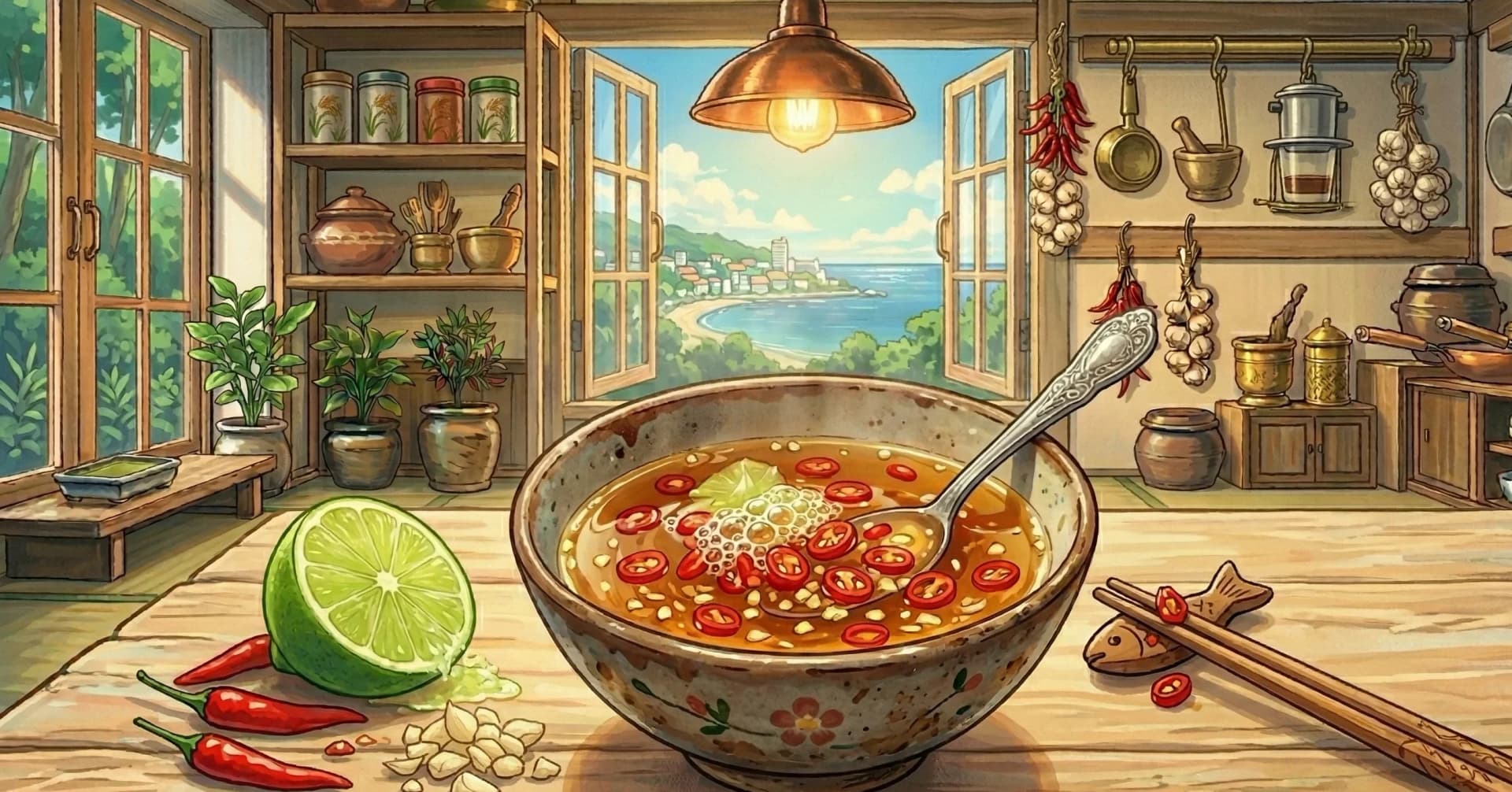
Sit down to a Vietnamese meal and there is usually a small bowl of pale amber sauce at every place, flecked with garlic and red chile. That is nước chấm. You dip spring rolls in it, pour it over noodle bowls and spoon it onto broken rice next to a grilled pork chop. It is salty, sour, sweet and hot at once, and when the balance is right none of them jumps out.
Nước chấm just means dipping sauce. The fish sauce version, nước mắm chấm, is the one most people mean, and every household mixes it a little differently. Cooks in central Vietnam make it stronger, and in the south it is often sweetened with palm sugar or coconut water. This is a middle-of-the-road table sauce, roughly two parts water to one part fish sauce, with lime for brightness.
What makes it easy is the order you build it in. Dissolve the sugar in warm water, add the lime and taste: it should taste like tart limeade. Then add the fish sauce a spoonful at a time until the sauce tastes balanced. Fish sauce brands vary a lot in saltiness, so no fixed amount suits every bottle. With the sweet-sour base already settled, you can tell exactly what each spoonful changes. The garlic and chile go in last, pounded with a pinch of sugar so their flavor reaches every dip.
It takes ten minutes and keeps for a week. Set it next to a plate of lettuce, herbs and rice noodles and you have dinner.
Inspired by Andrea Nguyen and Helen's Recipes.
At a Glance
Yield
About 1⅓ cups (eleven 2-tablespoon servings)
Prep
10 minutes
Cook
0 minutes (no cooking)
Total
10 minutes
Difficulty
Easy
Ingredients
Sauce Ingredients
- 3 tbspgranulated sugar, about 3 tablespoons, divided
- ⅔ cupwarm water
- ¼ cupfresh lime juice, from about 2 limes
- 1 tbspunseasoned rice vinegar (optional)
- ⅓ cupfish sauce, plus more to taste
Aromatics Ingredients
- 2 clovesgarlic, finely minced
- 2Thai (bird's eye) chiles, thinly sliced, or 1 serrano
To Garnish
- ½ ozcarrot, finely shredded (optional)
Method
- 1
Put the garlic, chiles and 1 teaspoon of the sugar in a mortar and pound for about 30 seconds, until you have a coarse, wet, orange-flecked paste. The sugar crystals work like grit and break the garlic down fast. No mortar? Mince the garlic and chiles together on a board, sprinkle the sugar over them and press and drag the flat of your knife across the pile a few times. Set the paste aside.
- 2
In a bowl or a jar, stir the rest of the sugar into the warm water until it has completely dissolved and no grains are left on the bottom, about 1 minute. Warm tap water is enough; boiling water isn't needed.
- 3
Add the lime juice, and the rice vinegar if you're using it. Taste. It should taste like a tart limeade, sour first with the sweetness right behind. If it seems flat, add a little more lime. If it makes you wince, add a pinch more sugar.
- 4
Add 4 tablespoons of the fish sauce, stir and taste, then add the last tablespoon. Keep going a teaspoon at a time if your fish sauce is on the mild side. You're looking for a light amber color and a sauce where salty, sour and sweet arrive together with none of them sticking out. On its own it should taste a little strong, because it is going onto unsalted lettuce, herbs and noodles.
- 5
Stir in the garlic and chile paste, and the shredded carrot if you're using it. Give it a few minutes while you set the table so the garlic and chile can flavor the whole batch.
- 6
Divide the sauce among small bowls so everyone has their own for dipping, or keep it in the jar and spoon it over noodle bowls and rice at the table.
Key Ingredient Benefits
Fish sauce (nước mắm): Made by layering anchovies with salt and letting them ferment for months, it gives the sauce its savory depth. It is also very salty. The USDA lists fish sauce at 7,851 mg of sodium per 100 g, which works out to roughly 1,400 mg per tablespoon. Diluted with water, lime and sugar, a 2-tablespoon serving of this sauce has about 640 mg. A roll dipped a few times picks up far less than that, but a noodle bowl dressed with several spoonfuls gets close. Most fish sauce is just anchovies and salt, though some brands add hydrolyzed wheat or vegetable protein, so check the label if you avoid gluten.
Garlic: Raw garlic is where allicin forms, and allicin is the compound most garlic research focuses on. Here the garlic is never cooked, so you get it at its sharpest.
Lime juice: Fresh lime gives the sauce a floral sourness that bottled juice doesn't have. The amount here adds only a little vitamin C per serving.
Bird's eye chiles: Small, thin chiles with a sharp heat. Restaurants often serve extra sliced chile on the side so each person can decide how hot their own bowl gets.
Sugar: About 3.5 grams per serving. It rounds off the salt and sour; leave it out and the sauce tastes harsh.
Why This Works
Building the sauce in two stages takes the guesswork out of it. Sugar, lime and water make a base you can judge on its own, and fish sauce goes in last because it is the ingredient that varies most from bottle to bottle. If you add everything at once and the sauce tastes off, it is hard to say whether it needs salt, sour or sweet. Tasting after each stage tells you.
Warm water dissolves the sugar in about a minute. Undissolved sugar sinks, so the first dips taste sour and the last ones taste like syrup.
Pounding the garlic does more than chop it small. When garlic cells are crushed, an enzyme called alliinase meets a compound called alliin and turns it into allicin, the source of raw garlic's sharp bite. According to the Linus Pauling Institute, that reaction is finished within 10 to 60 seconds of crushing. A pounded paste spreads that flavor, and the chile's heat, through the whole bowl instead of leaving it in a few unlucky bites. For the look you get in restaurants, with tiny flecks of garlic and chile floating on top, mince them very finely instead and add them only once the sugar has dissolved.
The ratio is lighter than some. A common basic formula is equal parts fish sauce and sugar with two parts water, which makes a punchy sauce. This version uses about twice as much water as fish sauce and adds lime, which suits a sauce people dip into all through the meal and spoon over noodles.
Substitutions & Variations
Vinegar instead of lime: Distilled or rice vinegar keeps longer than lime juice, which is why many restaurants use it. Use 3 tablespoons, taste and adjust. The sauce is sharper and loses the lime's fragrance.
Lemon: Lemon juice works in the same amount. It is a little less aromatic.
Coconut water: Replace some or all of the water with coconut water for a sweeter, rounder sauce closer to southern Vietnamese versions. Cut the sugar by about 1 tablespoon and taste.
Palm sugar: Use the same weight, shaved or chopped fine so it dissolves. It adds a light caramel note.
Vegetarian (nước chấm chay): Replace the fish sauce with light soy sauce or Maggi seasoning, starting with 3 tablespoons and tasting as you go. The sauce turns darker and loses the fermented-fish depth. Vegan fish sauces made from seaweed or mushrooms are another option.
A stronger dip: For fried spring rolls or grilled meat, cut the water to 1/3 cup. Everything else stays the same.
Pickled vegetables: Instead of raw carrot, add a spoonful of shredded đồ chua, the pickled daikon and carrot, for crunch and extra tang.
Serving Suggestions
Put a small bowl at each place whenever you serve fresh spring rolls (gỏi cuốn) or fried spring rolls (chả giò). Wrap the fried rolls in lettuce with mint first, then dip.
Pour it generously over grilled pork noodle bowls (bún thịt nướng) and toss everything together, or spoon it over broken rice with grilled pork (cơm tấm). It is also the sauce for crispy rice crêpes (bánh xèo) and steamed rice rolls (bánh cuốn).
Those recipes each include a small batch of their own. Keep a jar of this one in the fridge and you can skip that step, or use it to dress a cabbage and herb salad.
Storage & Reheating
Fridge: Keep it in a sealed jar for up to 1 week. The garlic gets stronger and the lime slowly loses its brightness after a few days, so taste and freshen it with a squeeze of lime before serving.
Make ahead: To keep it longer, make the base of sugar, water, lime and fish sauce without the garlic and chile. It keeps for about 2 weeks in the fridge. Stir in freshly pounded garlic and chile when you serve it.
Same day: It holds at room temperature for a few hours, so you can make it in the morning for dinner.
There is nothing to reheat; serve it cold or at room temperature.
Cultural Notes
In Vietnamese, nước chấm means "dipping liquid," and it covers a whole family of sauces. The fish sauce one is specifically nước mắm chấm, also called nước mắm pha, "mixed fish sauce." Wikipedia's entry on nước chấm gives the simplest version as one part fish sauce, one part sugar and two parts water, with lime juice or sometimes vinegar, plus raw garlic and bird's eye chile.
The same entry describes regional habits. In the north, cooks add broth made from pork and shrimp. Central Vietnam uses less water and fresh chile. In the south, palm sugar and coconut water often do the sweetening.
Hanoi's bún chả shows how far one sauce can stretch: there the grilled pork is served sitting in a warm, diluted bowl of it. It also goes with cơm tấm, chả giò, gỏi cuốn, bánh cuốn, bánh xèo and almost every bún noodle dish. Fresh spring rolls are also served with a peanut and hoisin sauce, and plenty of tables put out both.
Nutrition Facts
Calories: 19kcal (1%)|Total Carbohydrates: 4.4g (2%)|Protein: 0.5g (1%)|Total Fat: 0g (0%)|Saturated Fat: 0g (0%)|Cholesterol: 0mg (0%)|Sodium: 643mg (28%)|Dietary Fiber: 0g (0%)|Total Sugars: 3.9g
You Might Also Like
 Easy
Japanese Cuisine
Yakisoba Sauce (Homemade Japanese Stir-Fried Noodle Sauce)
5 minutes
 Easy
Vietnamese Cuisine
Cháo Gà (Vietnamese Chicken Rice Porridge)
1 hour 30 minutes
 Easy
Vietnamese Cuisine
Canh Chua Cá (Vietnamese Sweet and Sour Fish Soup)
35 minutes
 Easy
Indian Cuisine
Cucumber Raita (Kheera Raita)
12 minutes
Ratings & Comments
Ratings & Comments
Ratings
Share your thoughts on this recipe.
Sign in to rate and comment