Korean Cuisine
Samgyetang (Ginseng Chicken Soup)
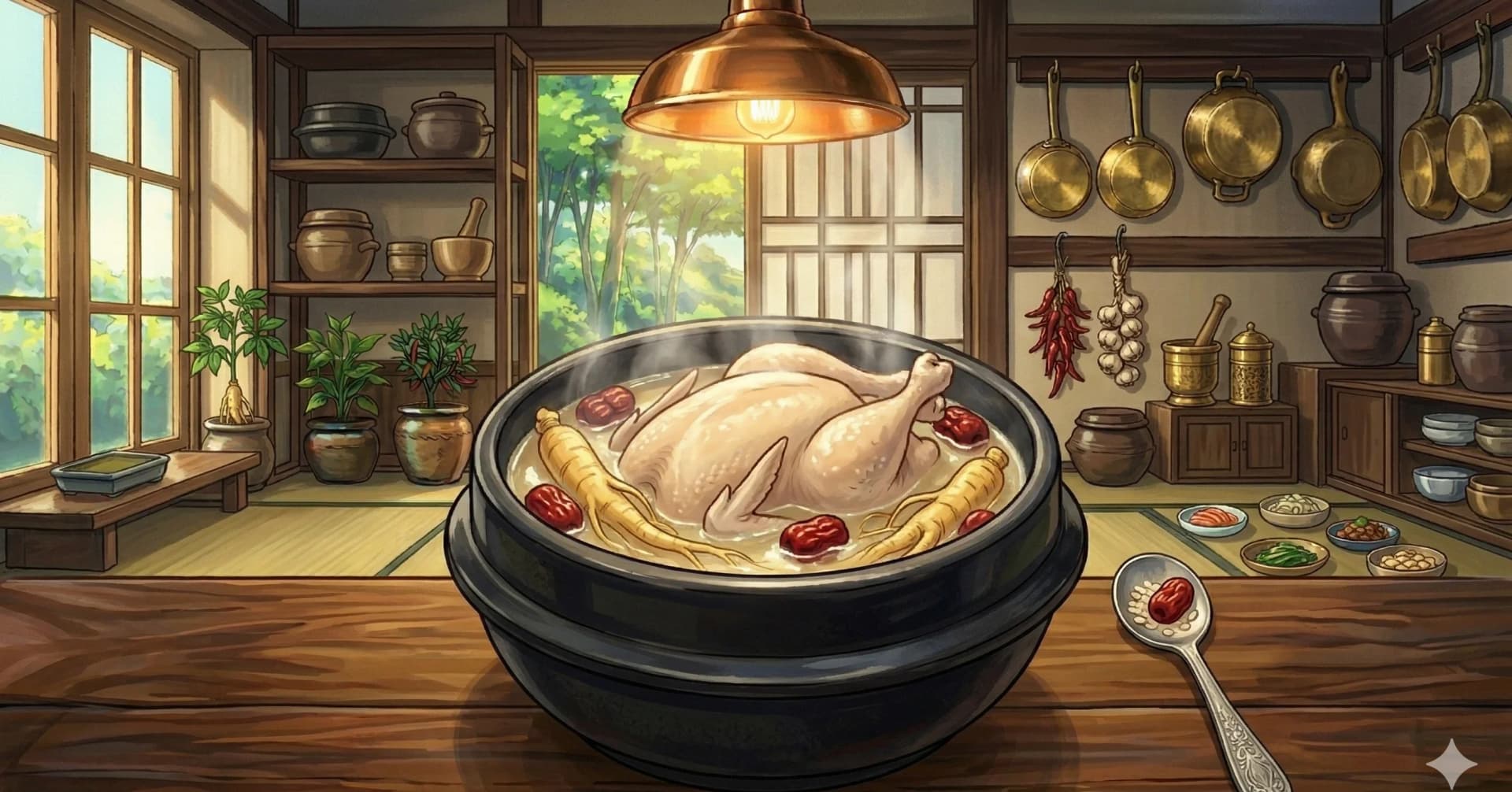
A whole young chicken stuffed with rice and ginseng, simmered until the broth turns silky and the meat falls from the bone
Samgyetang is the Korean answer to a hot summer day. That might sound counterintuitive, but the logic runs deep in Korean food culture: eating something hot and nourishing on the hottest days of the year (called boknal) helps the body regulate its own temperature and recover what the heat has taken. The soup is eaten on three specific days each summer, though no one would fault you for making it in January.
The recipe is elegantly simple. A small whole chicken, usually a Cornish game hen in the West, gets its cavity stuffed with soaked sweet rice, garlic cloves, and a piece of ginseng root. Jujubes go in or around the bird. Everything simmers together in a single pot until the rice swells into a soft porridge inside the chicken, the meat turns tender enough to pull apart with chopsticks, and the broth goes pale and slightly thick from the starch.
Unlike seolleongtang or galbitang, which build flavor from bones over many hours, samgyetang gets its character from the stuffing and the ginseng. The broth is mild by design. Each person seasons their own bowl with salt and pepper at the table, which is part of the ritual. A small dish of coarse salt, some chopped scallions, and perhaps a side of kkakdugi are all you need alongside.
The best samgyetang has a broth that feels almost creamy on the tongue from the dissolved sweet rice, with a faint bitterness from the ginseng that you notice only at the edges. It is one of those dishes that tastes simple but is doing a lot of quiet work.
At a Glance
Yield
2 servings
Prep
20 minutes
Cook
1 hour
Total
1 hour 20 minutes
Difficulty
Medium
Ingredients
- 2Cornish game hens (about 680 g each) (about 1.4 kg), or 1 small whole chicken
- 1½ ozsweet rice (glutinous rice), soaked in water for at least 1 hour
- 6garlic cloves, peeled
- 1fresh ginseng root, or 2 small dried ginseng roots (about 15 g), rehydrated
- 4dried jujubes (daechu)
- 2thin slices fresh ginger (about 2.5 cm each)
- 1scallion, white part only
- 1½ qtwater or light chicken stock
- 2scallions, finely chopped
- —Coarse salt
- —Black pepper
Method
- 1
Prepare the chickens. Rinse each hen inside and out under cold water. Pat dry with paper towels. Use a paper towel to wipe away any remaining blood inside the cavity. Trim excess fat from the openings but leave the skin intact.
- 2
Stuff the cavity. Drain the soaked sweet rice. Divide it between the two hens, spooning it into each cavity along with 3 garlic cloves and half the ginseng root. Leave about a quarter of the cavity empty so the rice has room to expand as it cooks. If the ginseng root has small offshoots, tuck those in as well.
- 3
Close the chickens. Cross the legs of each hen and tie them with kitchen twine, or make a small cut in the skin between one thigh and the cavity, then thread the opposite leg through to hold everything shut. Secure the neck cavity with a toothpick if needed. The goal is to keep the rice inside during cooking.
- 4
Build the pot. Place the stuffed hens breast-side up in a pot just large enough to hold them snugly. Add the jujubes, ginger slices, and scallion white. Pour in 6 cups of water or stock. The liquid should come about three-quarters of the way up the chickens.
- 5
Simmer. Bring to a boil over medium-high heat. Skim any grey foam that rises to the surface. Reduce heat to medium, cover, and boil gently for 15 minutes. Then reduce heat to medium-low and simmer, covered, for 30 to 35 minutes more. The chickens are done when the thigh meat pulls easily from the bone and the rice inside is soft and porridge-like.
- 6
Rest and serve. Turn off the heat and let the pot sit covered for 10 minutes. Transfer each hen carefully to a deep individual bowl. Ladle the hot broth over and around the chicken. Serve immediately with chopped scallions, coarse salt, and black pepper on the side for each person to season their own bowl.
Key Ingredient Benefits
Ginseng (Insam). Korean ginseng (Panax ginseng) has been used in East Asian medicine for thousands of years, traditionally associated with boosting energy, supporting immune function, and improving circulation. Modern research has investigated its ginsenoside compounds for potential adaptogenic properties. Evidence is mixed and ongoing. Ginseng may interact with blood thinners, diabetes medications, and stimulants. Fresh ginseng is sold at Korean markets and some health food stores.
Jujubes (Daechu). Dried red dates used across Korean and Chinese cooking. In traditional Korean medicine, they are considered warming and calming. They contribute a subtle sweetness to the broth and soften during cooking into a date-like texture.
Sweet Rice (Chapsal). Also called glutinous rice, though it contains no gluten. The high amylopectin starch content is what makes it sticky when cooked and gives the broth its characteristic body. Soak for at least one hour so it cooks evenly inside the chicken.
Why This Works
The sweet rice serves two purposes. Inside the chicken, it absorbs the juices and ginseng flavor, becoming a savory porridge that you eat by scooping it from the cavity. In the broth, the starch that leaches out during cooking gives the liquid a subtle body and silkiness that plain water would not have. This is why samgyetang broth feels richer than it looks.
Using a small bird matters. Cornish hens cook through in about 50 minutes total, which is enough time for the rice to swell and the ginseng to infuse the broth, but not so long that the breast meat dries out. A large roasting chicken would need much longer and the timing falls apart.
Ginseng contributes a light, pleasant bitterness that cuts through the richness of the chicken fat. Fresh ginseng is milder and slightly sweet; dried ginseng is more concentrated and bitter. Either works, but fresh is traditional for samgyetang.
Substitutions & Variations
No fresh ginseng? Dried ginseng works well. Soak it in warm water for 30 minutes before using. Ginseng tea bags or ginseng powder (about 1 teaspoon) can stand in if roots are unavailable, though the flavor will be less nuanced.
Chestnuts. Some versions add 2 to 3 peeled chestnuts to the stuffing alongside the rice. They add a starchy sweetness that complements the jujubes.
Pine nuts and ginkgo nuts. A tablespoon of pine nuts in the stuffing is common in restaurant-style samgyetang. Ginkgo nuts (canned or fresh, blanched) appear in more elaborate versions.
Whole chicken. If using a whole chicken instead of Cornish hens, increase the water to 8 cups, double the stuffing, and extend the simmer time to 1 hour 15 minutes.
Pressure cooker. Cook at high pressure for 25 minutes with natural release. The broth will be slightly less clear but very flavorful.
Serving Suggestions
Samgyetang is traditionally a one-bowl meal. Each person gets their own hen in a stone pot or deep bowl. Set out small dishes of coarse salt and black pepper for individual seasoning. A plate of kkakdugi provides crunch and acidity. Baek-kimchi is another excellent pairing, offering contrast without heat.
Some people enjoy a shot of ginseng liquor alongside the soup, which intensifies the ginseng thread running through the meal.
For a fuller table, serve with oi-muchim and a simple bowl of steamed rice on the side, though the rice inside the chicken is usually enough starch for most appetites.
Storage & Reheating
Samgyetang is best eaten the day it is made. The stuffed chicken does not store as well as a plain broth, because the rice continues to absorb liquid and becomes mushy.
If you do have leftovers, pull all the meat from the bones and combine it with the rice stuffing and broth. Store in an airtight container in the refrigerator for up to 2 days. Reheat gently on the stovetop over medium-low heat, adding a splash of water if the porridge has thickened.
The broth on its own (without rice or meat) freezes well for up to 2 months.
Cultural Notes
Samgyetang (삼계탕) is the most iconic dish in the Korean boyangsik (보양식, restorative food) tradition. The name combines sam (삼, ginseng), gye (계, chicken), and tang (탕, soup). The dish is a whole young chicken stuffed with glutinous rice, garlic, jujubes, and a full root of Korean ginseng, then simmered until the meat is silky tender. Despite being a hot, steamy chicken soup, samgyetang is overwhelmingly a summer dish in Korean culture. It gets eaten specifically during sambok (삼복), the three hottest days of the lunar calendar, under the traditional principle of iyeolchiyeol (이열치열, "fight heat with heat").
Iyeolchiyeol reflects a deep current in traditional Korean medicine. The body's internal energy weakens during extreme summer heat. Cold foods drain that energy further. The proper response is to consume warming, nourishing foods that restore inner vitality. Samgyetang restaurants in every Korean city run lines down the block during the three sambok days, and the national restaurant industry sees samgyetang sales jump 300 to 400 percent on those specific dates. The first day, chobok (초복), and the last day, malbok (말복), generate the highest demand.
The ginseng inside the chicken is the dish's spiritual and economic heart. The most prestigious version, sansam samgyetang (산삼삼계탕), uses six-year-aged Korean ginseng (which costs more per gram than most luxury foods) and can sell for $80 to $200 per bowl at high-end restaurants. The everyday version uses younger four-year ginseng or the cheaper susam (수삼, fresh ginseng), but the principle is the same. The dish is functional medicine in delicious form.
The leftover broth, thickened with rice, becomes a satisfying juk the next morning, and the empty stripped chicken bones are sometimes used to simmer a second-day stock.
Nutrition Facts
Calories: 740kcal (37%)|Total Carbohydrates: 26.6g (10%)|Protein: 65.3g (131%)|Total Fat: 40.8g (52%)|Saturated Fat: 11.4g (57%)|Cholesterol: 253mg (84%)|Sodium: 428mg (19%)|Dietary Fiber: 1.2g (4%)|Total Sugars: 0.4g
You Might Also Like
Ratings & Comments
Ratings & Comments
Ratings
Share your thoughts on this recipe.
Sign in to rate and comment