Korean Cuisine
Seolleongtang (Ox Bone Soup)
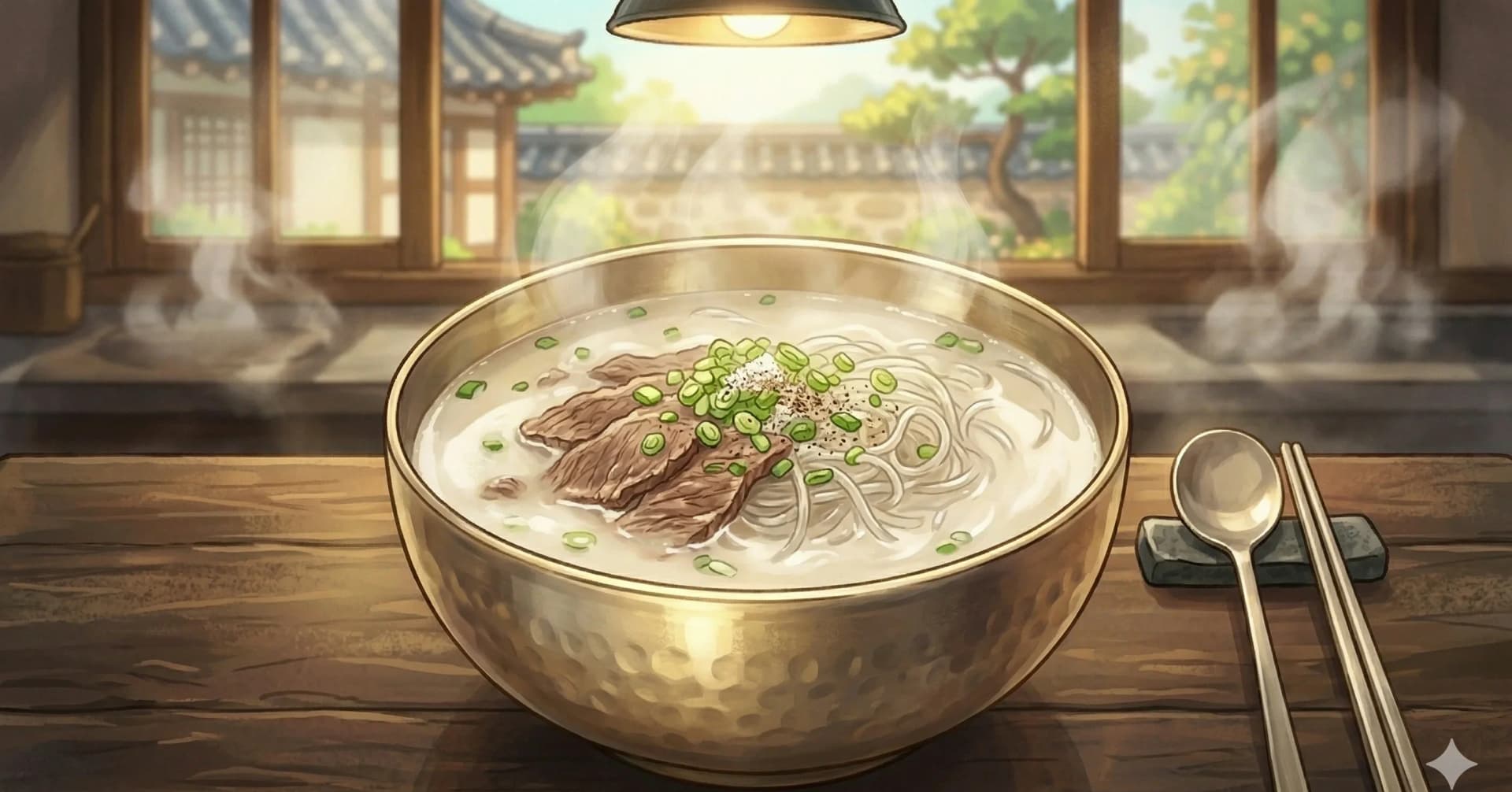
A milky white beef bone broth simmered for hours until the marrow dissolves into something deeply satisfying
Seolleongtang is not a recipe you make on a whim. It is a project, the kind that takes most of a day and fills your kitchen with a deep, beefy steam that clings to the curtains. But the technique itself is almost laughably simple: put bones in water, boil for a very long time, season at the table. That is the entire recipe.
What makes seolleongtang remarkable is what happens during those hours. The marrow melts out of the bones. The collagen from the knuckles and joints dissolves into the liquid. Fat renders and emulsifies. The broth, which starts clear, gradually turns the color of whole milk. This milky opacity is the hallmark of a well-made seolleongtang, and it cannot be faked. You either put in the time or you do not get the result.
The soup has been a cornerstone of Korean cuisine for centuries, traditionally served at specialized restaurants in Seoul where the pots never stop simmering. At home, the practical approach is to make a large batch, skim and portion it, and have the base for a week of meals in the freezer. Unlike samgyetang, which is a one-pot affair, seolleongtang rewards patience with volume.
At the table, each person builds their own bowl: a scoop of rice, slices of the brisket that cooked in the broth, a tangle of thin noodles if you like, and then the steaming broth ladled over everything. Salt, pepper, and chopped scallions go in to taste. Some people add kkakdugi directly into the broth, which is one of the great small pleasures of Korean eating.
At a Glance
Yield
8 servings
Prep
1 hour 30 minutes (mostly soaking)
Cook
6 hours
Total
7 hours 30 minutes
Difficulty
Medium
Ingredients
Broth Ingredients
- —1.4 to 1.8 kg beef marrow bones (sagol), cut into sections by your butcher
- 450to 900 g beef brisket or shank meat
To Serve
- —Cooked short-grain white rice
- 6 ozsomyeon (thin wheat noodles) or dangmyeon (glass noodles), cooked separately (optional)
- 3to 4 scallions, finely chopped
- —Coarse salt
- —Black pepper
Method
- 1
Soak the bones. Place the marrow bones in a large bowl of cold water and soak for about 1 hour to draw out blood. Drain and rinse thoroughly. In a separate bowl, soak the brisket in cold water for 1 hour. Drain and refrigerate until needed.
- 2
Parboil. Place the bones in a large stockpot and cover with cold water. Bring to a boil over high heat, then reduce to medium and boil for 5 minutes. You will see a significant amount of brown scum and impurities rise to the surface. Drain the bones, rinse them under running water, and scrub away any clinging residue. Clean the pot thoroughly.
- 3
First boil. Return the cleaned bones to the clean pot. Fill with cold water, leaving a few inches of room at the top for the boil. Bring to a boil over high heat, then reduce to medium. The broth needs to maintain a steady, active boil, not a gentle simmer. This sustained rolling motion is what emulsifies the fat and collagen into the milky white broth. Cover and boil for about 5 hours, checking occasionally and adding boiling water as needed to keep the bones submerged.
- 4
Cook the brisket. About 2 hours into the bone boil, add the soaked brisket to the pot. Continue boiling until the meat is very tender and easily pierced with a chopstick, about 1.5 to 2 hours. Remove the brisket, let it cool, and slice it thinly against the grain.
- 5
Strain the broth. After 5 to 6 hours of total cooking, the broth should be opaque and milky white. Strain it through a fine mesh strainer or colander into a large bowl or clean pot. Discard the spent bones.
- 6
Optional second extraction. For maximum yield, return the bones to the pot, cover with fresh cold water, and boil for another 3 to 5 hours. This second batch will also turn milky, though slightly less rich. Combine both batches.
- 7
Defat. Let the broth cool, then refrigerate until the fat solidifies on top. Lift off the fat cap and discard or save for cooking. Alternatively, use a fat separator while the broth is still warm.
- 8
Serve. Reheat the broth to a rolling boil. Place a scoop of rice and a tangle of cooked noodles (if using) in each bowl. Lay slices of brisket on top. Ladle the boiling broth over everything. Serve with chopped scallions, coarse salt, and black pepper for each person to season their own bowl.
Key Ingredient Benefits
Beef Marrow Bones (Sagol). The large, cylindrical leg bones with visible marrow in the center. Ask your butcher to cut them into 7 to 10 cm (3 to 4 inch) sections. Knuckle bones and foot bones (which contain more cartilage) can be added or substituted for an even more gelatinous result. The marrow itself is mostly fat, which dissolves during cooking and contributes to the broth's richness.
Brisket. A relatively tough cut with plenty of connective tissue, which is exactly what you want for a long broth. The collagen breaks down during the extended cook time, tenderizing the meat and adding body to the soup. Shank meat works equally well and contributes even more gelatin.
Somyeon. Very thin wheat flour noodles that cook in about 3 minutes. They are added to the bowl just before serving and soak up the broth beautifully. Cook them separately to avoid clouding the broth with starch.
Why This Works
The milky color is not a trick or an addition. It is the result of emulsification: the sustained high boil forces rendered fat and dissolved collagen to mix permanently with the water, the same principle behind making mayonnaise. A gentle simmer would keep the fat and water separate, producing a clear broth instead. This is why the recipe insists on a steady, rolling boil for the entire cooking time.
Soaking and parboiling the bones removes blood, bone dust, and surface impurities that would otherwise cloud the broth with off-flavors. The parboil is not optional. Without it, the finished soup will have a muddier taste and a greyish tinge rather than the clean white you want.
Cooking the brisket inside the bone broth serves two purposes: it flavors the meat deeply, and the meat in turn contributes its own gelatin and flavor back to the broth. Removing it before it falls apart completely means you get clean slices for serving.
Substitutions & Variations
Pressure cooker. Cook the soaked and parboiled bones at high pressure for 2 to 3 hours. The broth will turn milky. Release pressure naturally. This cuts the total time dramatically.
Oxtail. Adding 450 g (1 lb) of oxtail along with the marrow bones produces an even more gelatinous, rich broth. The oxtail meat can be served alongside the brisket.
Beef shank. Substitute for brisket if preferred. Shank has more connective tissue and produces an even more tender result, though it can be harder to slice cleanly.
Dangmyeon instead of somyeon. Glass noodles (sweet potato starch noodles) soaked and cooked briefly make for a chewier, more substantial alternative. Both are traditional.
Serving Suggestions
Seolleongtang is traditionally a one-bowl meal with rice, meat, and broth. The essential side is kkakdugi, cubed radish kimchi, which provides crunch, spice, and acid to cut through the richness. Some people drop pieces of kkakdugi directly into their broth.
A plate of baek-kimchi is the gentler alternative. Oi-muchim works well too, adding a cool, vinegary crunch.
For a table of Korean soups, pair seolleongtang with kimchi jjigae for contrast: the milky mildness of the bone broth against the fiery tang of the stew.
Storage & Reheating
Seolleongtang is one of the best soups for making ahead. The defatted broth keeps in the refrigerator for up to 5 days and freezes beautifully for up to 3 months. When cold, good seolleongtang will set into a firm jelly, which is a sign of high collagen content.
Reheat on the stovetop over medium-high heat until the broth returns to a full boil. The sliced brisket keeps separately in the refrigerator for up to 4 days. Add it to the hot broth to warm through just before serving.
Cook noodles and rice fresh for each serving rather than storing them in the broth.
Cultural Notes
Seolleongtang (설렁탕) is the milky-white ox-bone soup that anchors the Korean gomtang (곰탕) family of long-simmered beef preparations, alongside galbitang (short-rib soup) and dak gomtang (the chicken version). The dish's defining characteristic, the milky opaque whiteness of the broth, comes purely from mechanical emulsification. Hours of vigorous simmering break ox-bone marrow and collagen into microscopic fat droplets suspended in the water, which scatter light and produce the signature color. No dairy, no cream, no thickener.
The name's etymology is one of the most debated in Korean food history. The most widely accepted theory traces seolleongtang to the Seonnongdan (선농단), an altar in modern-day Seoul where Joseon-dynasty kings performed agricultural rites to ensure good harvests. After the ceremony, the sacrificial ox went into a huge pot of bone soup distributed to participants and observers, and the dish supposedly took its name from the ritual setting before being shortened to seolleongtang. Other linguists trace the name to Mongolian šülen (a meat broth), arguing that the dish was introduced during the Mongol occupation (1259-1356).
Seoul's seolleongtang restaurants are some of the oldest continuously operating businesses in Korea. The Imun Seolleongtang restaurant near Jongno, founded in 1907, is the most famous of these and has been designated a registered cultural heritage of modern Korean food culture. The dish is overwhelmingly associated with cold winter mornings and with the kkakdugi radish kimchi served alongside it (kkakdugi). The bright sour-spicy crunch of the kimchi is considered the perfect counterpoint to the soup's deep beefy richness.
Many Seoul office workers eat seolleongtang weekly during winter as a kind of mid-week restorative ritual. The dish is also a strong hangover-recovery food alongside haejangguk and gamjatang.
Nutrition Facts
Calories: 364kcal (18%)|Total Carbohydrates: 16.8g (6%)|Protein: 33.2g (66%)|Total Fat: 17.7g (23%)|Saturated Fat: 5.5g (28%)|Cholesterol: 57mg (19%)|Sodium: 251mg (11%)|Dietary Fiber: 0.5g (2%)|Total Sugars: 0g
You Might Also Like
Ratings & Comments
Ratings & Comments
Ratings
Share your thoughts on this recipe.
Sign in to rate and comment