Cross-Cultural · China
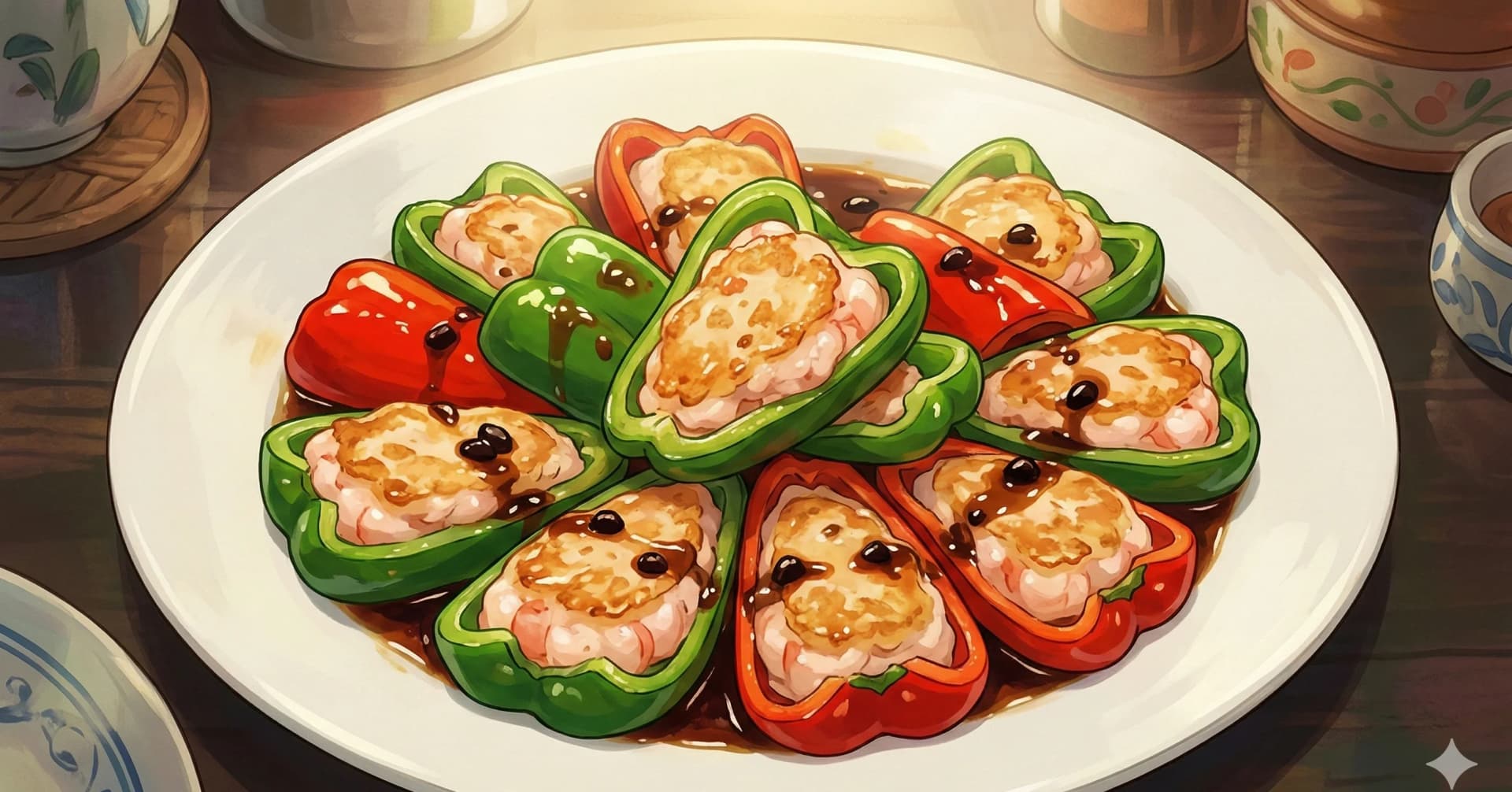
Chinese Stuffed Peppers (釀辣椒)
Bell pepper wedges stuffed with bouncy shrimp-fish paste, pan-fried and sauced with fermented black bean sauce
Stuffed peppers are the second of the Cantonese "Three Treasures," and they are a dim sum favorite that also works as a weeknight side dish. The same shrimp-and-fish paste filling used in stuffed eggplant and stuffed tofu goes into curved wedges of bell pepper, creating a dish that is bright, colorful, and satisfying in a way that belies its simplicity.
The technique has a detail that makes the difference between stuffed peppers that hold together and ones that fall apart in the pan: dusting the inside of each pepper wedge with cornstarch before pressing in the filling. The starch creates a dry surface that the wet paste grips, forming a bond that survives pan-frying and flipping. Without it, the filling slides out.
The filling itself needs thorough mixing and even some slapping against the bowl to develop the proteins that give it its characteristic bouncy, chewy texture. This is the same principle behind fish balls and shrimp toast. The more you work the paste, the more cohesive it becomes. The black bean sauce that goes on top is simple and fast: black bean paste, oyster sauce, soy sauce, sugar, and a cornstarch slurry cooked together until thick. It provides a salty, fermented depth that contrasts the sweet, mild pepper and the delicate seafood filling.
At a Glance
Yield
4 servings
Prep
35 minutes
Cook
10 minutes
Total
45 minutes
Difficulty
Medium
Ingredients
Filling Ingredients
- 10 ozshrimp, peeled
- 10 ozwhite fish fillet (swai), 285g
- 1 tspsalt
- 1 tspsugar
- 1/2 tspwhite pepper
- 2 tbspcornstarch
- 1 tbspsesame oil
Pepper Ingredients
- 1green bell pepper
- 1red bell pepper
- 1 tspcornstarch, for dusting peppers
Sauce Ingredients
- 1 tbspblack bean paste
- 1 tbspoyster sauce
- 1 tsplight soy sauce
- 1 tbspsugar
- 1 tbspcornstarch
- 4 tbspwater
To Finish
- 2 tbspcooking oil
- 1 tbspcooking wine
Method
- 1
Make the filling. Smash fish then shrimp into paste with a cleaver. Combine. Mix with salt, sugar, white pepper, cornstarch, water, sesame oil until sticky and bouncy. Refrigerate.
- 2
Cut peppers into large curved wedges (about 8 per pepper). Remove seeds. Dust insides with cornstarch.
- 3
Stuff about 1 tbsp filling per piece, pressing firmly. Oil the spoon to prevent sticking.
- 4
Mix sauce: black bean paste, oyster sauce, soy sauce, sugar, cornstarch, water.
- 5
Pan-fry filling-side down in a non-stick pan, covered, 2-3 min on medium until browned. Flip, cover 1 min. Splash cooking wine, cover, turn off heat, cook 1 min with residual heat.
- 6
Pour sauce into the pan with residual oil on high, stir until boiling. Turn off heat; sauce thickens as it cools. Pour over peppers.
Key Ingredient Benefits
Shrimp and white fish: The combination is what gives the filling its springy, almost bouncy texture characteristic of authentic Cantonese stuffed peppers. The shrimp provides sweetness and a slight chew; the white fish (typically swai, basa, or sole) provides a clean canvas that absorbs the seasoning. Both are high in lean protein and the shrimp is particularly rich in selenium and iodine.
Bell peppers: Cut into wedges that hold the shrimp-fish paste. The bell pepper's slight bitterness and crunch contrasts beautifully with the rich, soft filling. Both green and red peppers are traditionally used together for color variation. Bell peppers are high in vitamin C (red peppers more so) and provide a fresh, vegetal note to balance the dish.
Fermented black beans: The defining seasoning of the sauce. Black bean sauce is the canonical sauce for Cantonese stuffed vegetables (peppers, eggplant, and tofu being the "Three Treasures"). The fermented beans contribute concentrated umami that elevates the dish.
Oyster sauce: Provides additional savory depth and a glossy finish to the sauce. Most Cantonese stir-fries and braises use oyster sauce as a flavor multiplier.
Cornstarch: Used three ways: dusting the pepper cavities (helps the filling adhere), in the filling (binds the shrimp-fish paste), and in the sauce (creates the glossy, glaze-like consistency). The triple use of cornstarch is signature Cantonese technique.
Why This Works
Dusting the inside cavities of the peppers with cornstarch before stuffing is the technique that prevents the filling from popping out during cooking. The cornstarch creates a thin adhesive layer that fuses the filling to the pepper as both heat up. Without this step, the shrimp-fish paste contracts as it cooks and separates from the pepper, leaving an unappealing gap.
The shrimp-fish paste needs to be processed to the right texture. Too smooth and it becomes rubbery; too chunky and it falls apart. The correct texture is finely chopped with some small chunks remaining, then mixed vigorously to develop a slightly sticky, paste-like consistency. The cornstarch in the paste helps bind everything together.
Pan-searing the pepper wedges filling-side down first is crucial. The heat sears the filling, browning it slightly and locking it to the pepper. Then the peppers flip to skin-side down and finish cooking in the sauce. This two-stage cooking produces the contrast of browned, crisp filling on the bottom and tender pepper on top.
The black bean sauce reduces around the peppers in the final minutes, glazing each piece in a glossy, savory coating. The sauce should be thick enough to cling to the peppers when served, not pool around them.
Substitutions & Variations
White fish: Tilapia, cod, halibut, or sole all work. Avoid oily fish (salmon, mackerel) which produces a heavier, less delicate filling.
Shrimp: Cannot be skipped without significantly changing the dish. The shrimp provides essential springiness and sweetness.
Bell peppers: Use any color combination. Mini bell peppers can substitute for individual bite-sized servings (a popular party-food presentation). Chinese long peppers or banana peppers work for a milder, more elongated presentation. Hot peppers work for a spicier version but the dish loses its accessibility.
Fermented black beans: Black bean garlic sauce (jarred) substitutes in a pinch. Hoisin sauce is too sweet and not appropriate.
Oyster sauce: Vegetarian oyster sauce (made from mushrooms) works for a pescatarian version.
Cornstarch: Tapioca starch or potato starch substitute identically.
Serving Suggestions
Stuffed peppers with black bean sauce is one of the three "Cantonese Treasures" (along with stuffed eggplant and stuffed tofu), traditionally served together as a trio at Cantonese restaurants. For a full presentation, prepare all three with the same shrimp-fish filling and arrange together on a large platter.
For a family-style Chinese dinner, serve the stuffed peppers alongside steamed jasmine rice and a stir-fried green vegetable like gai lan. A clear soup like winter melon soup or egg drop soup rounds out the meal.
The dish also works well as part of a larger Chinese banquet menu with steamed fish, chow mein, and other Cantonese specialties.
Pair with hot Chinese tea (jasmine, pu-erh, or oolong) or a crisp white wine. Riesling or off-dry whites work well with the sweet-savory black bean sauce.
Storage & Reheating
Refrigerator: Store in an airtight container for up to 3 days. The pepper texture suffers slightly with longer storage but the flavor improves.
Reheating: Re-warm in a covered pan over medium heat with a splash of water for 3 to 4 minutes. Microwave works but loses the slight crispness of the seared filling. To restore some of the original texture, finish briefly under a high broiler or in a hot pan.
Make-ahead: The filling can be prepared up to 24 hours in advance and refrigerated. The peppers can be stuffed up to 6 hours in advance and refrigerated until cooking. The black bean sauce keeps for up to 1 week in the fridge.
Freezing: Cooked stuffed peppers freeze for up to 1 month. The pepper texture suffers significantly on thawing, so the dish is best frozen as a standalone meal rather than as part of a multi-course presentation.
Cultural Notes
Stuffed peppers with black bean sauce is part of the Cantonese "Three Treasures" (sān bǎo in Mandarin, sam bo in Cantonese): a trio of vegetables — bell peppers, eggplant, and tofu — stuffed with the same shrimp-fish paste and braised in black bean sauce. The combination has been a Cantonese restaurant staple for at least a century and is found in nearly every Cantonese restaurant in Hong Kong, Guangdong, and the global Chinese diaspora.
The technique of stuffing vegetables with seafood paste reflects the Cantonese culinary principle of liang (清, "clean" or "clear"), which favors delicate flavors that allow individual ingredients to shine. The shrimp-fish paste is light and subtle compared to the meat-based fillings used in northern Chinese stuffed dishes (like jiaozi), and the bell peppers contribute fresh, vegetal notes that keep the dish feeling balanced rather than heavy.
The dish is part of dim sum culture in some restaurants but more commonly appears on the lunch and dinner menu as a xiao chi (small dish) or family-style entrée. In Hong Kong, the dish is often called yeung chiu (literally "stuffed pepper") and is one of the most ordered items at family-style Cantonese restaurants.
The combination of seafood paste and fermented black beans is a classic Cantonese pairing that appears in numerous other dishes, including steamed clams, steamed scallops, and various seafood stir-fries. The umami of the black beans complements the sweet, briny flavor of seafood in a way that has been refined over centuries of Cantonese cooking.
Nutrition Facts
Calories: 262kcal (13%)|Total Carbohydrates: 15g (5%)|Protein: 28.6g (57%)|Total Fat: 9.1g (12%)|Saturated Fat: 1.1g (6%)|Cholesterol: 162mg (54%)|Sodium: 1061mg (46%)|Dietary Fiber: 1.8g (6%)|Total Sugars: 7.4g
You Might Also Like
Ratings & Comments
Ratings & Comments
Ratings
Share your thoughts on this recipe.
Sign in to rate and comment