Cross-Cultural · China
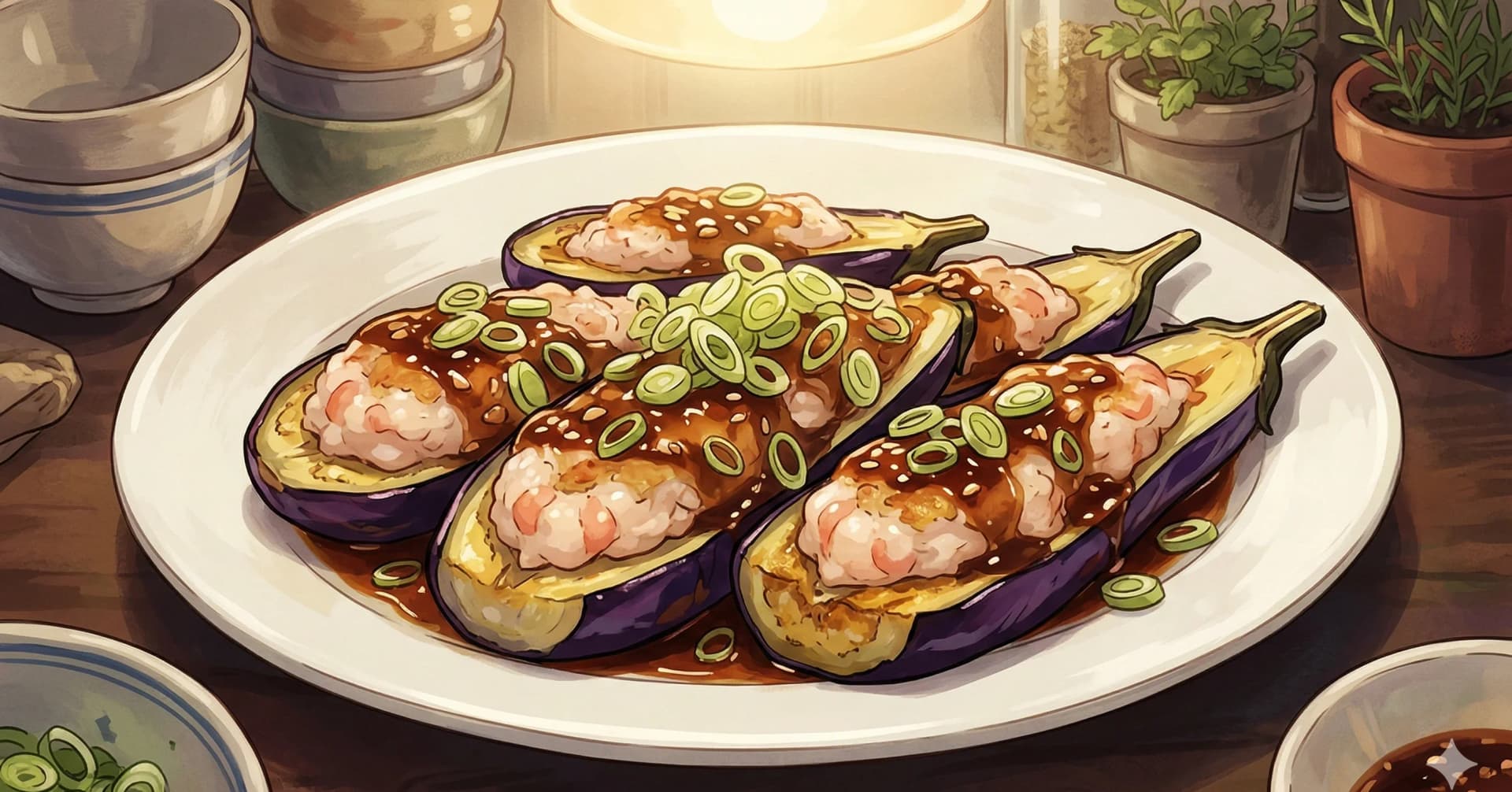
Chinese Stuffed Eggplant (釀茄子)
Hinge-cut Chinese eggplant stuffed with shrimp and fish paste, pan-fried and topped with a tangy yuxiang garlic sauce
Stuffed eggplant is one of the Cantonese "Three Treasures," a trio of stuffed dishes that also includes stuffed peppers and stuffed tofu. Each uses the same shrimp-and-fish paste filling but pairs it with a different sauce: yuxiang (garlic-vinegar) for the eggplant, black bean for the peppers, and oyster-fish for the tofu. The combination appears at dim sum houses and Cantonese home tables alike.
The filling is a paste made by smashing fish and shrimp separately with the flat side of a cleaver, then combining them and working the mixture until it becomes sticky and cohesive. This old-school technique produces a filling with a bouncy, almost springy texture that a food processor cannot quite replicate, though a processor gets you close enough for home cooking.
The eggplant is cut in a specific way: angled slices with a hinge cut, where the first cut goes three-quarters of the way through and the second cut separates the slice, creating connected pairs that open like a book. The filling goes into the slit, the eggplant gets pan-fried until golden, then steamed briefly with a splash of water to cook through. The yuxiang sauce, sweet, sour, and garlicky, goes over the top. Use Chinese or Japanese long eggplant. American globe eggplant is too thick and dense for this preparation.
At a Glance
Yield
4 servings
Prep
35 minutes
Cook
15 minutes
Total
50 minutes
Difficulty
Medium
Ingredients
Eggplant Ingredients
- 1 lbChinese eggplant, 450g
Filling Ingredients
- 7 ozshrimp, peeled
- 7 ozwhite fish fillet, such as swai or sole
- 1/2 tspsalt
- 1/2 tspsugar
- 1 tbspcornstarch
- 1/4 tspwhite pepper
- 1 tspsesame oil
Sauce Ingredients
- 2garlic cloves, minced
- 3ginger slices
- 1whole chili pepper
- 2 tbspsugar
- 2 tbsplight soy sauce
- 1 tbspdark soy sauce
- 1 tbspoyster sauce
- 1 1/2 tbsprice vinegar
- 5 tbspwater
- 2 tspcornstarch
- 4 tbspcooking oil
Method
- 1
Make the filling. Smash fish into a paste with the flat of a cleaver, then shrimp separately. Combine. Mix with salt, sugar, cornstarch, white pepper, water, and sesame oil until sticky. Refrigerate.
- 2
Cut eggplant with hinge cuts: first cut 3/4 through at an angle, second cut all the way through, creating connected pairs.
- 3
Stuff filling into eggplant slits. Press gently to close.
- 4
Mix sauce: sugar, soy sauces, oyster sauce, vinegar, water, cornstarch, chili sauce.
- 5
Pan-fry stuffed eggplant in oil on medium-low, covered, 1 min per side until golden. Add 2 tbsp water, cover, steam 2-3 min. Finish on high 15-20 sec.
- 6
In a clean pan, fry garlic, ginger, chili in oil until aromatic (20-30 sec). Pour in sauce, stir until boiling. Finish with sesame oil. Pour over eggplant.
Key Ingredient Benefits
Chinese (or Japanese) long eggplant: A slender, lavender-purple variety with thinner skin, fewer seeds, and a milder, sweeter flavor than the globe eggplant common in Western cooking. The thinner skin softens completely when pan-fried, eliminating the need to salt and drain. Eggplant is high in fiber, potassium, and contains nasunin, a purple anthocyanin antioxidant concentrated in the skin.
Shrimp: The protein backbone of the seafood paste filling. Shrimp contributes about 24 g of protein per 100 g, very low fat, and high concentrations of selenium, B12, and iodine. Fresh shrimp is essential — frozen-thawed shrimp produces a wetter, less bouncy paste. The "bounce" (Cantonese tang, 彈) of the finished filling depends on the quality of the raw shrimp.
White fish (cod, snapper, or tilapia): Added to the shrimp paste to stretch the protein and contribute a more delicate texture. Most Cantonese cooks use a mix of about 70% shrimp to 30% fish. The fish softens the bounce slightly and adds a fuller umami depth.
Garlic: Used in significant quantity in the yuxiang ("fish-fragrant") finishing sauce. Despite the name, yuxiang sauce contains no fish — the name refers to its origin in Sichuan cooking as a flavor profile traditionally used for fish dishes. Now it appears in stuffed vegetables, stir-fries, and many other dishes.
Chinese black vinegar and sugar: Together create the sweet-sour balance of the yuxiang sauce. Chinkiang vinegar (the most famous brand) has a deep, complex, almost balsamic-like quality from rice fermentation. The sugar tempers the acidity and creates a glossy glaze on the eggplant.
Cornstarch (for the paste): A small amount in the seafood filling acts as a binder and tenderizer. The cornstarch absorbs liquid, traps it in the paste, and produces the characteristic bounce when cooked.
Shaoxing wine: A splash in the filling helps remove any "fishy" notes and contributes aromatic depth.
Why This Works
The hinge cut — cutting the eggplant most of the way through but leaving a connecting strip — is the technique that makes this dish work. The hinge keeps the two halves attached so the filling stays in place, but allows the eggplant to open like a book for stuffing and cook evenly on both sides. A simple slice would let the filling fall out; a sandwich-style two-piece would require trickier flipping.
Developing the "bounce" (tang) in the seafood paste is the most important technique. The shrimp and fish are minced finely, then worked vigorously with salt and a small amount of cornstarch in a single direction (always clockwise or always counterclockwise — direction does not matter, consistency does). This vigorous mixing extracts soluble proteins from the seafood (myosin and actomyosin), which cross-link and produce the characteristic bouncy, springy texture. The same principle drives steamed shrimp dumplings (har gow), wonton filling, and fish balls.
Pan-frying rather than deep-frying preserves the eggplant's silky texture while creating a golden crust on the seafood paste. Deep-frying would over-brown the filling and produce a tougher result. Medium-high heat in shallow oil, filling-side down first, creates the right balance.
The yuxiang sauce is added at the very end, just before serving. Adding it earlier would steam the eggplant in sauce and lose the crispy filling. The sauce is added off-heat or briefly at the end, just to coat and glaze. The cornstarch slurry thickens the sauce to a glossy consistency that clings to the eggplant.
The garlic is divided strategically: most goes into the sauce, but a small amount is added raw at the very end. The raw garlic burst on top of the warm sauce produces the characteristic yuxiang fragrance — fresh, sharp, aromatic. Some restaurants add a final drizzle of chili oil or a few drops of toasted sesame oil for additional aromatic complexity.
Substitutions & Variations
Eggplant: Chinese long eggplant is ideal. Japanese long eggplant works identically. Italian or globe eggplant works but requires salting and draining first to remove bitterness, and the thicker skin produces a different texture. Fairy tale eggplants (small purple-and-white striped) work and look beautiful.
Shrimp and fish paste: Most fishmongers will mince shrimp and fish for you. Frozen pre-made shrimp paste (sold in Chinese groceries) works but produces a less bouncy filling. Vegetarian version: replace seafood with pressed firm tofu mashed with chopped shiitake mushrooms and wood ear.
Without a food processor: Use a heavy cleaver to mince the shrimp and fish by hand — this is the traditional Cantonese method and many cooks consider it superior (the texture is slightly coarser and more interesting). About 5 to 8 minutes of chopping is enough.
Chinese black vinegar: Balsamic vinegar substitutes acceptably (it shares the same complex, slightly sweet, fermented quality). Rice vinegar produces a sharper, less complex sauce. Worcestershire sauce can add depth in a real pinch.
Shaoxing wine: Dry sherry is the closest substitute. Dry sake works.
Sugar: Brown sugar adds depth. Honey produces a different but excellent result. Skip entirely if avoiding sweet flavors, but the yuxiang character will be muted.
Spicy yuxiang version: Add a tablespoon of doubanjiang (Sichuan chili-bean paste) to the sauce for the classic Sichuan yuxiang flavor. The original yuxiang preparation is Sichuan, and the spicy version is the most authentic.
Different fillings: A pork-and-water-chestnut filling is traditional in some regions. Ground chicken or turkey works with the same technique. Mushroom-only is a popular vegetarian variation.
Serving Suggestions
Stuffed eggplant is one of the Cantonese "Three Treasures" (san bao, 三寶) — typically served alongside stuffed peppers and stuffed tofu as a three-element dish. At a dim sum restaurant, the three are often plated together; at home, making one of the three is perfectly acceptable.
For a complete Cantonese home meal, serve with steamed jasmine rice, a stir-fried green like gai lan or bok choy, and a clear soup. The yuxiang sauce spoons over rice beautifully.
For a more elaborate dinner, pair with steamed fish with ginger and scallion, beef with oyster sauce, and a vegetable. This is a typical four-dish home banquet.
In dim sum service, stuffed eggplant typically appears as a hot dish later in the meal, after the steamed dumplings (har gow, siu mai) but before the rice dishes. A bamboo steamer brings 3 to 4 pieces, enough to share among 2 to 3 people.
Pair with hot Chinese tea (jasmine, oolong, or pu-erh). Cold light beer works well with the savory sauce. Avoid wine — the vinegar and garlic in the yuxiang sauce clash with most wines.
Storage & Reheating
Refrigerator: Stores well for up to 3 days in an airtight container. The filling firms up and the sauce thickens overnight, but the dish remains good. The eggplant absorbs more sauce as it sits, which improves rather than diminishes flavor.
Reheating: Steaming for 4 to 5 minutes is the gentlest method and preserves the eggplant texture. Pan-reheating in a covered skillet over low heat with a splash of water also works well. Microwave in 30-second intervals if pressed for time, but the eggplant tends to overcook in spots.
Make-ahead components: The seafood paste can be prepared up to 24 hours in advance and held refrigerated, tightly covered. The eggplant can be cut up to 4 hours ahead and held in a bowl of salted water (to prevent oxidation). The yuxiang sauce can be mixed days in advance.
Restaurant trick: Many Cantonese restaurants pan-fry the stuffed eggplant pieces, hold them at room temperature, then steam to order. This produces a slightly different texture (less crispy, more uniformly soft) but is a useful technique for entertaining: fry in advance, steam fresh when guests arrive.
Freezing: Acceptable for up to 2 months. Freeze before pan-frying (the seafood paste freezes well; cooked eggplant suffers more). Thaw overnight in the refrigerator and pan-fry from there.
Leftover use: Chop leftovers and stir into fried rice or congee for a quick next-day meal.
Cultural Notes
Stuffed eggplant (釀茄子, niàng qiézi in Mandarin, yeung ke ji in Cantonese) is one of the foundational dishes of Cantonese home cooking and one of the iconic yeung ("stuffed") preparations. The technique of stuffing vegetables with seafood paste is broadly characteristic of Hakka and Cantonese cooking and appears across the regional cuisines of Guangdong and Hong Kong.
The dish is part of a category called yeung san bao (釀三寶, "stuffed three treasures") — eggplant, peppers, and tofu all stuffed with the same seafood paste. The three are often served together as a single banquet item, with each element providing different textures and visual appeal. The Cantonese name san bao (三寶) literally means "three treasures," reflecting the elevated status of this preparation in Cantonese home cooking.
The yuxiang ("fish-fragrant") sauce that finishes the dish is technically a Sichuan invention. The flavor profile — garlic, vinegar, sugar, soy, sometimes chili — was originally developed in Sichuan as a way to make fish dishes taste even more "fish-fragrant." Over time, the yuxiang flavor was adopted across other regional cuisines and applied to non-fish dishes like eggplant and pork. The Cantonese version is typically less spicy than the Sichuan original, and the dish here represents the Cantonese adaptation.
The technique of developing "bounce" (tang, 彈) in seafood paste is fundamental to Cantonese cooking. Properly bounced filling appears in har gow, wonton wrappers, fish balls, and stuffed vegetables. The technique is taught early in Cantonese cooking schools and is one of the markers of a properly trained Cantonese cook.
In Hakka cuisine, a related preparation called niàng dòufu (釀豆腐, stuffed tofu) is a signature regional dish. The Hakka stuffed tofu and Cantonese stuffed three treasures both descend from older preparation techniques in southern China, and the connection between Hakka and Cantonese cooking is particularly visible in these yeung dishes. Many Hong Kong restaurants offer both styles side-by-side on their menus.
Nutrition Facts
Calories: 251kcal (13%)|Total Carbohydrates: 20.1g (7%)|Protein: 21.3g (43%)|Total Fat: 9.9g (13%)|Saturated Fat: 1g (5%)|Cholesterol: 114mg (38%)|Sodium: 1113mg (48%)|Dietary Fiber: 3.6g (13%)|Total Sugars: 12.5g
You Might Also Like
Ratings & Comments
Ratings & Comments
Ratings
Share your thoughts on this recipe.
Sign in to rate and comment