Indian Cuisine
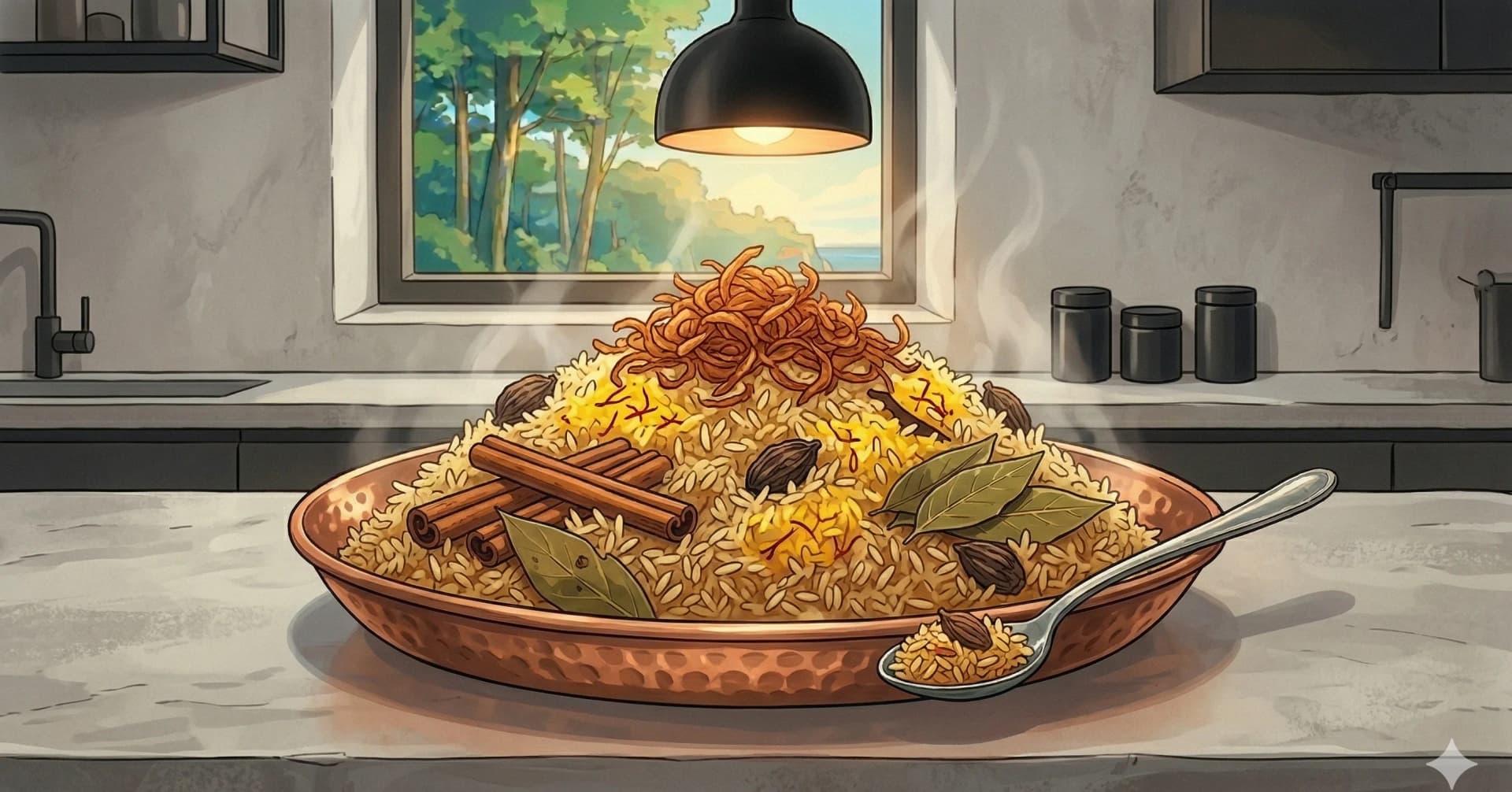
Broth-Cooked Pilaf (Yakhni Pulao)
Awadhi basmati rice cooked in rich mutton bone stock with seared chops
Yakhni pulao is one of the most technically sophisticated rice preparations in the Indian culinary tradition, and one of the most rewarding. It is built on yakhni: the aromatic bone broth that is both a dish and a technique in Awadhi cooking. Mutton bones and meat simmered with whole spices and garlic until the stock is rich with collagen, the meat has given everything it has, and the resulting liquid has a depth that no shortcut can produce.
The stock is the recipe. The rice, cooked in this enriched yakhni, tastes of something that water-cooked rice simply cannot. Every grain absorbs the gelatin and the rendered lamb fat and the spice compounds that have simmered for over an hour into the liquid. The rice does not merely accompany the lamb — it carries the flavour of the lamb throughout itself.
The marrow extraction step (removing the cooked meat from the yakhni bones, pressing the marrow through a sieve into the stock, enriching the broth with what would otherwise be discarded) is the step that separates a carefully made yakhni pulao from a merely good one. Bone marrow is pure fat and connective tissue in concentrated form. Strained into the stock, it adds a glossy, unctuous body that no other technique produces.
The lamb chops are cooked separately (pan-fried in their own layer of ghee) and arranged over the layered rice before the whole pot is sealed with dough for the final dum. Kewra jal (pandanus water) added to the yakhni brings a floral, slightly sweet fragrance that is the final signature of Awadhi rice cooking.
At a Glance
Yield
Serves 6–8
Prep
30 minutes
Cook
2 hours 30 minutes
Total
3 hours
Difficulty
Involved
Ingredients
- ¾ lbyakhni cuts (mutton nalli / marrow bones, boti / boneless chunks, puth / hindquarter)
- ¼ ozbrown cardamom pods (about 2 pods)
- ⅓ tspcinnamon stick (about 3 cm)
- 5 wholecloves
- 1¾ tbspginger, roughly sliced
- 1¾ tbspgarlic (about 3 cloves), roughly crushed
- ⅔ tspsalt
- 3 cupwater
- 6 ozmutton chops (rib or loin pieces)
- ¼ ozbrown cardamom (about 1 pod)
- ⅓ tspcinnamon stick (about 3 cm)
- ⅔ tspsalt
- 1 tbspghee (for pan-frying)
- ¾ lbbasmati rice
- 2 tbspfat (skimmed from yakhni surface)
- 10 wholecloves
- ¼ ozgreen cardamom pods (about 5 pods)
- 1¾ ozplain yoghurt (curd), beaten
- 1⅔ tspred chilli powder
- ⅔ tspkewra jal / pandanus water
- ⅓ tspwhole black pepper
- 3½ ozonions (about ½–1 onion), thinly sliced (for frying to golden)
- ⅓ cupghee (divided)
- 2 tspgarlic water (a small quantity of water in which garlic has been soaked for 30 minutes)
- 3½ ozwhole wheat dough
Method
- 1
Wash the yakhni cuts (350 g). Rinse the marrow bones, boti, and puth under cold running water (700 ml).
- 2
Cook the yakhni. Heat 85 g of ghee (17 ml) in a large, wide pot over high heat. Add the garlic (3 cloves) water (10 ml) — let it sizzle and evaporate. Add the sliced onions (100 g) and fry for 12–15 minutes until deep golden brown. Remove the onions to a plate and set aside. Divide the remaining ghee into three portions mentally.
- 3
In two-thirds of the ghee (85 g) remaining in the pot: Add 1 cinnamon stick, 3 brown cardamoms, the yakhni cuts, 5 whole cloves (5), ginger-garlic paste (optional), and salt (4 g). Stir well and cover. Cook for 10 minutes, turning the pieces to ensure even browning on all sides until lightly golden. Add enough cold water to cover by 4 cm (about 1 litre). Pressure cook for 45 minutes — first 20 minutes on high heat, then reduce to low for remaining 25 minutes. Allow to cool naturally.
- 4
Extract the marrow and strain. Remove the meat pieces from the stock. The meat on the yakhni cuts should be very soft — the flesh can be pulled away from the bones easily. Remove and set the flesh aside. Crack the marrow bones open or press the marrow out with a skewer into a small bowl. Push the marrow through a fine sieve into the stock to enrich it. Strain the entire stock through a muslin cloth or very fine strainer. You should have approximately 700–800 ml of clear, rich yakhni. Set aside.
- 5
Finish the yakhni. In a pot, combine the strained yakhni with 1 litre total liquid (add water to reach 1 litre if needed). Add the beaten yoghurt (50 g), red chilli powder (½ teaspoon), kewra jal (½ teaspoon), and black pepper (¼ teaspoon). Bring to a boil, skimming any foam or excess fat (2 tablespoons) from the surface. Season and check. Reserve 700 ml for cooking the rice. **Prepare the chops:**
- 6
Pan-fry the chops. In the remaining third of the ghee (or fresh ghee in a separate pan), cook the mutton chops (175 g) with the brown cardamom (1 pod), cinnamon, and salt (4 g) over medium heat. Turn occasionally to ensure even cooking, about 20–25 minutes total, until the chops are cooked through and golden on the outside. Set aside. **Cook the rice:**
- 7
Parboil the rice. Rinse the basmati rice (350 g). In a large pot, bring plenty of salted water to a boil. Add the 2 tablespoons of fat skimmed from the yakhni, the whole cloves (10), and green cardamoms. Add the rice and par-cook: stir and cook for about 8 minutes, until the rice is three-quarters done (still slightly firm at the centre). Drain through a sieve immediately. **Assemble and dum:**
- 8
Layer the pulao. In a wide, greased degchi or deep pot, arrange alternating layers: begin with cooked yakhni meat pieces, then three-quarter-done rice, then chops, then more rice, until all ingredients are used. Pour approximately 400 ml of the finished yakhni stock over the top.
- 9
Seal and dum. Roll the wheat dough (100 g) into a rope and press to seal the lid. Cook on very low heat (using a heat diffuser if available) for 30 minutes. Remove from heat and rest, still sealed, for 10 minutes.
- 10
Serve. Break the seal at the table. Serve from one corner, scooping through all the layers.
Key Ingredient Benefits
Bone marrow is one of the most nutrient-dense elements of animal anatomy: extremely high in fat-soluble vitamins (particularly K2, A, and D), and containing both saturated and monounsaturated fats as well as collagen proteins. In Unani medicine, marrow preparations are considered among the highest muqawwi (strengthening) food substances and appear in preparations for recovery, vitality, and physical endurance. The gelatin produced when marrow-rich bones are simmered has been associated in preliminary research with joint health and gut lining integrity.
Kewra jal (Pandanus amaryllifolius flower water) is made by distilling the flowers of the pandan plant, the same aromatic plant that gives Southeast Asian cooking its characteristic green-floral fragrance. In North Indian cooking it appears primarily in Awadhi and Mughal-influenced preparations as a finishing perfume. It is traditionally associated with clarity and cooling in Unani and folk traditions.
Basmati rice aged for a minimum of one year is considered essential for yakhni pulao. As rice ages, its moisture content decreases, the starch structure firms, and the grains cook to a more separate, elongated result. Aged basmati also produces more of the aromatic compound 2-acetyl-1-pyrroline upon cooking (the molecule responsible for basmati's characteristic fragrance). In yakhni pulao, this fragrance compounds with the kewra and the spiced stock to create the finished dish's aroma, which should fill the room when the sealed pot is opened at the table.
Why This Works
The marrow extraction step (pressing cooked bone marrow through a sieve into the stock) is the transformation that makes yakhni stock genuinely different from regular chicken or beef broth. Bone marrow is rich in gelatin precursors, fat-soluble vitamins, and what Awadhi cooks call khalis ras (the pure essence of the animal). When this is pushed through the sieve into the stock, it creates a natural emulsion as the fat and gelatin mix with the hot liquid. The rice that absorbs this stock has a coating, lip-clinging quality that plain stock cannot achieve.
Kewra jal (pandanus water) is the perfume element of Awadhi cooking. A few drops transform the stock from savoury-only to something with a floral top note that is immediately identifiable as the Lucknow kitchen's signature. Used sparingly, it does not make the dish taste of flowers; it adds a barely perceptible sweetness and lift that removes heaviness from the long-cooked stock.
The garlic water method (soaking raw garlic in water and using the water rather than the raw clove) is an Awadhi technique for adding garlic's flavour without its sharpness. The water-soluble allicin compounds from the garlic dissolve into the soaking water; the garlic itself is discarded. The result is a subtle garlic flavour that supports without asserting.
Substitutions & Variations
No pressure cooker: Braise the yakhni cuts in a covered pot with the spices and water for 1.5–2 hours on a low simmer. The stock will be good but slightly less concentrated.
Without marrow bones: Use bone-in shoulder or neck cuts. They produce collagen-rich stock without the marrow step. The stock will be slightly less rich but excellent.
No kewra: Omit entirely. The dish is still very good; the kewra is a refinement, not a structural requirement.
Serving Suggestions
Yakhni pulao is Awadhi celebration cooking. Serve it at the table in the sealed pot, opening the dough seal in front of guests. Accompany with a bowl of thick plain yoghurt raita, sliced raw onion with lemon and chilli, a sweet mango chutney, and crispy papadums. This is Eid food, wedding food, the rice dish that announces a serious meal. Nothing about it is casual, and nothing about it should be.
Storage & Reheating
Refrigerate for up to 2 days. The stock will have been fully absorbed by day two — add a splash of water and reheat very gently in a covered pot over low heat. The marrow fat will solidify on top overnight; stir back in when reheating. Freezes adequately for up to 1 month — the rice texture changes slightly but the flavour holds well.
Cultural Notes
Yakhni pulao (यखनी पुलाव, "broth pulao") is the Kashmiri and Awadhi rice-and-meat preparation in which long-grain basmati rice is cooked directly in a deeply infused meat broth (yakhni, from the Persian yakhni meaning "broth"). The dish is distinct from biryani in important ways: where biryani layers separately cooked rice and meat, yakhni pulao cooks the rice in the meat broth so the grains absorb the meat flavor throughout, producing a more uniform and less dramatically layered dish. The technique reflects the Persian pilaf tradition that arrived in north India through the Mughal courts and was then adapted regionally by Awadhi and Kashmiri cooks.
The broth is the technical heart of the dish. Meat (typically goat or lamb on the bone) is slow-simmered for ninety minutes to two hours with whole spices wrapped in a muslin pouch: green and black cardamom, cinnamon, cloves, bay leaf, fennel seed, dried ginger, and sometimes mace and nutmeg. The pouch keeps the whole spices from breaking up in the broth and allows the cook to remove them once they have donated their aromatic compounds. Onions, ginger, and garlic are sometimes added to the simmering pot for additional depth. The resulting broth is golden, deeply aromatic, and clean rather than thick, with the meat falling tender from the bone.
The cooking method then uses the broth to cook the rice. Soaked basmati rice is added to a measured amount of the strained broth in a heavy pot (the ratio is typically one part rice to one-and-a-half parts broth), with the cooked meat layered in among the rice. The pot is brought to a boil, then covered tightly and reduced to very low heat for fifteen to twenty minutes, after which the heat is turned off and the pot rests for ten more minutes so the rice finishes through residual steam. The finished dish has fluffy, separately distinct rice grains uniformly perfumed by the yakhni, with tender meat distributed throughout. The Kashmiri version sometimes adds dried fruits (apricots, raisins) and a final scatter of sliced almonds. The dish is one of the foundational pulao preparations of north Indian cooking and contrasts with the heavier, more aggressively spiced biryani family.
Nutrition Facts
Calories: 479kcal (24%)|Total Carbohydrates: 42g (15%)|Protein: 17g (34%)|Total Fat: 26g (33%)|Saturated Fat: 13g (65%)|Cholesterol: 85mg (28%)|Sodium: 750mg (33%)|Dietary Fiber: 1g (4%)|Total Sugars: 2g
You Might Also Like
Ratings & Comments
Ratings & Comments
Ratings
Share your thoughts on this recipe.
Sign in to rate and comment