Korean Cuisine
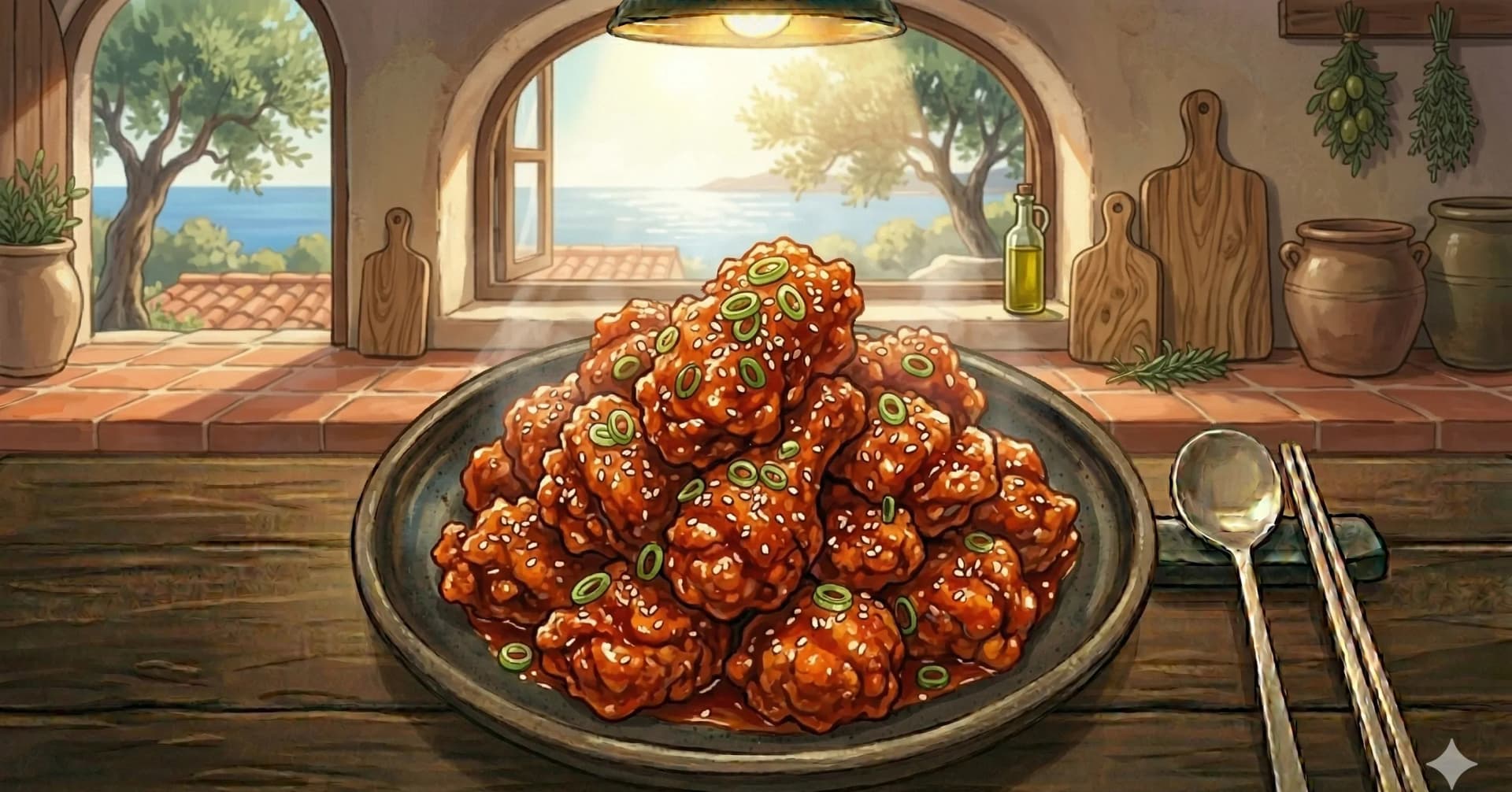
Yangnyeom Chicken (Korean Fried Chicken)
Twice-fried chicken coated in a sweet, spicy, and sticky gochujang-based sauce
The crust shatters when you bite through it, a sound so distinct and satisfying that it has its own onomatopoeia in Korean: bask-bask, the crispy crunch of perfectly fried chicken. Beneath that thin, glass-like shell is juicy, steaming meat, and over everything clings a sticky, glossy sauce that is sweet, spicy, tangy, and garlicky in equal measure. This is yangnyeom chicken, the reason Korean fried chicken has earned a global reputation.
Korean fried chicken emerged in the 1970s and 1980s as Korea's economy grew and Western-style fried chicken arrived. Korean cooks reimagined the dish, replacing heavy, seasoned flour batters with a lighter coating of potato starch and rice flour, and introducing the revolutionary technique of double frying. The first fry cooks the chicken through and begins to set the crust. The second fry, at a higher temperature, dehydrates the crust further and creates a shell so crispy that it remains audible even after being coated in sauce. This was the breakthrough that made Korean fried chicken different from every other tradition.
Yangnyeom, meaning "seasoned," refers to the sticky red sauce that defines this particular style. It is built on gochujang, sweetened with honey or corn syrup, sharpened with rice vinegar, and perfumed with garlic and ginger. The sauce goes on just before serving, so the crust has only seconds of contact before you eat it. The tension between the shattering crust and the clinging sauce is the entire point.
The practical insight: oil temperature control is everything. If the first fry is too hot, the crust browns before the meat cooks through. If the second fry is too cool, the crust does not achieve its legendary crunch.
At a Glance
Yield
4 servings
Prep
30 minutes (plus 1 hour brining optional)
Cook
30 minutes
Total
1 hour 30 minutes
Difficulty
Involved
Ingredients
Chicken Ingredients
- 2¾ lbchicken wings, separated into drumettes and flats (tips removed)
- ⅞ tspfine salt
- 1¼ tspblack pepper
- 1¾ tbspminced garlic
- 1¾ tbspminced ginger
- 1 tbsprice wine (mirin)
- —Vegetable oil for deep frying (about 2 liters)
Coating Ingredients
- ⅔ cuppotato starch (or cornstarch)
- 1 ozrice flour
- ¾ tspbaking powder
- ½ tspfine salt
Sauce Ingredients
- ¼ cupgochujang
- 1 ozketchup
- 1½ ozhoney (or corn syrup)
- 1 tbspsoy sauce
- 1 tbsprice vinegar
- 1¾ tbspminced garlic
- 2½ tspminced ginger
- 2 tspsesame oil
- 1½ tspgochugaru (optional, for extra heat)
To Serve
- —Toasted sesame seeds
- —Sliced scallions
- —Pickled radish cubes (chicken mu)
Method
- 1
Season the chicken wings. Toss the drumettes and flats with salt, pepper, garlic, ginger, and rice wine. Let them sit for at least 15 minutes, or brine in the refrigerator for up to 1 hour for more flavor penetration.
- 2
Prepare the coating. Whisk together the potato starch, rice flour, baking powder, and salt in a large bowl.
- 3
Pat the chicken pieces dry with paper towels. Excess moisture prevents the coating from adhering and causes dangerous splattering in the oil. Each piece should feel relatively dry to the touch.
- 4
Toss the chicken in the starch mixture, pressing the coating onto each piece to create an even, thin layer. Shake off any excess. The coating should be visibly thin, not thick and clumpy.
- 5
Heat the vegetable oil in a large, deep pot or Dutch oven to 160°C (320°F). Use a thermometer. This lower temperature is correct for the first fry. There should be enough oil to submerge the chicken pieces without crowding.
- 6
Fry the chicken in batches for the first time, about 8 to 10 minutes per batch. The chicken will be cooked through but only lightly golden, not deeply browned. The crust will look pale and slightly bubbly. Remove to a wire rack and let rest for 10 minutes. This resting period is essential. The residual heat finishes cooking the interior while the surface moisture migrates out.
- 7
While the chicken rests, make the yangnyeom sauce. Combine the gochujang, ketchup, honey, soy sauce, rice vinegar, garlic, ginger, sesame oil, and gochugaru in a small saucepan. Cook over medium-low heat for 3 to 4 minutes, stirring constantly, until the sauce is smooth, glossy, and slightly thickened. It should coat the back of a spoon. Remove from heat.
- 8
Raise the oil temperature to 180°C (355°F) for the second fry. This higher temperature is what creates the shattering crunch.
- 9
Fry the chicken a second time in batches for 3 to 4 minutes, until the crust is deeply golden and sounds hollow when tapped with tongs. The surface should be visibly drier and more rigid than after the first fry.
- 10
Drain the twice-fried chicken on a wire rack for about 1 minute. The pieces should feel light and crispy, with an audibly crunchy shell when you press gently.
- 11
Transfer the hot chicken to a large bowl. Pour the warm sauce over the chicken and toss vigorously but gently, coating every piece in a thin, even layer of glossy red sauce. Work quickly. The sauce should cling to the crust without soaking in.
- 12
Pile the sauced chicken on a serving platter. Sprinkle generously with toasted sesame seeds and sliced scallions. Serve immediately alongside pickled radish cubes.
Key Ingredient Benefits
Gochujang: The fermented chili paste provides complex flavor from its combination of chili peppers, glutinous rice, and soybeans. Capsaicin from the chili peppers has been studied for its potential thermogenic and anti-inflammatory effects.
Potato starch: Creates a lighter frying crust than wheat flour. It is naturally gluten-free, though the rice flour in this recipe may contain trace gluten depending on processing.
Honey: Provides fructose and glucose that caramelize rapidly, contributing to the sauce's glossy appearance and sticky texture. Honey also contains trace amounts of antioxidants and enzymes.
Chicken wings: Provide protein, iron, and zinc. The skin-on preparation contributes collagen and fat, which keep the meat moist during double frying.
Why This Works
Double frying is the technique that distinguishes Korean fried chicken from all others. The first fry at a lower temperature cooks the meat through and partially sets the starch coating. The resting period between fries allows moisture from inside the chicken to migrate to the surface and evaporate. The second fry at a higher temperature then crisps the now-drier surface into a thin, glass-like shell that stays crunchy far longer than a single-fried crust.
Potato starch creates a lighter, crispier crust than wheat flour. Its starch granules expand during frying and then contract as they cool, forming a rigid, almost crystalline structure. Rice flour adds a subtle additional crunch and helps the coating adhere.
The sauce is applied at the last moment, just before serving. This preserves the crust's crunch for the critical first few minutes of eating. If the sauce sits on the chicken for too long, moisture will soften the crust. This is why Korean fried chicken is typically made to order in restaurants, not held in warming trays.
Substitutions & Variations
Chicken cut: Drumsticks, thighs, or boneless thighs can replace wings. Adjust frying times accordingly: larger pieces need 12 to 14 minutes for the first fry and 4 to 5 minutes for the second.
Gan-jang (soy garlic) chicken: For the non-spicy version, replace the yangnyeom sauce with a glaze of 45 ml soy sauce, 30 g honey, 20 g minced garlic, 10 g butter, and 5 ml rice vinegar, cooked together until slightly thickened.
Sweetener: Corn syrup (mulyeot) is more commonly used in Korean restaurants than honey because it creates a glossier, stretchier coating. Either works.
Air fryer: Coat and air-fry at 180°C (355°F) for 20 minutes, flipping halfway. It will not achieve the same shattering crunch as deep frying but produces a significantly lighter result.
Snow cheese chicken: A popular Korean variation where the fried chicken is dusted with a thick layer of powdered cheese after saucing.
Serving Suggestions
Korean fried chicken is the centerpiece of chimaek (chicken and beer), Korea's beloved pairing. Serve with cold beer, pickled radish cubes, and nothing else needed. For a fuller meal, add tteokbokki on the side. Coleslaw dressed with a light vinegar dressing provides a crisp, fresh contrast. The chicken is always accompanied by pickled radish (chicken mu), which cleanses the palate between bites.
Storage & Reheating
Leftover fried chicken: Store unsauced chicken separately from the sauce in the refrigerator for up to 2 days. The sauce will soften the crust overnight.
Reheating: Place the unsauced chicken on a wire rack over a baking sheet and reheat in a 200°C (400°F) oven for 8 to 10 minutes. The oven will re-crisp the crust. Warm the sauce separately and toss just before serving.
Do not microwave: Microwaving turns the crust irreversibly soft and chewy.
Freezing unsauced chicken: Freeze the double-fried, unsauced chicken in a single layer on a baking sheet, then transfer to a freezer bag. Reheat from frozen in the oven at 200°C for 15 minutes. Sauce after reheating.
Cultural Notes
Yangnyeom chicken (양념치킨) is the sticky, gochujang-glazed Korean fried chicken that defines the modern global understanding of "Korean fried chicken." Yangnyeom (양념) means "seasoned" or "marinated" in Korean, and the word distinguishes this version from huraideu chikin (후라이드 치킨, plain fried chicken), the second pillar of the modern Korean chicken canon. Most Korean fried chicken restaurants serve both, and the standard order, banban (반반, "half-half"), combines a portion of each in one delivery.
The dish's history begins in the early 1980s with Yoon Jong-gye, the founder of the Pelicana chicken chain, who developed the gochujang-honey-garlic glaze that would become the template for the entire yangnyeom category. The dish's rise was tied directly to the late-1980s Korean economic boom, the explosion of late-night drinking culture, and the rapid spread of motorcycle delivery services. By the 1990s, Korean fried chicken was inseparable from beer (chimaek, 치맥, the portmanteau of chikin + maekju = chicken + beer), and the chimaek pairing became one of the most defining leisure rituals of contemporary Korean urban life.
The Korean Wave (hallyu) of the 2000s and 2010s spread chimaek culture globally. Korean dramas like My Love from the Star (별에서 온 그대, 2013) prominently featured chimaek and triggered a measurable spike in Korean fried chicken restaurant openings across China, Vietnam, and the United States. Today, Korean fried chicken chains like Bonchon, BBQ Chicken, and Kyochon operate over 50,000 restaurants worldwide, and many regional yangnyeom variations have emerged outside Korea (honey butter, garlic soy, snow cheese, and many others).
The defining characteristic that all yangnyeom variations share is the twice-fried crispy skin underneath a thin layer of glossy, lacquered sauce. That textural experience has become globally synonymous with "Korean food" itself.
Nutrition Facts
Calories: 1050kcal (53%)|Total Carbohydrates: 42.2g (15%)|Protein: 56.1g (112%)|Total Fat: 71.6g (92%)|Saturated Fat: 15.3g (77%)|Cholesterol: 333mg (111%)|Sodium: 1750mg (76%)|Dietary Fiber: 1.5g (5%)|Total Sugars: 8.6g
You Might Also Like
Ratings & Comments
Ratings & Comments
Ratings
Share your thoughts on this recipe.
Sign in to rate and comment